A sidechain is a separate blockchain with its own validators and consensus rules, connected to a main chain such as Ethereum or Bitcoin by a two-way bridge. Its security comes from its own validator set and from whoever controls the bridge, not from the main chain. That is the key difference from a rollup, which posts its transaction data to Ethereum and lets Ethereum’s rules settle disputes. Examples: Polygon PoS and Gnosis Chain on Ethereum, Liquid and Rootstock on Bitcoin. Several large documented losses tied to sidechain ecosystems have come through their bridges, such as Ronin in March 2022.
Search for “sidechain” and most of what comes back is about music production, where sidechaining means letting one track (usually a kick drum) duck the volume of another. This guide is about the blockchain meaning. Most explainers stop at “a separate chain connected by a bridge” and then call almost every scaling network a sidechain, rollups included. That blurs the one question that matters to you: who can take or freeze the funds if something goes wrong? Below you will find a plain definition, how the bridge works, real examples with their actual trust models plus a side-by-side security comparison of sidechains, rollups, validiums and plasma.
What is a sidechain in blockchain?
A sidechain is an independent blockchain that runs alongside a main chain (often called the parent chain or mainnet) and is linked to it by a two-way bridge, so assets can move between the two. It sets its own block times, fees and consensus rules. It is secured by its own validators.
ethereum.org’s sidechain documentation (page last updated 23 February 2026) states the security point directly: “Each sidechain is responsible for its security and doesn’t inherit Ethereum’s security properties.” It also draws the line that separates sidechains from layer 2 networks: “Unlike layer 2 scaling solutions, sidechains do not post state changes and transaction data back to Ethereum Mainnet.” Some sidechains do post small commitments to Ethereum, as Polygon PoS does with its checkpoints (below), but not the full transaction data a rollup posts.
What is the main purpose of using a sidechain? To get cheaper, faster transactions or features the main chain does not offer (smart contracts on Bitcoin, for example) while still letting users bring main-chain assets in and out. The price is a different, usually smaller, set of parties you have to trust.
How a sidechain works
Its own consensus
A sidechain does not wait for Ethereum or Bitcoin to agree on its blocks. ethereum.org lists proof-of-authority, delegated proof-of-stake and Byzantine fault tolerant protocols as typical choices. Sidechains often use faster blocks and higher gas limits than Ethereum. ethereum.org notes the side effect: big, fast blocks make a full node harder to run, which can concentrate validation in a few “supernodes” and raise the risk of collusion.
The two-way bridge (or peg)
Coins do not physically travel between chains. The usual pattern is lock and mint:
- You send tokens to a bridge contract or address on the main chain, where they are locked.
- The bridge operators (validators, a federation or a multisig) confirm the deposit.
- An equivalent token is minted to you on the sidechain.
- To return, the sidechain token is burned. The operators confirm the burn, then the original tokens are released on the main chain.
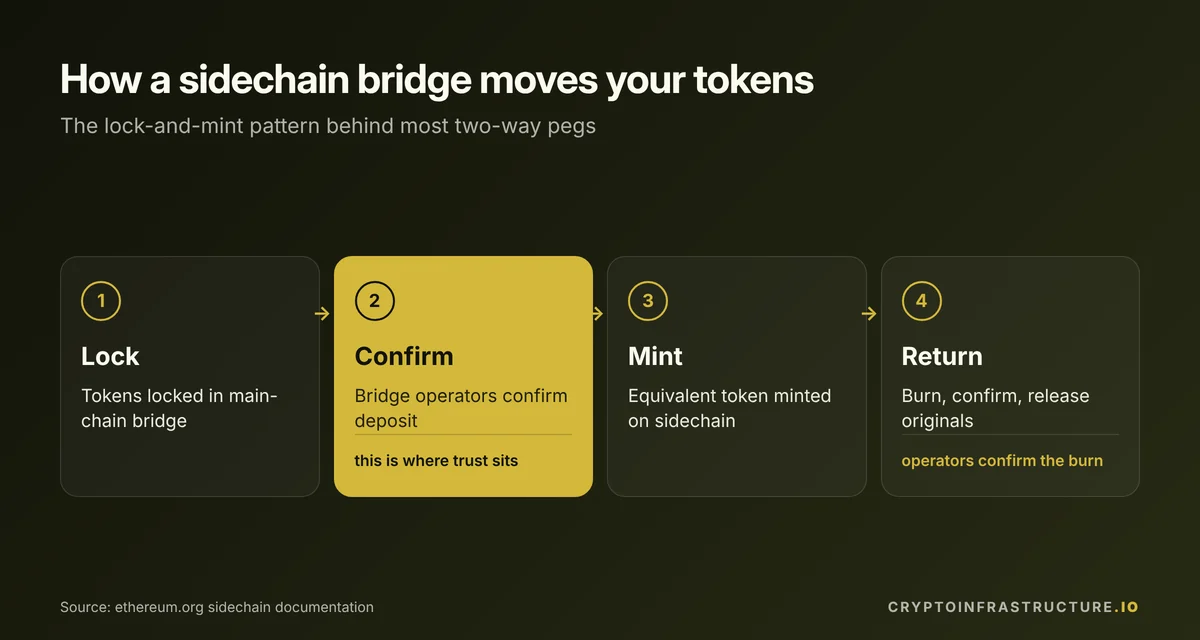
Step 2 and step 4 are where the trust sits. If enough bridge signers are compromised or collude, they can release locked funds to themselves. The tokens on the sidechain then lose their backing. ethereum.org’s list of sidechain cons says the same thing in one line: a “quorum of malicious validators” can commit fraud.
EVM compatibility
Many Ethereum sidechains run the Ethereum Virtual Machine, so Solidity contracts written for Ethereum can be deployed unchanged and wallets connect through the sidechain’s RPC endpoint. This lets apps reach lower fees without rewriting their contracts, with the trade-offs below. If you are choosing an endpoint provider for any of these networks, see the blockchain API and RPC provider comparison.
Sidechain examples and their real trust models
The word “sidechain” covers very different designs. What changes from one to the next is who signs blocks and who controls the bridge.
Polygon PoS (Ethereum)
Polygon’s own documentation describes the network as “an EVM-compatible Proof-of-Stake sidechain for Ethereum”. It has two layers: Heimdall-v2, a proof-of-stake validation layer built on Cosmos SDK and CometBFT, plus Bor, a block producer built on Go Ethereum. Validators stake POL in staking contracts on Ethereum. Heimdall-v2 periodically publishes a Merkle root of recent Polygon blocks to Ethereum as a “checkpoint”, which Polygon uses for withdrawal finality and proof of burn. A checkpoint is a commitment, not the full transaction data, so Ethereum cannot rebuild Polygon’s state from it. That is why Polygon PoS is still a sidechain and not a rollup.
Gnosis Chain (Ethereum)
Gnosis describes itself as “one of the first Ethereum sidechains” (it launched as xDai). Its documentation says its Merge replaced the old proof-of-authority consensus with proof of stake through the Gnosis Beacon Chain. GNO is used for staking and xDai is the gas token, with blocks about every 5 seconds (Gnosis docs). Gnosis has its own validator set, separate from Ethereum’s.
Liquid Network (Bitcoin)
Liquid is a federated sidechain. According to the Liquid technical overview, it has more than 80 federation members, with Blockstream as technical provider. Blocks must be signed by at least two thirds of the block signers, about one block a minute. Moving BTC in (a peg-in) needs 102 Bitcoin confirmations. Moving out (a peg-out) needs signatures from more than two thirds of the “watchmen” who control the multisig, and only to addresses on an authorised key list. If the network stalls for an extended period, a timelock hands the funds to three emergency keys. You are trusting a named group of companies, not Bitcoin miners.
Rootstock (Bitcoin)
Rootstock is merge-mined: Bitcoin miners can secure it at the same time as Bitcoin. Rootstock says it is secured by “over 85% of Bitcoin’s hash power” (a project claim). Its bridge, the PowPeg, holds BTC in a multisig whose keys sit in tamper-resistant hardware modules (PowHSMs) run by functionaries. Peg-outs need the “majority of PowPeg members”. Peg-ins take 100 Bitcoin blocks and peg-outs 4,000 Rootstock blocks. The design tries to bind the signers to proof of work, but a signer set still controls the peg.
| Sidechain | Main chain | Who produces blocks | Who controls the bridge |
|---|---|---|---|
| Polygon PoS | Ethereum | PoS validators staking POL (Heimdall-v2 and Bor) | Polygon validator set, with checkpoints to Ethereum |
| Gnosis Chain | Ethereum | PoS validators staking GNO | The operators of the bridge you use, not Ethereum’s validators |
| Liquid | Bitcoin | Federation block signers (two-thirds threshold) | Federation watchmen (more than two-thirds threshold) |
| Rootstock | Bitcoin | Merge-mining Bitcoin miners | PowPeg signers using hardware modules (majority) |
Sources: Polygon, Gnosis, Liquid and Rootstock documentation.
Sidechains vs rollups vs L2s: the security model
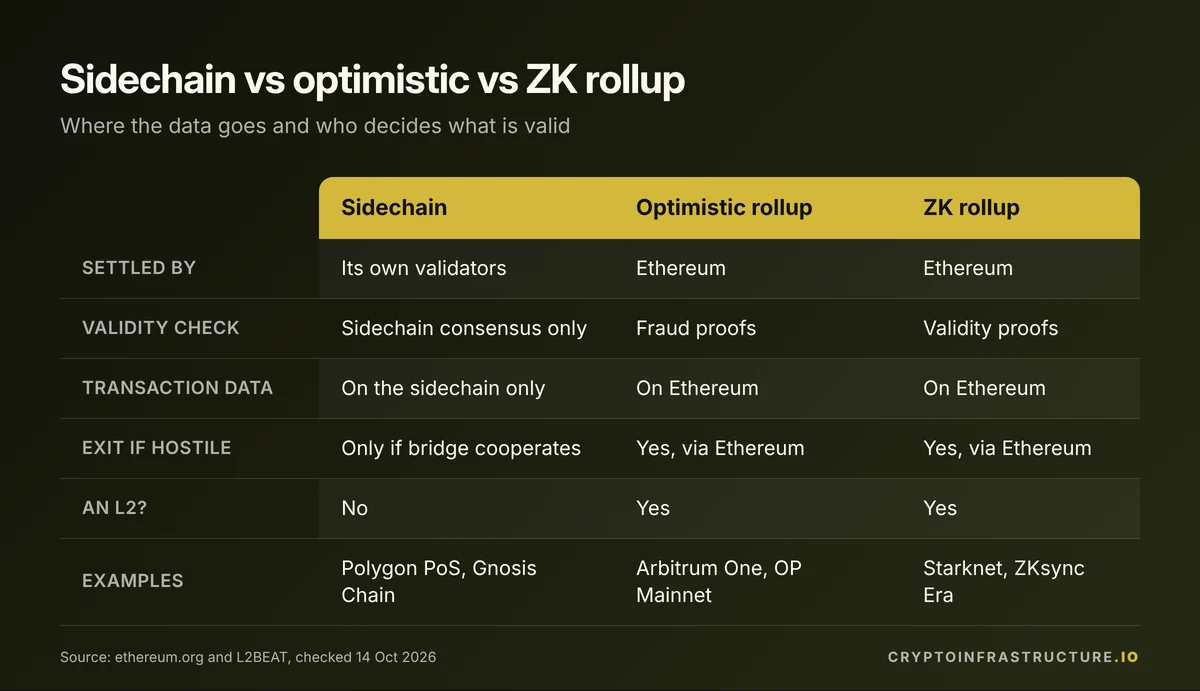
The difference comes down to where the data goes and who decides what is valid. ethereum.org’s scaling overview (last updated 13 April 2026) defines layer 2 as the category of offchain solutions that “derives its security from Mainnet Ethereum”. A rollup executes transactions off Ethereum but posts the transaction data to Ethereum, so anyone can rebuild its state and Ethereum enforces the result. A sidechain does neither, which is why ethereum.org does not call sidechains layer 2s.
What are rollups in cryptocurrency? Rollups batch many transactions, run them off the main chain, then post the data and a claim about the new state to Ethereum. Optimistic rollups assume the claim is valid unless someone proves fraud during a challenge window. ZK (zero-knowledge, or validity) rollups attach a cryptographic proof that Ethereum checks before accepting the new state. The rollup’s sequencer orders transactions; see what a sequencer is for why that role still carries trust.
Validiums and plasma sit in between. Both settle on Ethereum but keep transaction data off it. ethereum.org’s validium page warns that if operators withhold the data, users “can’t build the Merkle proofs” needed to withdraw, so funds can be frozen. Its plasma page (last updated 25 June 2026) describes plasma chains as anchored to Ethereum with fraud proofs and exit games, but exposed to a “mass exit problem” when an operator misbehaves. L2BEAT, the main independent tracker of Ethereum scaling projects, files validiums and optimiums (the optimistic equivalent) as “light” L2s that require “an additional trust assumption”, as opposed to “strong” L2s such as rollups (L2BEAT FAQ).
| Sidechain | Optimistic rollup | ZK rollup | Validium / optimium | Plasma | |
|---|---|---|---|---|---|
| Who agrees on blocks | Its own validators | Sequencer orders; Ethereum settles | Sequencer orders; Ethereum settles | Operator orders; Ethereum settles | Operator; Ethereum settles disputes |
| How validity is checked | Sidechain consensus only | Fraud proofs in a challenge window | Validity proofs checked on Ethereum | Validity proofs (validium) or fraud proofs (optimium) | Fraud proofs and exit games |
| Where transaction data lives | On the sidechain only | On Ethereum (calldata or blobs) | On Ethereum | Off Ethereum (sometimes held by a data availability committee) | With the operator |
| Can you exit if operators turn hostile? | Only if the bridge signers cooperate | Yes, through Ethereum, subject to the project’s stage | Yes, through Ethereum, subject to the project’s stage | Not if data is withheld (funds can freeze) | In theory, via exit games; mass exits are the weak point |
| Main trust assumption | Honest majority of its validators and bridge signers | At least one honest challenger; upgrade keys | Sound proof system; upgrade keys | Data holders publish data when needed | Users watch the chain and exit in time |
| Called an L2 by ethereum.org / L2BEAT? | No | Yes | Yes | “Light” L2 with extra trust (L2BEAT) | Treated separately from rollups by ethereum.org |
| Examples | Polygon PoS, Gnosis Chain, Liquid, Rootstock | Arbitrum One, OP Mainnet, Base | Starknet, ZKsync Era, Linea, Scroll | Projects in L2BEAT’s Validiums & Optimiums tab | None named here |
Sources: ethereum.org scaling, sidechains, validium and plasma pages; L2BEAT FAQ and summary (all).
Rollups are not all equal either: L2BEAT stages
Posting data to Ethereum is necessary but not enough. Most rollups still have operators or councils who can upgrade the contracts. L2BEAT’s stages framework (page last updated 23 July 2025) grades this:
- Stage 0: state roots and data posted to Ethereum and a working proof system, but the operators can still override it (“full training wheels”).
- Stage 1: blocking or forging withdrawals needs at least 75% of a Security Council. Upgrades by anyone else give users at least 7 days to exit.
- Stage 2: the proof system is open to everyone. Users get at least 30 days to exit before unwanted upgrades.
In October 2026, the Rollups tab on L2BEAT’s summary listed 22 projects. Stages shown for the best-known ones:
| Project | Proof type (L2BEAT) | Stage |
|---|---|---|
| Arbitrum One | Optimistic | Stage 1 |
| OP Mainnet | Optimistic | Stage 1 |
| Base | Optimistic | Stage 1 |
| Starknet | Validity (ZK) | Stage 1 |
| ZKsync Era | Validity (ZK) | Stage 0 |
| Linea | Validity (ZK) | Stage 0 |
| Scroll | Validity (ZK) | Stage 0 |
| Mantle | Validity (ZK) | Stage 0 |
Source: L2BEAT scaling summary, October 2026 snapshot. Stages change; look at the live page before relying on them. Polygon PoS does not appear in the Rollups tab.
A concrete example of what a stage means: L2BEAT’s Arbitrum One page (snapshot dated 18 August 2026; details may have changed since) lists data availability on Ethereum and interactive fraud proofs that anyone with the required 3,600 ETH stake can join. It also lists a challenge period of 6 days 8 hours, a 9-of-12 Security Council able to act in emergencies plus the option to force transactions through Ethereum if the sequencer fails. A sidechain does not get these Ethereum-enforced protections. Any safeguards it has, such as Liquid’s emergency timelock, come from its own design and its own signers, and the validator set has the final word.
Is layer 1 better than layer 2?
Neither is better in general. A layer 1 like Ethereum is the most expensive place to transact and the hardest to change. A rollup gives you lower fees while keeping Ethereum as the referee, with the stage telling you how much trust in its operators remains. A sidechain usually gives you low fees and its own feature set, but you are back to trusting its validators and bridge. Which one fits depends on how much value is at stake and how long you hold it there.
Bridge risk: where sidechain losses actually happen
A sidechain’s consensus can work exactly as designed and users can still lose funds, because the bridge is usually a small multisig or validator set holding everything locked on the main chain. Two dated incidents show the pattern:
| Date | Bridge | What happened | Reported loss |
|---|---|---|---|
| 23 March 2022 (found 29 March) | Ronin bridge (Axie Infinity’s chain to Ethereum) | Attacker used hacked private keys for 5 of the 9 bridge validators (four run by Sky Mavis, one by Axie DAO) to sign fake withdrawals. Noticed only when a user could not withdraw 5,000 ETH. | 173,600 ETH and 25.5M USDC, per Ronin’s statement |
| 23 June 2022 | Harmony Horizon bridge (Harmony to Ethereum) | Private keys of bridge signers were compromised and decrypted; Harmony found no smart contract flaw. Afterwards it moved the Ethereum side to a 4-of-5 multisig. | About $100 million at the time, per Harmony |
Sources: Ronin Network statement of 29 March 2022 as quoted by Security Affairs; Harmony’s Horizon bridge post-mortem. On 14 April 2022 the FBI attributed a $620 million Ethereum theft reported on 29 March to North Korea’s Lazarus Group and APT38; the FBI statement does not name Ronin, though the date and amount match.
The lesson for any sidechain: count the bridge signers, find out who runs them, look at the signing threshold and ask how the keys are stored. In the Ronin case, one operator effectively held four of the five signatures needed. Bridge failures also spread beyond the bridge itself: the April 2026 Kelp DAO rsETH exploit, covered in what DeFi is and where the risks are, shows how forged bridge tokens can drain lending markets that never touched the bridge.
Sidechain vs mainnet vs testnet
These terms get mixed up. ethereum.org’s networks page defines mainnet as “the primary public Ethereum production blockchain”, where transactions carry real value. A testnet is a network for testing, where tokens are meant to have no value: Sepolia is the recommended default for app developers and Hoodi is for testing protocol upgrades and validators. A sidechain is neither. It is a separate production network with real value, connected to a mainnet by a bridge.
Is a sidechain the same as a shard?
No. A shard is part of one network and shares that network’s validators and security. A sidechain is a different network with different validators. For how sharding works and how Ethereum uses it, see what sharding is.
Is sidechaining necessary?
For Bitcoin, sidechains such as Liquid and Rootstock remain one of the main ways to get faster settlement or smart contracts without changing Bitcoin itself. For Ethereum, ethereum.org counts rollups as layer 2s that take their security from Ethereum and does not count sidechains. A sidechain is an option for apps that accept a different trust model in exchange for low fees and their own rules. So a sidechain is a design choice, not a requirement. Nothing about it makes funds held there risk-free.
Common mistakes in sidechain explainers
Among the ranking pages reviewed:
- Listing rollups as a type of sidechain. Rollups post data to Ethereum and inherit its settlement guarantees; sidechains do not.
- Calling “Polygon” a sidechain without saying which product. Polygon’s docs describe Polygon PoS as a sidechain. The name alone does not tell you the trust model.
- Skipping the federation. Liquid is often described without saying that a federation of named companies signs its blocks and controls the peg.
- Leaving bridge losses vague. “Bridges can be hacked” is true but not useful. Signer counts and thresholds are what you can actually verify.
What this means for you
Before you move funds or deploy an app on a network that calls itself an L2 or a sidechain, look at three things: whether its transaction data is posted to the main chain, who can sign withdrawals on the bridge and at what threshold plus (for rollups) its current L2BEAT stage. If the data stays off the main chain and a small group controls the bridge, treat it as a sidechain whatever the marketing says. Size what you keep there accordingly. If you are building, account abstraction works on many of these networks; see what account abstraction is. More plain-English explainers are in Guides. How this site sources and dates its facts is set out in the methodology.
This guide is general information, not investment advice. Nothing here is a recommendation to use any network, bridge or protocol. See the site’s disclaimer.