US crypto regulation is split across several agencies and the states, with no single crypto law covering the whole market. The SEC decides when a token offering is a securities offering. Since 17 March 2026 it applies a five-category token taxonomy that the CFTC joined. The CFTC oversees crypto derivatives and opened a rulemaking on retail leveraged crypto trading on 5 October 2026. FinCEN treats exchanges and custodial wallets as money transmitters under federal anti-money laundering rules. The GENIUS Act (signed 18 July 2025) covers payment stablecoins. The CLARITY Act, which would have split spot-market oversight between the SEC and CFTC, failed a Senate cloture vote 49-50 on 15 September 2026 and is not law. States license exchanges and custodians, led by New York’s BitLicense and California’s licensing law, which started on 1 July 2026.
If you search for US crypto regulation, most of the pages you find list agencies without saying what each one actually controls. Many were written before the SEC’s 2026 rule changes and the CLARITY Act’s defeat in the Senate. That leaves the practical question open: which rules apply to you, as a holder, an exchange, a token issuer or a DeFi developer? This guide gives a dated “who regulates what” map for each federal agency, Congress and the states, then a table of what applies to each type of reader. Each entry is tied to the regulator’s own release or the vote record.
Based on the SEC press releases 2025-47, 2026-30, 2026-76 and 2026-100; CFTC releases 9242-26 and 9307-26; FinCEN guidance FIN-2019-G001; the Senate roll call record; the GENIUS Act text (Public Law 119-27); IRS Form 1099-DA pages; the House Ways and Means markup record; and the NYDFS, California DFPI and Wyoming Division of Banking sites. This is education, not legal or tax advice.
Who regulates crypto in the US? The short answer
No single US regulator covers crypto. Oversight depends on what you do with it. The SEC covers token offerings that are securities. The CFTC covers crypto futures and other derivatives. FinCEN covers anti-money laundering rules for businesses that move crypto for others. The IRS covers tax, bank regulators cover banks and stablecoin issuers, and state regulators license exchanges and custodians. Google’s AI Overview for this search gives the same list of agencies but stops there, without dates or a split of responsibilities. The map below fills that in.
The US crypto regulation map
| Who | What it covers in crypto | Latest dated action | Status |
|---|---|---|---|
| SEC | Offers and sales of tokens that are securities or sold under investment contracts; exchanges, brokers and custodians dealing in crypto securities; investment advisers and funds | 17 Mar 2026 interpretation (release 2026-30); 18 Aug 2026 Regulation Crypto Assets proposal (2026-76); 1 Oct 2026 custody proposal (2026-100) | Interpretation in effect; both rule proposals open for comment, not final |
| CFTC | Crypto futures, perpetuals and other derivatives; fraud and manipulation in digital commodities; leveraged retail commodity transactions | 29 May 2026 perpetuals policy statement (9242-26); 5 Oct 2026 ANPRM on retail crypto transactions (9307-26) | Policy in effect; ANPRM is a pre-proposal, comments due about 12 Dec 2026 |
| Treasury / FinCEN | Anti-money laundering: exchanges and hosted wallets are money transmitters (MSBs); Travel Rule at $3,000 | FIN-2019-G001 (9 May 2019) still the core guidance | In effect |
| Bank regulators (OCC, Fed, FDIC) | Banks’ crypto custody and activities; national trust charters; federal stablecoin issuers | GENIUS Act rulemakings during 2026 | Most stablecoin rules still proposed |
| Congress: GENIUS Act | Payment stablecoins | Signed 18 Jul 2025 (Public Law 119-27) | Law; takes full effect by 18 Jan 2027 at the latest |
| Congress: CLARITY Act (H.R. 3633) | Market structure: would split spot oversight between the SEC and CFTC | Senate cloture vote failed 49-50, 15 Sep 2026 | Not law |
| IRS / Congress (tax) | Crypto taxed as property; broker reporting on Form 1099-DA; proposed wash-sale rule | H.R. 10357 cleared Ways and Means 38-5, 16 Sep 2026 | 1099-DA in effect; H.R. 10357 not law |
| States | Money transmission and crypto licences, custody charters, consumer protection | California DFAL licensing from 1 Jul 2026; NY-Wyoming MOU 1 Oct 2026 | In effect |
Sources: each agency’s release named in the table, the Senate roll call record and the House Ways and Means markup record.
SEC: the 2026 taxonomy, two proposals and the end of the lawsuits
What is the SEC’s interpretation of crypto assets?
On 17 March 2026 the SEC issued a Commission interpretation of how federal securities laws apply to crypto assets (SEC press release 2026-30). It sets out a “token taxonomy” of five categories: digital commodities, digital collectibles, digital tools, stablecoins and digital securities. It also covers airdrops, protocol mining, protocol staking and the wrapping of non-security crypto assets. The CFTC joined the interpretation and said it would administer the Commodity Exchange Act consistently with it.
Two points matter in practice. First, Chairman Paul Atkins said most crypto assets are not securities in themselves and that investment contracts can end. A token that is not a security can still be sold as part of an investment contract, and the securities rules then apply to that sale. Second, Asset Servicing Times reported on 20 March 2026 that the interpretation treats protocol mining, protocol staking and wrapping of non-security assets as not being offers or sales of securities. An interpretation is not a statute: a future Commission can revise it. Atkins himself described it as a bridge while Congress works on market structure legislation.
Regulation Crypto Assets (proposed 18 August 2026)
On 18 August 2026 the SEC proposed “Regulation Crypto Assets” (press release 2026-76, release 33-11434, file S7-2026-27). It would create:
- a one-time exemption from registration for offerings of up to $5 million over four years;
- a second exemption for up to $75 million in each 12-month period, with financial statements and ongoing reporting;
- principles-based narrative disclosure for both exemptions;
- a conditional safe harbour under which a crypto asset is not treated as part of an “investment contract” once the issuer has completed or permanently stopped the managerial efforts it promised;
- preemption of state securities registration for offers and sales under these exemptions and certain secondary trades.
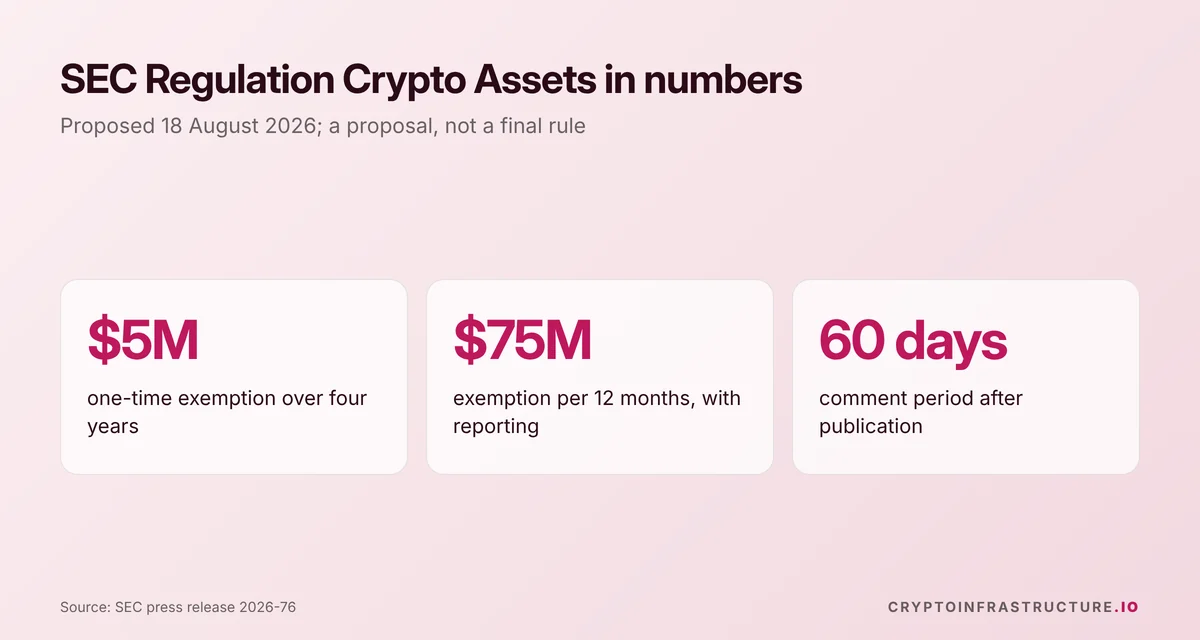
It is a proposal. Comments run for 60 days from Federal Register publication. The final rule may differ. The tokenomics guide covers what the proposed disclosures mean for supply, allocation and vesting design.
The October 2026 custody proposal
On 1 October 2026 the SEC proposed custody rules for crypto held by registered investment advisers and regulated funds (press release 2026-100). The proposal would let state trust companies act as crypto custodians and allow some crypto assets to be self-custodied, with conditions. Comments are open for 60 days after Federal Register publication. The institutional custody guide explains the conditions and the bank charter routes.
SEC vs Coinbase: what was the outcome?
The case ended without a court ruling. The SEC sued Coinbase in June 2023, alleging it operated as an unregistered exchange, broker and clearing agency. On 27 February 2025 the SEC announced it had filed a joint stipulation with Coinbase to dismiss the case (SEC press release 2025-47). The SEC said the dismissal reflected its decision to reform its approach to crypto through its Crypto Task Force, set up on 21 January 2025. It said the dismissal was “not an assessment of the merits” of the claims. It also said the dismissal does not reflect its position on any other case.
So no court decided whether the tokens on Coinbase were securities. Coinbase was not declared compliant. The SEC simply stopped pursuing the case. If you see a page calling it a Coinbase “win in court”, that overstates it. The Coinbase evidence review covers the company’s licences and other regulatory history.
CFTC: derivatives, perpetuals and a new rulemaking
The CFTC regulates commodity futures, options and swaps. It can act against fraud and manipulation in commodities, including digital commodities. It does not license spot crypto exchanges; spot trading is still mostly covered by state money transmission licences. Two 2026 actions matter:
- Perpetual futures, 29 May 2026. CFTC release 9242-26 issued a policy statement on listing perpetual contracts and an order allowing a designated contract market (DCM) to list a perpetual contract on the spot price of bitcoin. Perpetuals on other assets go through case-by-case review under CFTC Regulation 40.3. The leverage and perps guide explains how these contracts work.
- Retail crypto transactions ANPRM, 5 October 2026. CFTC release 9307-26 is an advance notice of proposed rulemaking (ANPRM) on leveraged, margined or financed retail crypto transactions under section 2(c)(2)(D) of the Commodity Exchange Act. It also asks whether to create a “crypto asset market”, a subcategory of DCM built for these transactions. It was published in the Federal Register on 13 October 2026 (91 FR 64811), so the 60-day comment period runs to about 12 December 2026. An ANPRM is a step before a proposed rule; several outlets have called it “proposed rules”, which overstates it.
Treasury and FinCEN: money transmission and the Travel Rule
Federal anti-money laundering rules apply whether or not a token is a security. The site’s MSB licence guide covers registration in detail. The core position comes from FinCEN guidance FIN-2019-G001 of 9 May 2019, still current on FinCEN’s site:
- Exchangers and administrators (businesses that exchange crypto for money or other crypto, or that issue and redeem a virtual currency) are generally money transmitters under the Bank Secrecy Act.
- Users who get crypto to buy goods or services for themselves are not money transmitters, however they obtained it.
- Hosted wallet providers that hold and transmit crypto for account holders are money transmitters. Unhosted wallet software, and multisig providers that only add a second key without accepting and moving value, are not.
- DApps: when a decentralised application accepts and transmits value, the money transmitter definition can apply to the DApp, its owners or operators, even if it is not run for profit.
- Travel Rule: transfers of $3,000 or more (or the crypto equivalent) can trigger the requirement to pass sender and recipient information between institutions.
Money transmitters register with FinCEN and run an AML programme. They usually also need state money transmitter licences, which are separate.
Banking regulators and the OCC charter route
The Office of the Comptroller of the Currency (OCC), the Federal Reserve and the FDIC supervise banks’ crypto activities and are writing rules for federally supervised stablecoin issuers under the GENIUS Act. For crypto firms, the important route is a national trust bank charter from the OCC, which allows custody under federal supervision instead of state by state. The institutional custody guide lists which firms hold or have conditional approval for these charters, with dates.
Congress: GENIUS is law, CLARITY is not
GENIUS Act status
The GENIUS Act (S. 1582) was signed on 18 July 2025 as Public Law 119-27. It is the one federal crypto statute in force. In outline:
- Payment stablecoins may be issued only by permitted issuers. A coin that meets the payment stablecoin definition is outside the Act’s definition of a security.
- Issuers with up to $10 billion outstanding may choose a “substantially similar” state regime (section 4(c)); above that, they must move to federal oversight.
- From three years after enactment (18 July 2028), digital asset service providers may not offer or sell a payment stablecoin to US persons unless it comes from a permitted issuer or a qualifying foreign issuer (section 3(b)).
- The Act takes full effect by 18 January 2027 at the latest, or earlier if final rules come first.
Most implementing rules from the agencies are still proposals. The stablecoin regulation guide tracks which ones are final and which are proposed.
Is the CLARITY Act expected to pass?
Not in its current form, as things stand. The CLARITY Act (H.R. 3633) passed the House in July 2025. On 15 September 2026 the Senate voted 49-50 on cloture on the motion to proceed to the bill, short of the 60 votes needed. The Senate roll call record lists it as vote 234, result “Rejected”, and shows no later votes on the bill. The bill has not been withdrawn, but it cannot move in the Senate without 60 votes. The CLARITY Act guide explains what the bill would have changed. Until a bill like it passes, the line between SEC and CFTC jurisdiction rests on the March 2026 interpretation and agency rules, which a future commission can change.
When will crypto be regulated in the US?
It already is, just not by one comprehensive law. Securities, derivatives, anti-money laundering, tax, stablecoin and state licensing rules all apply today. What is missing is a statute that defines which spot crypto markets the SEC and CFTC each oversee. That was CLARITY’s job. No replacement bill has passed either chamber. For monthly changes, see the regulation news roundup.
Tax: 1099-DA and the wash-sale bill
The IRS treats crypto as property, so selling, swapping or spending it can produce a capital gain or loss. Two dated changes:
- Form 1099-DA. The IRS digital assets page says brokers must report gross proceeds for transactions on or after 1 January 2025 and basis on certain transactions on or after 1 January 2026. The form instructions include optional de minimis rules: qualifying stablecoin sales need not be reported if a customer’s gross proceeds are $10,000 or less for the year, and specified NFT sales if they are $600 or less. The Coinbase taxes guide shows how the form works in practice.
- H.R. 10357, the Digital Asset Tax Certainty Act. On 16 September 2026 the House Ways and Means Committee advanced it, as amended by Chairman Smith’s substitute, by 38 votes to 5. It would extend the wash-sale rule to traded digital assets, with a proposed start date of 14 September 2026. No House floor vote has been reported and it is not law. The tax-loss harvesting guide explains what that start date would mean for trades made now.
State crypto rules
States license the businesses that hold and move crypto for customers. The four you are most likely to meet:
| State | Rule | Who it covers | Key date |
|---|---|---|---|
| New York | BitLicense under 23 NYCRR Part 200; or a limited purpose trust charter | Virtual currency business activity involving New York or New York residents, wherever the firm is based | In force since June 2015 |
| California | Digital Financial Assets Law (DFAL), run by the DFPI | Businesses exchanging, storing or transferring digital financial assets for California residents, plus crypto kiosk operators | Licensed, or applied for a licence, by 1 Jul 2026 |
| Wyoming | Special purpose depository institution (SPDI) charter; state digital asset law | Fully reserved banks focused on digital asset custody and related services | SPDI law in effect from 1 July 2019 |
| New York and Wyoming together | Memorandum of understanding between NYDFS and the Wyoming Division of Banking | Firms licensed or chartered in one state, or applying in both | Signed 1 Oct 2026 |
Sources: NYDFS virtual currency licensing page and 1 October 2026 press release; California DFPI DFAL page (updated 13 February 2026); Wyoming Division of Banking SPDI page.
New York. NYDFS says out-of-state firms need a BitLicense if their activity involves New York or people there. A New York limited purpose trust company or state-chartered bank can do the same activity without a BitLicense if the Superintendent approves it. The BitLicense guide covers the fee, bond, timeline and NYDFS fines.
California. From 1 July 2026, firms covered by the DFAL must be licensed by the DFPI or have applied for a licence. Under the law’s kiosk provisions, operators must cap transactions at $1,000 per customer per day; confirm the current kiosk rules on the DFPI’s DFAL page.
Wyoming. SPDIs take deposits and provide custody and fiduciary services, mainly for digital assets. They may not lend fiat deposits. They must back those deposits fully with unencumbered liquid assets. The Division’s page says four SPDI charters had been approved, but the page carries a 2021 copyright, so the count may be out of date.
The NY-Wyoming MOU. Signed on 1 October 2026, it commits the two regulators to share analyses and exam data to make dual applications quicker. They will also coordinate exam schedules, work toward joint exams plus exchange supervisory reports and notices of possible enforcement. It sets no timelines.
Which states are the most crypto-friendly?
It depends on whether you mean as a resident or as a business. Google’s AI Overview for this question names Wyoming, New Hampshire, Texas, Florida and Nevada. Most of the pages it cites rank states mainly on whether they have a state income tax. That matters if you are an individual paying tax on gains. For a business, the better measure is licensing. Wyoming built a dedicated charter (the SPDI) and a digital asset law. New York and California are the opposite: demanding, but clear about what you need. A state with no crypto-specific licence is not automatically friendlier: its general money transmission law may still apply to custodial crypto businesses, so check with that state’s regulator.
What applies to you
| Reader | Federal rules that apply | State rules that apply | Watch next |
|---|---|---|---|
| Individual holder or trader | IRS property treatment; Form 1099-DA from your broker (proceeds from 2025, basis from 2026); CFTC rules if you trade crypto futures or perps on a US venue. Buying and holding for yourself needs no licence (FinCEN users rule) | State income tax on gains; the platform you use must hold the licences for your state | H.R. 10357 wash-sale bill (cleared committee 16 Sep 2026, no floor vote reported; would apply from 14 Sep 2026 if enacted as approved); GENIUS Act platform limit from 18 Jul 2028 |
| Exchange, broker or custodial wallet | FinCEN MSB registration, AML programme and Travel Rule at $3,000; SEC rules for any crypto securities; CFTC rules for derivatives and leveraged retail trades; 1099-DA reporting | Money transmitter licences state by state; BitLicense or trust charter for New York; DFAL licence for California | CFTC ANPRM comments (about 12 Dec 2026); stablecoins you list must come from permitted issuers from 18 Jul 2028 |
| Token issuer or project team | SEC March 2026 taxonomy and investment contract analysis; Regulation Crypto Assets if adopted ($5m and $75m exemptions); GENIUS Act if you issue a payment stablecoin | State securities rules, unless preempted under a final Regulation Crypto Assets | Final Regulation Crypto Assets; whether market structure legislation returns |
| DeFi developer | FinCEN: software that does not accept and transmit value is generally outside money transmission, but a DApp that does can be a money transmitter; SEC investment contract analysis if you sell a token; CFTC if the protocol offers derivatives to US users | Generally none for publishing code alone; licences apply if you hold or move customer funds | How the CFTC ANPRM treats software developers; final SEC rules |
Built from the federal and state sources cited above. This is a starting map, not legal advice for your specific model.
What are new crypto regulations in 2026?
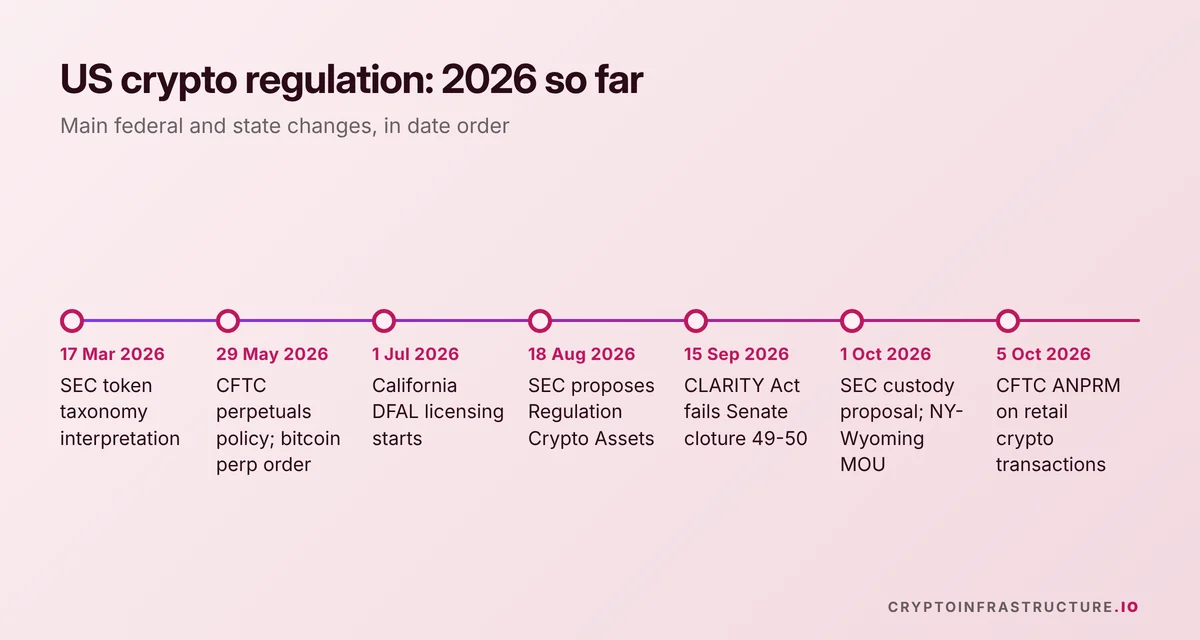
In date order, the main US changes this year: the SEC’s token taxonomy (17 March), the CFTC perpetuals policy and bitcoin perpetual order (29 May), California’s DFAL licensing start (1 July), the SEC’s Regulation Crypto Assets proposal (18 August), the CLARITY Act’s Senate defeat (15 September), H.R. 10357 clearing committee (16 September), the SEC custody proposal and the NY-Wyoming MOU (both 1 October) plus the CFTC ANPRM (5 October). Three of these are proposals or pre-proposals, so check their status before relying on them.
What this means for you
- If you hold crypto: keep your own cost basis records, compare them with your 1099-DA and watch H.R. 10357 before any year-end loss sale.
- If you run a platform: map every product to a regulator (spot to FinCEN and the states, derivatives to the CFTC, securities to the SEC). Comment on the CFTC ANPRM before about 12 December 2026 if you offer leverage.
- If you issue a token: run it through the March 2026 taxonomy, keep promises specific and limited in time and treat the August 2026 exemptions as proposals until finalised.
- If you build DeFi: the line FinCEN draws is whether you accept and transmit value. Keep custody of user funds out of your design unless you plan to be licensed.
- Everyone: remember that agency interpretations can be reversed. Review this map again when Congress returns to market structure.
For licensing and AML help, see the KYC/AML & Compliance section and the guide to when you need a crypto lawyer. The methodology explains how this site sources and dates its facts.
This guide is general information, not legal or tax advice. Rules and agency positions change; confirm your position with a qualified adviser. See the site’s disclaimer.