There is no federal “MSB licence” in the US. A crypto business that exchanges or transmits convertible virtual currency registers with FinCEN as a money services business on Form 107, and FinCEN charges no fee for that. The cost sits at state level: money transmitter licences (or crypto-specific licences such as California’s DFAL licence and New York’s BitLicense), each with its own application fee, surety bond and net worth rule. As of 14 October 2026, the official figures for four key states range from a $375 application fee in Florida to a $7,500 fee plus review costs in California, while bonds of $100,000 to $500,000 and net worth of at least $100,000 per state are the money that really ties up your budget.
If you are launching an exchange, wallet, on-ramp or crypto payments product for US customers, “MSB licence cost” is usually the first budget line someone asks you to fill. Most pages ranking for that phrase are written by consultancies selling the work, and several blur a free federal registration with the state licences that actually cost money. This guide separates the two, shows the official fees, bonds and net worth rules for California, Texas, Florida and New York, labels consultant estimates as estimates, and covers Canada’s FINTRAC registration briefly. Everything was checked against regulators, statutes and the CSBS on 14 October 2026.
Is an MSB a licence or a registration?
At federal level it is a registration. Under 31 CFR 1022.380, a money services business “must register with FinCEN” whether or not a state licenses it. You file the Registration of Money Services Business form (FinCEN Form 107) through the BSA E-Filing System. FinCEN’s own MSB registration page says a listing “is not a recommendation, certification of legitimacy, or endorsement” of the business, and that FinCEN does not verify what registrants submit.
So when a vendor sells you a “US MSB licence”, what you get federally is a filing acknowledgement and a BSA identifier, not permission to operate. The permission comes from the states.
Does a crypto business need to register as an MSB?
Usually yes, if it handles other people’s crypto. FinCEN’s guidance FIN-2019-G001 (9 May 2019) says that “exchangers and administrators generally qualify as money transmitters under the BSA, while users do not.” Section 4.2.1 adds that “hosted wallet providers are account-based money transmitters”, because they receive, store and transmit crypto for account holders.
The same guidance says a person using an unhosted wallet on their own device to buy goods or services for themselves is not a money transmitter. In practice:
- Likely an MSB: custodial exchanges, brokers, hosted wallets, crypto ATM and kiosk operators, on-ramps that take fiat and send crypto (or the reverse), and issuers that can redeem their own token.
- Likely not an MSB on that activity alone: people buying or selling crypto for themselves, and businesses that simply accept crypto as payment for their own goods.
Edge cases such as non-custodial software, DeFi front ends and multisig services turn on facts, which is where the guide to when you need a crypto lawyer comes in.
How to register with FinCEN (and how long it lasts)
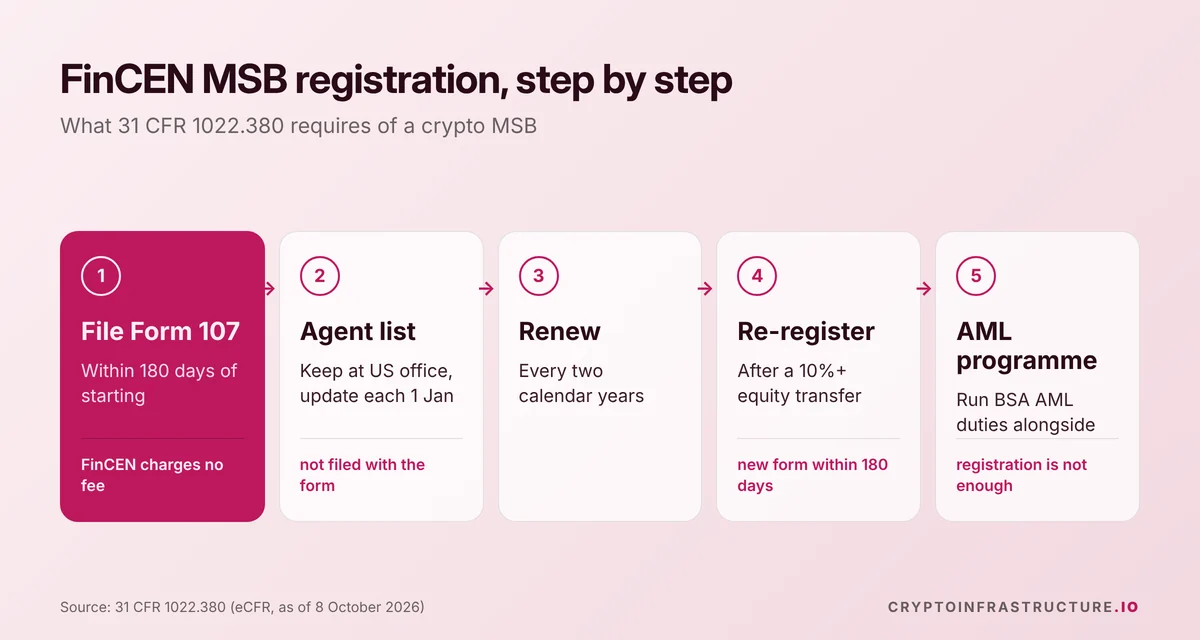
- File within 180 days. 31 CFR 1022.380(b)(3) requires the initial Form 107 by the end of the 180-day period starting the day after the business is established.
- Keep an agent list. If you use agents, 1022.380(d) requires a list kept at your US location and updated each 1 January. It is not filed with the form.
- Renew every two calendar years. The registration period is two calendar years, and each renewal is due by the last day of the calendar year before the new period. FinCEN removes entities that miss renewal from its public list once a year.
- Re-register after big changes. A transfer of more than 10 percent of voting power or equity, a change of control that triggers state re-registration, or more than a 50 percent increase in agents each require a new form within 180 days.
- Build the AML programme alongside. Registration does not replace the BSA anti-money-laundering programme, reporting and recordkeeping duties. The crypto compliance guide covers KYC, AML, the Travel Rule and the vendors that do the work.
Penalties for skipping it: 1022.380(e) makes it unlawful to do business without registering, sets a civil penalty of $5,000 for each violation (each day counts as a separate violation) and points to 18 U.S.C. 1960 for criminal penalties (eCFR, up to date as of 8 October 2026).
Federal cost: FinCEN charges no filing fee (FinCEN MSB registration page and the pages reviewed, checked 14 October 2026). Paper filings take about 60 days to process, so e-filing is the practical route.
What is a money transmitter licence?
A money transmitter licence (MTL) is the state permission to receive money or monetary value and transmit it. Regulators generally treat crypto businesses as money transmitters, and Wolters Kluwer’s licensing guide (updated November 2024) says state licensing applies in every state except Montana. Some states have also written crypto into separate laws (New York’s BitLicense, California’s Digital Financial Assets Law). Licensing follows your customers: you need permission in each state you serve, not only where you are incorporated.
The Money Transmission Modernization Act
To cut the 50-state patchwork, the Conference of State Bank Supervisors drafted the Money Transmission Modernization Act (MTMA). As of 23 April 2026, CSBS says “31 states have adopted the MTMA in full or in part”, with bills pending in Alaska, Louisiana, Maryland, Michigan and Oklahoma (CSBS, 23 April 2026). The same post announced MTMA implementation guidance on stablecoins and on how leases count in tangible net worth.
The MTMA sets a common tangible net worth formula: the greater of $100,000 or 3 percent of total assets for the first $100 million, 2 percent of assets between $100 million and $1 billion, and 0.5 percent above $1 billion (CSBS model text, approved 21 May 2025). Texas’s version, below, uses the same tiers. Adoption does not mean identical fees: each state still sets its own application and renewal charges.
How much does an MSB licence cost in the US?
Split the budget into three layers: the federal filing (free), state fees (spent), and state bonds and net worth (committed, not spent, but locked up as long as you hold the licence). Official figures for four states that matter most to crypto businesses:
| State | Licence and legal basis | Application fee | Surety bond / security | Net worth |
|---|---|---|---|---|
| Federal | FinCEN MSB registration, 31 CFR 1022.380 | None | None | None |
| California | DFAL licence (Financial Code Division 1.25), from 1 July 2026 | $7,500 plus DFPI’s reasonable review costs (reported) | Initial expectation $500,000; final amount set in review (reported) | Initial expectation $100,000 tangible net worth (reported) |
| Texas | Money transmission licence, Finance Code ch. 152 (MTMA-based) | Set by rule; not confirmed for this article | $100,000, or up to 100% of average daily Texas money transmission liability capped at $500,000 when net worth is 10% of assets or less (§152.352) | Greater of $100,000 or 3% of assets up to $100m, then MTMA tiers (§152.351) |
| Florida | Money services business, ch. 560 Part II (money transmitters) | $375; renewal $750; $38 per branch or authorised vendor location (§560.143) | Set by rule, not less than $50,000 or more than $2 million (§560.209) | $100,000 plus $10,000 per extra Florida location, max $2 million (§560.209) |
| New York | BitLicense, 23 NYCRR Part 200, plus a separate money transmission licence if you move fiat | $5,000 (see the BitLicense guide) | Bond or trust account generally at least $500,000 (NYDFS) | Set case by case (section 200.8) |
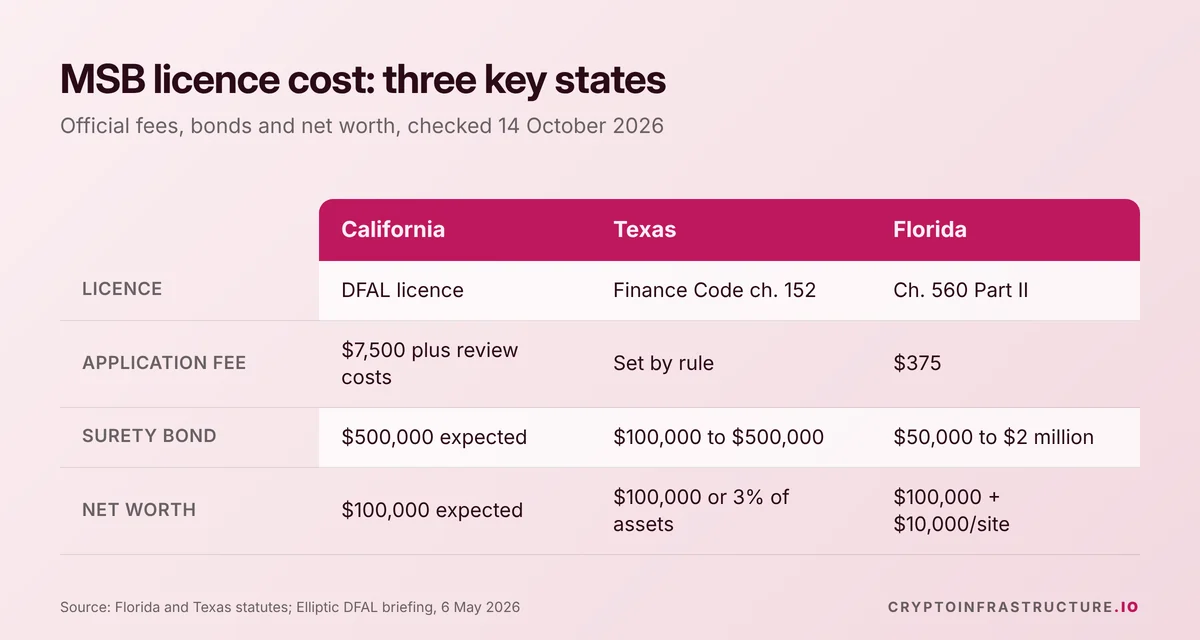
Checked 14 October 2026: FinCEN and eCFR (federal); 2026 Florida Statutes ss. 560.143 and 560.209; Texas Finance Code ss. 152.351 and 152.352 as amended by H.B. 3833 (effective 1 September 2025); NYDFS virtual currency licensing page. California figures come from Elliptic’s DFAL briefing of 6 May 2026, not a DFPI fee schedule; DFPI’s DFAL page (updated 13 February 2026) confirms the 1 July 2026 deadline but does not list the fee.
California in more detail. DFPI says that “beginning July 1, 2026, companies must be licensed by the DFPI or have applied for a license”, after AB 1934 (signed 29 September 2024) pushed the date back from 1 July 2025. Elliptic’s May 2026 briefing says DFPI began accepting applications on 9 March 2026, that a placeholder filing does not count, and that firms with both fiat and crypto flows need two licences (DFAL plus a money transmission licence). If you serve Californians and have not filed, you are past the deadline as of this update.
Texas in more detail. Some surety bond pages in search results still quote a $300,000 Texas minimum, which matches the older chapter 151 rule (§151.308). The current MTMA-based chapter 152 (added by S.B. 895 in 2023, amended by H.B. 3833 from 1 September 2025) sets the money transmission bond at $100,000 up to a $500,000 cap. Texas also has a separate chapter 160 for digital asset service providers, which requires an extra report when one applies for a new money transmission licence.
Worked example: what one state ties up
Assume a new crypto on-ramp with $2 million of total assets, net worth below 10 percent of assets, and $300,000 of average daily Texas money transmission liability. Under §152.351, 3 percent of $2 million is $60,000, so the $100,000 floor applies. Under §152.352 the bond is the greater of $100,000 or $300,000, so $300,000. Texas alone then needs $100,000 of tangible net worth and a $300,000 bond before you count fees, staff or counsel. Note that a surety bond is usually bought for an annual premium rather than posted in cash; premiums depend on the surety and are not covered here.
Repeat that for every state you serve and the pattern is clear: the application fees are hundreds to low thousands of dollars per state, while the bonds and capital run to six figures per state.
Official costs vs consultant estimates
Consultant pages mix their own fees into “licence cost”. The table keeps them apart. Vendor figures are as published on the pages reviewed and were not verified with the vendors.
| Item | Official figure (as of 14 October 2026) | Consultant or vendor estimate (labelled) |
|---|---|---|
| FinCEN Form 107 | $0 | About $1,860 for attorney preparation (ConsultantLM, as shown in Google’s AI Overview) |
| State application fees | $375 (FL) to $7,500 plus review costs (CA, reported) | “Hundreds to thousands of dollars per state” (Fraxtional, July 2025) |
| State renewals | $750 (FL) | “$250 to $1,000” a year in most states (Harbor Compliance, undated) |
| Surety bonds | $50,000 to $2 million (FL range); $100,000 to $500,000 (TX); about $500,000 (NY, CA expectation) | “USD 10,000 up to USD 2,000,000+” depending on state (Legal AES, August 2026) |
| Canada FINTRAC registration | $0 | USD 9,500 to 11,500 end to end (Rennoco, July 2024); USD 12,500 from scratch (a LinkedIn article by a licensing firm) |
None of the top pages reviewed gave a sourced all-in figure for a 50-state crypto licence footprint, so this guide does not either. Ask any adviser to split a quote into official fees, bond premiums, capital, staff and their own fees.
How long does it take?
The federal part is quick once your company exists: e-file Form 107 and you get an acknowledgement. Vendor pages reviewed put FinCEN registration at about 4 to 12 weeks end to end including preparation, and state money transmitter licences at roughly 3 to 9 months each (FinHost, March 2026). These are vendor estimates, not regulator figures. New York runs longer; the BitLicense guide covers the 90-day rule and the 12 to 24 months that vendors report.
What is an MSB in Canada, and what does it cost?
Canada also uses registration, not a federal licence. FINTRAC lists “dealing in virtual currencies” as an MSB service, covering “both virtual currency exchange and virtual currency transfer services”, and requires domestic and foreign MSBs to register before operating in Canada. FINTRAC states it “does not charge registration fees” (FINTRAC, page modified 1 October 2025), and provincial or territorial licensing, where it applies, does not remove the duty to register.
In brief: register before you operate, then renew every two years; FINTRAC charges nothing for renewal either, while advisers quote $1,500 to $5,000 per renewal for updated compliance documents and checks (Rennoco, August 2026). Quebec runs its own MSB licence on top; Rennoco puts the provincial fee at $826 plus $163 per person for security clearance. A FINTRAC registration does not let you serve US customers, so offers of “ready-made Canadian MSB licences” do not solve a US licensing problem.
Red flags when you buy MSB licensing help
- “US MSB licence” sold as one product. Federal registration is free and gives no operating permission; the state licences are the work.
- Texas bond quoted at $300,000 minimum. That matches the older chapter 151 rule; check the current chapter 152 figures.
- No mention of California’s 1 July 2026 DFAL deadline on a page selling US crypto licensing.
- Ready-made licensed companies for sale. A transfer of more than 10 percent of equity or voting power triggers FinCEN re-registration under 1022.380(b)(4), and state licences carry their own change-of-control rules, so nothing transfers quietly.
- A budget built from application fees alone. Bonds and net worth are where the money is.
What this means for you
As of 14 October 2026, budget for FinCEN registration as a free compliance filing you must not miss (180 days, renew every two calendar years), and treat the state layer as the real cost. Map the states your customers are in, check whether each has adopted the MTMA, and price the bond and net worth before the fee. If you are planning a full exchange launch, read the guide to starting a crypto exchange and compare other markets in the VASP licence guide, which sets official fees side by side across 11 jurisdictions. Compliance providers are reviewed in the KYC/AML & Compliance section under the site’s methodology.