The BitLicense is the licence the New York State Department of Financial Services (NYDFS) requires, under 23 NYCRR Part 200, before a business carries on virtual currency business activity involving New York or New York residents. As of 14 October 2026, the official application fee is $5,000 (non-refundable), capital is set case by case under section 200.8, and customer assets must be backed by a surety bond or trust account that NYDFS says is generally at least $500,000. The rule gives NYDFS 90 days to decide once it deems a file complete, but getting to “complete” is the slow part: vendor pages report 12 to 24 months end to end. NYDFS lists 39 authorised entities, split between BitLicensees and limited purpose trust companies.
If you run an exchange, wallet, payments or custody business and want New York customers, the BitLicense question comes up early, and most of the answers online come from consultancies selling the application work. They tend to give the $5,000 fee, skip the dates on NYDFS guidance, and leave out what enforcement has actually cost licensees. This guide sets out who needs a BitLicense, what the application contains, what it really costs, how long it takes, the conditional and trust charter routes, and the fines NYDFS has issued, all checked against NYDFS pages and the text of Part 200 on 14 October 2026.
What is a BitLicense?
A BitLicense is the business licence for virtual currency activity issued by NYDFS under 23 NYCRR Part 200. The regulation took effect on 24 June 2015. Part 200 states that no person may engage in virtual currency business activity without a licence from the superintendent. “BitLicense” is the industry’s name for it; NYDFS’s own register calls it a Virtual Currency License.
It is a state licence. It sits on top of federal requirements, not in place of them: section 200.4(c) lists FinCEN registration as one of the factors NYDFS weighs. Other US states run their own money transmission or crypto regimes, so a BitLicense covers New York only.
Who needs a BitLicense?
Part 200 defines five regulated activities (section 200.2(q)) when they involve New York or a New York resident:
- receiving virtual currency for transmission, or transmitting it;
- storing, holding or maintaining custody or control of virtual currency on behalf of others;
- buying and selling virtual currency as a customer business;
- performing exchange services as a customer business;
- controlling, administering or issuing a virtual currency.
NYDFS’s licensing page gives practical examples: crypto payments and remittances, custody, retail and institutional trading, fiat-to-crypto and crypto-to-crypto exchange, stablecoin and token issuance, staking-as-a-service, merchant point-of-sale services and crypto payroll.
Out-of-state and offshore firms are covered. NYDFS says a business needs a BitLicense if its activity involves New York or people in New York, wherever the company is based. If you do not want the licence, you have to keep New York customers out.
Who does not need one (per NYDFS, checked 14 October 2026): consumers investing for themselves; merchants and consumers who use crypto only to buy or sell goods and services; mining alone; private, non-commercial sales of self-mined coins; developers providing software as a purely technical service; and financial advisers giving advice on crypto. Merely accepting charitable donations is outside the rule, but NYDFS says charitable organisations are not exempt as a class if they carry on a regulated activity.
BitLicense vs limited purpose trust charter vs bank charter
NYDFS offers more than one route. The choice changes your fees, your powers and whether you also need a money transmitter licence.
| Route | Legal basis | Application fee | Money transmission in NY | Fiduciary powers | Typical users |
|---|---|---|---|---|---|
| BitLicense (Virtual Currency License) | 23 NYCRR Part 200 | $5,000 (section 200.5) | Needs a separate NY money transmitter licence | No | Exchanges, brokers, payment firms, crypto ATM operators |
| Limited purpose trust company charter | New York Banking Law, plus Part 200 obligations | $12,500 (reported by Crowell & Moring, May 2022) | Allowed without a separate money transmitter licence | Yes | Custodians, stablecoin issuers, exchanges wanting trust status |
| New York State bank charter | New York Banking Law, with superintendent approval for crypto activity | Not covered here | Not covered here | Not covered here | Banks adding crypto services |
| Conditional BitLicense | Section 200.4(c) | Same application as a full licence | As for a BitLicense | No | Early-stage firms, often working with an authorised partner |
Checked 14 October 2026 on the NYDFS virtual currency licensing page and 23 NYCRR 200.4 and 200.5. The trust charter fee comes from a law firm alert, not an NYDFS fee schedule fetched for this article; confirm it with NYDFS.
The trust charter is what Gemini, Coinbase Custody, BitGo, PayPal Digital and Circle’s New York trust company hold. If you want to see how that status plays out for a retail exchange, the Coinbase vs Gemini comparison explains why Gemini’s New York trust charter matters and what sits outside it.
BitLicense requirements
Part 200 is a full prudential and conduct regime, not a registration. The main requirements:
- Capital (section 200.8): no fixed number. NYDFS sets it per licensee after weighing the make-up of assets and liabilities, actual and expected volume, leverage, liquidity, the protection already provided by the bond or trust account, the customers served and the products offered. Capital must be held in cash, virtual currency or high-quality, highly liquid, investment-grade assets.
- Customer protection (section 200.9): a surety bond or a US dollar trust account held with a qualified custodian, in a form and amount NYDFS accepts. NYDFS’s licensing page says the minimum is generally $500,000 and may rise with the business model. Custodied crypto must be held in the same type and amount owed to customers and may not be lent, pledged or encumbered without the customer’s direction.
- AML and sanctions: a BSA/AML and OFAC programme, plus NYDFS’s own Part 504 transaction monitoring and filtering rule. NYDFS issued guidance on using blockchain analytics on 28 April 2022.
- Cybersecurity: Part 200 has its own cybersecurity section, and NYDFS’s Part 500 cybersecurity regulation also applies.
- Governance and fitness: NYDFS issued guidance on the character and fitness of directors, senior officers and managers on 22 January 2024.
- Coin listing: to offer a coin in New York you need specific NYDFS approval, a DFS-approved coin listing policy you self-certify under (guidance of 15 November 2023), or a coin on the Greenlist. As of 14 October 2026 the Greenlist holds BTC, ETH, GUSD, GYEN, ZUSD, RLUSD, USDW and GOLD, and licensees must notify NYDFS at least ten days before offering a Greenlisted coin.
- Custody structure: NYDFS guidance of 30 September 2025 on custodial structures for customer protection in insolvency replaced the January 2023 version.
- Customer service: guidance on complaint handling, 30 May 2024.
- Examinations and assessments: licensees are examined at least once every two years, and since 8 June 2022 New York law lets NYDFS charge virtual currency firms annual supervisory assessments and examination costs (Crowell & Moring, May 2022).
What the application contains
Section 200.4(a) lists what a sworn application must include. In summary:
- Legal name, trade names, entity type, formation date and jurisdiction.
- All affiliates and an organisation chart.
- Biographical information for each director, principal officer, principal stockholder and principal beneficiary, with background reports from an independent investigator.
- Fingerprints and photographs for those people and for employees with access to customer funds.
- A management chart showing lines of authority.
- Current financial statements and a projected balance sheet and income statement for the next year.
- A description of current, past and proposed business, products, websites, target market and any New York address.
- All banking arrangements.
- Every written policy and procedure Part 200 requires.
- A sworn affidavit on pending or threatened legal proceedings.
- Tax compliance verification from the New York State Department of Taxation and Finance.
- Insurance policies, if any.
- Your method for valuing virtual currency in fiat.
How to apply for a BitLicense
- Submit the NMLS Company Account Request Form and name a primary and secondary account administrator. Login details go to the primary administrator within three days.
- Work through NYDFS’s BitLicense Application Checklist and file a substantially complete application in NMLS. Firms already filing MU1 and MU2 forms for other states add only the New York items.
- Put the NMLS identification number on every paper document.
- Expect follow-up requests. NYDFS may ask for more than the checklist and may suggest a pre-application call or meeting.
NYDFS says that failing to submit every checklist item “is the most common reason for delays in the application process” (NYDFS virtual currency licensing page, checked 14 October 2026).
If you are still deciding where to launch, the guide to starting a crypto exchange covers the licence, technology and liquidity decisions together, and the VASP licence guide compares official fees across 11 jurisdictions.
How much does a BitLicense cost?
The $5,000 fee is the smallest line. A realistic budget has several layers, and only the first two have published figures:
| Cost layer | What it is | Official figure (as of 14 October 2026) |
|---|---|---|
| Application fee | Covers processing, review and investigation; not refunded if denied or withdrawn | $5,000 (section 200.5) |
| Bond or trust account | Customer protection under section 200.9; money tied up, not spent | Generally at least $500,000 per NYDFS, higher for riskier models |
| Regulatory capital | Held for as long as you are licensed | Case by case under section 200.8; no published minimum |
| Ongoing supervision | Annual assessments and examination costs | Set by NYDFS each year; not published as a fixed amount |
| Money transmitter licence | Needed by BitLicensees that transmit fiat; not needed by trust companies | Separate application, fees not covered here |
| People, systems, advisers | Compliance officer, AML and sanctions tools, cybersecurity, audits, counsel | No official figure |
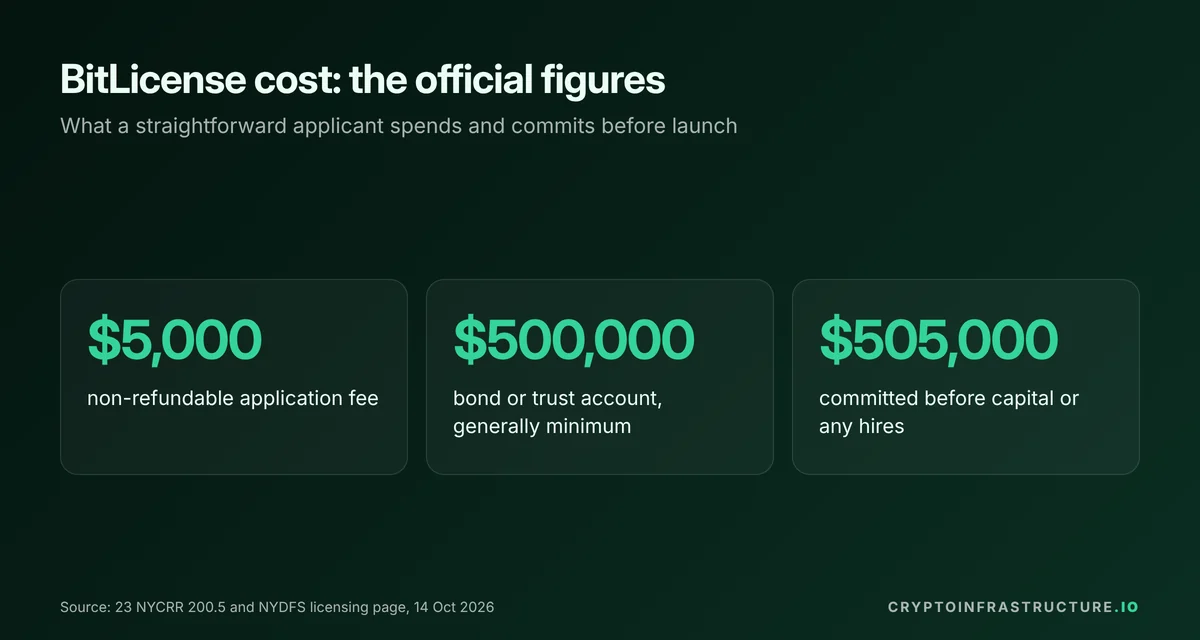
Worked example using only official figures: a BitLicense applicant with a straightforward model pays $5,000 to apply and commits at least $500,000 to a bond or trust account before launch. That is $5,000 spent and $505,000 committed before NYDFS has set its capital requirement, before any money transmitter licence, and before a single hire.
Estimates from the ranking pages (not official): one glossary page ranking for this keyword estimates $350,000 to $1.5 million or more to obtain the licence and $400,000 to $1.5 million or more a year to run it. It gives no source or method, so treat these as an order of magnitude, not a quote. Ask any adviser to split their estimate into official fees, capital, staff and their own fees.
How long does it take to get a BitLicense?
Section 200.6 says the superintendent “shall approve or deny every application for a license hereunder within 90 days” of the filing NYDFS deems complete, and the period can be extended at the superintendent’s discretion. NYDFS does not publish average processing times; its page says only that completion times vary and that most delays come from missing items.
In practice the 90-day clock starts late. Reported timelines on the pages ranking for this keyword, all from compliance vendors:
- 12 to 24 months for a typical approval (Spark glossary page);
- 12 to 18 months for simpler models and 24 months or more for custody and stablecoin businesses (InnReg, January 2026);
- “commonly” more than a year, driven by deficiency letters (Corgentum, October 2026).
These are reported estimates, not NYDFS figures. The register does show approvals are still flowing: NYDFS granted authorisations to MoonPay USA (June 2025), Bullish US Operations (September 2025), MoonPay Trust Company (November 2025), Zap Solutions (February 2026), GalaxyOne Prime NY and Mastercard Transaction Services (US) (both May 2026) and Circle’s New York trust company (July 2026).
One change may help firms licensed elsewhere. On 1 October 2026 NYDFS and the Wyoming Division of Banking signed a memorandum of understanding to share analysis and examination data on firms licensed in one state or applying in both, with the stated aim of streamlining applications and moving toward joint examinations (NYDFS, 1 October 2026). The release gives no timelines.
The conditional BitLicense
Section 200.4(c) lets the superintendent, at its sole discretion, grant a conditional licence to an applicant that does not yet meet every requirement. The terms that matter:
- It expires two years after issue unless NYDFS renews it or removes the conditional status.
- NYDFS can attach any reasonable conditions and can examine a conditional licensee more often and more deeply.
- NYDFS weighs the nature and scope of the business, expected volume, risks to consumers and markets, mitigation, FinCEN registration, other licences, experience and any prior conditional history.
NYDFS proposed the framework on 24 June 2020, with comments due 10 August 2020, built around applicants working with an already authorised BitLicensee or trust company that provides structure, capital, systems or staff. A conditional licence is a licence, not a shortcut around Part 200: you still file the full application.
How many companies hold a BitLicense?
As of 14 October 2026, NYDFS’s regulated entities list has 39 entries: 11 with a Virtual Currency License only, 15 with a Virtual Currency License and a money transmitter licence, and 13 limited purpose trust companies. So 26 entities hold a BitLicense and 13 operate under a trust charter. Some groups appear twice, such as Coinbase (BitLicense and trust company), MoonPay, NYDIG and PayPal. The earliest grant date on the list is Circle Internet Financial’s (September 2015), followed by Gemini Trust Company (October 2015).
The list also changes in the other direction. NYDFS has published voluntary surrenders by Coinsource (December 2023), Genesis (January 2024), SoFi Digital Assets (March 2024), Cboe Clear Digital (October 2024) and Bakkt entities (April 2025).
BitLicense enforcement: what failures have cost
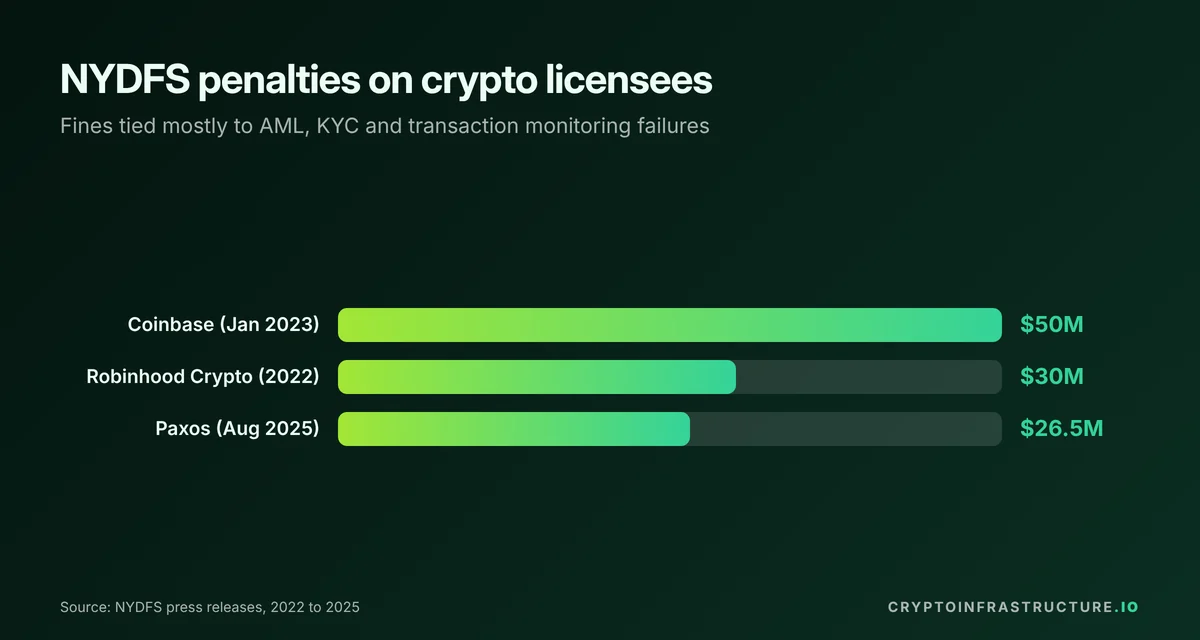
Most NYDFS crypto penalties found in this research turned on AML, KYC and transaction monitoring, not on the licence application itself.
| Date | Entity | Penalty | Required compliance spend | Main findings |
|---|---|---|---|---|
| 2 August 2022 | Robinhood Crypto, LLC | $30 million | Independent consultant | BSA/AML and transaction monitoring failures, cybersecurity deficiencies, Part 200 and Part 504 violations, improper 2019 compliance certifications |
| 4 January 2023 | Coinbase, Inc. | $50 million | $50 million over two years | KYC/CDD treated as a “check-the-box exercise”, a backlog of over 100,000 unreviewed monitoring alerts by late 2021, late suspicious activity reports |
| 7 August 2025 | Paxos Trust Company | $26.5 million | $22 million | Inadequate due diligence on its Binance partnership, systemic AML failures, weak KYC/CDD, monitoring that missed money-laundering patterns |
Sources: NYDFS press releases of 2 August 2022, 4 January 2023 (Coinbase) and 7 August 2025 (Paxos), checked 14 October 2026. This is not a complete list of NYDFS crypto actions.
The pattern is clear: holding the licence is the start of supervision, not the end of it. If your monitoring cannot keep pace with growth, the licence becomes the route through which the penalty arrives.
What else changed in 2026
- Stablecoins: on 9 June 2026 NYDFS proposed a stablecoin regulation that builds on its June 2022 guidance and aligns it with the federal GENIUS Act, with a one-year transition for existing New York issuers. The stablecoin regulation guide tracks where that stands.
- Wyoming MOU: signed 1 October 2026, covering coordinated licensing and supervision (see above).
- New licensees: Mastercard and GalaxyOne Prime NY were licensed in May 2026, and Circle’s New York trust company was chartered in July 2026.
Red flags when planning a BitLicense application
- A quoted timeline in weeks. The 90-day rule only starts once NYDFS deems the file complete.
- A budget built around the $5,000 fee. The bond, capital and compliance staff are the real cost.
- “We’ll serve New York from offshore.” NYDFS says the licence follows New York customers, not your headquarters.
- Listing any coin you like. Without a DFS-approved listing policy or Greenlist status, each new coin needs approval.
- Forgetting the money transmitter licence. A BitLicensee moving fiat needs one; a trust company does not.
What this means for you
As of 14 October 2026, a BitLicense is achievable but slow and expensive, and it brings permanent supervision. Decide first between a BitLicense and a trust charter, because that choice settles your fees, fiduciary powers and money transmitter needs. Budget the bond and capital before the fee, build your AML and transaction monitoring to the standard NYDFS has enforced against Coinbase and Paxos, and file a complete application, since that is the one part of the timeline you control. If you need outside help, see the guide to when you need a crypto lawyer and the providers in the KYC/AML & Compliance section, assessed under the site’s methodology.