To start a crypto exchange you make six decisions in order: the business model (order-book exchange, DEX, broker or OTC desk), the market and licence, the build path (custom, white label or crypto-as-a-service), the core stack (matching engine, custody, compliance and fiat rails), where liquidity comes from, and how you will prove security before launch. The software is the cheapest of these.
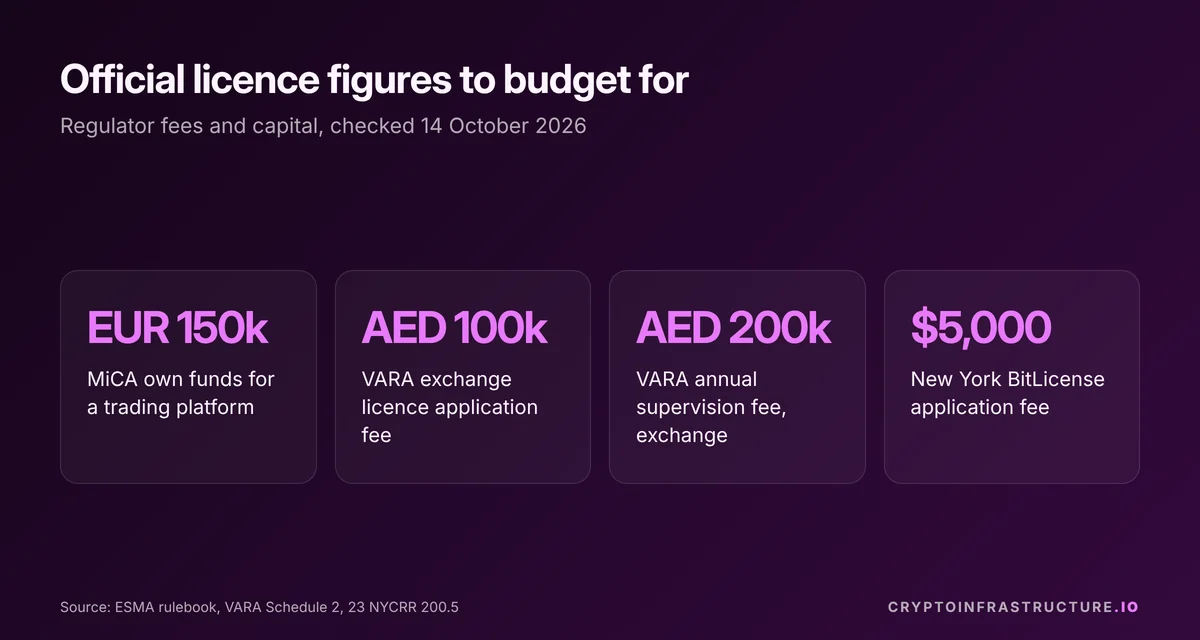
As of 14 October 2026, an EU trading platform needs MiCA authorisation and at least EUR 150,000 of own funds, Dubai’s VARA charges AED 100,000 to apply for an exchange licence plus AED 200,000 a year in supervision fees, and a New York BitLicense application costs $5,000 before any legal work. Your launch date is set by the slowest of three things: the licence, a bank saying yes, and signed liquidity.
If you are planning how to create a crypto exchange, most of the guides you will find are written by development shops selling the build, and their cost figures stop at the software invoice. That leaves out the parts that decide whether you can open at all: the licence, the capital it locks up, the bank and payment partners, and an order book that is not empty on day one.
This guide is the end-to-end roadmap for a founder or fintech team. It covers which kind of exchange to start, how licensing and build choices fit together, what the core stack contains, how liquidity works (and the shortcut that gets people charged), how to approach security, a realistic launch sequence, and a cost model built only from official fees and published pricing, with every assumption stated.
How do you start a crypto exchange? The short answer
You start a crypto exchange by choosing a model and a market first, getting the licence that market requires, then building or licensing the trading software, connecting custody, compliance tools, banking and liquidity, and passing an independent security review before real money goes in. Google’s AI Overview for this search compresses that into “legal compliance, a software framework, banking rails and strong security controls” (checked 14 October 2026). That is the right list. What it does not tell you is the order, which matters, because the licence and the bank take the longest and cannot be bought off the shelf.
- Pick the business model: order-book exchange, DEX, broker or OTC desk.
- Pick the market and licence: where your customers live decides the regulator.
- Pick the build path: custom build, white label software, or a licensed crypto-as-a-service partner.
- Assemble the core stack: matching engine, wallets and custody, KYC, transaction monitoring and Travel Rule, fiat rails.
- Arrange liquidity: market makers and liquidity providers under written terms.
- Prove security: custody design, penetration testing and incident plans before launch.
- Launch in stages: closed beta, limited markets, then scale.
Step 1: Choose your business model
“Crypto exchange” covers four different businesses. If you are asking how to start a crypto trading platform, this is the first decision, because it sets your licence class, your capital, your tech and your liquidity needs.
| Model | What you run | Custody of customer assets | Liquidity need | Regulatory weight |
|---|---|---|---|---|
| Centralised exchange (CEX) | Your own order book and matching engine; customers trade with each other | You, or a custodian you appoint | Highest: you need tight spreads on every listed pair | Highest: trading platform plus custody in most regimes |
| Broker (instant buy and sell) | A buy and sell interface; you fill orders against a liquidity provider | You, a custodian or a partner | Lower: you route orders to one or more providers | High: exchange and custody activities, but no trading venue |
| OTC desk | Quote-based large trades for institutions and high-net-worth clients | Often settled directly, sometimes custodied | Balance sheet or provider credit lines | Exchange activity; heavy KYC on fewer clients |
| Decentralised exchange (DEX) | Smart contracts (an automated market maker or on-chain order book) plus a front end | Users keep their own keys | Liquidity pools funded by third parties | Depends on how decentralised it really is and on local law; front-end operators and token issuers can still be in scope |
Most first-time operators start as a broker or a small order-book exchange focused on one region, because an order-book exchange with dozens of pairs needs liquidity on every one of them. A DEX avoids custody but swaps it for smart contract risk, audit costs and legal uncertainty. Videos promising to start a crypto exchange “without a licence” usually mean a DEX or an offshore registration; neither lets you serve customers in markets that license the activity.
Step 2: Choose the jurisdiction and licence
Licensing follows the customer, not the company. The question is not “where is it cheapest to incorporate?” but “where do the people I want to serve live, and what does their regulator require?” A summary of the main routes, all checked 14 October 2026:
| Market | What an exchange operator needs | Official figures checked |
|---|---|---|
| European Union | MiCA authorisation as a crypto-asset service provider (CASP) in one member state, then passporting across the EU | Minimum own funds of EUR 125,000 for custody and exchange services, EUR 150,000 for operating a trading platform (ESMA single rulebook). The transitional period ended on 1 July 2026; ESMA expected unauthorised firms to have executed wind-down plans by then (AMF, 23 June 2026) |
| United States | FinCEN registration as a money services business, state money transmitter licences, and a BitLicense (or trust charter) for New York | FinCEN registration within 180 days of starting money transmission, renewed every two years, no fee shown on FinCEN’s page; BitLicense application fee $5,000, non-refundable (23 NYCRR 200.5) |
| United Kingdom | FCA registration today; full FSMA authorisation under the new cryptoasset regime | Application window 30 September 2026 to 28 February 2027; firms that will not be authorised by commencement must run off UK business (FCA) |
| Dubai | A VARA licence for each virtual asset activity | Exchange services: AED 100,000 application fee and AED 200,000 annual supervision fee; custody the same; a licence extension fee applies to each extra activity (VARA Schedule 2) |
For the full 11-jurisdiction table with capital, timelines and offshore options, see the VASP licence guide. Two country deep dives cover popular choices: the Lithuania crypto licence and its MiCA transition and the Hong Kong VATP licence. This is a summary, not legal advice; a specialist crypto law firm should confirm the position for your model before you commit.
A practical rule: in the US, FinCEN’s 2019 guidance (FIN-2019-G001) says exchangers of convertible virtual currency “generally qualify as money transmitters” (FinCEN guidance). If you exchange crypto for customers, assume you are regulated somewhere, and find out where before writing code.
Step 3: Build, white label or crypto-as-a-service
There are three ways to get the platform. They differ less in what the exchange looks like than in who holds the licence, who controls the keys and how hard it is to leave.
| Path | Who holds the licence | Typical speed (vendor claims) | Main trade-off |
|---|---|---|---|
| Custom build | You | About 9 to 14 months for a lean custom MVP (Purrweb, a development agency) | You own the code and the roadmap, and you fund a permanent engineering and security team |
| White label software (licensed or hosted) | You | “As little as 60 days” (AlphaPoint, a white label vendor) | Fast and cheaper to start; vendor roadmap, revenue share and lock-in |
| Crypto-as-a-service | Mostly the partner, in its licensed markets | Integration time only | Least licensing work; you do not run an order book, and your customers’ assets sit with the partner |
The vendor timelines describe the technical setup only. White label providers, development studios and lock-in terms are compared in detail in the white label crypto exchange guide. If you go the custom route, use the checklist in how to vet a blockchain development studio before signing a build contract.
Step 4: The core stack (crypto exchange architecture)
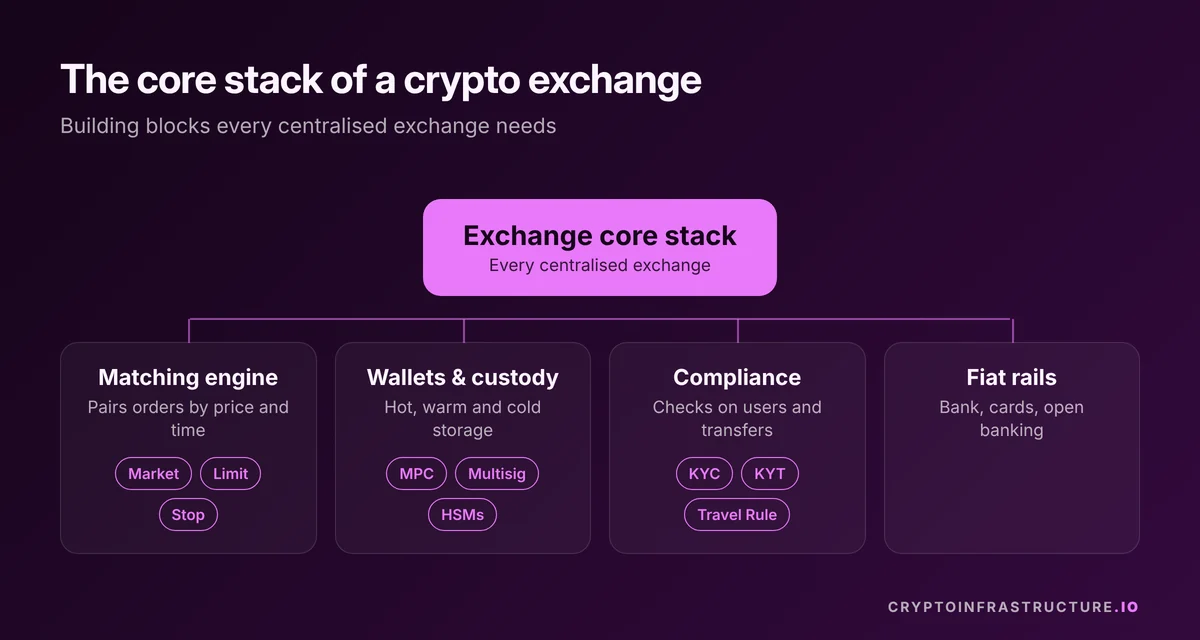
Whatever path you choose, every centralised exchange has the same building blocks. When you assess a vendor or a build plan, ask who supplies, operates and tests each one.
Matching engine and order book
The matching engine pairs buy and sell orders according to price and time priority and updates the order book. It must handle market, limit and stop orders, cancel and replace safely under load, and produce an audit trail regulators and auditors can follow. For a broker model there is no matching engine; instead an order router quotes prices from liquidity providers and fills against them.
Wallets and custody
Customer assets usually sit in a mix of hot wallets (online, for withdrawals), warm wallets and cold storage. The key questions are who generates and holds the keys, how many people must approve a withdrawal, and whether you use multi-party computation (MPC), multisig or hardware security modules. Most new exchanges integrate a specialist custody or wallet infrastructure provider rather than building key management themselves; the institutional custody guide compares the models. Under MiCA, an authorised CASP cannot outsource custody to an unauthorised firm (ESMA, as reported by the AMF on 23 June 2026).
KYC, KYT and the Travel Rule
- KYC: identity verification, liveness checks and sanctions and PEP screening at onboarding.
- KYT (know your transaction): blockchain analytics that score deposits and withdrawals for links to sanctioned addresses, hacks, mixers and darknet markets.
- Travel Rule: sending and receiving originator and beneficiary information with crypto transfers. In the US, FinCEN’s guidance applies the Funds Travel Rule to transmittals of $3,000 or more. FATF’s June 2025 update counted 99 jurisdictions that had passed or were passing Travel Rule legislation, so expect it in almost every market.
Tools, vendors and policies are covered in the crypto compliance guide and the KYC/AML & Compliance section.
Banking and fiat rails
If customers deposit dollars, euros or dirhams, you need a bank or payment institution that will hold client funds and process transfers, plus card or open-banking on-ramps. This is often the slowest partnership to land, and many banks ask which licence you hold before they open an account. Settle it in parallel with the licence application, not after.
Admin, risk and reporting
The back office runs user management, limits, fee schedules, reconciliation of wallets against the ledger, suspicious activity reporting and regulatory reports. Ask to see it working, because this is where compliance staff spend their day.
Step 5: Liquidity, market makers and aggregation
A new exchange has no traders, so its order book starts empty. Wide spreads and thin depth drive away the first users, which keeps the book thin. There are three common fixes:
- Liquidity aggregation (for brokers and new venues): connect to one or more liquidity providers or larger exchanges and route or hedge orders there. Your prices track the wider market from day one, at the cost of the provider’s spread and fees.
- Professional market makers: firms that place two-sided quotes on your order book under a contract specifying spread, depth and uptime. Get those obligations in writing, along with how the firm is paid and what happens when markets move fast.
- Shared order books: some white label vendors connect your exchange to a network order book. Check what happens to your liquidity if you leave the vendor.
The shortcut to avoid is fake volume. One of the top-ranking guides for this search suggests using a service to “simulate liquidity” through “virtual transactions” to give the impression of a healthy exchange. That is wash trading. On 9 October 2024 the SEC charged three so-called market makers, ZM Quant, Gotbit and CLS Global, alleging they sold “market-manipulation-as-a-service” by trading with themselves to create “the false appearance of an active trading market”, with bots generating billions of dollars in artificial volume a day (SEC press release 2024-166). If a liquidity offer sounds like volume rather than real two-sided quotes, walk away. Providers are covered in the Market Makers & Liquidity section.
Step 6: Security and audits
An exchange is a permanent target. In February 2025, North Korean hackers stole about $1.5 billion in virtual assets from Bybit, according to the FBI’s public service announcement of 26 February 2025 (FBI IC3). Bybit was a large, established exchange; a new one has fewer staff and less monitoring. Before launch, plan for at least:
- Custody controls: most assets in cold storage, withdrawal limits and multi-person approval on hot wallet top-ups, and a tested key recovery procedure.
- Independent penetration testing of your deployment, including the wallet and signing flow, not only the vendor’s code. A vendor’s certificate covers the vendor.
- Smart contract audits if you run any on-chain component (a DEX, a bridge or token contracts).
- Monitoring and incident response: who can pause withdrawals, how you tell customers, and how you notify your regulator.
- Proof of reserves or attestations once you hold customer assets, so customers can check balances match liabilities.
Industry standards such as the CryptoCurrency Security Standard (CCSS), maintained by a steering committee with C4, give you a checklist for key management. None of these steps makes an exchange safe; they reduce and expose risk.
Launch timeline: what runs in parallel
Vendors quote weeks for the software. Your launch date is set by the slowest of the licence, the bank and liquidity. A realistic sequence:
| Phase | What happens | Duration indicator |
|---|---|---|
| 1. Model, market and legal opinion | Choose model and markets, get a legal opinion on licence class | Weeks |
| 2. Licence application | Company, capital, policies, senior staff, application file | Licensing agencies estimate 6 to 12 months (Crassula, a vendor); no regulator checked commits to a fixed overall timeline, and NYDFS says “completion times vary” |
| 3. Banking and payments | Client money accounts, on-ramps, card acquiring | Parallel with phase 2; often contingent on it |
| 4. Platform | White label setup or custom build | Weeks (white label) to about 9 to 14 months (custom MVP), per vendors |
| 5. Liquidity and custody contracts | Market maker and liquidity agreements, custody integration | Parallel with phase 4 |
| 6. Security review | Penetration test, fixes, retest, incident drills | Before any real customer funds |
| 7. Staged launch | Closed beta, limited pairs and limits, then scale | Ongoing |
In the US, note FinCEN’s rule that money transmitters register within 180 days of starting. In the UK, the new regime’s application window closes on 28 February 2027.
How much does it cost to start a crypto exchange?
Google’s AI Overview for “how much does it cost to develop a crypto exchange” puts development at $15,000 to $500,000+ (checked 14 October 2026), citing development companies. That range is software only. The second AI Overview for this topic admits that licensing, compliance, legal and security “can easily double” startup costs, but gives no figures. Below is a model that separates three kinds of cost, using only official fee schedules and published vendor pricing, all checked 14 October 2026.
The three layers
- Capital you must hold: not spent, but locked up for as long as you are licensed.
- Fees with a published price: regulator fees and vendor list prices.
- Quote-only costs: legal advice, staff, liquidity contracts, penetration testing, banking. No reliable public price exists; get quotes and add them.
Published figures you can plug in
| Line item | Published figure | Source (checked 14 October 2026) |
|---|---|---|
| EU trading platform own funds (MiCA class 3) | EUR 150,000 minimum (EUR 125,000 for exchange and custody without a platform) | ESMA single rulebook |
| Dubai exchange licence | AED 100,000 application, AED 200,000 a year supervision; custody carries its own AED 200,000 supervision fee, and each extra activity a licence extension fee | VARA Schedule 2 |
| New York BitLicense | $5,000 application fee, non-refundable | 23 NYCRR 200.5 |
| US federal MSB registration | No fee shown | FinCEN MSB registration page |
| Hosted white label platform | 15% revenue share; subscription price not listed | HollaEx pricing page |
| Wallet and custody infrastructure | Custom plans “starting at $36,000 per year”; Essentials $999 a month for up to 6 months, capped at $1,000,000 quarterly outbound volume | Fireblocks pricing page |
| KYC verification | $1.35 per verification ($149 monthly minimum) for ID verification; $1.85 ($299 minimum) for the plan with AML screening; transaction monitoring on custom pricing | Sumsub pricing page |
Prices are each vendor’s own published figures, exclude tax and are not independently verified. Vendors are named as examples of published pricing, not recommendations. Development-shop quotes from the ranking pages are excluded because they are not list prices.
Worked example: a small EU order-book exchange on hosted white label
Illustrative assumptions only, not a forecast. Replace each with your own numbers:
- Licence: MiCA CASP authorisation including a trading platform, so own funds of at least EUR 150,000 held.
- Monthly trading volume: $10 million; blended fee you charge: 0.15%. Gross fee revenue: $10,000,000 × 0.0015 = $15,000 a month.
- Platform revenue share at 15%: $15,000 × 0.15 = $2,250 a month, $27,000 a year.
- New verified users: 2,000 a month at $1.35 each = $2,700 a month, $32,400 a year (AML screening on the higher plan would raise this).
- Wallet infrastructure on a custom plan from $36,000 a year (the $999 Essentials plan is time-limited and its $1 million quarterly outbound cap is far below exchange volumes).
Published-price floor: about $95,400 a year in spending plus EUR 150,000 held as capital, before national application fees, legal work, compliance staff, transaction monitoring, liquidity, banking, penetration testing, hosting outside the vendor package and marketing. Those quote-only lines usually decide the real budget, which is why any single “cost to start a crypto exchange” figure without assumptions is not useful.
Dubai and US comparisons
- Dubai exchange with own custody: AED 100,000 application fee, plus a licence extension fee for the custody activity (amount not confirmed for this article), and AED 400,000 a year in supervision fees for the two activities, plus VARA’s paid-up capital per activity (see the VASP licence guide for the capital table).
- United States: FinCEN registration shows no fee and the BitLicense application is $5,000, but you also need state money transmitter licences. AlphaPoint, a vendor, estimates $1 million to $3 million over 12 to 18 months for state licences, and $200,000 to $500,000 a year for ongoing compliance. Treat these as one vendor’s estimates, not official figures.
Mistakes that sink new exchanges
- Building before licensing. A platform that cannot produce the reports, Travel Rule data or audit trail your regulator expects has to be rebuilt.
- Budgeting the software only. The AI Overview’s $15,000 to $500,000 range is for development, not for an operating exchange.
- Buying volume instead of liquidity. Wash trading is what the SEC charged market makers for in October 2024.
- Treating an offshore registration as global. It covers the registering jurisdiction, not customers in the EU, UK or Singapore.
- Leaving the bank to last. Without fiat rails, a fiat-to-crypto exchange cannot onboard its first customer.
- Trusting a vendor certificate as your security. Test your own deployment, especially the wallet and signing flow.
What this means for you
Starting a crypto exchange in 2026 is a regulated financial business first and a software project second. Decide your model and markets, price the licence and capital, line up banking and real liquidity, and only then choose between building, white label and crypto-as-a-service. Use the cost model above with your own volumes and quotes, and put every vendor’s “launch in weeks” claim next to your licence timeline.
Next steps on this site: compare platforms in the white label exchange guide, check licences in the VASP licence guide, plan your compliance stack with the crypto compliance guide, and browse Exchanges and Market Makers & Liquidity. How providers are assessed is set out in the methodology.