A gas fee is what you pay a blockchain network to process your transaction. On Ethereum it equals the gas your transaction uses multiplied by a price per unit of gas: a base fee set by the protocol, which is burned, plus an optional priority fee (tip) for the validator. A plain ETH transfer uses 21,000 gas. Solana charges a fixed 5,000 lamports per signature plus an optional priority fee. Layer 2 rollups charge for their own execution plus the cost of posting your data back to Ethereum. On 13 October 2026, Etherscan put a standard Ethereum gas price at 0.3 gwei, which works out to about $0.02 for a plain ETH transfer.
You go to send some crypto and your wallet adds a “network fee” you did not set and cannot quite explain. Sometimes it is a fraction of a cent, sometimes it is more than the amount you are sending. This guide explains what a gas fee is, how Ethereum, Solana and layer 2 networks each set it, what a gas limit does and how to work out a fee yourself, with worked examples whose assumptions are stated. Live fee readings are from 13 October 2026 unless a different date is given.
What is a gas fee?
A gas fee is the payment you make to a blockchain network to run your transaction or smart contract call. “Gas” is the unit that measures how much computation an action takes and the fee is that amount of gas multiplied by a price per unit. The term comes from Ethereum, but people now use “gas fee” loosely for transaction fees on most smart contract networks.
The fee does two jobs. It pays the validators who include and process your transaction and it stops anyone from flooding the network with free spam or programs that run forever, because every step of computation costs something.
Fees are paid in the network’s own token: ETH on Ethereum and its layer 2s (such as Arbitrum, OP Mainnet and Base) and SOL on Solana. That is why you can hold $500 of USDC in a wallet and still be unable to send it: you need a little of the native token to pay the fee.
How gas fees work on Ethereum
The ethereum.org gas documentation (page last updated 24 June 2026) defines gas as “the unit that measures the amount of computational effort” and gives the fee formula as:
Fee = units of gas used × (base fee + priority fee)
Prices are quoted in gwei. One gwei is one billionth of an ETH (0.000000001 ETH).
Gas used: how much work your transaction does
Every operation in the Ethereum Virtual Machine has a gas cost. A standard ETH transfer needs 21,000 gas. A token swap, an NFT mint or a lending transaction runs more contract code and touches more storage, so it uses more gas. 1inch’s own explainer puts a typical swap at five to ten times a plain transfer, depending on how many pools it touches.
The base fee: set by the protocol and burned
Since the London upgrade in 2021, which brought in EIP-1559, every Ethereum block has a base fee: a minimum price per gas that every transaction in that block must pay. You do not choose it. The protocol adjusts it automatically:
- Each block has a gas target equal to half of the block gas limit.
- If the previous block used more gas than the target, the base fee rises; if it used less, it falls.
- The change is capped at 12.5% per block, per ethereum.org.
The base fee is burned, meaning that ETH is destroyed rather than paid to anyone. This is the most common point that older explainers get wrong when they say gas “goes to miners”. Ethereum has used proof of stake since 2022 and has validators, not miners. The base fee goes to no one.
The priority fee: a tip for the validator
On top of the base fee you can add a priority fee, or tip, which goes to the validator that includes your transaction. ethereum.org describes it as an incentive for validators to include transactions and a way for users to outbid each other for a place in a block. When the network is quiet, a tip of zero or close to it is usually enough. When many people want into the same block, higher tips get priority.
Bots that compete to be first in line for an arbitrage or a liquidation also pay high tips and that ordering game is a large topic of its own. See what MEV is and how sandwich attacks work.
Max fee and refunds
Wallets also let you set a max fee per gas, the most you are willing to pay. If the base fee plus your tip comes in below it, ethereum.org says you are refunded the difference. That is why the fee shown before you confirm is often an upper bound and the fee you actually pay is lower.
What is a gas limit?
“Gas limit” means two different things and both come up in the questions people ask.
- Transaction gas limit: the most gas you allow your transaction to use. Your wallet usually estimates it for you. If execution runs out of gas before finishing, ethereum.org says the EVM reverts the changes “but all the gas provided will still be consumed for the work performed.” In other words, a failed transaction still costs you a fee. If the limit is too low even to pass basic validation, the transaction is rejected before inclusion and no gas is spent.
- Block gas limit: the most gas all transactions in one block can use combined. It sets Ethereum’s capacity per block and the base fee target is half of it.
The block gas limit has changed a lot and many ranking explainers have not caught up. One widely read page still describes a block size of “15 million gas to 30 million gas”. The Fusaka upgrade, which went live on 3 December 2025, included EIP-7935, which in the words of the Ethereum Foundation’s Fusaka announcement “raises Ethereum’s default gas limit to 60M”. Fusaka also added EIP-7825, a protocol cap of 16,777,216 gas on any single transaction. A sample block on Etherscan (block 26,186,162, produced 13 October 2026 at 21:08 UTC) had a gas limit of 60,000,000 and used 41.71% of it.
A bigger block limit adds capacity. It does not set a fee by itself, but when blocks are less full than the target, the base fee falls, which is part of why mainnet fees in October 2026 were a fraction of what they were in busy periods of earlier years.
Blob fees: the second fee market on Ethereum
Since the Dencun upgrade in 2024, Ethereum has had a separate fee for data that layer 2 rollups publish. EIP-4844 added “blob-carrying transactions”: chunks of data of 128 KiB each that contracts cannot read and that nodes keep for about 18 days. According to the EIP-4844 specification, blob gas is “independent of normal gas and follows its own targeting rule, similar to EIP-1559” and the blob fee is burned.
You rarely pay a blob fee directly. Rollups pay it when they post batches of their users’ transactions and pass the cost on. The same sample block on 13 October 2026 carried 6 blobs at a blob gas price of about 0.019 gwei, for total blob fees of roughly 0.0000148 ETH across both blob transactions. Fusaka’s follow-up forks raised blob capacity to a target of 14 and a maximum of 21 blobs per block from 7 January 2026. For how blobs fit into Ethereum’s data sharding plan, read what sharding is and why Ethereum switched to blobs.
How gas fees are calculated: worked Ethereum examples
The examples below use stated, hypothetical inputs so you can follow the arithmetic. They are not forecasts. Change the inputs to match what your wallet or a gas tracker shows.
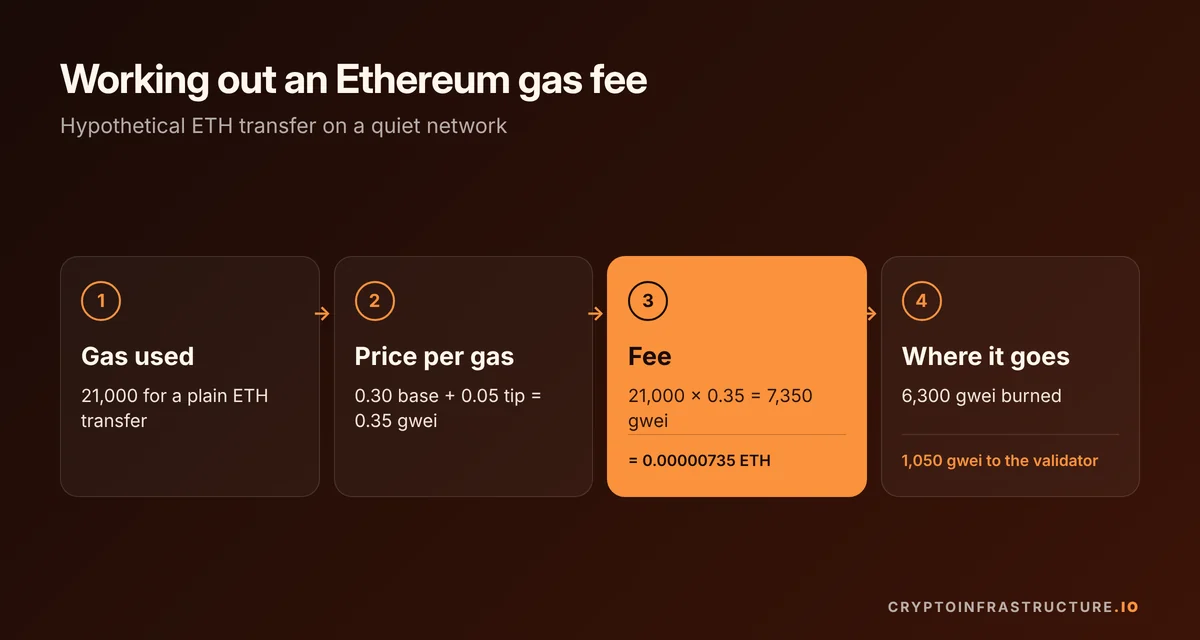
| Scenario (hypothetical) | Gas used | Base fee + tip (gwei) | Fee in ETH | Fee in USD at an assumed $2,500 per ETH |
|---|---|---|---|---|
| ETH transfer, quiet network | 21,000 | 0.30 + 0.05 = 0.35 | 0.00000735 | about $0.018 |
| Token swap, quiet network | 150,000 (assumed) | 0.30 + 0.05 = 0.35 | 0.0000525 | about $0.13 |
| ETH transfer, busy network | 21,000 | 20 + 2 = 22 | 0.000462 | about $1.16 |
| Token swap, busy network | 150,000 (assumed) | 20 + 2 = 22 | 0.0033 | about $8.25 |
Formula from ethereum.org. The 0.30 gwei base fee is close to Etherscan’s reading on 13 October 2026; the 20 gwei “busy” figure, the 150,000 gas swap and the $2,500 ETH price are assumptions for illustration only.
Taking the first row step by step:
- Gas used: 21,000.
- Price per gas: 0.30 gwei base fee + 0.05 gwei tip = 0.35 gwei.
- Fee: 21,000 × 0.35 = 7,350 gwei = 0.00000735 ETH.
- Of that, 21,000 × 0.30 = 6,300 gwei is burned and 21,000 × 0.05 = 1,050 gwei goes to the validator.
- If you had set a max fee of 1 gwei, you would be refunded the unused 0.65 gwei per unit of gas.
The same transfer costs about 63 times more in the “busy” row, purely because of the price per gas. The work done did not change. That is the whole answer to “why is ETH gas so high right now” when it is high: demand for block space pushes the base fee up block after block and people competing for priority add bigger tips.
Current Ethereum gas fees (dated snapshot)
The Etherscan gas tracker showed the following on 13 October 2026:
| Tier | Gas price (gwei) | Base fee | Priority fee | Etherscan’s estimated time |
|---|---|---|---|---|
| Standard | 0.3 | 0.3 | 0 | about 2 minutes |
| Fast | 0.348 | 0.3 | 0.048 | about 30 seconds |
| Rapid | 0.382 | 0.3 | 0.082 | about 30 seconds |
At the ETH price Etherscan showed at that moment ($2,508.57), it estimated a swap at $0.27 to $0.34 and a bridge transaction at $0.09 to $0.11. Gas prices move every 12 seconds or so, so treat these as one reading, not a typical cost. Any fee figure without a date and time attached tells you little.
How gas fees work on Solana
Solana does not use the word gas in its protocol, but the idea is the same and the model is simpler. Per the Solana fee structure documentation, every transaction pays:
- A base fee of 5,000 lamports per signature. A lamport is 0.000000001 SOL, so a transaction with one signature pays 0.000005 SOL. Half of the base fee is burned and half goes to the block-producing validator.
- An optional prioritization fee. You set a compute unit price and a compute unit limit. The fee is the price multiplied by the limit, divided by 1,000,000 (the price is in micro-lamports). The prioritization fee goes 100% to the validator, none is burned.
Solana’s “compute units” play the role Ethereum’s gas plays in measuring work. Its docs give a default of 200,000 compute units per instruction and a maximum of 1,400,000 per transaction. Note that the priority fee is charged on the limit you request, not on what you use, so wallets and apps that request a tighter limit pay less for the same price.
Worked Solana example (hypothetical)
| Transaction | Base fee | Priority fee | Total | USD at an assumed $150 per SOL |
|---|---|---|---|---|
| Simple transfer, 1 signature, no priority fee | 5,000 lamports | 0 | 0.000005 SOL | about $0.00075 |
| 1 signature, 200,000 CU limit at 10,000 micro-lamports per CU | 5,000 lamports | 2,000 lamports | 0.000007 SOL | about $0.00105 |
Uses the formulas in Solana’s fee documentation. The compute unit price and the SOL price are assumptions for illustration.
Local fee markets
On Ethereum, one popular NFT mint can raise the base fee for everyone, because all transactions compete for the same block space at one price. Solana’s design leans toward pricing contention per account instead. Its scheduler counts the accounts a transaction writes to (write locks) when estimating its cost and the infrastructure firm Helius describes Solana as having “local fee markets” that let blockspace and “specific accounts” be priced more accurately. In practice, a rush on one hot program tends to push up priority fees for transactions touching those accounts more than for unrelated transfers. The guarantee is limited, though: Helius itself calls the per-account ordering guarantees “loose”.
How gas fees work on layer 2 networks
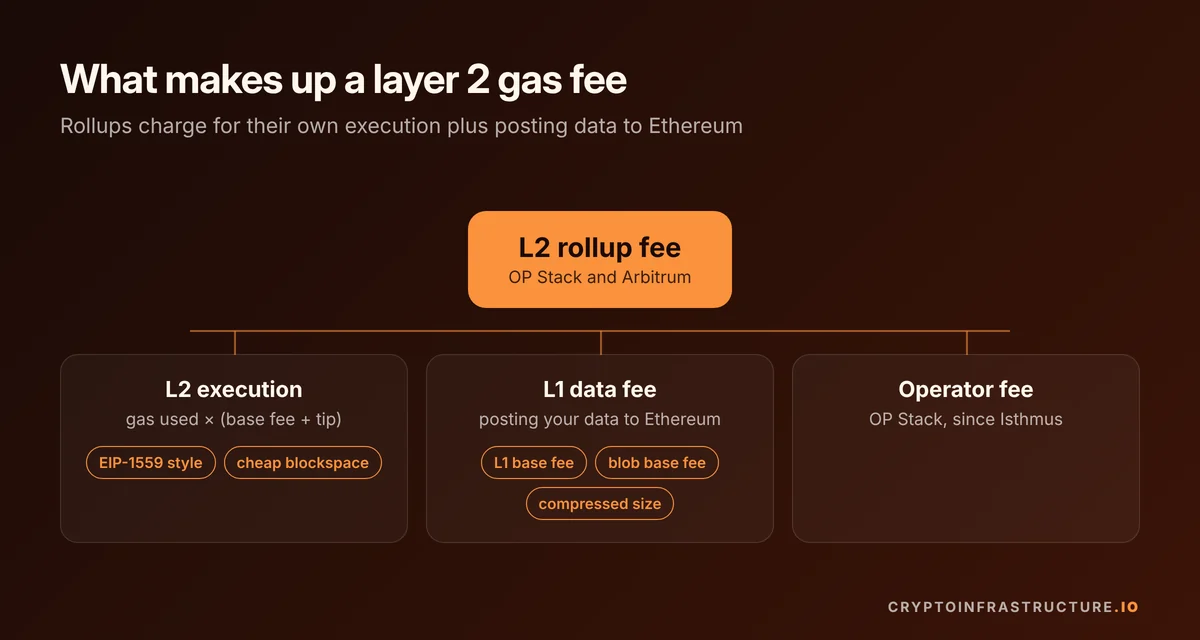
Layer 2 rollups run transactions off Ethereum’s main chain and then post the data back to Ethereum, so a rollup fee has two main parts: the cost of running your transaction on the L2 and your share of the cost of publishing data to Ethereum (L1).
OP Mainnet and other OP Stack chains
The Optimism fee documentation says fees are made up of an execution gas fee, an L1 data fee and, since the Isthmus upgrade, an operator fee:
Total fee = operator fee + gas used × (base fee + priority fee) + L1 data fee
- The execution part works like Ethereum’s: OP Mainnet uses the same EIP-1559 mechanism to set a base fee, just on far cheaper block space.
- The L1 data fee is based on an estimate of your transaction’s compressed size, priced using both Ethereum’s regular base fee and its blob base fee, weighted by scalars the chain operator sets.
Arbitrum
Arbitrum’s gas documentation describes the same split in its own terms: a parent chain (L1) component that covers posting your transaction’s data, estimated by compressing the transaction and applying a price per byte that is adjusted over time so collected fees track real posting costs, plus a child chain (L2) component that covers computation and storage. The L2 gas price has a floor set by the chain. Tips are ignored on Nitro chains unless the chain owner turns tip collection on; Arbitrum’s docs say Arbitrum One does collect them, sending 97% to the Arbitrum DAO treasury and 3% to the Arbitrum Developer Guild.
Why L2 fees are low and when they are not
Both Ethereum’s regular base fee and its blob base fee are inputs to the L1 data fee formula above. When either rises on Ethereum, the data part of your L2 fee rises with it, even if the L2 itself is quiet. Your L2 transaction is also ordered by the rollup’s sequencer, which affects how priority works there; see what a sequencer is.
On 14 October 2026, l2fees.info listed sending ETH at $0.09 on Optimism, $0.09 on Arbitrum One and $0.07 on zkSync Era, against $1.10 on Ethereum layer 1. The page shows no timestamp and its layer 1 figure is far higher than Etherscan’s estimate the evening before, so treat its numbers as a rough ranking, not a current price. growthepie also tracks per-chain L2 fees if you want a second view.
Ethereum, Solana and L2 fees side by side
| Ethereum (L1) | Solana | OP Stack / Arbitrum (L2) | |
|---|---|---|---|
| Unit of work | Gas | Compute units (plus a per-signature fee) | L2 gas plus L1 data size |
| Required fee | Base fee per gas, set per block by EIP-1559 | 5,000 lamports per signature | L2 base fee plus L1 data fee (plus an operator fee on OP Stack) |
| Optional fee | Priority fee (tip) | Prioritization fee (CU price × CU limit) | Priority fee; on Arbitrum only if tips are enabled |
| Burned | All of the base fee; all blob fees | 50% of the base fee | On the L1 side, whatever the rollup pays in base and blob fees to Ethereum |
| Paid in | ETH | SOL | ETH on these chains |
| Main driver of spikes | Demand for Ethereum block space | Contention on busy accounts and programs | Ethereum data costs, plus L2 demand |
Sources: ethereum.org gas docs, EIP-4844, Solana fee structure docs, Optimism and Arbitrum fee docs.
Which crypto has the lowest gas fee?
There is no permanent answer and pages that crown one network are usually describing a single moment or selling something. What the mechanics tell you: Solana’s required fee is fixed at 5,000 lamports per signature, so a plain transfer stays very cheap in SOL terms unless you add a priority fee. Ethereum layer 2s showed sends at under $0.10 on l2fees.info on 14 October 2026. Ethereum layer 1 can be cheap or expensive depending on demand; in October 2026 a plain transfer was around two cents by Etherscan’s estimate. In every case, the USD cost also moves with the price of the fee token. A cheaper network is not automatically the right one: check where your assets and the apps you need actually are and what bridging between them costs.
Common gas fee errors and what they mean
“Insufficient funds for gas” (for example on Base)
This means the account does not hold enough of the network’s fee token on that specific network. On Base and other Ethereum L2s, fees are paid in ETH on that L2, so ETH sitting on Ethereum mainnet or on a different L2 does not count. You need to move a small amount of ETH onto that same network first. Holding stablecoins or other tokens does not help, because they cannot pay the fee.
“Failed to estimate gas limit”
Wallets estimate the gas limit by simulating your transaction before you sign it. If the simulation fails, the wallet has no figure to show. Often the cause is that the transaction would fail if sent: not enough token balance, an expired quote, a missing approval or a contract that would reject the call. Forcing it through with a manual gas limit usually just produces a failed transaction and, as ethereum.org notes, gas spent on a failed transaction is not returned.
A transaction stuck as pending
If you set a max fee or tip too low and the base fee rose, your transaction can wait in the queue and every later transaction from the same account waits behind it. The fix is a replacement with the same nonce and a higher fee, which most wallets offer as “speed up” or “cancel”. The step-by-step version is in what a nonce is and how stuck transactions get unstuck.
How to pay less in gas fees
- Check a gas tracker first. On Ethereum, the base fee changes every block. Non-urgent transactions can wait for a quieter period.
- Use a lower max fee for non-urgent transactions. Your transaction only goes through when the base fee drops below it. The trade-off is that it may sit pending.
- Do small, frequent activity on a layer 2. The same action usually costs a small fraction of the layer 1 fee. Bridging to and from L1 still has costs and its own risks.
- Avoid unnecessary approvals and failed transactions. Each approval is a separate transaction and failed transactions still pay gas.
- Do not overpay tips by default. When the network is quiet, Etherscan’s own “standard” tier on 13 October 2026 used a tip of zero.
Gas fee mistakes and myths
- “Gas fees go to miners.” Not on Ethereum since 2022. The base fee is burned and the tip goes to a validator.
- “21,000 gwei is the minimum fee.” 21,000 is gas units for a transfer, not gwei. The fee is those units times the gas price.
- “A failed transaction is free.” It is not. The gas consumed up to the failure is charged.
- “Gas limit and gas price are the same thing.” The limit caps how much work you allow; the price is what you pay per unit.
- “Exchanges charge gas fees.” Trades inside a centralized exchange’s own books are not on-chain and have no gas fee. Withdrawals to a wallet are on-chain. Exchanges set their own withdrawal fees, which can differ from the live network fee.
What this means for you
If you are an occasional user, the two habits that matter most are holding a little of the native token on every network you use and checking the fee before you confirm, especially on Ethereum mainnet. If you are comparing networks, look at how each sets its fee (auction, fixed base or L1-linked) rather than a single quoted number, since that tells you how fees behave when demand jumps. If you build applications, gas costs are part of your users’ experience: smart wallets can let someone else pay the fee, which is covered in what account abstraction is.
For more on how these networks are built, read sidechains vs rollups vs L2s, or browse the rest of the Guides.