Restaking means taking crypto that already secures one network, usually staked ETH, and pledging it again to secure other services, called AVSs on EigenLayer. In return the restaked funds can earn extra rewards. They can also be slashed (partly destroyed) if the operator running them breaks a service’s rules. EigenLayer switched slashing on for mainnet on 17 April 2025. Liquid restaking tokens such as Kelp’s rsETH and Renzo’s ezETH wrap the whole thing in a tradable token, which adds smart contract, bridge and depeg risk on top. In October 2026 DefiLlama showed about $10.1 billion in restaking protocols, roughly $6.3 billion to $6.5 billion of it in EigenLayer (now branded EigenCloud).
Restaking gets explained as “earn twice on the same ETH”. That is the sales version. The engineering version is that the same deposit now carries two sets of promises, and if either set is broken, the deposit pays. This guide explains what restaking is, starting from plain staking. It covers how EigenLayer works (restakers, operators, AVSs, operator sets and unique stake), how Symbiotic and Karak differ, what liquid restaking tokens add plus the risks layer by layer, with the incidents that have already happened. Figures are snapshots with their date or period stated, not forecasts.
What is restaking?
Restaking is reusing assets that are already staked to secure a proof-of-stake blockchain so that they also secure other services at the same time. The restaker accepts extra slashing conditions from those services in exchange for extra rewards. On Ethereum, the main restaking protocol is EigenLayer, which lets staked ETH, liquid staking tokens and other tokens back “actively validated services” (AVSs) such as data availability layers, oracles and bridges.
The idea did not start on Ethereum. According to Galaxy Research, Polkadot experimented with shared security around 2020. Cosmos launched “replicated security” in May 2023. EigenLayer launched on Ethereum in June 2023.
First, what does staking mean in crypto?
Staking is locking a network’s token to take part in running it. ethereum.org defines it as “the act of depositing ETH to activate a validator, a participant in Ethereum’s consensus protocol.” Your own validator needs at least 32 ETH (and can hold up to 2,048 ETH); pooled and liquid staking services accept smaller amounts.
What is a validator in crypto?
A validator is the software and stake that take part in consensus. On Ethereum, validators propose new blocks, check other validators’ work and vote on which chain is correct. Going offline costs a small amount of ETH. Provable misbehaviour, such as signing two conflicting blocks, is slashed: part of the stake is destroyed and the validator is removed. That penalty is what makes staked ETH “security”. Restaking borrows exactly that idea and applies it to new services.
Staking vs liquid staking vs restaking vs liquid restaking
| Model | What you hold | What your asset secures | Who can penalise it |
|---|---|---|---|
| Staking | Locked ETH in a validator | Ethereum | Ethereum’s protocol rules |
| Liquid staking | A token such as Lido’s stETH or ether.fi’s eETH/weETH | Ethereum | Ethereum’s rules, plus the staking protocol’s contracts |
| Native restaking | A validator whose withdrawal address points to an EigenLayer EigenPod | Ethereum plus the AVSs your operator opts into | Ethereum and each AVS’s slashing rules |
| Liquid restaking | A liquid restaking token (LRT) such as rsETH or ezETH | Ethereum plus whatever the LRT protocol chooses | All of the above, plus the LRT’s contracts, bridges and market price |
Each row down the table adds a layer of promises. That is the whole risk story in one table. The sections below unpack it.
How does EigenLayer work?
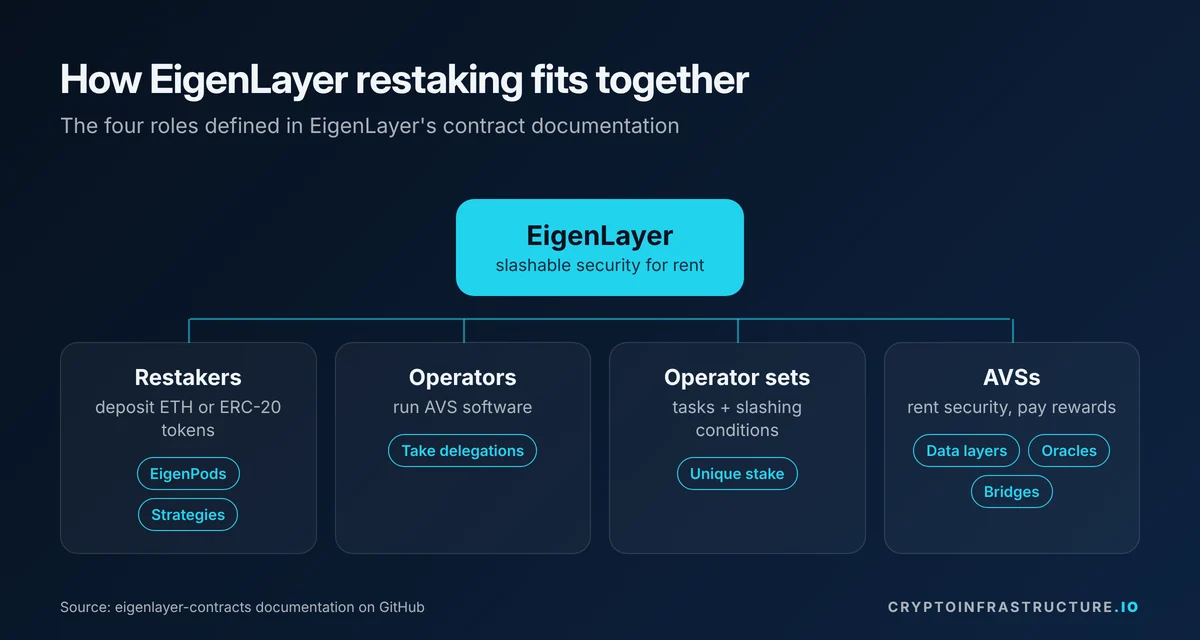
EigenLayer is a set of smart contracts on Ethereum that turns deposited assets into slashable security that other services can rent. Its contract documentation (the eigenlayer-contracts repository on GitHub) defines four roles:
- Restakers (stakers): “any party who has assets deposited (or ‘restaked’) into EigenLayer.” Assets can be native beacon chain ETH (through an EigenPod) or ERC-20 tokens through “strategies”. A strategy factory lets anyone deploy a strategy for a new ERC-20, so the set of restakable tokens is not limited to ETH.
- Operators: node operators who run AVS software and accept stake delegated to them. Restakers usually delegate rather than run AVS software themselves.
- AVSs (actively validated services): services that need their own validation, such as data availability layers, oracles or bridges, and that pay for security instead of building their own validator set.
- Operator sets: groups an AVS creates, each with its own tasks and slashing conditions. Operators choose which sets to join.
What does EigenLayer do, in one line?
It lets an AVS say “this operator’s allocated stake can be slashed if it breaks my rules” and lets restakers earn the AVS’s rewards for accepting that. Google’s AI Overview for “what does EigenLayer do” describes the reward half well and leaves the slashing half as a follow-up question. The slashing half is the part that decides what you can lose.
Slashing went live on 17 April 2025
For almost two years EigenLayer ran without slashing. Several of the pages that rank for “what is restaking” were written in that period, which is why they describe slashing as a future feature. Eigen Labs announced on 17 April 2025 that slashing “is now live on Mainnet”. Two design points matter:
- It is opt-in at the operator level. Slashing applies only when an operator allocates stake and registers to a slashable operator set. ELIP-002, the upgrade proposal, notes that stakers have no separate opt-in: their delegated stake becomes slashable when their operator allocates it. Your risk depends on what your operator chooses.
- Unique stake. An operator allocates a proportion (“magnitude”) of its delegated stake to a given operator set, and only that AVS can slash that slice. ELIP-002 explains the reason: under the earlier shared model, “an AVS sharing slashable stake could be inadvertently exposed to the risks of slashing by other AVSs.” Unique stake caps how far one AVS’s slash can spread.
Withdrawal delays and what happens to slashed funds
The contract documentation sets these mainnet parameters:
| Parameter | Mainnet value | What it means for you |
|---|---|---|
| Withdrawal delay | 100,800 blocks (14 days) | Queued withdrawals “remain slashable” for the whole delay, so leaving does not end your exposure at once. |
| Deallocation delay | 100,800 blocks (14 days) | Stake an operator removes from an AVS stays slashable by that AVS for 14 days. |
| Allocation configuration delay | 126,000 blocks (17.5 days) | Changes to an operator’s allocation settings, and to who can slash an operator set, take effect only after this wait. |
| Slashing execution | “Instant and irreversible” once triggered | There is no undo at contract level. |
| Slashed funds | Burned by default; “redistributing” operator sets send them to a recipient fixed at creation | Redistribution is not supported for native ETH. In a redistributing set, slashed funds go to someone, which creates an incentive to slash. |
None of these delays are guarantees about how a specific LRT handles withdrawals. A liquid restaking protocol adds its own queue on top.
Other restaking protocols: Symbiotic, Karak and beyond Ethereum
Symbiotic describes itself as “a collateral markets platform that brings enforceable economic guarantees onchain”. DefiLlama now lists it in a “Collateral Markets” category rather than Restaking. Its building blocks are vaults run by curators, applications (the services being secured) and operators. Slashing is set per vault when it is deployed. According to Symbiotic’s slashing documentation, a vault can use instant slashing, veto slashing (resolvers get a window to block a request) or no slashing. The vault’s “Burner” decides whether slashed collateral is burned, redistributed or sent to a treasury or insurance pool. The practical point: on Symbiotic, the risk you take depends heavily on which vault you choose.
Karak was described by Galaxy Research in 2024 as a “generalized” restaking protocol, accepting assets beyond ETH. DefiLlama lists it under Restaking with TVL on Ethereum, Arbitrum and its own Karak Network. Karak’s documentation could not be accessed, so its current slashing design is not described here.
Outside Ethereum, DefiLlama’s Restaking category also includes Babylon (Bitcoin staking) and small Solana programmes such as Jito Restaking and Solayer. If you are asking whether staking on Solana is risky, the same logic applies: plain staking carries the base chain’s penalties, and any restaking layer adds the new service’s rules on top.
Restaking TVL snapshot (October 2026)
| Protocol (DefiLlama) | Category on DefiLlama | TVL, October 2026 |
|---|---|---|
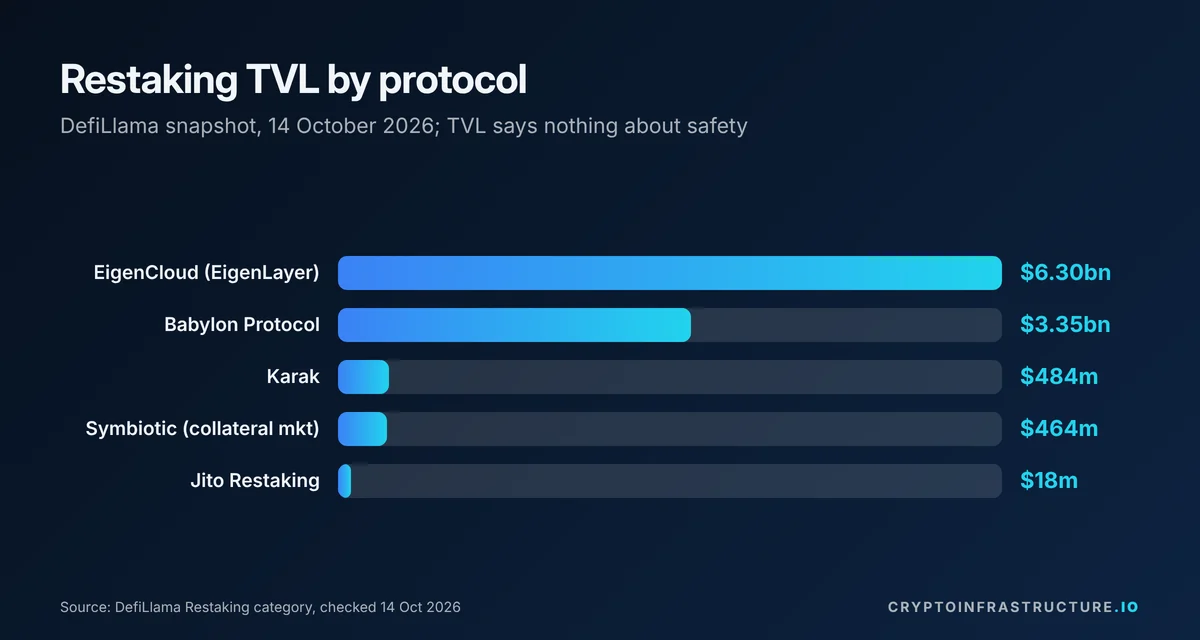
| All Restaking protocols | Restaking | About $10.13bn |
| EigenCloud (EigenLayer) | Restaking | About $6.30bn on the category page, $6.47bn on the protocol page |
| Babylon Protocol | Restaking | About $3.35bn |
| Karak | Restaking | About $484m |
| Symbiotic | Collateral Markets | About $464m |
| Jito Restaking / Solayer Restaking | Restaking | About $18m / $10.5m |
Source: DefiLlama Restaking category and protocol pages. TVL moves with token prices daily and says nothing about safety. For scale, Galaxy Research counted about $20.1bn in restaked assets on 25 June 2024, so the sector is well below its 2024 level.
Two measurement notes. DefiLlama’s category page and protocol page can count EigenLayer slightly differently (for example in which tokens or chains they include), which is why the two EigenLayer figures differ. Galaxy’s 2024 figure and DefiLlama’s TVL also use different methods, so treat the comparison as a rough indication of scale, not an exact change.
What are liquid restaking tokens (LRTs)?
A liquid restaking token is a receipt for restaked assets. You deposit ETH or a liquid staking token with an LRT protocol. It restakes the assets through EigenLayer or Symbiotic and chooses operators. You get a token you can trade or use as collateral. Kelp describes rsETH as “a Liquid Restaked Token (LRT) issued by Kelp DAO”. It says holders can exit either by swapping on DEXs for instant liquidity or by redeeming through its contracts.
| Liquid restaking (DefiLlama) | TVL, October 2026 |
|---|---|
| All Liquid Restaking protocols | About $1.33bn |
| Kelp (rsETH) | About $1.03bn |
| Renzo (ezETH) | About $116m |
| Mantle Restaking, Swell, Puffer, Bedrock, Mellow | Each under $41m |
ether.fi: the biggest name has stepped back from restaking
Many explainers still list ether.fi as the leading liquid restaking protocol. Its own staking documentation now says “eETH and weETH do not bundle additional restaking exposure” and calls eETH “a rebasing liquid staking token”. It describes restaking as a separate, optional product, weETHs, “built with weETH and the Symbiotic ecosystem.” In late September 2026, ether.fi CEO Mike Silagadze told CoinDesk the protocol would cut its remaining structural link to EigenLayer, leaving under 1% of its assets restaked. He said “there are no longer meaningful yield opportunities in the restaking space” (as republished by KuCoin and BingX news). If you hold weETH expecting restaking exposure, that is no longer what it is.
What are the risks of restaking?
The ranking explainers mostly list “slashing” and “smart contract risk” in a sentence each. Restaking risk is better read as layers: each layer you add keeps every risk below it.
| Layer | Risk | How it shows up | Documented example or mechanism |
|---|---|---|---|
| Base staking | Ethereum penalties and slashing | Validator offline or double-signing | Ethereum protocol rules (ethereum.org) |
| Restaking protocol | AVS slashing | Operator breaks an AVS’s rules or has a software fault; slash is instant and irreversible | EigenLayer slashing live since 17 April 2025 |
| Restaking protocol | Correlated slashing | One operator error or shared software bug hits many services, or many operators, at once | Unique stake limits spread between AVSs but not a fault shared by operators running the same client |
| Restaking protocol | Smart contract and upgrade risk | Bug in EigenLayer, Symbiotic or vault contracts; admin keys change parameters | Delays on allocation and slasher changes (17.5 days) are a partial safeguard |
| LRT protocol | Depeg | LRT trades below the value of its backing on DEXs | Renzo ezETH, 24 April 2024 |
| LRT protocol | Bridge and cross-chain risk | LRT copies on other chains fail if the bridge is fooled | Kelp DAO rsETH bridge exploit, 18 April 2026 |
| Exit | Liquidity and withdrawal delay | 14-day EigenLayer queue, plus the LRT’s own queue; DEX liquidity can be thin | Queued withdrawals remain slashable |
| DeFi use | Leverage and liquidation | LRT used as collateral to borrow ETH and “loop”; a small depeg triggers liquidations | Gearbox and Morpho liquidations in the ezETH depeg |
Incident 1: Renzo ezETH depeg, 24 April 2024
Early on 24 April 2024, Renzo’s ezETH fell as low as $750 on Uniswap, about 0.27 WETH, CoinDesk reported. Holders were selling to move into other restaking platforms amid anger over Renzo’s token allocation. Thin DEX liquidity amplified the fall. Users who had borrowed against ezETH were liquidated on Gearbox and Morpho. The price recovered within hours. Nothing was hacked; the lesson is that an LRT is only worth its backing if you can actually reach the backing. The market can price it far lower in the meantime.
Incident 2: Kelp DAO rsETH bridge exploit, 18 April 2026
On 18 April 2026 an attacker forged a LayerZero cross-chain message claiming 116,500 rsETH had been burned on another chain. The Ethereum side released about $290 million worth. Rekt’s analysis describes the configuration as “one required DVN. No optional DVNs”, a single verifier; Kelp DAO and LayerZero dispute who was responsible for that setup. The attacker deposited rsETH on Aave and borrowed WETH, pushing WETH pools to 100% utilisation, with estimated Aave bad debt of about $124 million to $230 million. Kelp paused rsETH contracts across mainnet and several L2s. None of this involved EigenLayer slashing. It was the LRT and bridge layers failing. It spread to lenders who never held rsETH. The site’s DeFi explainer covers how that contagion played out.
What are the downsides of staking compared with restaking?
Plain staking has two main downsides: penalties and slashing under the chain’s own rules, plus lock-up or queue time when you exit (and contract risk if you use a liquid staking token). Restaking keeps all of that and adds AVS slashing, operator choice, longer exit paths plus, through an LRT, depeg, bridge and leverage risk. Restaking rewards are paid by AVSs and protocols and change over time. None of the sources reviewed publishes a guaranteed rate, and this guide does not quote one.
Is restaking safe?
No restaking setup can be called safe. Questions that narrow the risk: Which operator holds your stake, and which operator sets has it allocated to? Are those sets slashable, and are any of them redistributing? What are the exit queues at each layer? Does the LRT rely on a bridge, and how many verifiers does that bridge require? Is the LRT widely used as collateral, so that a depeg would trigger liquidations? Has the protocol had an incident, and how did it respond?
Why does restaking exist at all?
A new service that needs validators, such as an oracle or a data layer, normally has to launch its own token and validator set. Its security is then only as large as that token’s value. Restaking lets it rent security from assets already staked on Ethereum. Consensys researchers framed this in 2024 as pooled security: a market where operators pick services based on reward versus risk. The trade-off, raised by Galaxy Research, is that slashing and stake concentration at the restaking layer can feed back into the base chain. The site’s guide to who owns Ethereum covers how stake and validators are distributed today.
What this means for you
Restaking is a way to make staked assets back more than one set of promises. If you are evaluating it, treat each layer as a separate decision: the operator and its allocations, the restaking protocol’s slashing design, the LRT’s contracts and bridges plus how you would exit in a stressed market. Confirm the delays and TVL figures above on the source before relying on them, because the sector has changed fast, from slashing going live in April 2025 to the Kelp DAO exploit in April 2026 and ether.fi moving its main tokens away from restaking in 2026. If you are building wallets or apps that hold restaked tokens, the same layering applies to smart accounts; the guide to account abstraction covers that side.
For how this site researches and dates its claims, read the methodology. Find more plain-English explainers in Guides.
This guide is general information, not investment advice. Restaking can lose you money through slashing, depegs and exploits; nothing here is a recommendation to use any protocol. See the site’s disclaimer.