Nobody owns Ethereum. It has no company, CEO or shareholders, and protocol changes go through an open proposal process (EIPs) that client developers implement and node operators choose to run. The non-profit Ethereum Foundation funds research and grants but, in its own words on ethereum.org, does not control the network. What can be owned is ETH, the token. As of 14 October 2026, Lido is the largest staking entity at 21.5% of staked ETH, Bitmine is the largest corporate holder at 6.03 million ETH (per its own SEC filing), BlackRock’s ETHA trust holds 3.45 million ETH, and Vitalik Buterin’s attributed holdings are about 224,000 ETH, an estimate from on-chain analytics, not a disclosure.
Ask “who owns Ethereum?” and you get two different questions folded into one. The first is about control: who can change the rules, shut it down or take a cut. The second is about ETH, the token: who holds the most of it. Most pages that rank for this answer neither well. Some are biographies of Vitalik Buterin from 2018 or 2019, and the big “rich lists” call the deposit contract’s balance “staked ETH” when roughly half of that total is no longer staked.
This guide separates the two questions, explains how Ethereum is actually governed, and lists the largest holders from their own filings, holdings pages and labelled on-chain addresses. All figures were checked on 14 October 2026 unless another date is given. There is no price talk here: amounts are in ETH, not dollars.
Who owns Ethereum? The short answer
No person, company or foundation owns Ethereum. It is an open-source network run by independent node operators and validators around the world. ethereum.org puts it plainly: Ethereum “has no CEO, board, or single controlling party”, and no one person or organisation can change its rules or shut the network down alone (page last updated 21 July 2026).
What people can own is ETH, the network’s native token, used to pay transaction fees and to stake as a validator. Owning ETH, even a lot of it, gives you no vote on protocol changes, no equity and no claim on any company. That is the key difference from owning shares in a business.
Who created Ethereum?
Ethereum was founded by Vitalik Buterin, who conceived it in late 2013, according to ethereum.org. The same page says Ethereum had eight co-founders, with Gavin Wood and Joseph Lubin among those who joined later. The eight are usually listed as Vitalik Buterin, Gavin Wood, Joseph Lubin, Anthony Di Iorio, Mihai Alisie, Amir Chetrit, Charles Hoskinson and Jeffrey Wilcke.
- Crowdsale: July to August 2014, raising 31,000 BTC (about $18 million at the time) in exchange for ETH, per ethereum.org.
- Launch: the network went live on 30 July 2015 with the genesis block.
- Proof of stake: The Merge, completed in the Paris upgrade on 15 September 2022, replaced mining with staking.
Founding Ethereum did not make anyone its owner. Several co-founders left early to start other projects (Gavin Wood went on to Polkadot and Parity, Charles Hoskinson to Cardano, Joseph Lubin to Consensys), and Ethereum kept running.
Who controls Ethereum? How decisions are actually made
Control over Ethereum is spread across several groups, and none of them can force a change on the others. ethereum.org’s governance page describes the process as offchain: decisions happen through public discussion and are then written into software, rather than through a token vote (page last updated 6 June 2026).
The EIP process
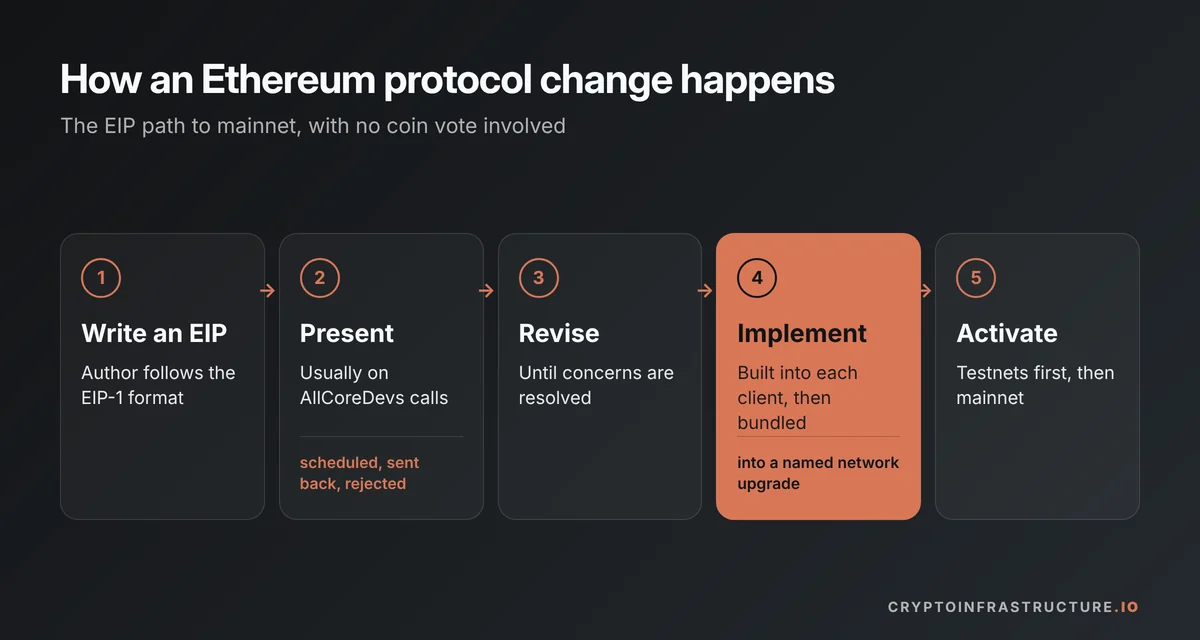
Every protocol change starts as an Ethereum Improvement Proposal (EIP), a public technical specification anyone can write. The path to mainnet, per ethereum.org:
- An author writes a Core EIP following the format set out in EIP-1.
- The proposal is presented to protocol developers, usually on the public AllCoreDevs calls. It can be scheduled, sent back for changes or rejected.
- The author revises it until concerns are resolved. Discussion also runs on Ethereum Magicians and ethresear.ch.
- Accepted EIPs are implemented and tested in each client, then bundled into a named network upgrade, because everyone has to upgrade at the same time.
- The upgrade activates on testnets first, then on mainnet.
Who has a say
| Group | What they control | What they cannot do |
|---|---|---|
| Client development teams (core developers) | What code gets written and shipped in the independent client implementations | Make anyone install it |
| Node operators and validators | Which software they actually run, so which upgrade goes live | Change the rules alone; a minority that refuses an upgrade ends up on a separate chain |
| EIP authors | What gets proposed | Get it accepted without support |
| ETH holders, app developers and users | Social pressure, and which chain they treat as “Ethereum” after a split | Vote on-chain on protocol changes; there is no coin vote |
| Ethereum Foundation | Funding, research, grants, coordination | Control the network (ethereum.org’s own wording) |
ethereum.org notes that protocol developers generally avoid shipping EIPs “where the contentiousness outweighs the benefits”, and that there is no single metric, such as a coin vote, that measures community consensus. The ultimate check is the ability to fork. After the 2016 DAO hack, most of the community moved to a forked chain that reversed the theft. People who disagreed kept running the original chain, which became Ethereum Classic. ethereum.org says the community now follows a policy of not intervening over contract bugs or lost funds.
Does Vitalik Buterin control Ethereum?
Not formally. He has no veto, no admin key and no special vote in the EIP process. He does have a lot of informal influence: he wrote the original design, still publishes research that shapes the roadmap, and is one of the most followed voices in the ecosystem. Whether that soft influence is too large is a real, ongoing debate among Ethereum developers. But he could not stop the network or push through a change that client teams and node operators reject.
What the Ethereum Foundation does (and how much it holds)
The Ethereum Foundation (EF) is a Swiss non-profit. ethereum.org describes its job as managing funds for development, giving grants, organising events and education, and coordinating research, and says: “While important, it does not control the network.”
Its latest published treasury figures come from the EF Report 2024, as of 31 October 2024:
| Item (as of 31 October 2024) | Figure |
|---|---|
| Total treasury | About $970.2 million |
| Crypto holdings | $788.7 million (81.3%), of which 99.45% in ETH |
| Non-crypto investments and assets | $181.5 million (18.7%) |
| Spending, 2022 | $105.4 million |
| Spending, 2023 | $134.9 million |
Source: Ethereum Foundation, EF Report 2024 (checked 14 October 2026). The report gives values in US dollars, not an ETH count. No newer treasury report was listed on ethereum.foundation on 14 October 2026.
In a treasury policy post dated 4 June 2025, the EF said it targets annual operating spending of 15% of its treasury and keeps a buffer of 2.5 years of operating runway. Its treasury is spread across many addresses and off-chain assets, so use the published report, not any single wallet, to judge the EF’s size.
Who runs Ethereum’s validators?
Since The Merge, blocks are proposed and attested by validators that lock up ETH. The hildobby ETH staking dashboard on Dune showed 43,998,878 ETH staked across 1,374,965 validators when checked on 14 October 2026 (dashboard last refreshed two days earlier). The largest staking entities it identifies:
| # | Entity | Type | ETH staked | Share of staked ETH |
|---|---|---|---|---|
| 1 | Lido | Liquid staking protocol | 9,493,855 | 21.5% |
| 2 | Binance | Exchange | 3,273,297 | 7.4% |
| 3 | ether.fi | Liquid restaking protocol | 1,741,076 | 3.9% |
| 4 | Kraken | Exchange | 1,649,935 | 3.7% |
| 5 | Coinbase | Exchange | 1,517,185 | 3.4% |
| 6 | Figment | Staking provider | 1,316,051 | 3.0% |
| 7 | Blockdaemon | Staking provider | 1,071,713 | 2.4% |
| 8 | Kiln | Staking provider | 827,533 | 1.9% |
| 9 | Everstake | Staking provider | 803,648 | 1.8% |
| 10 | Upbit | Exchange | 643,008 | 1.5% |
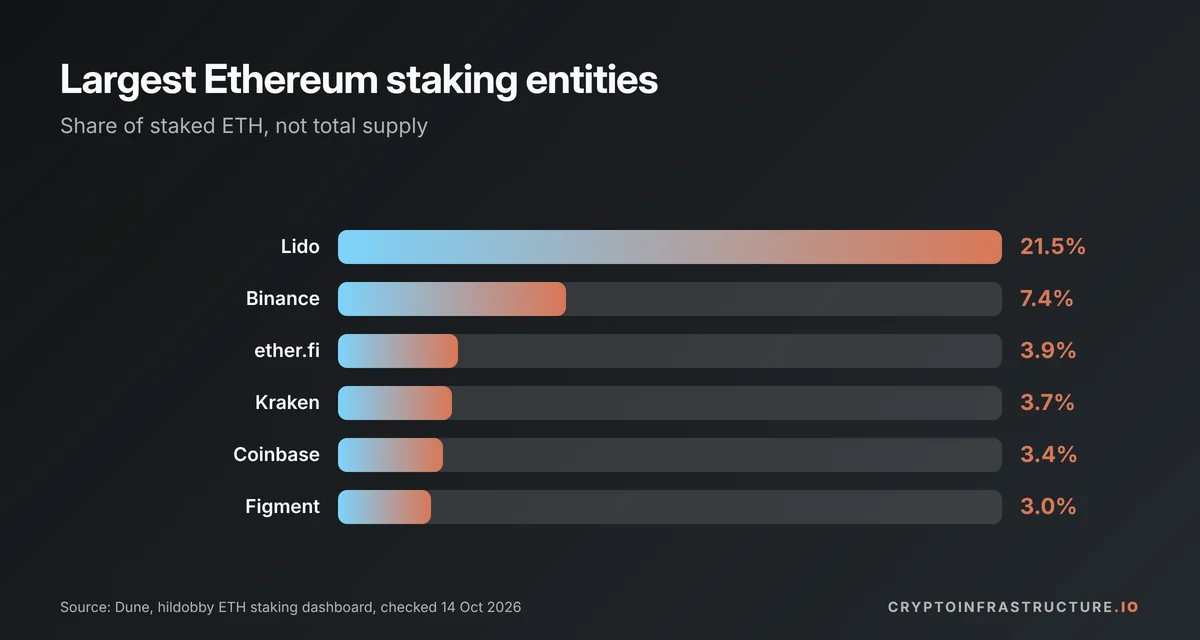
Source: Dune, hildobby “Ethereum ETH Staking” dashboard (checked 14 October 2026). Shares are of staked ETH, not of total supply. Entity labels are the dashboard author’s, based on known deposit addresses.
Three things to keep in mind when reading this table:
- An entity is not one owner. Lido’s 21.5% is ETH deposited by many separate users through one protocol. Exchange staking is mostly customer ETH.
- Labels miss some big stakers. Bitmine says in its 8-K filed 13 October 2026 that it has 5,067,309 ETH staked through its own MAVAN platform and partners, yet it does not appear under its own name in the dashboard’s top entities. Large holders often stake through operators such as those listed above, so the operator gets the label.
- Why concentration matters. If one entity ran a third or more of all staked ETH, it could disrupt finality; past half, it could have a large say over which blocks become canonical. No single entity is near those levels on this data, but the combined share of the top few is the number to watch.
Who owns the most Ethereum (ETH)?
Total supply was 122,128,910.53 ETH on Etherscan’s supply page on 14 October 2026. Here are the largest holders, each from the best source available for that type of holder:
| Holder | Type | ETH | As of | Source |
|---|---|---|---|---|
| Beacon Deposit Contract | Protocol contract (not an owner) | 91,993,057 (cumulative deposits) | 14 Oct 2026 | Etherscan |
| Bitmine Immersion Technologies | Public company treasury | 6,028,946 | 11 Oct 2026 | SEC Form 8-K |
| iShares Ethereum Trust (ETHA), BlackRock | Spot ETF | 3,453,884 | 12 Oct 2026 | iShares holdings page |
| Coinbase | Exchange (mostly customer funds) | About 3.85 million | 29 Sep 2026 | Arkham research |
| Binance | Exchange (mostly customer funds) | About 3.65 million | 29 Sep 2026 | Arkham research |
| Wrapped Ether (WETH) contract | Token contract (not an owner) | 2,049,113 | 14 Oct 2026 | Etherscan |
| Upbit | Exchange | About 1.62 million | 29 Sep 2026 | Arkham research |
| Base and Arbitrum bridges | Layer 2 bridge contracts | About 777,000 and 729,000 | 29 Sep 2026 | Arkham research |
| Fidelity Custody | Custodian | About 558,000 | 29 Sep 2026 | Arkham research |
Sources: Etherscan address and supply pages, iShares ETHA holdings page, Bitmine 8-K filed 13 October 2026, Arkham “Top ETH Holders” research dated 29 September 2026 (all checked 14 October 2026).
The deposit contract is not “75% of ETH staked”
The single biggest balance on Ethereum sits in the Beacon Deposit Contract, which Etherscan showed at 91,993,057 ETH on 14 October 2026. Several ranking pages and Google’s AI Overview describe this as ETH “locked to secure the network”, with one analytics report calling it about 75% of supply. That reads the number wrong.
Validators join by sending ETH into this contract, but since the Shanghai/Capella upgrade, withdrawals are paid out by the consensus layer to each validator’s withdrawal address, as ethereum.org’s withdrawals page explains. They do not flow back out through the contract. So its balance is a running total of everything ever deposited. The amount actually staked was about 44.0 million ETH on the Dune data above, roughly 36% of supply. Nobody “owns” the contract balance either; it is protocol plumbing.
Exchanges and ETFs hold other people’s ETH
Exchange balances are mostly customer deposits, not the exchange’s own money. Etherscan labels some of these wallets publicly: for example, the address tagged “Binance 7” with the label “Cold Wallet” held 1,996,008 ETH on 14 October 2026. Exchange totals such as Arkham’s come from grouping many such addresses, so treat them as estimates.
Spot ETFs work the same way. ETHA’s own holdings page lists 3,453,883.91 ETH as of 12 October 2026, held for the trust’s shareholders. BlackRock also runs a separate staked Ethereum trust (ETHB), which is not included in that figure.
Corporate treasuries
Bitmine Immersion Technologies is the largest company holder on public record. Its 8-K filed with the SEC on 13 October 2026 reports 6,028,946 ETH as of 11 October 2026, which it says is 4.9% of supply, with 5,067,309 ETH staked. These are the company’s own reported figures. Its stated goal is to reach 5% of supply. Owning that much ETH gives Bitmine staking income and influence as a large validator operator, but no formal say in the EIP process.
How much Ethereum does Vitalik Buterin own?
There is no official figure. Buterin does not publish his holdings, so every number you see is an on-chain estimate. The most cited one is from Arkham, which attributes about 224,000 ETH to Buterin’s known wallets as of May 2026, and says it was about 330,000 ETH in 2021. Arkham notes the real total could be higher because of wallets it cannot link to him.
Some caveats before you rely on any figure:
- His public ENS address, vitalik.eth, held only about 5.77 ETH on Etherscan on 14 October 2026. The larger amounts are spread across other addresses that analytics firms attribute to him.
- Attribution is inference from transaction patterns, not proof of ownership. Funds sent to grants or charity can still sit in wallets labelled as his.
- Older figures you may find (350,000 ETH in a 2019 CryptoSlate analysis, or net-worth estimates in the tens of billions on some exchange blogs) are either out of date or inconsistent with on-chain data.
Arkham’s 29 September 2026 report also attributes about 133,000 ETH to Joseph Lubin and about 116,000 ETH to Jeffrey Wilcke, and lists early buyer Rain Lohmus at 250,000 ETH that he reportedly cannot access after losing his keys. The same caveats apply: these are attributions, not disclosures.
Common mistakes on “who owns Ethereum” pages
Among the pages reviewed for this guide (checked 14 October 2026), these errors came up most:
- Calling the deposit contract balance “staked ETH”. It counts all deposits ever made; actual staked ETH is about half of it.
- Describing ETH as mined. One top-ranking page still explains mining rewards. Ethereum has used proof of stake since 15 September 2022.
- Treating net-worth estimates as fact. One page gives two contradictory figures for Buterin’s holdings within the same article. Without a dated source and address list, a number is a guess.
- Stale corporate rankings. Treasury-company holdings change weekly. Lists from 2025 are out of date; Bitmine’s own filings put it at 6.03 million ETH as of 11 October 2026.
What this means for you
If you came here wondering whether someone can switch Ethereum off or take it over: no single owner exists, and changing the protocol takes agreement across client developers, validators and node operators, with forking as the last resort. The real concentration questions are practical ones: how much staking runs through a handful of providers, and how much ETH sits with exchanges, ETFs and treasury companies that hold it for others. Those numbers change weekly, so check the dated sources above rather than any list, including this one, that is more than a few weeks old.
For how validators and node infrastructure are run in practice, see blockchain API and RPC node providers. For how institutions hold large crypto balances, read institutional crypto custody. Related explainers include what sharding is and how Ethereum scales today and what DeFi is, and you can browse more in Guides. How this site sources and dates its figures is set out in the methodology.


