Coinbase vs Gemini has no single winner. As of 14 October 2026, the two differ in ways that matter to different users. On published entry-tier fees, Coinbase Advanced (0.50% maker, 0.90% taker in the US) costs less than Gemini ActiveTrader (0.60% maker, 1.20% taker), which reverses what most comparison pages say. Gemini publishes a longer run of independent SOC 1 and SOC 2 reports and serves all 50 states, but most of its US customers are now held by Gemini Moonbase, LLC, a Florida money transmitter, not its New York trust company.
Gemini is also shrinking: it announced an exit from the UK, EU and Australia in February 2026, and its assets on platform fell from $18.2 billion to $8.4 billion in the year to 30 June 2026. Coinbase is larger and licensed across the EU under MiCA, but carries the heavier record of anti-money-laundering fines and a 2025 insider data theft. Neither publishes a Merkle-tree proof of reserves, and neither publishes insurance terms that cover your individual account.
If you are choosing between Coinbase and Gemini, you have probably read that Gemini is the cheaper, more security-focused option and Coinbase the bigger one with more coins. Some of that is out of date. Both exchanges changed their fee schedules in 2026, Gemini moved most US accounts to a different legal entity in 2025, and both companies now file quarterly reports with the SEC that say more than their marketing pages do.
This comparison puts the two side by side on the criteria in this site’s methodology: licences by region, proof of reserves and audits, custody and insurance as each company states it, dated fees with a worked example, where you can use each one, and every incident and enforcement action found. It does not pick a winner. It shows you which one fits which kind of user, and why.
Coinbase vs Gemini: the short answer
Coinbase and Gemini are both US-regulated, US-listed crypto exchanges, and both serve customers in New York. As of 14 October 2026, Coinbase has the lower published entry-tier trading fees, the broader regulatory footprint outside the US, and the larger balance sheet. Gemini has the longer published series of independent control reports, availability in all 50 states, and a New York trust company behind its custody product. Gemini’s record is dominated by the 2022 collapse of its Earn lending programme; Coinbase’s by anti-money-laundering failures and a 2025 data theft. Which matters more depends on where you live, how you trade and what you want protected.
Side-by-side: Coinbase vs Gemini at a glance
Each row summarises evidence set out in the sections below. Read the section before relying on any one cell.
| Criterion | Coinbase | Gemini |
|---|---|---|
| US operating entity | Coinbase, Inc. (NMLS 1163082) | Gemini Moonbase, LLC for most US users (NMLS 2403509); Gemini Trust Company, LLC for New York and Idaho (NMLS 1518126) |
| New York status | Virtual currency licence 122466 and money transmitter licence; separate NY-chartered custody trust company | Gemini Trust Company is a NYDFS-chartered limited purpose trust company |
| Outside the US | MiCA licence from Luxembourg’s CSSF, June 2025, covering the EU | Wind-down of UK, EU and Australia announced 5 February 2026; Singapore licence held |
| Proof of reserves | No Merkle-tree proof found; states it holds assets 1:1 | No Merkle-tree proof found; states customer funds are held 1:1 and segregated |
| Independent reports | Annual financial statement audit; quarterly SEC filings | SOC 1 Type 2 and SOC 2 Type 2 for each year to 30 September 2025; audited financials; quarterly SEC filings |
| Entry-tier advanced trading fee (US) | 0.50% maker, 0.90% taker (from 16 September 2026) | 0.60% maker, 1.20% taker (schedule dated 1 September 2026) |
| Instant buy fee | Variable, shown before you confirm, plus spread | Variable, shown before you confirm, plus spread |
| US state coverage | Licence table lists 45 states plus DC and Puerto Rico; five states not listed | All 50 states |
| Biggest incident | 2025 insider data theft; Coinbase estimated $180 million to $400 million in costs | 2022 Earn freeze; NYDFS settlement in 2024 returned at least $1.1 billion |
| Largest penalty found | $50 million NYDFS penalty (2023), plus $50 million compliance spend | $37 million NYDFS penalty (2024), plus $40 million contribution |
All entries checked 14 October 2026 against each exchange’s licence, fee and help pages, its latest quarterly report to the SEC, and regulator releases.
How this comparison works
The criteria come from the site’s methodology: track record, transparency, security practices, pricing clarity and jurisdiction coverage. For an exchange comparison they translate into six checks, applied to both exchanges in the same order:
- Licences and regulators by region, from each exchange’s own licence pages and its SEC filings
- Proof of reserves and audits, including what each company reports to the SEC
- Custody and insurance, labelled as company statements unless an independent document backs them
- Fees, from each exchange’s own fee page with the date it shows, and a worked example at $100 and $10,000
- Asset and state availability
- Incident and enforcement history, dated and sourced
There was no hands-on testing, and neither exchange paid to be included. There are no affiliate links on this page. The same structure is used for the other exchange comparisons in this series.
Licences and regulators by region
Both exchanges are regulated, but through different companies in different places. The table shows which entity serves you and who supervises it.
| Region | Coinbase | Gemini |
|---|---|---|
| United States (federal) | Coinbase Derivatives, LLC is a CFTC-registered designated contract market | Gemini Trust Company and Gemini Moonbase are registered money services businesses with FinCEN. Gemini Titan, LLC holds a CFTC designated contract market licence for its prediction markets. |
| US states | Coinbase, Inc. lists money transmitter licences in 45 states plus DC and Puerto Rico. Its Indiana, Louisiana, Tennessee and Virginia licences do not cover virtual currency. California, Hawaii, Massachusetts, Montana and Wyoming are not in the table, and the page does not say why. | Gemini says it holds money transmitter licences “or the statutory equivalent in all U.S. states requiring such licenses” (10-Q, 30 June 2026). Gemini Moonbase is a Florida-based licensed money transmitter. |
| New York | Coinbase, Inc. holds New York virtual currency licence 122466 and money transmitter licence MT 103755. Coinbase Custody Trust Company, LLC is a NYDFS-chartered limited purpose trust company. | Gemini Trust Company, LLC is a NYDFS-chartered limited purpose trust company. It serves customers in New York and Idaho and institutional accounts that need a qualified custodian. |
| European Union | MiCA crypto-asset service provider licence from Luxembourg’s CSSF, granted 20 June 2025 (Yahoo Finance, 24 June 2025) | Wind-down of EU operations announced 5 February 2026. Its Malta-licensed EU subsidiary no longer offers its tokenised securities product. |
| United Kingdom | Not listed on Coinbase’s US licence page; not verified for this article | Wind-down announced 5 February 2026 |
| Australia | Not verified for this article | Wind-down announced 5 February 2026 |
| Singapore | Not verified for this article | Gemini says its foreign subsidiaries hold required licences, “including from the Monetary Authority of Singapore” |
Checked 14 October 2026 on Coinbase’s licences page, Gemini’s legal and support pages, and Gemini’s 10-Q for the quarter to 30 June 2026. Non-US Coinbase permissions beyond the EU are covered in the Coinbase safety review.
Which Gemini company holds your account?
This is the point most comparisons miss. Gemini’s reputation rests on its New York trust charter, but since 21 May 2025 most US customers have been moved from Gemini Trust Company, LLC to Gemini Moonbase, LLC, depending on their state. Gemini’s own FAQ describes Moonbase as “a Florida-based entity licensed as a money transmitter in the states where it operates”, while the trust company “operates under New York law as a licensed limited purpose trust company”. Customers in New York and Idaho stay with the trust company, and the Gemini Custody product remains with it.
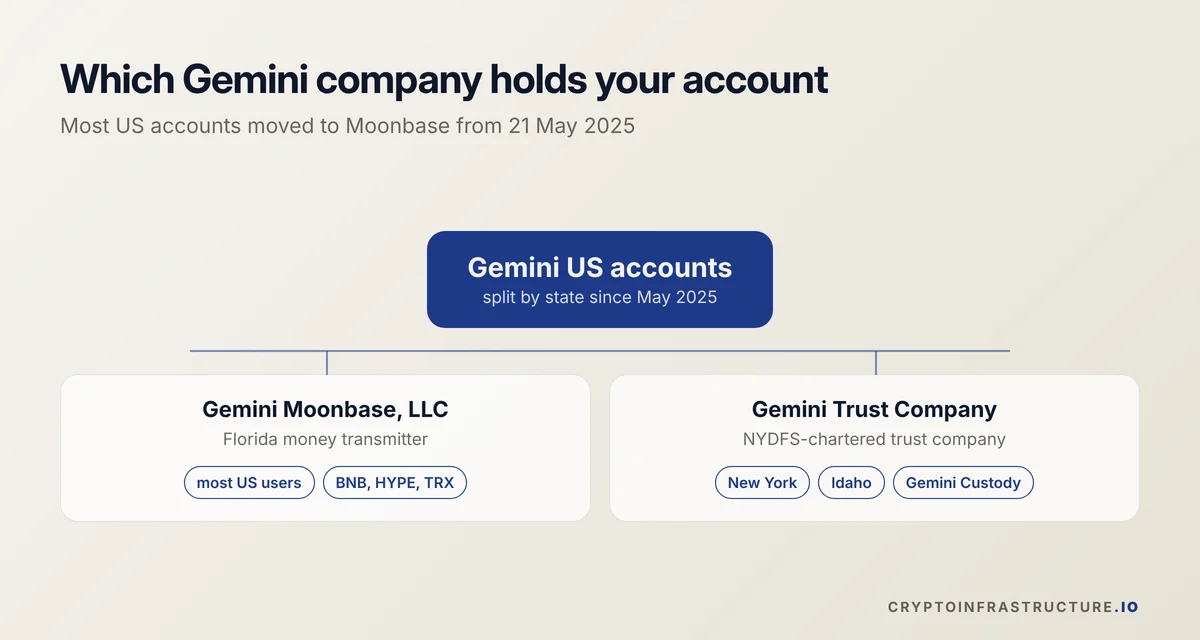
Gemini says the move changed nothing about how you buy, sell or store crypto. The new user agreement does, however, set out “distinctions between omnibus and segregated accounts” and says your rights and protections depend on your jurisdiction. If you hold crypto on Gemini outside New York, read the Moonbase user agreement rather than assuming trust company rules apply to you. Some assets on Gemini’s list, such as BNB, HYPE, TRX and WLFI, are only offered to Moonbase customers.
Proof of reserves, audits and what the SEC filings show
Neither exchange publishes a Merkle-tree proof of reserves, the kind that lets you check your own balance is included. Both point to audits and public filings instead. Since Gemini’s 2025 listing, both companies file quarterly 10-Q reports with the SEC, which makes a like-for-like comparison possible.
| Item | Coinbase | Gemini |
|---|---|---|
| Merkle-tree proof of reserves | None found on Coinbase’s security page | None listed in Gemini’s Trust Center |
| Company statement on reserves | “We hold our customers’ assets 1:1”; audited annually by an independent third party | “All customer funds held on Gemini are held 1:1 and available for withdrawal at any time”; digital assets held in accounts segregated from Gemini’s own |
| Independent control reports | Not checked for this article | SOC 1 Type 2 and SOC 2 Type 2 exams for every year from 2019 to 30 September 2025; Gemini’s Trust Center names Deloitte |
| Customer custodial (fiat) funds, 30 June 2026 | $4.30 billion | $454.7 million |
| Net loss, quarter to 30 June 2026 | $359.5 million | $107.7 million |
| Net loss, six months to 30 June 2026 | $753.6 million | $216.7 million |
| Assets on platform | Not compared (Coinbase reports a different metric) | $8.4 billion at 30 June 2026, down from $18.2 billion a year earlier |
From each company’s 10-Q for the quarter to 30 June 2026 (Coinbase filed 30 July 2026, Gemini filed 13 August 2026) and each company’s security or trust page, checked 14 October 2026.
Is Gemini losing money?
Yes, as a company. Gemini Space Station, Inc. reported a net loss of $107.7 million for the quarter to 30 June 2026 and $216.7 million for the first half of the year. Its quarterly trading volume was $3.8 billion, against $11.3 billion a year earlier. Coinbase also reported a loss for the same quarter, of $359.5 million. A company loss does not mean customer assets are missing; both state that customer assets are held 1:1 and separately. It does tell you about the business you are trusting with your balance, and Gemini’s filing shows it shrinking in 2026.
Custody and insurance: what each company says
These points are company statements from user agreements, help pages and SEC filings. None has been tested by an exchange insolvency in court.
Coinbase
- Ownership: the US user agreement (last updated 22 July 2026) says “Title to Supported Digital Assets shall at all times remain with you and shall not transfer to Coinbase.”
- Lending: its security page says Coinbase “doesn’t lend or take any action with your assets without your permission.”
- FDIC: “Coinbase is not an FDIC-insured bank.” Your US dollar balance may get pass-through FDIC cover if a partner bank fails. Your crypto does not; the agreement says digital assets are not protected by the FDIC or SIPC.
- Insurance: Coinbase’s security page does not mention insurance, and its insurance help article did not load on 14 October 2026. The Coinbase safety review sets out what its crime policy and Account Protection cover and exclude.
Gemini
- Cold storage: Gemini’s 10-Q says “the overwhelming majority of digital assets on our platform are held in cold storage.” It gives no percentage.
- Segregation: the Trust Center says customer digital assets and fiat are held in accounts segregated from Gemini’s own, and that Gemini does not act on them without your authorisation.
- Insurance: Gemini’s Moonbase FAQ refers to its “Digital Asset Insurance” but the pages checked give no amount or terms. Its 10-Q is blunter: “Our insurance coverage for such malfeasance is limited and may not cover the extent of loss nor the nature of such loss.” It also discloses that it pledged 623 bitcoin, worth $36.5 million at 30 June 2026, as collateral to insurance providers in connection with its money transmitter licence requirements.
Some ranking pages quote specific insurance totals for both exchanges. Those figures did not appear in either company’s pages or SEC filings checked for this article, so they are left out here. The practical point is the same for both: no policy found insures your individual account against theft or account takeover.
Coinbase vs Gemini fees (checked 14 October 2026)
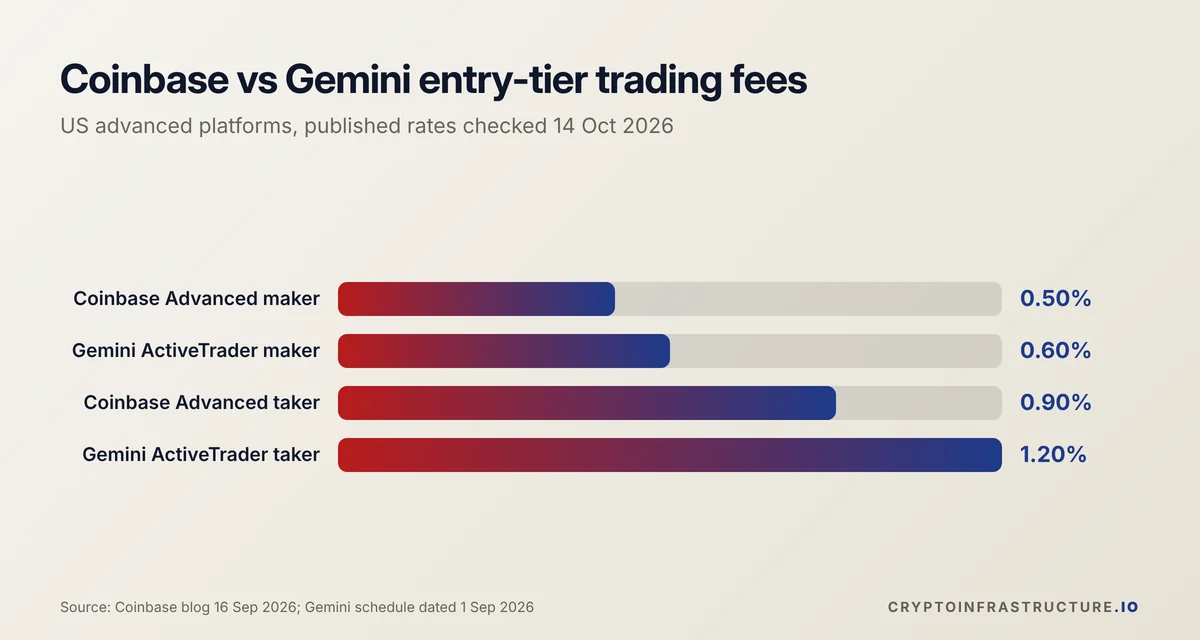
Both exchanges run two pricing systems: an instant buy that charges a variable fee plus a spread, and an order-book platform (Coinbase Advanced, Gemini ActiveTrader) with published maker and taker rates. A maker order adds liquidity to the order book, usually a limit order that does not fill at once. A taker order removes it, usually a market order.
| Fee | Coinbase | Gemini |
|---|---|---|
| Entry-tier maker (US) | 0.50% | 0.60% |
| Entry-tier taker (US) | 0.90% | 1.20% |
| Next tier starts at | $10,000 in 30-day volume or a qualifying USDC balance (rates shown after sign-in) | $10,000 in 30-day volume or $1 million balance: 0.40% maker, 0.80% taker |
| Stablecoin pairs | Shown after sign-in | 0% on RLUSD/USD, USDC/GUSD and GUSD/USD; 0% maker, 0.01% taker on other stablecoin pairs |
| Instant buy | Varies by payment method, order size, market conditions, location and asset; spread included in the price | Varies by payment method, order size, market conditions, jurisdiction and asset; spread included in the price |
| Other published fees | 1% limit order execution fee on simple trades; Coinbase One waives trading fees “with certain limitations”, not the 1% limit order fee | Debit card deposits 3.49%; ACH deposits and withdrawals free; crypto withdrawals carry a network fee |
| Source and date | Coinbase blog, 16 September 2026; Coinbase fee help pages | Gemini ActiveTrader schedule dated 1 September 2026; transfer schedule dated 20 January 2026 |
Coinbase’s full Advanced tier table sits behind a sign-in screen; the entry rates above come from Coinbase’s own announcement. Gemini’s full tier table is public.
Worked example: $100 and $10,000
Assumptions: a new US customer at the entry tier on each advanced platform, buying bitcoin with US dollars already in the account, so no deposit fee applies. Fees are the trading fee only; spread does not apply on the order book, and withdrawal network fees are extra.
| Order | Coinbase Advanced | Gemini ActiveTrader |
|---|---|---|
| $100 market order (taker) | $0.90 (0.90%) | $1.20 (1.20%) |
| $100 limit order that rests on the book (maker) | $0.50 (0.50%) | $0.60 (0.60%) |
| $10,000 market order (taker) | $90.00 (0.90%) | $120.00 (1.20%) |
| $10,000 limit order that rests on the book (maker) | $50.00 (0.50%) | $60.00 (0.60%) |
A single $10,000 trade lifts your 30-day volume to the $10,000 threshold on both exchanges, so later trades that month may qualify for the next tier. At Gemini that tier is 0.40% maker and 0.80% taker; Coinbase shows its rate only after sign-in. For instant buys, neither exchange publishes a fixed fee, so compare the total in the order preview, which includes the fee, before you confirm.
Is Gemini cheaper than Coinbase?
Not on the published entry-tier rates checked on 14 October 2026. Many ranking pages, and Google’s AI Overview for this search, say Gemini’s base fees are lower, quoting rates such as 0.20% to 0.40% for Gemini and 0.40% to 0.60% for Coinbase. Gemini’s own schedule dated 1 September 2026 starts at 0.60% maker and 1.20% taker, and Coinbase’s US entry tier since 16 September 2026 is 0.50% maker and 0.90% taker. Those older figures no longer match either exchange’s own pages. Gemini does charge nothing on several stablecoin pairs, which matters if you mostly move between stablecoins and dollars.
Assets and where you can use each exchange
- US states: Gemini says it is available in all 50 US states. Coinbase’s licence table covers 45 states plus DC and Puerto Rico and does not list California, Hawaii, Massachusetts, Montana or Wyoming, without explaining why; confirm availability for your state in the Coinbase app. The Coinbase Card is not offered in Hawaii, per Coinbase’s card page.
- Countries: Coinbase holds an EU-wide MiCA licence. Gemini’s help centre still says it is “available in 60+ countries”, but its 10-Q reports the wind-down of the UK, EU, other European jurisdictions and Australia announced on 5 February 2026, so treat the 60+ figure as out of date if you live in those regions.
- Assets: Gemini’s support page listing tradable assets, checked 14 October 2026, names about 79, including stablecoins, with some limited to Moonbase customers and USDT not available in New York. Coinbase’s asset count was not verified for this article; ranking pages give figures between 200 and 260. Count matters less than whether the specific asset you want is listed in your state.
Incident and enforcement history
Neither exchange has had its own wallets drained in any incident found for this article. Both have records worth reading before you deposit.
Coinbase
| Date | What happened | Outcome |
|---|---|---|
| 19 March 2021 | CFTC: inaccurate trade reporting on its former GDAX platform (2015 to 2018) and wash trading by a former employee | $6.5 million civil penalty |
| 4 January 2023 | NYDFS: customer due diligence described as “a simple check-the-box exercise” and a backlog of more than 100,000 unreviewed transaction monitoring alerts | $50 million penalty plus $50 million in compliance spending |
| 27 February 2025 | SEC civil enforcement action against Coinbase, Inc. and Coinbase Global, Inc. | Dismissed by joint stipulation, citing the SEC’s new Crypto Task Force |
| Disclosed 15 May 2025 | Criminals paid support contractors and employees outside the US to copy customer data, then demanded money. Coinbase says passwords and private keys were not compromised and the staff involved could not access customer funds. | Ransom not paid. Coinbase estimated $180 million to $400 million in remediation and voluntary customer reimbursement costs (8-K) |
| 6 November 2025 | Central Bank of Ireland: about 30 million transactions worth over €176 billion went unmonitored because of configuration faults, in breaches running from April 2021 to March 2025 | €21,464,734 fine |
Gemini
| Date | What happened | Outcome |
|---|---|---|
| November 2022 to 2024 | Genesis Global Capital, which borrowed Gemini Earn customers’ crypto, defaulted on about $1 billion in loans in November 2022 and filed for bankruptcy two months later. Over 200,000 Earn customers could not access their crypto. | NYDFS settlement on 28 February 2024: at least $1.1 billion returned to Earn customers, a $40 million contribution and a $37 million penalty. NYDFS found Gemini failed to vet Genesis and did not keep adequate reserves. |
| 12 January 2023 | SEC charged Genesis and Gemini Trust Company over the unregistered offer and sale of securities through Gemini Earn | Dismissed with prejudice by joint stipulation after Earn users recovered their assets in kind (Coinpaper, 24 January 2026) |
| 2 June 2022 to 6 January 2025 | CFTC lawsuit over statements Gemini made to CFTC staff | $5.0 million penalty by consent order, without admitting or denying. A joint motion to vacate the order was filed on 27 May 2026. |
| 5 February 2026 | Wind-down of UK, EU, other European and Australian operations, with about 200 jobs cut | Ongoing, per the 10-Q |
| 18 March 2026 | Securities class action alleging misleading statements in Gemini’s IPO registration statement | Pending |
| 21 April 2026 | New York Attorney General petition alleging Gemini Titan ran an unlicensed gambling business through Gemini Predictions | Pending; Gemini says it will defend the claims |
| As of 30 July 2026 | 376 arbitrations by Earn users seeking additional interest beyond their bankruptcy recovery | 15 bellwether cases proceeding, the rest stayed |
Checked 14 October 2026 against releases from the CFTC, NYDFS, SEC and Central Bank of Ireland, Coinbase’s 8-K of 15 May 2025 and Gemini’s 10-Q for the quarter to 30 June 2026.
The two records point to different risks. Coinbase’s are mostly about controls: who it onboards and how it monitors transactions. Gemini’s biggest failure involved customer assets directly: Earn users lent their crypto to a third party Gemini had not properly vetted and waited well over a year to get it back. The episode is the clearest test either exchange has faced of what happens to customer assets under stress.
Is Gemini safe to buy crypto?
No exchange can be called safe outright, and Gemini is no exception. The evidence as of 14 October 2026: it is regulated in New York as a trust company and holds money transmitter licences elsewhere in the US; it publishes annual SOC 1 and SOC 2 Type 2 reports and audited financials; it states customer assets are held 1:1 and segregated; and no theft from its own wallets was found in the sources checked for this article.
Against that sit the Earn failure and the 2024 NYDFS findings, a company that lost $216.7 million in the first half of 2026 and is shrinking its footprint, limited insurance by its own account, and no Merkle-tree proof of reserves. The US exchange rankings apply the same criteria to Gemini alongside five other exchanges.
Is there something better than Coinbase?
“Better” depends on the criterion you care about most. On published entry-tier fees, Gemini is not cheaper than Coinbase, as the fee section shows. On proof of reserves, neither offers a Merkle-tree check, so if that matters to you, look at exchanges that publish one. The best US exchanges list ranks six exchanges on the same five criteria, and the Kraken safety review covers the most common alternative in detail.
Gemini credit card vs Coinbase card
The two cards are different products. The Gemini Credit Card is a credit card issued by WebBank with no annual fee and no foreign transaction fee, paying crypto rewards of 4% on gas, EV and transit (on up to $300 of spending a month), 3% on dining, 2% on groceries and 1% on everything else, per Gemini’s card page checked 14 October 2026.
The Coinbase Card described on Coinbase’s card page is a debit card issued by Pathward, N.A., with crypto rewards that vary and no annual fee, available to US customers outside Hawaii. Several comparison pages also describe a Coinbase One Card credit card; its terms were not verified for this article. Credit card rewards paid in crypto carry the price risk of that crypto, and are no reason on their own to choose an exchange.
Which fits which user
- You trade on the order book and fees come first: Coinbase Advanced has the lower entry-tier rates in the US on the dates checked. Compare again once your volume moves you up a tier.
- You mostly convert between stablecoins and dollars: Gemini charges 0% on several stablecoin pairs.
- You want independent control reports: Gemini publishes SOC 1 and SOC 2 Type 2 reports going back to 2019.
- You live in New York: both serve you, Coinbase under a virtual currency licence and Gemini through its trust company.
- You live in one of the five states missing from Coinbase’s licence table: check Coinbase’s in-app availability; Gemini says it serves all 50 states.
- You live in the UK, EU or Australia: Gemini is winding down there; Coinbase holds an EU-wide MiCA licence.
- Company stability matters to you: both reported losses in 2026; Gemini’s assets on platform more than halved in a year, and it is exiting markets.
Where should you keep crypto after you buy it?
No insurance found in either company’s documents covers your individual account against theft or takeover, and neither licence guarantees your balance. Leaving coins on either exchange means trusting its solvency and controls. Moving them to a wallet you control removes that counterparty risk but makes you responsible for the keys. Learn how to store a seed phrase before you move anything you cannot afford to lose.
What this means for you
As of 14 October 2026, the Coinbase vs Gemini choice is a trade between different kinds of evidence, not a contest with a winner. Coinbase is cheaper at the published entry tier, larger, and licensed across the EU, with a record of fines for weak anti-money-laundering controls and a serious 2025 data theft.
Gemini publishes more independent control reports and serves every US state, but most US accounts now sit with a Florida money transmitter rather than its New York trust company, it is retreating from markets outside the US, and its Earn failure is the most direct customer-asset loss in either record. Before you deposit, check which entity will hold your account, read the fee page with a date on it, and size what you leave on the exchange to the risks above. Exchange comparisons on this site are reviewed monthly, and sooner after a hack, delisting or enforcement action.
For the full evidence on each platform, see Is Coinbase Safe? and the best US crypto exchanges ranking, or browse the Exchanges section.