Whether Binance is safe enough for you depends on where you live and what you need protected. As of 14 October 2026 the evidence is: no new US settlement in 2026, but the US Justice Department is reviewing whether Binance has kept to its 2023 plea deal, an Australian court penalty of AUD 10 million in March 2026, no MiCA licence in the EU (new services for EU users stopped from 1 July 2026), licences in Abu Dhabi and Dubai, one exchange hack (7,000 BTC in May 2019, covered from Binance’s own SAFU fund), and a monthly proof of reserves that is a snapshot, not an audit.
Your crypto on Binance is not covered by insurance or a government scheme. SAFU is a reserve Binance controls, not a policy you can claim on.
“Is Binance safe?” usually comes from someone about to deposit, or someone already holding a balance who has just seen another Binance headline. Most answers give you a list of 2FA settings and a line about the 2023 fine. That leaves out what has happened since: a presidential pardon for the founder, a federal review of the plea deal, a new court penalty in Australia and an exit from the EU market. This guide sets out the evidence on the same six points this site uses for every exchange, and says plainly what risk is still yours.
Is Binance safe? The short answer
No exchange can be called safe outright, and Binance’s record cuts both ways. On one side, it has not lost client crypto in an exchange hack since 2019, when it covered a 7,000 BTC theft from its own fund. It publishes a proof of reserves every month and holds licences from regulators in Abu Dhabi and Dubai. On the other side, it pleaded guilty to US anti-money-laundering and sanctions crimes in November 2023, and in October 2026 the Justice Department said it is checking whether Binance has kept that deal. It lost access to the EU market in July 2026 for want of a MiCA licence. And nothing protects your balance if the exchange fails.
This guide covers the six areas the site uses for every exchange safety review:
- Enforcement and settlements, dated and sourced, including what happened in 2026
- Licences by region, from regulator registers where they could be checked
- Proof of reserves: method, latest snapshot and limits
- SAFU and insurance, and what they actually cover
- Hack and incident history
- The risk that remains for you
These map onto the site’s methodology criteria of track record, transparency, security practices and jurisdiction coverage.
Were there Binance settlements in 2026?
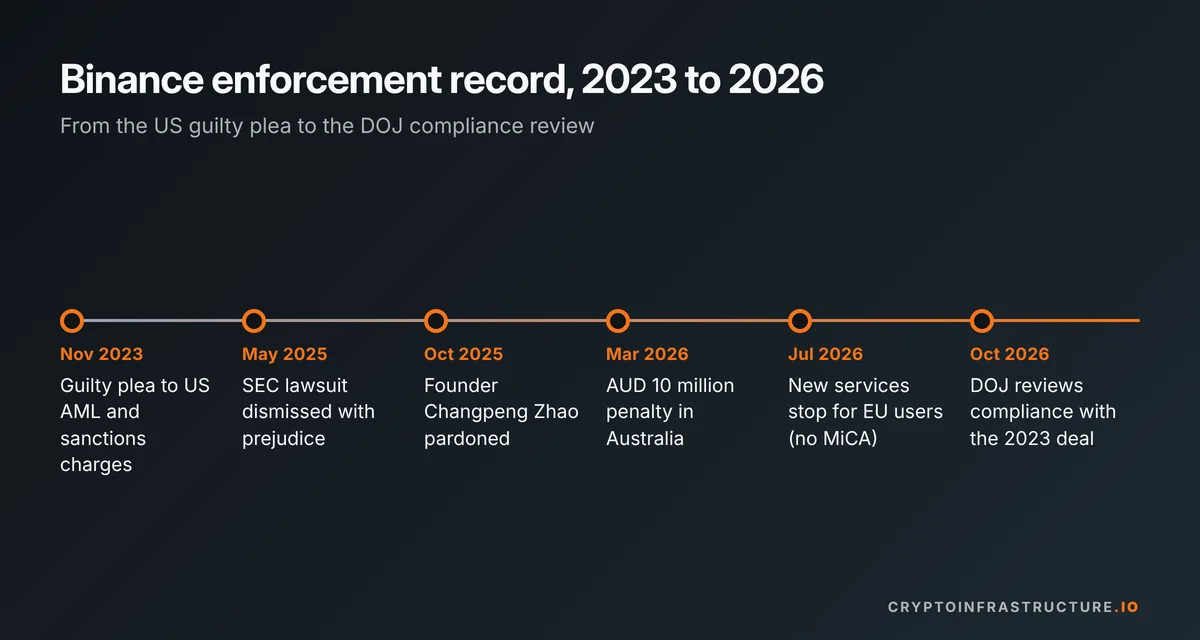
Not in the US. No new settlement between Binance and the Justice Department, Treasury or the CFTC was found for 2026 when this article was checked on 14 October 2026. What 2026 brought instead was a court penalty in Australia, a federal review of the 2023 deal, and a forfeiture case involving Binance accounts. Here is what each one is.
| Date | What happened | What it means for users | Source |
|---|---|---|---|
| 27 March 2026 | Federal Court of Australia ordered Binance Australia Derivatives (Oztures Trading Pty Ltd) to pay an AUD 10 million penalty plus ASIC’s costs. It admitted classing 524 retail clients as wholesale investors from July 2022 to April 2023, which denied them retail protections on crypto derivatives. | Clients lost AUD 8.66 million trading and paid AUD 3.9 million in fees. About AUD 13.1 million was already paid back in 2023. The penalty is on top. | ASIC release 26-055MR, as reported by The Block, 27 March 2026 |
| 17 April 2026 | Senator Richard Blumenthal wrote to the Justice Department and FinCEN asking about the status of Binance’s compliance monitors and whether they had reported misconduct. | The public record does not show whether the monitors are still in place. | The Block and Fortune, 17 April 2026 |
| 14 to 15 September 2026 | The US Attorney’s Office for the Southern District of New York filed a civil forfeiture complaint for about $61 million in crypto it says came from sanctioned Iranian oil sales. It alleges two Chinese companies used Binance trading accounts to launder the money. | Binance itself was not charged. The allegations are not proven unless a court rules for the government. | The Block, 15 September 2026; Crypto Briefing, 9 October 2026 |
| 9 October 2026 | The head of the Justice Department’s Criminal Division said prosecutors are reviewing whether Binance has complied with its 2023 settlement, as part of an Iran sanctions investigation. | No new charges have been filed. A finding of breach could reopen the settled case. | Bloomberg, 9 October 2026, as reported by Crypto Briefing and The Daily Hodl |
Checked 14 October 2026. “No 2026 US settlement” means none was found in DOJ, Treasury or CFTC releases or press coverage reviewed for this article.
The 2023 US resolution, and where the monitorship stands
Every “is Binance safe” answer has to start with the November 2023 case, because it is the record you are relying on when you trust Binance with money. On 21 November 2023, Binance Holdings Limited pleaded guilty to Bank Secrecy Act violations, failing to register as a money transmitting business and violating the International Emergency Economic Powers Act (US sanctions law). Founder Changpeng Zhao (CZ) pleaded guilty to failing to maintain an effective anti-money-laundering programme and resigned as CEO.
| Agency | Amount | Main terms |
|---|---|---|
| Department of Justice | $4.32 billion ($2.51 billion forfeiture plus a $1.81 billion criminal fine) | Independent compliance monitor for three years |
| FinCEN (Treasury) | $3.4 billion civil penalty | Five-year monitorship; Binance never filed a suspicious activity report, covering more than 100,000 suspicious transactions |
| OFAC (Treasury) | $968 million | More than 1.67 million trades between US persons and users in sanctioned places such as Iran, August 2017 to October 2022 |
| CFTC | $2.7 billion ($1.35 billion disgorgement plus $1.35 billion penalty); $150 million from CZ | Separate civil resolution |
Sources: DOJ release, 21 November 2023; Treasury release, 21 November 2023; CFTC release 8825-23. The DOJ credited about $1.8 billion toward the other agencies’ resolutions, so the amounts overlap and should not be added together.
Since then, three things have changed the picture:
- The SEC case ended. The SEC’s separate June 2023 lawsuit was dismissed with prejudice on 29 May 2025. The SEC said it acted “in the exercise of its discretion and as a policy matter”, not on the merits (SEC litigation release 26316).
- CZ was pardoned. President Trump pardoned Zhao on 23 October 2025, as PBS NewsHour reported that day. The pardon covers Zhao personally. It did not undo the company’s plea.
- The monitorship status is unclear. Bloomberg reported in September 2025 that the Justice Department was weighing whether to drop the monitor requirement early. No public decision was found. The April 2026 Senate letters asked this exact question, and the October 2026 review suggests the 2023 terms are still being enforced. Treat the monitors as in place unless the DOJ or FinCEN says otherwise.
Is Binance regulated? Licences by region
Partly, and less than it was a year ago. There is no single “Binance licence”. Different Binance companies hold different permissions, and the list has changed in 2026.
| Region | Binance entity | Status as of 14 October 2026 | Source |
|---|---|---|---|
| Abu Dhabi (ADGM) | Nest Exchange Limited; Nest Clearing and Custody Limited; Nest Trading Limited | FSRA licences as a recognised investment exchange, a recognised clearing house and a broker-dealer. Announced 8 December 2025, with regulated activity starting 5 January 2026. These are the only entities on Binance’s own licences page. | Binance licences page; Cointelegraph, 8 December 2025 |
| Dubai (VARA) | Binance FZE | VASP licence VL/24/04/001, status active, issued 15 April 2024, for exchange (including virtual asset derivatives), broker-dealer, management and investment, and lending and borrowing services | VARA public register |
| European Union | None under MiCA | No MiCA licence. Binance withdrew its application in Greece on 24 June 2026 and said it would apply in another member state. Customers in France, Italy, Spain and Poland were told new services would stop from 1 July 2026, when the MiCA transition period ended. Binance said user assets “remain safe and secure” and sent withdrawal instructions. | Binance statement via Yahoo Finance, 24 June 2026; FX News Group, 25 June 2026; Financial Times via Sharecast, 26 June 2026 |
| India | Binance (global platform) | Registered with FIU-IND as a reporting entity since August 2024, after an Rs 18.82 crore penalty in June 2024. This is an anti-money-laundering registration, not a licence. See the Binance in India guide. | FIU-IND order 10/2024 |
| Australia | Binance Australia Derivatives (Oztures Trading) | Its Australian financial services licence was cancelled in April 2023 at its own request. AUD 10 million penalty in March 2026 (see above). | The Block, 27 March 2026 |
| United States | Binance.US (separate company) | The 2023 DOJ settlement applied to Binance’s global operations, not to Binance.US, which is a separate legal entity with its own licences. | Cointelegraph, 16 September 2025 |
Checked 14 October 2026. Binance’s licences page showed only the three ADGM entities when checked; registrations in other countries could not be confirmed from it. The legal position of Binance in the US, UK, Canada and Australia gets its own guide in the Exchanges section.
What a licence does and does not tell you
A licence means a regulator can supervise and sanction that specific entity. It does not tell you which entity holds your account, and it does not guarantee your balance. If you are outside Abu Dhabi and Dubai, your account may sit with an entity that is not on either register. Check which Binance company your terms name before you rely on any licence.
Does Binance have proof of reserves?
Yes. Binance publishes a proof of reserves (PoR) every month. This is how it works and what the latest checked report shows:
| Item | What Binance publishes |
|---|---|
| Method | A Merkle tree of user balances, so you can check that your balance is included, plus a zk-SNARK proof (a zero-knowledge proof) that the liabilities report was computed correctly. Binance publishes the verifier code on GitHub (binance/zkmerkle-proof-of-solvency). |
| Who checks it | No independent auditor is named on Binance’s PoR page. Binance’s earlier accountant, Mazars, paused all proof-of-reserves work for crypto clients in December 2022. It said its reports were agreed-upon procedures at a single point in time, not audits (CNBC, December 2022). |
| Latest report found | The 45th report, snapshot 1 August 2026. User balances of about 657,000 BTC, 3.98 million ETH and 32.9 billion USDT (The Cryptonomist, 19 August 2026). Crypto Briefing reported BTC and ETH coverage of 100.25% and SOL at exactly 100%. |
| Assets | Ratios are reported for a set of major assets. The page does not state a total asset count. |
Checked 14 October 2026. Binance’s PoR page did not display a snapshot date or ratios when retrieved, so the figures above are from press reports of the August 2026 report. Reports for September and October 2026 were not found. Check the live page before relying on these numbers.
The limits matter more than the ratio. A PoR shows that, on the snapshot date, Binance controlled wallets holding at least as much of the listed assets as users held on its books. It does not show that the assets were not borrowed or pledged elsewhere. It does not show Binance’s other debts. And it does not cover any day after the snapshot. The README of Binance’s own verifier code describes what Binance publishes as its liabilities. The asset side is matched to wallets Binance identifies, without an independent audit opinion.
What is SAFU, and is Binance insured?
Binance is not insured in the way a bank deposit is. Its main protection is SAFU (Secure Asset Fund for Users), a reserve that Binance holds itself.
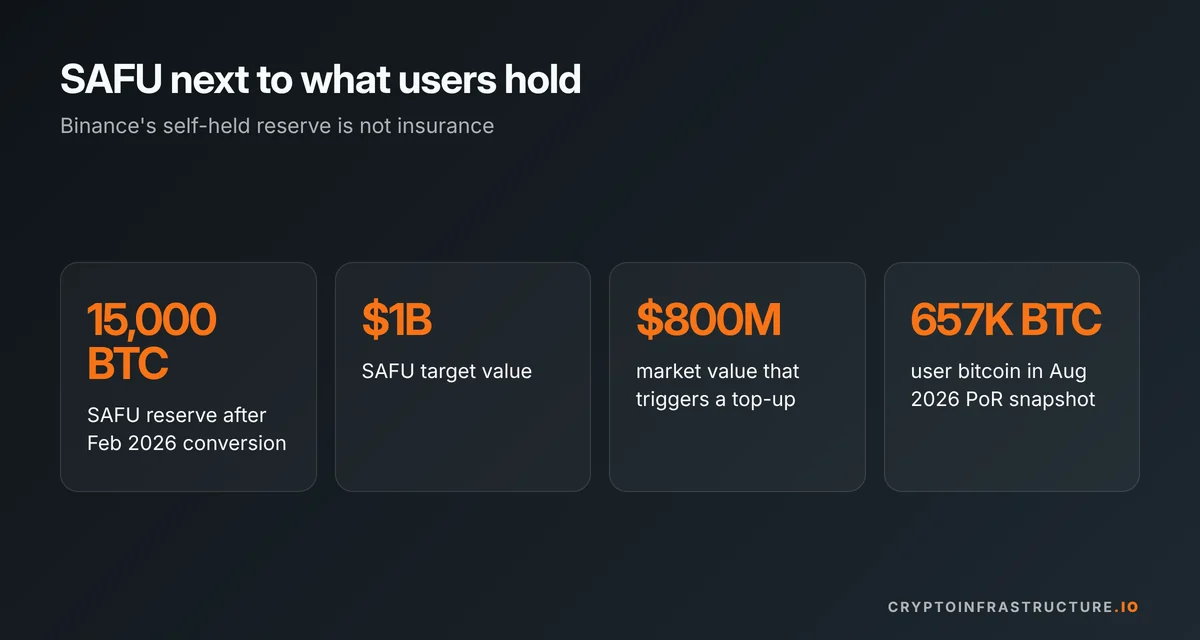
- Size and form: On 30 January 2026 Binance said it would convert the $1 billion SAFU reserve into bitcoin. It finished on 12 February 2026 with 15,000 BTC, worth about $1.005 billion at the time, and published the wallet address (The Block, 12 February 2026).
- Top-up rule: Binance said it will rebalance the fund to $1 billion if its market value falls below $800 million because of BTC price moves. In other words, the fund is allowed to fall by up to 20% before it is topped up.
- Track record: SAFU covered the May 2019 hack in full (see below).
- What it is not: no published policy, claims process or user entitlement was found in the sources checked for this article. Forbes Advisor Australia’s review also notes it gives no coverage terms. Binance decides when SAFU pays.
The fund is also small next to what users hold: 15,000 BTC against about 657,000 BTC of user bitcoin in the August 2026 report. It can absorb a hot-wallet loss like 2019. It could not cover a failure of the exchange as a whole.
Is Binance FDIC insured?
No. Binance.com is not a US bank, and no deposit insurance or government compensation scheme covering Binance balances was found in any region reviewed. Some ranking pages mention FDIC cover of up to $250,000. That refers to US dollar balances at Binance.US, a separate company, not to Binance.com.
Has Binance ever been hacked?
Yes, once at the exchange level. A separate 2022 exploit hit BNB Chain, Binance’s associated blockchain, not exchange accounts. Some ranking pages mix the two up.
| Date | What happened | User funds | Source |
|---|---|---|---|
| 7 May 2019 | Hackers withdrew 7,000 BTC from Binance’s bitcoin hot wallet, about 2% of its BTC holdings, in a single transaction. They had obtained “a large number of user API keys, 2FA codes, and potentially other info”. Deposits and withdrawals were suspended for about a week. | Covered by SAFU: “No user funds will be affected,” per Binance | Binance announcement, 7 May 2019 |
| 6 to 7 October 2022 | An attacker exploited a proof-verification bug in the BSC Token Hub, BNB Chain’s cross-chain bridge, and took 2 million BNB (about $560 million). About $100 million to $130 million was moved to other chains before the chain was paused. | A blockchain bridge exploit, not a theft from Binance exchange accounts. No source checked reported exchange user losses. | The Block, 7 October 2022 |
Checked 14 October 2026. No other exchange-wide theft of client crypto at Binance was found in the sources reviewed.
The 2019 lesson is still relevant. The theft started with stolen API keys and 2FA codes from user accounts. Your own account security is part of the exchange’s security.
Can you withdraw money from Binance?
Usually, yes, but access has been cut off by regulators before, and that is the risk to plan for. Indian users lost app access from January to August 2024 while Binance was unregistered with FIU-IND. EU users lost new services from 1 July 2026, though Binance sent withdrawal instructions. In both cases the reason was regulation, not solvency. Binance’s terms of use could not be retrieved in full for this article, so check the current terms for its rights to freeze or close accounts.
Is Binance safe for US citizens?
The question usually means Binance.US, which is a separate company with its own licences and record. The 2023 DOJ settlement applied to Binance’s global operations, not to Binance.US. One part of that case is directly relevant to Americans: OFAC found Binance matched trades between US persons and users in sanctioned countries from 2017 to 2022. Whether Binance.US is legal in your state is a separate question, covered in the site’s guide on Binance’s legal status in the US, UK, Canada and Australia.
Can I trust Binance? What the record says
Trust here means trusting Binance’s controls and solvency with what you leave on it. The record gives you points on both sides:
| In Binance’s favour | Against |
|---|---|
| Covered the 2019 hack from its own fund | Guilty plea in 2023 to US anti-money-laundering and sanctions offences |
| Monthly proof of reserves with user-verifiable inclusion | No named auditor for PoR since Mazars stopped in 2022 |
| Active licences in Abu Dhabi and Dubai | No MiCA licence; EU services stopped in July 2026 |
| $1 billion SAFU reserve with a published wallet | DOJ reviewing plea compliance in an Iran sanctions inquiry (October 2026) |
| SEC lawsuit dismissed in 2025 | AUD 10 million Australian penalty in 2026 for misclassifying retail clients |
How to weigh that is your call. For a like-for-like comparison, the Kraken safety review and the Coinbase safety review use the same six points.
What is the risk of using Binance?
- Exchange failure: no insurance or compensation scheme stands behind your balance, and SAFU is far smaller than total user assets.
- Regulatory access risk: your access depends on Binance’s standing in your country, as Indian users in 2024 and EU users in 2026 found.
- Enforcement risk: if the DOJ finds a breach of the 2023 deal, it could reopen the settled case. What that would mean for operations is unknown.
- Account takeover: stolen API keys and 2FA codes were the way in for the 2019 hackers.
- Product risk: derivatives and leverage carry losses no fund covers. The Australian case shows clients were exposed to them without the protections they were owed.
How to reduce the risk you control
- Know which entity you are with. Check the Binance company named in your terms and whether it appears on a regulator’s register.
- Use the strongest two-factor option Binance offers, rather than SMS codes where you have a choice, and turn on withdrawal address whitelisting and an anti-phishing code.
- Limit or delete API keys. Give any key only the permissions it needs, and never withdrawal rights for a third-party tool.
- Keep only what you are actively trading on the exchange. Move long-term holdings to a wallet you control, and learn how to store your seed phrase first, since that responsibility becomes yours.
- Watch regulatory news for your country. In both 2024 and 2026, access changed at short notice. The site’s monthly regulation roundup tracks these changes.
What this means for you
As of 14 October 2026, the evidence on Binance is mixed. It has a monthly proof of reserves with clear limits, a $1 billion bitcoin reserve that covered its one exchange hack, and licences in Abu Dhabi and Dubai. Against that: a 2023 criminal plea whose terms the DOJ is now reviewing, a 2026 Australian penalty, no EU licence, and no insurance on your balance. The title of this guide asks about 2026 settlements. The accurate answer is that 2026 brought a penalty and a review, not a new US settlement, and the review is the one to watch. Size what you leave on Binance to the trust that record supports.
For the same evidence check on other platforms, see the Exchanges section. For how an anti-money-laundering registration differs from a licence, the Binance in India guide walks through one case in detail.