Whether Kraken is safe enough for you depends on what you need protected. As of 14 October 2026 the evidence is: licences or registrations in the US, UK, EU, Australia and, since 6 October 2026, Dubai; a Merkle-tree proof of reserves with a 30 June 2026 snapshot showing 100.3% to 102.9% coverage of the main assets checked; no confirmed loss of client crypto in the incidents found; and five regulatory actions since 2021, the largest payment being $30 million to the SEC in 2023. Your crypto on Kraken is not covered by insurance or by the FDIC. If Kraken failed, a court could treat your assets as available to its creditors.
“Is Kraken safe?” is usually asked by someone about to send money to the exchange or already holding a balance there. Most answers give you a confident “yes” and a list of 2FA settings. That does not help much if you want to know what happens if the exchange is hacked, freezes your withdrawal or goes bust. This guide sets out the evidence instead: licences by region, proof of reserves, custody claims, insurance, incident and enforcement history. It then says plainly what risk is still yours.
Is Kraken safe? The short answer
No exchange can be called safe outright. What you can check is the evidence, and Kraken publishes a good deal of it. As of 14 October 2026, it is registered or licensed in the US, UK, EU, Australia and Dubai and publishes proof of reserves. In the incidents found for this article, it has not lost client crypto. It has also paid penalties to regulators in the US and Australia. What you do not get is insurance on your balance or a government compensation scheme. Kraken’s own UK risk page says that if it went bankrupt, “you might not receive any of your investment capital held on the Kraken exchange back”.
The rest of this guide shows the evidence behind each of those points. It covers six areas, and this site uses the same six for every exchange safety review:
- Licences by region, from regulator registers where they could be checked
- Proof of reserves: method, who checked it, and the snapshot date
- Custody and cold storage, labelled as company claims
- Insurance, and what it actually covers
- Incident and enforcement history, dated and sourced
- The risk that remains for you
These map onto the site’s methodology criteria of track record, transparency, security practices and jurisdiction coverage.
Is Kraken regulated? Licences by region
Yes, but there is no single “Kraken licence”. Different Payward companies hold different permissions in each country (Payward, Inc. is Kraken’s parent). Kraken’s terms say its “regulatory status for its various products and services differs per jurisdiction” and that “you may not be protected by government compensation and/or regulatory protection schemes”.
| Region | Kraken entity | Regulator and permission | Source |
|---|---|---|---|
| United States | Payward Interactive, Inc. | FinCEN money services business (MSB) registration; state money transmitter licences (NMLS ID 1843762). California licence application under the Digital Financial Assets Law pending with the DFPI. New York is not among the listed states. | Kraken legal disclosures |
| United States | Kraken Financial (Payward Financial, Inc.) | Wyoming special purpose depository institution (SPDI) charter, granted 2020, launched March 2024; for institutional and private clients in certain states | Kraken Financial page; Kraken legal disclosures |
| United Kingdom | Payward Limited | FCA cryptoasset business registration under the Money Laundering Regulations, effective 22 November 2021 | Kraken legal disclosures |
| United Kingdom | Payward Services Limited; Crypto Facilities Limited | FCA e-money authorisation (FRN 1010381); FCA investment firm for Kraken’s derivatives venue (FRN 757895) | Kraken legal disclosures |
| European Union | Payward Europe Solutions Limited | Crypto-asset service provider under MiCA, authorised by the Central Bank of Ireland (announced 25 June 2025, passportable across the EU and EEA) | Kraken legal disclosures; Decrypt, 26 June 2025 |
| European Union | Payward Europe Digital Solutions (CY) Limited | CySEC investment firm, licence 342/17, for investment and derivatives services | Kraken legal disclosures |
| Australia | Bit Trade Pty Ltd | AUSTRAC registration for the exchange. Kraken states it does not hold an Australian financial services licence for its exchange services; derivatives go through Beaufort Fiduciaries (AFSL 545124) | Kraken legal disclosures |
| UAE (Dubai) | Payward FZCO | VARA VASP licence VL/26/10/002, status active, issued 6 October 2026, for broker-dealer and management and investment services | VARA public register |
| Singapore, India | None listed | Kraken’s disclosures page lists no entity for either country | Kraken legal disclosures |
All entries checked 14 October 2026 against Kraken’s legal disclosures page and, for Dubai, the VARA register. The UK, Irish and Australian entries are as Kraken lists them; confirm them on the FCA, Central Bank of Ireland and AUSTRAC registers before relying on them.
Dubai is the newest addition. Blockhead reported on 13 October 2026 that the VARA approval is the final stage of licensing after a preliminary approval in May. It also reported that Kraken plans to go live for UAE customers “in the coming weeks”, with derivatives later and subject to further approval.
Is Kraken regulated in the US?
Partly. In the US Kraken is regulated as a money transmitter. It is registered with FinCEN and holds licences from individual states, and Kraken Financial is supervised by the Wyoming Division of Banking. Kraken’s disclosures list no federal licence, and New York does not appear on its state licence list.
What registration does not mean
Several of these permissions are anti-money-laundering registrations, not consumer protection. The UK is the clearest case. Kraken’s UK risk page says assets on Kraken “are not covered by investor protection schemes”. It also says the Financial Ombudsman Service “will not assist in disputes with Kraken”. A licence in any region tells you a regulator can supervise and sanction the entity. It does not guarantee your balance.
Does Kraken have proof of reserves?
Yes. Kraken publishes a proof of reserves on its proof of reserves page. This is how it works and what the latest snapshot shows (checked 14 October 2026):
| Item | What Kraken publishes |
|---|---|
| Method | An accountant takes an anonymised snapshot of client balances and builds a Merkle tree from it. Kraken signs messages proving control of its on-chain addresses, and the accountant checks those holdings against client balances. You can check that your own balance is included. |
| Who checked it | An “independent 3rd party accountant”, not named on the page. The last firm named publicly in coverage found for this article was The Network Firm, for the 30 September 2024 snapshot (Finance Magnates, 4 November 2024). |
| Latest snapshot | 30 June 2026 |
| Reserve ratios at that date | BTC 102.9%, ETH 100.5%, SOL 100.6%, XRP 102.3%, ADA 100.3%, USDC, USDT and USDG “105%+” |
| Scope | Selected assets only. Includes spot, staking, margin and futures balances under the methodology. The page lists BTC, ETH, SOL, USDC, USDT and XRP as in scope but shows ratios for ADA and USDG too. |
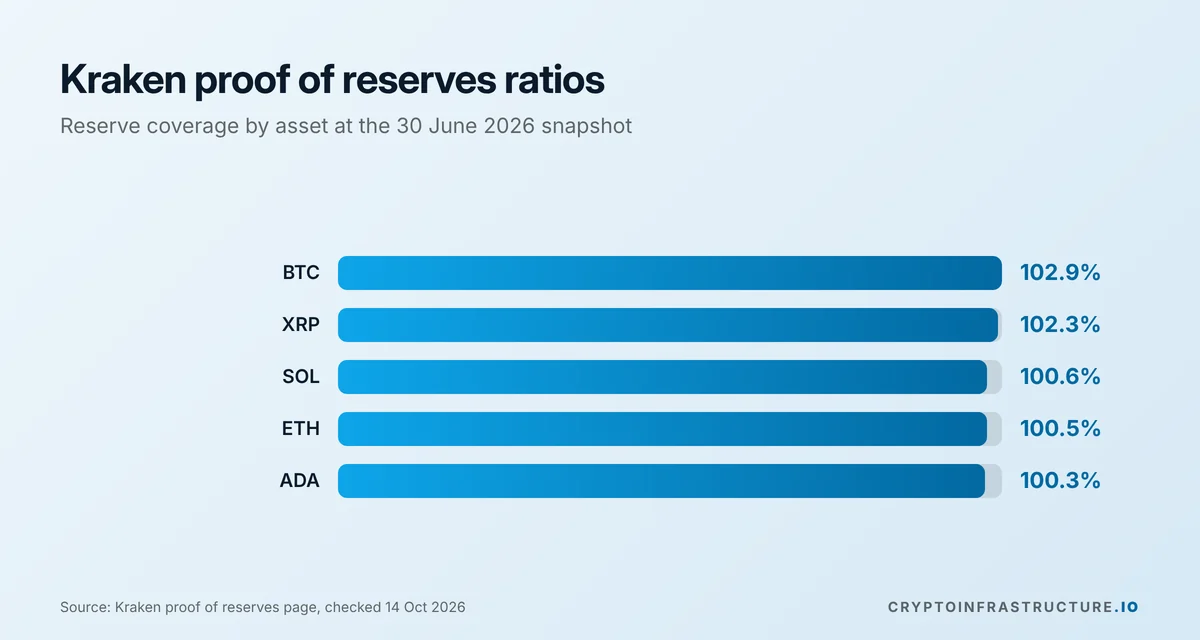
The limits matter as much as the ratios, and Kraken states them itself. A point-in-time check “cannot prove exclusive possession of private keys” and “cannot identify any hidden encumbrances or prove that funds had not been borrowed”. Assets can also be lost or stolen after the snapshot. So proof of reserves shows that, on 30 June 2026, Kraken controlled at least as much of the listed assets as it owed clients in them. It does not cover Kraken’s other liabilities, and it does not cover today.
Custody and cold storage: what Kraken claims
Everything in this section comes from Kraken, not from an independent check.
- Cold and hot wallets: Kraken’s security page says it uses “advanced cold storage and hot wallet solutions”. It gives no percentage. The “95%” cold storage figure on some review sites does not appear on that page.
- Physical security: Kraken says its infrastructure “resides in secure cages under 24/7 surveillance by armed guards”.
- Certifications: ISO/IEC 27001:2022 certified, and a completed SOC 2 Type 1 examination. Kraken does not give dates for either, and its security page does not mention a SOC 2 Type 2 report.
- Bug bounty: Kraken runs a public bug bounty programme.
Do you actually own your crypto on Kraken?
On paper, yes. Kraken’s Global Terms of Service (last updated 6 October 2026) say that “title to Digital Assets you hold within your account remains with you at all times” and that none of the assets in customer accounts are Kraken’s property. Kraken also says it will not lend or pledge your assets. The exceptions are bonded staking and collateral posted for OTC options.
The same terms add two caveats. Your coins may sit in “shared blockchain addresses” that Kraken controls, with your share tracked on Kraken’s ledger. And Kraken warns that “a court may disagree with our treatment of your Digital Assets and subject them to claims of our creditors”. In practice, owning the asset on paper is not the same as holding the keys yourself.
Is Kraken FDIC insured?
No. Neither your crypto nor your cash balance on the exchange is FDIC insured. The sources:
- Kraken’s Global Terms state in capitals: “neither your account nor your digital assets are covered by insurance against losses”.
- Kraken’s support article on insurance (updated 6 October 2026) says “cryptocurrency exchanges do not qualify for deposit insurance programs because exchanges are not savings institutions”.
- Kraken Financial, the Wyoming SPDI, is a state-chartered bank, but Kraken says “deposits at Kraken Financial are not insured by the Federal Deposit Insurance Corporation (FDIC)”. Wyoming instead requires fiat deposits to be backed 100% or more by cash or high-quality liquid assets.
- In the UK, Kraken’s risk page says assets on Kraken “are not covered by investor protection schemes”, which includes the Financial Services Compensation Scheme (FSCS).
Some ranking pages say Kraken “maintains insurance” for exchange-level breaches. No such policy appears in Kraken’s own terms. If an exchange ever offers you insurance, ask who the insurer is, what events it covers, and whether you are a beneficiary or only the exchange is.
Has Kraken ever been hacked?
No incident found for this article involved a confirmed loss of client crypto. There have been two notable security events:
| Date | What happened | Client funds | Source |
|---|---|---|---|
| 9 to 20 June 2024 | A deposit bug let accounts be credited before deposits cleared. Three accounts, including one linked to security firm CertiK, withdrew nearly $3 million from Kraken’s treasury. Kraken says it fixed the bug within hours of the bug bounty report. The funds were returned on 20 June minus a small amount lost to fees. | Not affected, per Kraken: “from Kraken’s treasuries, not other client assets” | The Block, 19 to 20 June 2024 |
| 13 April 2026 | Kraken said a criminal group was trying to extort it and claimed to have some client account information. Kraken said limited client data may have been taken when support staff photographed and filmed records, in one incident in 2025 and one earlier in 2026. The number of affected clients was not disclosed. | “Client funds were never at risk,” per Kraken’s chief security officer | Bloomberg Law, 13 April 2026 |
Checked 14 October 2026. No exchange-wide theft of client crypto at Kraken was found in the sources reviewed.
None of the top-ranking “is Kraken safe” pages reviewed for this article mention the 2026 event, and it matters. Leaked account data does not move your coins. It does make you a better phishing target, because a scammer can quote real details about your account. Treat any unexpected “Kraken support” call or email as suspect, whatever it knows about you.
Kraken’s enforcement history
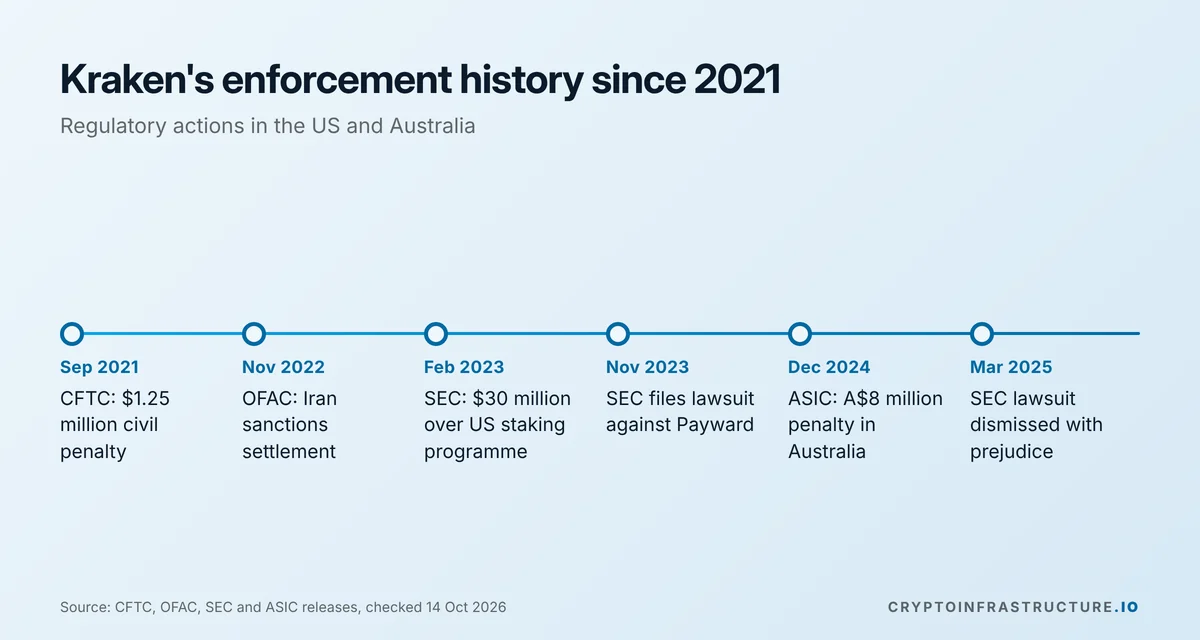
Kraken has faced regulatory action five times since 2021. None of these actions found that client funds were missing. They concern unregistered products, sanctions screening and product design.
| Date | Regulator | What it was about | Outcome |
|---|---|---|---|
| 28 September 2021 | CFTC (US) | Margin trading offered to US retail customers off a registered exchange; operating as an unregistered futures commission merchant | $1.25 million civil penalty |
| 28 November 2022 | OFAC, US Treasury | Services exported to users who appeared to be in Iran | $362,158.70 settlement plus $100,000 more on sanctions controls |
| 9 February 2023 | SEC (US) | Unregistered offer and sale of a staking-as-a-service programme advertising returns of up to 21% | $30 million paid; US staking programme halted under the order |
| 20 November 2023 to 27 March 2025 | SEC (US) | Lawsuit filed November 2023 against Payward, Inc. and Payward Ventures, Inc. | Dismissed with prejudice on 27 March 2025. The SEC said the dismissal was a policy decision, “not on any assessment of the merits” |
| 23 August 2024 and 12 December 2024 | ASIC and Federal Court (Australia) | Bit Trade offered a margin extension product to more than 1,100 Australian customers without a target market determination | A$8 million penalty plus costs; the judge pointed to “a seriously deficient compliance system” |
Checked 14 October 2026 against the CFTC, OFAC, SEC and ASIC releases.
The ASIC case is the one to read if you trade with leverage. The court found customers paid more than US$7 million in fees and interest on the product and lost more than US$5 million trading. One investor lost almost US$4 million.
Can you lose your crypto on Kraken?
Yes, in several ways that none of the above removes:
- Exchange failure: there is no insurance or compensation scheme. Kraken’s terms admit a court might treat client assets as available to creditors.
- Account takeover: account security depends partly on you. Kraken’s insurance article says “no amount of security on our end can make up for inadequate personal security”.
- Your own transfer errors: Kraken’s UK risk page warns that sending to the wrong address or network can mean permanent loss.
- Trading and leverage losses: Kraken says it “is not liable for any client trading losses”.
What happens if Kraken goes bust?
No one can say for certain, because it would depend on the Kraken entity, the country and the court. What the documents show is this. Kraken’s terms say your assets are yours, not Kraken’s. They also say a court could disagree. The UK risk page says you “might not receive any of your investment capital” back. Proof of reserves lowers the chance that the coins are simply missing, but it does not decide who gets paid first in an insolvency.
Why can’t I withdraw money from Kraken?
Usually because of a hold. Kraken’s withdrawal holds article (updated 8 October 2026) lists these:
- 72 hours on card, Apple Pay, Google Pay and PayPal purchases
- Seven days on Plaid ACH purchases and SEPA Direct Debit recurring buys
- Up to 24 hours on withdrawals to new addresses after a password change
- One business day on stock and ETF sale proceeds
Beyond holds, Kraken’s terms let it “lock, disable and close accounts” and suspend withdrawals “at any time and without liability or prior notice”. In other words, access to your funds is ultimately Kraken’s call.
Is Kraken publicly traded?
No. As of 14 October 2026 Kraken’s parent, Payward, Inc., is private. Payward said in November 2025 that it had confidentially submitted a draft registration statement to the SEC. On 3 September 2026, Crowdfund Insider reported unnamed sources saying it is not preparing to list before the second quarter of 2027. The same report says the company has not announced a new date or a postponement.
Is Kraken safer than Coinbase or Robinhood?
Do not trust a ranking that answers this in one word. Compare the same six points for each platform: which entity serves your country, the latest proof of reserves and its limits, the custody terms, what insurance (if any) covers, incident history, and enforcement history. This guide is the first in a series that does exactly that for each major exchange. You can follow it in the Exchanges section.
How to reduce the risk you control
- Use the strongest login protection Kraken offers. Its security page lists FIDO2 two-factor authentication with passkeys and says there is no phone or SMS account recovery.
- Turn on the Global Settings Lock, which time-locks changes to your account settings, and require email confirmation for new withdrawal addresses.
- Limit API keys to the permissions you need, using Kraken’s granular settings.
- Treat contact from “Kraken” as suspect, especially after the 2026 data exposure.
- Keep only what you are actively trading on the exchange. Move long-term holdings to a wallet you control, and learn how to store your seed phrase first, since that responsibility becomes yours.
What this means for you
As of 14 October 2026, Kraken publishes a good deal of checkable evidence. That includes entity-by-entity licence disclosures, a dated proof of reserves with stated limits, and an incident record with no confirmed loss of client crypto. On the other side are five regulatory actions since 2021, one of them a lawsuit later dismissed, and a 2026 client data exposure. Most importantly, your balance has no insurance or compensation scheme behind it. The remaining risk is counterparty risk: you are trusting Kraken’s solvency, controls and judgement with whatever you leave on it. Size what you hold there to match that trust.
For the same evidence check on other platforms, see the Exchanges section. For how licensing works differently by country, the Binance in India guide shows what an anti-money-laundering registration does and does not cover.