Phantom is a self-custody wallet: Phantom says it never has access to your funds, so there is no exchange balance for the company to freeze, lend or lose. That does not make it risk-free. As of 14 October 2026, Phantom publishes only two third-party audit reports (Kudelski Security, 2021, and Least Authority, 2024), its wallet app and extension code are not public, and its record includes the 2022 “Demonic” browser-extension flaw (fixed by April 2022, with no reported losses in Phantom’s disclosure) and a 2025 US lawsuit alleging weak key protection, which Phantom calls “entirely without merit”.
Phantom itself was not the cause of the August 2022 Slope wallet drain. Its scam warnings, transaction previews and open blocklist reduce but do not remove phishing risk. The “biggest Solana wallet” label is widely repeated but no independent tracker of Solana wallet share was found; Phantom reports more than 15 million users, and Forbes put the total at 22 million in February 2026.
“Is Phantom wallet safe?” is usually asked by someone about to move SOL or memecoins off an exchange, or someone who has just seen a wallet drained on X. Most answers say “yes, it is non-custodial, just be careful” and stop there. That skips what matters for a self-custody wallet: who controls the software that holds your keys, what has been audited and when, what has gone wrong before, and what the built-in scam protection really does. This review sets out that evidence, dated and sourced, in the same format as the site’s Trust Wallet and MetaMask reviews, then says what risk stays with you.
Is Phantom wallet safe? The short answer
No wallet can be called safe outright. What you can check is the evidence. Phantom is non-custodial, so the main risk of an exchange (the company losing or misusing your balance) does not apply. The risk moves to two places instead: the software Phantom ships to your phone or browser, and your own handling of the recovery phrase and every transaction you sign. The Phantom-related losses reviewed for this article came mainly from the second category: leaked phrases, malware and drainer sites.
For self-custody wallets this series checks six things:
- Custody model: where the keys are created and who can reach them
- Company and funding: who controls the software updates
- Open-source status: what code anyone can inspect
- Audits and bug bounty: who checked what, and when
- Incident history: dated, with what was lost and what Phantom said
- The risk that remains for you: phishing, drainers, malware and backups
These map onto the site’s methodology criteria of track record, transparency and security practices.
Is Phantom really Solana’s biggest wallet?
Probably the most widely used, but that cannot be confirmed with independent data. As of 14 October 2026:
- Phantom’s own About page lists “15M+” users next to its January 2025 Series C. Its 2026 wallet guide says more than 15 million people have chosen Phantom “since launch”. Both are company figures without a measurement date.
- Forbes (23 February 2026) reported 22 million users globally, about 3 million of them added during 2025.
- Fortune’s 2026 Crypto 100 ranks Phantom No. 5 and cites “more than 15 million monthly active users” and about $25 billion in self-custodied crypto, also undated, and describes it as the “go-to” self-custodial wallet for Solana.
None of these sources, and none of the ranking pages reviewed for this article, gives Phantom’s share of Solana wallets against rivals such as Solflare or Backpack. Phantom itself calls the wallet “one of the most proven and popular wallets in crypto”, not the largest on Solana. Treat “biggest” as a common description, not a measured fact. User numbers also say nothing about security: a popular wallet is simply a bigger target for phishing kits and fake apps.
How Phantom’s custody model works
Everything in this section is Phantom’s own description, not an independent test.
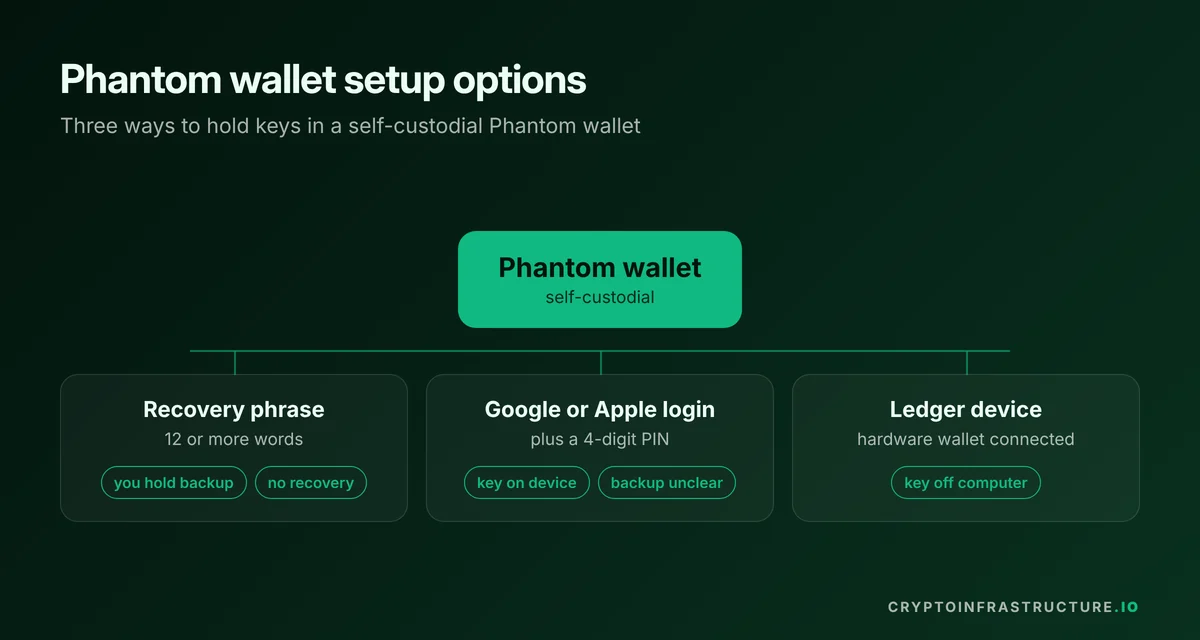
- Self-custody. Phantom’s security page says: “Self-custodial means you control your funds. We never have access.” It also says Phantom does not track personally identifiable information or asset balances.
- Recovery phrase wallets. A standard Phantom wallet is backed by a Secret Recovery Phrase of 12 or more words, per Phantom’s own wallet guide. Lose the phrase and your device, and no one can restore the wallet. The seed phrase guide explains how that backup works and how to store it.
- Google or Apple login wallets. Phantom also lets you create a wallet by signing in with Google or Apple and setting a 4-digit PIN. Phantom’s developer documentation describes this wallet as created “in a protected environment on the user’s device”, “that only the user can authorize”, and calls the setup non-custodial. The documentation reviewed does not explain how those keys are backed up or recovered, so you are trusting a design you cannot fully inspect. If you use this option, also export or back up a recovery method you control.
- Hardware option. Phantom says you can connect a Ledger device, which keeps the private key off your phone or computer.
The practical consequence: Phantom cannot freeze your wallet, block a withdrawal or lend your coins. The flip side is that no one can reverse a mistaken transfer or recover a stolen phrase for you.
Who owns Phantom, and who funds it?
Phantom is built by Phantom Technologies, Inc., a private, venture-backed company. A group of engineers and designers started it in January 2021, per Phantom’s About page; Fortune names the co-founders as Brandon Millman (CEO), Francesco Agosti (CTO) and Chris Kalani, and places the company in San Francisco.
| Date | Round | Investors named by Phantom |
|---|---|---|
| July 2021 | Series A, $9 million | a16z, Variant, Jump Capital and others |
| January 2025 | Series C, $150 million at a $3 billion valuation | Co-led by Sequoia Capital and Paradigm, with a16z crypto and Variant |
Checked 14 October 2026 against Phantom’s About page. Forbes (23 February 2026) reported 2025 revenue of $320 million, up 60% from $200 million.
What the ownership does and does not mean
- It does not give investors your coins. In a self-custody design no investor or employee holds your keys.
- It does mean you trust whoever ships the updates. Phantom controls the code that creates and stores your keys and pushes updates to your device. A malicious or faulty update can reach keys that never leave your device by design. That is what happened to Trust Wallet’s browser extension in December 2025 (see the Trust Wallet review); no equivalent incident at Phantom was found.
- It is a growing trading business. Phantom now offers swaps, staking, perpetual futures and a USD stablecoin product. Ranking reviews (CryptoSlate, Coincub, Finder) list a 0.85% fee on in-app swaps. More features mean more code that has to be secured, and the published audits predate several of them.
Is Phantom open source?
No, not the wallet itself. Phantom’s public GitHub organisation holds SDKs, demos, documentation and its scam blocklist, but no repository among those listed is the mobile app or browser extension (checked 14 October 2026). You cannot read the code that handles your keys. You can read the blocklist: its README calls it “the single source of truth for URLs that are flagged as malicious by the Phantom extension”, and anyone can propose additions by pull request.
This is a real difference from wallets that publish their core key library. It means you rely on Phantom’s audits and track record rather than on public review of the code.
Has Phantom been audited? Does it have a bug bounty?
Phantom’s security page says its code “has been audited by top software auditing firms” and links to a public audit-reports repository, which says it “contains all third party audit reports for Phantom”. As of 14 October 2026 it holds two:
| Year (from file name) | Auditor | Note |
|---|---|---|
| 2021 | Kudelski Security | Before Phantom added Ethereum, Bitcoin and other chains |
| 2024 | Least Authority | Most recent report published |
Three limits are worth knowing. First, two reports in five years is a short list for a wallet now spanning nine networks. Second, nothing published covers features added since 2024, such as perpetual futures, the stablecoin and card product, or the Google and Apple login wallets. Third, an audit checks code at a point in time; it does not check how each release is built and published.
Bug bounty. Phantom’s security page says it pays up to $50,000 for vulnerabilities “that may result in the loss of user funds”. Its bug-bounty page sends researchers to a program on Cantina and says reports filed elsewhere may not be eligible; current reward tiers are set on that Cantina page, not on Phantom’s site.
Has Phantom ever been hacked?
Phantom has never held user funds on its servers, so there has been no exchange-style hack. No case was found in which Phantom’s own software was confirmed as the cause of a mass drain. The record that does exist:
| Date | What happened | Outcome |
|---|---|---|
| Reported to Phantom September 2021; fixes January to April 2022; disclosed 15 June 2022 | “Demonic”: security firm Halborn found that browser extension wallets, Phantom among them, could expose an imported recovery phrase to an attacker who already had access to the device. Phantom said exploiting it needed a separate vulnerability giving physical or logical access to the machine. The same flaw was tracked as CVE-2022-32969 for MetaMask. | Phantom said users were protected by April 2022. Its disclosure reports no losses. |
| 2 to 9 August 2022 | About $4.08 million drained from 9,230 Solana wallets. Developers traced it to the Slope wallet, which had sent users’ seed phrases to its server in plain text. | Phantom said it found no evidence its systems were compromised, and that affected Phantom users had moved keys to or from another wallet (The Block, 10 August 2022). |
| Filed 14 April 2025 | Murphy v. Phantom Technologies (US District Court, Southern District of New York): 14 plaintiffs allege an attacker took a private key from browser memory after hacking the user’s computer, then dumped about $500,000 of tokens through Phantom’s swapper. The suit also targets OKX and seeks at least $3.1 million. | Allegations only. Phantom called the claims “entirely without merit” (Decrypt). No ruling was found as of 14 October 2026. |
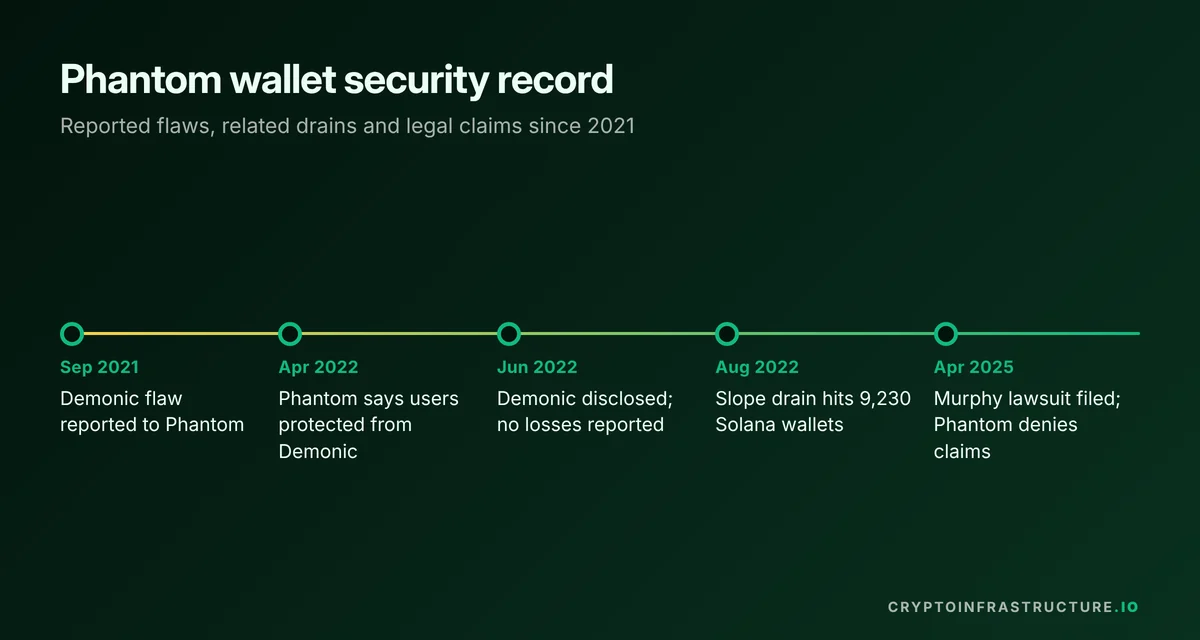
The pattern matches other software wallets: when a computer is infected with malware, a browser extension wallet is exposed, whoever made it. The Demonic flaw and the Murphy allegations both involve an attacker who already had access to the device.
Can someone hack your Phantom wallet?
Yes, though it rarely means breaking the encryption. Funds leave a Phantom wallet in four main ways:
- Your recovery phrase is exposed: typed into a fake site, sent to fake “support”, stored in a photo or cloud note, or stolen by malware.
- You sign a malicious transaction: a drainer site asks you to approve a transfer or hand over token authority.
- You install a fake app or extension. Lookalike Phantom download pages on non-Phantom domains turned up repeatedly in the research for this article.
- You send to the wrong address, for example after address poisoning, where a lookalike address is planted in your transaction history.
None of these is reversible. A confirmed transfer on Solana or any other public blockchain cannot be recalled by Phantom or anyone else.
What Phantom’s scam protection actually does
Phantom’s protection is one of its main selling points. Here is what the company’s own pages say each part does, and its limits.
- Transaction previews. Phantom simulates transactions before you approve them to show expected asset changes. When it introduced the feature on 7 October 2021 it wrote: “While the simulation does not provide a guarantee, it should help users make more informed decisions.” Phantom says its previews are powered by Blowfish, a security company it incubated and later brought in-house.
- Malicious-dApp warnings. Phantom’s developer documentation says it shows “This dApp could be malicious” when it cannot reliably predict a transaction’s outcome, and a “new or has not been reviewed yet” warning for newly seen domains.
- Open blocklist. Known phishing domains are redirected to a warning page, using the public blocklist described above.
- Spam NFT burn. You can burn unsolicited NFTs, which are a common lure to drainer sites.
The limit is the same for every wallet: warnings work on known patterns. A new drainer domain or a carefully built transaction can pass before it is flagged, and a warning does nothing if you click through it. The documentation reviewed describes these warnings for Solana transactions; it does not say whether every check works the same way on each EVM network.
Which chains does Phantom support?
Phantom announced BNB Chain on 1 October 2026 as its ninth network: Solana, Ethereum, Base, Polygon, Robinhood Chain, Arc, HyperEVM, Bitcoin and BNB Chain (Solana Compass, citing Phantom’s post on X). It has also dropped networks: Monad support ended on 26 August 2026 and Sui support on 24 September 2026, after which Phantom stopped showing Sui balances or signing Sui transactions. Several ranking pages still list Sui as supported. If you hold assets on a network Phantom drops, you need to import your recovery phrase into another wallet that supports it. Your coins stay on chain; only the interface goes away.
Phantom vs MetaMask: what to compare
Both are non-custodial software wallets with mobile apps and browser extensions, so they share the same basic risk: your keys on an internet-connected device, your phrase as the backup, and trust in the publisher’s updates. Phantom started on Solana and added EVM chains and Bitcoin; MetaMask started on Ethereum. Rather than choosing on a vendor’s feature table, compare the six points used here. The MetaMask safety review covers that wallet in the same format.
What is the safest crypto wallet to have?
None is safe outright, but the risks differ by type. A software wallet like Phantom keeps keys on a phone or in a browser. A hardware wallet keeps them on a separate device, which removes the risk of malware or a bad extension update reading them, although a phishing site can still trick you into signing a harmful transaction. Phantom supports Ledger devices, which is one way to keep larger amounts off your computer. Custodial exchanges carry different risks again, set out in the Kraken safety review.
How do I make sure my Phantom wallet is secure?
These are the steps no audit or company policy can take for you:
- Back up the recovery phrase offline, never in a photo, email or cloud note, and never type it into a website. See the seed phrase guide.
- Download only from phantom.com or the official app stores, and ignore download links in ads, DMs and emails.
- Treat all inbound “support” as a scam. Phantom said in 2021 that its representatives will never contact you on Twitter (now X), Discord, Telegram or other chat apps.
- Read every signing request and do not click through a malicious-dApp warning. The DeFi explainer covers why approvals are a common route to losses.
- Keep the computer clean. If you use the browser extension, malware on the machine is the main threat; use the mobile app or a Ledger for larger holdings.
- Copy addresses from a trusted source, not your transaction history, and check the network before sending.
- Split funds. Use a separate “burner” wallet for new tokens and unfamiliar dApps, and keep savings in a wallet that never connects to them.
What this means for you
As of 14 October 2026, Phantom gives you self-custody: by its own account the company cannot access your funds, and no breach of Phantom’s own systems causing user losses was found. It runs scam previews, a public blocklist and a bug bounty, and it disclosed the 2022 Demonic flaw with a dated fix.
Against that, its wallet code is closed, only two audit reports are published (2021 and 2024), and none covers the trading, stablecoin and social-login features added since. A 2025 lawsuit alleging weak key protection in the extension is unresolved, and Phantom denies it. The “biggest Solana wallet” description is plausible but unmeasured, and size makes it a prime phishing target. The remaining risk is mostly yours: the phrase, the device, and what you sign.
Before moving funds into any self-custody wallet, read the seed phrase guide. To see how other wallets compare on the same six points, read the Trust Wallet and MetaMask reviews.