MetaMask is a self-custody wallet: your keys are created on your device and stored there in a password-encrypted vault, so the company cannot freeze, lend or move your coins. That does not make it risk-free.
As of 14 October 2026 the record shows no theft of user funds traced to a flaw in MetaMask’s own wallet code, but it does show a 2022 browser bug (“Demonic”) that could leave your recovery phrase readable on disk, a 2022 iCloud backup phishing case that cost one user about $650,000, waves of fake MetaMask extensions, and a 30 September 2026 security incident in part of MetaMask’s infrastructure that forced it to exit Ethereum staking validators (MetaMask says it has found no indication that wallets or customer funds were affected).
The company behind it, Consensys Software Inc., announced on 9 September 2026 that it is renaming itself MetaMask. Most losses still come from phishing, fake apps and malicious signatures, which only you can prevent.
“Is MetaMask safe?” usually comes from someone about to connect a wallet to their first DeFi app, or someone who has just heard about a drained wallet. Most answers say “yes, if you are careful” and add a list of tips, and several still claim MetaMask has “never been hacked” and is “open source”. Both claims need qualifying. This guide sets out how MetaMask actually stores your keys, who controls the software, what has been audited and paid for under its bug bounty, what has gone wrong before, and what risk stays with you, all dated and sourced.
Is MetaMask safe? The short answer
No wallet can be called safe outright, and MetaMask is no exception. What you can check is the evidence. MetaMask is non-custodial, so the main risk of an exchange (the company losing or misusing your balance) does not apply. The risk moves to two places instead: the software MetaMask ships to your browser or phone, and your own handling of the recovery phrase and of what you sign. Both are covered below.
Exchange reviews on this site check licences, proof of reserves and insurance. Those barely apply to a wallet that never holds your funds. For self-custody wallets this series checks six things instead, as in the Trust Wallet review:
- Custody model: where the keys are created and stored
- Ownership: who controls the company and the software updates
- Open code: what you or anyone else can inspect
- Audits and bug bounty: who checked what, and when
- Incident history: dated, with losses where known
- The risk that remains for you: phishing, drainers, fake apps, Snaps and backups
These map onto the site’s methodology criteria of track record, transparency and security practices.
How does MetaMask store your keys?
This is the core of the question, and the part most ranking pages skip. MetaMask’s FAQ says it stores your Secret Recovery Phrase, passwords and private keys “in an encrypted format locally” on the device where it is installed. MetaMask’s servers do not hold them, and its help centre says that unless you link a Google or Apple account, MetaMask “does not control any of your personal or private data on our servers”.
The encrypted vault
The encryption is handled by MetaMask’s public library browser-passworder. Its README says a key is derived from your password using PBKDF2 with a random salt, and the data is encrypted with AES-GCM. In the library’s current source (checked 14 October 2026), the default is PBKDF2 with SHA-256 at 900,000 iterations, producing a 256-bit AES-GCM key. An older setting of 10,000 iterations is kept for vaults created before the change.
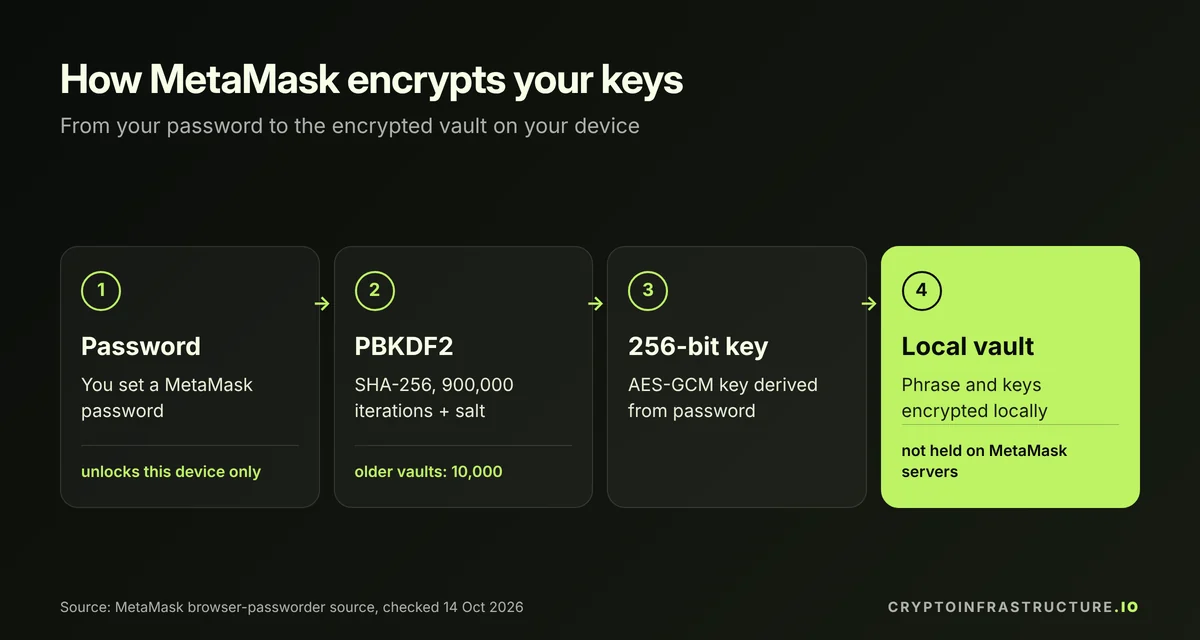
What that means in practice:
- Your password only unlocks this device. MetaMask’s user guide says the password “unlocks MetaMask on that device” and “does not recover your wallet”.
- The phrase is the real key. The same guide calls the recovery phrase “the master key to your wallet”: whoever holds it controls every account derived from it. The seed phrase guide explains how that phrase works and how to store it.
- A stolen vault file is only as strong as your password. PBKDF2 slows down guessing, but a short or reused password still weakens the protection. That matters for the backup and malware risks below.
- Imported accounts are separate. MetaMask’s FAQ warns that accounts added by private key or JSON file are not covered by your recovery phrase and need their own backup.
Social login is a different model
MetaMask now also lets you set up a wallet with a Google or Apple account. Its help centre says that in this case your recovery phrase is “encrypted and sharded across five different nodes”, and only your Google or Apple account plus your MetaMask password can decrypt the shards. That removes the paper backup but makes your email account part of your wallet’s security. Use a unique password and strong two-factor protection on that account.
Can MetaMask recover your wallet?
No. MetaMask’s FAQ says that “if you lose your Secret Recovery Phrase, MetaMask can’t help you recover your wallet”. If you forget your password, you restore the wallet from the phrase and set a new one. If you lose both the phrase and the device (or, for social login, access to the linked account), the funds cannot be recovered by anyone.
Does MetaMask require KYC?
Not to create or use the wallet. As above, MetaMask holds none of your personal data unless you link a Google or Apple account. Add-on products such as the MetaMask Card or buying crypto through a third-party provider sit on top of the wallet and can carry their own sign-up checks. Treat any message asking you to “verify” your MetaMask wallet as a scam: MetaMask’s help centre says its support team “never contacts you first”.
Can the government track MetaMask?
Your transactions, yes, in the sense that anyone can. MetaMask’s FAQ notes that transactions are recorded on the blockchain and “are publicly available”. A wallet address is pseudonymous, not anonymous: once it is linked to you, for example through an exchange that knows your identity, its history can be followed.
Who owns MetaMask?
MetaMask was founded in 2016 by Kumavis and Dan Finlay, according to MetaMask’s own 10th-anniversary post (14 July 2026), and has been developed by Consensys Software Inc., the Ethereum software company founded by Ethereum co-founder Joseph Lubin. That is changing. In a press release dated 9 September 2026, Consensys Software Inc. said it will rebrand as MetaMask and run the consumer wallet platform, with Lubin as Chairman and CEO.
Its protocol and institutional business, including the Linea network and the Besu and Teku Ethereum clients, moves to a newly formed company that keeps the Consensys name. The separation is expected to complete by the end of 2026. As of 14 October 2026, MetaMask’s own website footer still reads “Consensys Software Inc.”
What the ownership does and does not mean
- It does not give the company your coins. Neither MetaMask nor Consensys holds your keys. Lubin repeated this after the September 2026 incident: “You custody and control your own keys” (via AMBCrypto, 4 October 2026).
- It does mean you trust whoever ships the updates. The company controls the code that generates and encrypts your keys and pushes updates to your browser and phone. The same is true of every software wallet.
- It does not make MetaMask a regulated custodian. There is no exchange-style licence, proof of reserves or deposit insurance on your balance to check, because there is no balance held for you. Whether you can legally buy, sell or pay tax on crypto is set by your country, not by the wallet. If you are in India, the Binance India guide covers the current rules for exchanges there.
Is MetaMask open source?
Its code is public, but it is not open source in the strict sense, a point most ranking pages get wrong. The MetaMask browser extension repository on GitHub is public and readable, and anyone can report bugs and contribute. But its LICENSE file (checked 14 October 2026) is a custom Consensys licence, not an OSI-approved open-source licence. It reserves all rights, allows use only for “Non-Commercial Use” (including projects with up to 10,000 monthly active users), and bars copying, modifying or redistributing the code outside that grant. For you as a user, the practical point is that security researchers can read and test the code. The licence limits who may reuse it, not who may inspect it.
MetaMask also maintains LavaMoat, an open-source toolset its security page describes as protecting JavaScript against supply-chain attacks, and the extension repository uses it in its build. That is relevant because malicious package updates are one of the main ways browser wallets have been compromised elsewhere.
Has MetaMask been audited?
Partly, and less transparently than its marketing suggests. MetaMask’s 10th-anniversary post refers to “regular independent security audits”, and its security page says it is “rated the #1 most secure wallet across all platforms by Coinspect”. Both are company claims. Unlike some wallets, MetaMask’s security page does not publish a dated list of audit reports with firms and scopes for the core extension and mobile app, so you cannot check what was reviewed or when.
Two things are documented in detail:
| Control | What the public record shows | Checked |
|---|---|---|
| Bug bounty (HackerOne) | Launched June 2022. Covers the browser extension, mobile app and Snaps at the top “wallet tier”, with critical rewards of $3,000 to $50,000. HackerOne shows $731,105 paid in total and 389 reports resolved. The programme page currently says MetaMask “is taking a break and is not accepting new submissions”. | 14 October 2026 |
| Snaps that touch keys | MetaMask’s Snaps documentation requires a third-party audit from an approved auditor before any Snap that uses key-management permissions can be allowlisted, and those audit reports are made public. Every Snap needs at least two approvals from the Snaps team. | 14 October 2026 |
Sources: MetaMask’s HackerOne programme page (rewards last updated 4 September 2026) and MetaMask’s Snaps allowlisting documentation.
The bounty pause is worth watching. A public bounty is one of the few independent signals of how seriously a wallet treats outside research. MetaMask’s page gives no reason or end date for the break.
Has MetaMask ever been hacked?
It depends what you mean. No public report checked for this guide shows MetaMask’s servers holding or losing user funds, because they do not hold any. But “never hacked” is too strong. There have been real security problems in MetaMask’s software and infrastructure, and repeated large thefts from MetaMask users through the routes around the wallet.

| Date | What happened | Losses and outcome |
|---|---|---|
| 18 April 2022 | iCloud backup phishing. MetaMask warned iOS users that app-data backups to iCloud could include their wallet data and told them how to turn the backup off. A scammer posing as Apple support tricked one user into sharing a one-time code, took over his Apple account and drained his wallet. | About $650,000 from one verified victim (CPO Magazine, 22 April 2022). Reports differ on whether the backup held the phrase in readable form or the password-encrypted vault; either way, a cloud account became a route to the wallet. |
| 15 June 2022 | “Demonic” (CVE-2022-32969), disclosed by Halborn. Browsers’ session-restore feature could save text typed into a non-password field to disk unencrypted, so a recovery phrase imported with “Show Secret Recovery Phrase” ticked could be stored in plain text. MetaMask users who imported a phrase on version 10.11.2 or earlier were at risk. | Exploitation needed access to an unencrypted disk on a device that had been lost or compromised. The Halborn disclosure advised affected users to migrate to new accounts and does not report any losses. |
| April to July 2025 | “FoxyWallet” campaign: more than 40 fake Firefox extensions impersonating MetaMask, Coinbase Wallet, Trust Wallet, Phantom and others, found by Koi Security. They cloned real wallet code and sent recovery phrases to attackers. | No total loss figure published. Mozilla removed most of the flagged extensions (Decrypt, 4 July 2025). Not a flaw in MetaMask itself, but a direct risk to anyone installing “MetaMask” from the wrong listing. |
| 30 September 2026 (ongoing) | MetaMask disclosed an “ongoing security incident” affecting part of its infrastructure and began exiting Ethereum validators in its non-custodial staking operations, including those it runs for Lido, as a precaution. Root cause not disclosed. | MetaMask’s 1 October update says “there is no indication that MetaMask wallets or customer funds have been affected”. An Ethereum researcher estimated that about 0.36 ETH in block-production payments was diverted and that about 17,000 validators were being exited; MetaMask has not confirmed these figures (CoinDesk, 1 October 2026). Lido said stETH holders need take no action. |
Checked 14 October 2026 against MetaMask’s user update page (latest text dated 1 October 2026), Halborn’s disclosure, CPO Magazine, Decrypt and CoinDesk. The September 2026 incident was still under investigation at the time of checking.
The 2026 incident matters mainly for what it does not show. MetaMask says it does not manage withdrawal keys for staked assets on behalf of clients, and the affected systems were staking infrastructure, not the wallet software that holds your keys. But it is a reminder that the company now runs far more than a wallet (staking, swaps, a card, perpetuals and prediction-market access), and every extra service is extra infrastructure to defend. If you staked through MetaMask, follow its official update page rather than messages or social posts.
Can someone hack your MetaMask wallet?
Yes, though in practice it rarely means breaking the encryption. Funds are taken from MetaMask wallets in five main ways:
- Your recovery phrase is exposed: typed into a fake site, given to a fake “support” agent, stored in a photo, cloud note or cloud backup, or read by malware.
- You sign a malicious request: a drainer site asks for a token approval or a “permit” signature that hands control to an attacker. MetaMask’s own December 2025 security report describes one user losing over $440,000 in USDC to a single malicious permit signature.
- You install a fake wallet, such as the extensions in the table above.
- Malware on your computer reads browser data. The same MetaMask report describes info-stealers hidden in fake game downloads that target browser wallet extensions.
- You send to the wrong address, for example after address poisoning plants a look-alike address in your history.
None of these is reversible. A confirmed on-chain transfer cannot be recalled by MetaMask or anyone else.
Snaps and permissions: the add-on risk
Snaps are third-party add-ons that run inside the MetaMask browser extension and can add new networks, transaction warnings or other features. MetaMask’s documentation splits their permissions in two. “Open” permissions, such as showing notifications, dialogs or transaction insights, can be used by any Snap without review. “Protected” permissions, which include access to key-derivation functions, require the Snap to be allowlisted by MetaMask, and the key-management ones also require a published third-party audit.
That is a sensible design, but three limits remain. A review and audit check code at a point in time. A Snap with access to key material can, by design, derive keys from your phrase. And MetaMask’s bug bounty treats bugs in third-party Snaps as the Snap developer’s problem: they are “not bounty eligible”. Install only Snaps you need, check what permissions each one requests, and remove the ones you no longer use.
The same thinking applies to dapp connections and token approvals. Connecting a site shares your address; approving a token can let a contract move it later. The DeFi explainer covers how approvals work and why they are a common route to losses.
Protections MetaMask offers, and what they do not cover
- Security alerts and transaction simulation. MetaMask’s security page describes phishing alerts and readable transaction previews. By the company’s own figures in its July 2026 anniversary post, its protections blocked more than 6.5 million malicious website visits and nearly 150,000 malicious transactions in 2025. These are company claims and no warning system catches every new scam.
- Transaction Shield (paid). MetaMask’s help centre lists it at $9.99 a month or $99 a year, covering up to $10,000 a month of eligible losses on up to 100 transactions, on the browser extension only (checked 14 October 2026). It excludes the most common losses: a compromised recovery phrase or private key (including through phishing or malware), hacked protocols and market losses. It is a reimbursement product run by MetaMask, not insurance on your balance.
- Hardware wallet support. MetaMask’s security page lists Ledger, Trezor, Keystone, Lattice, AirGap Vault and NGRAVE ZERO. With a hardware wallet connected, the private key stays on the device and every transaction needs a physical confirmation, which removes the risk of malware or a malicious update reading your key. It does not stop you approving a malicious transaction on the device, so you still need to read what you sign.
Is MetaMask legit, and how does it compare?
MetaMask is a real product from an established company, not a scam: the 9 September 2026 press release reports more than 100 million downloads across about 190 countries. “Legit” is not the same as “safe”, though, and its popularity is exactly why fake MetaMask apps, extensions, emails and support accounts are so common. MetaMask’s help centre says there are only two forms of the wallet, the browser extension and the mobile app, and that you should install only from metamask.io or the official browser and app stores.
If you are weighing MetaMask against Coinbase Wallet, Trust Wallet or Phantom, compare them on the same six points used here rather than on feature tables: custody model, ownership, open code and licence, dated audits and bounty, incident history and phishing protections. The Trust Wallet review uses the same format, and a direct MetaMask and Trust Wallet comparison is planned for this site.
Can you lose your crypto using MetaMask?
Yes. These are the steps that remain your responsibility, and no audit or company policy removes them:
- Back up the recovery phrase offline, never in a photo, email, cloud note or cloud backup, and never type it into a website. See the seed phrase guide.
- Use a long, unique MetaMask password. It is what protects the encrypted vault if your device, browser profile or backup is copied.
- On iPhone, check what your iCloud backup includes for the MetaMask app, given the 2022 case above.
- Install only from metamask.io or the official stores, and check the publisher before you install an extension.
- Read every signature request. Reject approvals and permits you do not understand, and revoke old approvals.
- Keep Snaps to a minimum and check their permissions.
- Treat all inbound “support” contact as a scam. MetaMask says it will never ask for your recovery phrase.
- Connect a hardware wallet for larger balances.
If you think your wallet is compromised, assume the phrase is exposed: create a new wallet with a new phrase on a clean device, move whatever is left, and revoke approvals from the old address. Importing the same phrase elsewhere does not fix it, which is also what Halborn advised for Demonic-affected wallets.
What this means for you
As of 14 October 2026, MetaMask gives you real self-custody: your keys are encrypted on your device with a public, well-documented scheme, and the company cannot freeze or lose your balance. Its code is public for anyone to inspect, though under a restrictive licence rather than an open-source one, and its HackerOne bounty has paid out more than $731,000 since 2022 but is currently paused. It does not publish a dated audit list for the core wallet.
Its record includes a 2022 browser storage flaw, an iCloud backup route that cost one user about $650,000, constant fake-extension campaigns and, on 30 September 2026, an infrastructure incident that hit its staking operations, with no indication so far that wallets were affected. The company is also mid-way through splitting from Consensys, which changes the name on the box but not who holds your keys. The remaining risk is mostly yours: the phrase, the password, the device and what you sign.
Before moving funds into any self-custody wallet, read the seed phrase guide. To compare that responsibility with keeping crypto on an exchange, see the Kraken and Coinbase safety reviews.