Is Uphold safe? Uphold is a real, registered company, not a scam, but “legit” is not the same as protected. As of 14 October 2026 the evidence is: US money transmitter licences in most states (not New York, Hawaii, Louisiana, Massachusetts, Montana, Nebraska or Wisconsin, with California pending); an FCA anti-money-laundering registration in the UK; a Bank of Portugal VASP registration in Europe, with no MiCA authorisation listed in Uphold’s own disclosures; a reserves page that claims “100%+” backing but names no auditor and now sits behind a login; and a $5 million New York settlement in May 2026 over the CredEarn product that collapsed in 2020.
Your crypto on Uphold is not FDIC insured, and if you are served by its Bahamas entity (users outside the US, UK, Canada, EU, EEA and Switzerland) the user agreement passes legal title to your coins to Uphold.
“Is Uphold legit?” usually comes from someone who has seen Uphold’s 4.6 Trustpilot score and then a Reddit thread calling it a scam. Both exist. Most reviews answer with a confident “yes, it’s regulated” and an affiliate button. That does not tell you what Uphold’s licences actually cover, what its reserve page proves, or what happened to the 6,000 customers who bought CredEarn through it. This review sets out that evidence, dated, and then says plainly what risk stays with you.
Is Uphold safe and legit? The short answer
Yes, Uphold is a legitimate business. It has operated since 2015, holds state money transmitter licences in the US and is registered with the UK’s Financial Conduct Authority. Whether it is safe enough for your money is a separate question, and no exchange can be called safe outright. As of 14 October 2026, what you can check is this:
- Uphold is licensed or registered in the US, UK, Portugal and the Bahamas, but several of these are anti-money-laundering registrations, not consumer protection.
- It publishes a reserves page, but the page names no independent auditor and the figures now require a login to view.
- No hack of Uphold’s own platform was found in the sources reviewed for this article.
- It has paid a US sanctions settlement (2023) and a New York settlement over CredEarn (2026).
- Your crypto is not covered by FDIC insurance or the UK’s compensation scheme.
This site checks every exchange on the same six points: licences by region, proof of reserves, custody terms, insurance, incident and enforcement history, and the risk left with you. They map onto the site’s methodology. The same check for other platforms is in the Kraken, Coinbase and Crypto.com reviews.
Is Uphold regulated? Licences by region
Partly, and differently in each region. Uphold is a group of companies, all owned by Uphold Ltd., and which one you deal with depends on where you live. Uphold’s important disclosures page (last updated 1 July 2026) lists them:
| Region | Uphold entity | Regulator and permission | What it means for you |
|---|---|---|---|
| United States | Uphold HQ Inc. (NMLS ID 1269875) | FinCEN-registered money services business (MSB); state money transmitter licences. California licence application under the Digital Financial Assets Law (DFAL) pending. | Hawaii, Louisiana, Massachusetts, Montana, Nebraska, New York and Wisconsin do not appear on Uphold’s US licence list (page updated 1 July 2026). Alaska’s licence covers fiat transactions only. |
| United States | Uphold Securities Inc. | FINRA and SEC registered broker-dealer (CRD 34071) | Covers securities products only, which are custodied by Apex Clearing. Not your crypto. |
| United Kingdom | Uphold Europe Limited (FRN 938277) | FCA cryptoasset registration under the Money Laundering Regulations, registered since 17 February 2022. Uphold also lists this company as an e-money agent of Optimus Cards UK Ltd. | The FCA register states the Financial Ombudsman Service cannot consider complaints and the FSCS cannot consider claims against this firm. |
| European Union | Uphold Digital Assets Europe, Unipessoal, Lda (Portugal) | Registered with the Bank of Portugal as a virtual asset service provider (VASP) | Uphold’s disclosures list no MiCA crypto-asset service provider (CASP) authorisation. See the MiCA note below. |
| Rest of world | Uphold Worldwide Ltd. (Bahamas, reg. 177867) | Registered with the Securities Commission of the Bahamas as a digital asset business and exchange | Serves users outside the US, UK, Canada, EU, EEA and Switzerland, under Bahamas law and courts. |
Checked 14 October 2026 against Uphold’s important disclosures and US regulators pages and, for the UK, the FCA register entry for FRN 938277.
Is Uphold licensed under MiCA?
Not according to Uphold’s own disclosures as of 14 October 2026. They list a Bank of Portugal VASP registration and no MiCA CASP authorisation. This matters because the MiCA transition period, which let firms registered under national rules keep serving clients, ended across the EU on 1 July 2026. Several top-ranking reviews say Uphold is regulated “in Europe” by Lithuania’s Financial Crime Investigation Service (FCIS). No Lithuanian entity appears in Uphold’s current disclosures. If you live in the EU, check the ESMA register of authorised CASPs and Uphold’s terms for your country before you deposit.
What registration does not mean
A FinCEN registration or an FCA anti-money-laundering registration lets a regulator supervise how a firm handles financial crime. It does not insure your balance or give you a compensation scheme. Tennessee’s notice on Uphold’s US page says it plainly: the state licence and surety bond “do not cover the transmission of virtual currency”.
Does Uphold have proof of reserves?
Uphold has a transparency page that claims more than most exchanges, but it proves less than it appears to. Here is what it showed on 14 October 2026:
| Item | What Uphold publishes |
|---|---|
| Claim | Uphold says it publishes its assets and liabilities “in real-time” and is “always 100%+ reserved”. |
| Figures | Not visible without an account. The page says “Login to see Uphold’s Reserve by Tier” and shows a blurred image in place of the numbers. |
| Who checked it | No auditor or attestation firm is named on the page. It refers to “regular US State audits” without detail. |
| Method | No Merkle tree or other way to check that your own balance is included is described on the page. |
| Certifications | SOC 2 Type 2, ISO 27001 and PCI DSS. These cover information security and payments, not reserves. |
| Lending | “We never loan out your funds”, unless you have chosen to stake or use DeFi lending. |
Several ranking pages call this “real-time proof of reserves” and some say it is audited. The page reviewed for this article gives no auditor, no snapshot date and no method you can check. Liabilities that a company reports about itself cannot show that it owes you no more than it says. Compare the Kraken review, where an accountant signs off a dated Merkle-tree snapshot that each user can check. Kraken’s version has limits too, but it is checkable in a way Uphold’s page currently is not.
Custody: who actually owns your crypto on Uphold?
The answer depends on your region, and it is less favourable than “your keys, your coins”.
- Outside the US, UK, Canada, EU, EEA and Switzerland: Uphold’s user agreement with Uphold Worldwide Ltd. (last updated 20 August 2026) says “legal title to any Assets placed on our Platform will pass to Uphold”. You keep the beneficial interest. Your assets are held apart from Uphold’s operating accounts but are “commingled with the Assets of other Uphold users” in omnibus accounts.
- Lending: the same agreement says Uphold will not “lend, re-use, re-hypothecate, pledge, or otherwise encumber cryptoassets” without your instruction, except where law requires it.
- California: Uphold’s disclosures say California residents’ digital assets are held in trust and “are not subject to the claims of Uphold HQ Inc.’s general creditors”. Uphold makes no such statement for other states on that page.
- Freezes: the agreement lets Uphold “terminate, suspend or restrict your access to the Platform” at any time to protect users or itself.
Uphold’s security page claims 2FA, advanced encryption and a bug bounty run through Intigriti. It gives no cold storage percentage, so treat any review that quotes one as unsourced.
Is Uphold Vault secure?
Vault is a different custody model and lowers your exposure to Uphold, at a price. It is a 2-of-3 multi-signature wallet. You hold the Vault Key on your phone and a Backup Key you record yourself. Uphold holds the third key, which co-signs and helps replace a lost key. Uphold says it never has access to your two keys, and that you can move funds with them without its permission. It also says you are trusting it not to keep copies of keys generated in the app.
As of 14 October 2026, Vault supports BTC, HBAR, XRP and the XRPL tokens CORE, SOLO and RLUSD. It costs $19.99 a month or $199.99 a year after a 30-day trial, with existing users kept on their current price until 1 January 2027. Several ranking reviews still quote $4.99 a month. If your subscription ends, Uphold deletes its key 60 days later. If you lose both of your keys, the funds are gone. Before you rely on self-custody, read how to store a seed phrase.
Is Uphold FDIC insured?
Not for crypto. Uphold’s disclosures say digital asset balances “are not insured or guaranteed by the Federal Deposit Insurance Corporation” and are not covered by SIPC either. Uphold mentions private insurance against theft or loss but says details are “available upon request”, so you cannot see what it covers or whether you benefit from it.
The FDIC coverage you see advertised applies only to cash in the US USD Interest Account, which is placed with partner banks. Yahoo Finance’s review (31 August 2026) describes coverage of up to $2.5 million spread across up to 10 banks at $250,000 each. That protects you if a partner bank fails, not if Uphold does. In the UK, the FCA register confirms the FSCS will not consider a claim against Uphold Europe Limited.
Uphold fees: what you actually pay
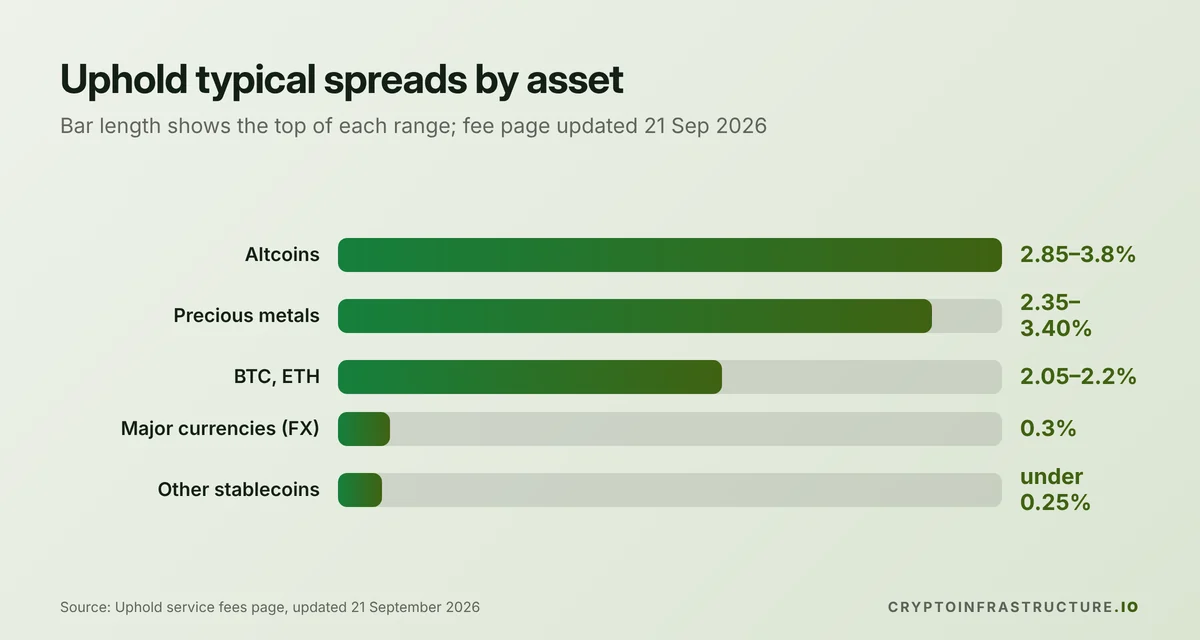
Uphold does not charge a separate trading commission on most trades. The cost is built into the spread, the gap between the price you pay and the market price. Uphold’s service fees page (last updated 21 September 2026) gives these typical spreads for the US, UK and Europe:
| Asset | Typical spread |
|---|---|
| BTC, ETH | 2.05% to 2.2% |
| Altcoins | 2.85% to 3.8% |
| USD to supported USD stablecoins | 0% at 1:1 for the first $20,000 per rolling month, while the stablecoin is within 0.2% of $1 |
| Other stablecoins | Under 0.25% |
| Major currencies (FX) | 0.3% |
| Precious metals | 2.35% to 3.40% |
When you trade between two asset types, the higher rate applies, so swapping an altcoin into a stablecoin costs the altcoin rate. Uphold’s help centre adds a $0.99 fee on trades under $500. Staking commission is 35% of rewards for boosted staking from 15 October 2026 and 50% for flexible staking.
Worked example (as of 14 October 2026)
Assumptions: you buy bitcoin with US dollars already in your account, at the fee page’s BTC spread of 2.05% to 2.2%, and no card or instant-withdrawal fees.
- $100 of BTC: spread of $2.05 to $2.20, plus the $0.99 small-trade fee, so $3.04 to $3.19 in total, or about 3.0% to 3.2%.
- $1,000 of BTC: spread of $20.50 to $22.00. No small-trade fee applies.
The spread applies again when you sell, so a buy and later sale roughly doubles the cost. Finder and Yahoo Finance report a 3.99% fee for card deposits and 1.75% for instant withdrawals, on top of the spread. Uphold’s service fees page links to the help centre for those rates rather than listing them.
Has Uphold ever been hacked?
No hack of Uphold’s own platform involving theft of client crypto was found in the sources reviewed for this article (checked 14 October 2026). BitDegree’s review (updated 29 August 2026) reports one third-party incident: in July 2022 a breach at the email provider Customer.io exposed some Uphold client email addresses, which Uphold reported to the UK Information Commissioner’s Office.
Account-level fraud is a bigger day-to-day risk. Uphold’s help centre runs a dedicated fraud and security hub with articles on suspected account hacks, requests to transfer funds and suspicious calls or emails. Treat any unexpected “Uphold support” contact as suspect.
Uphold’s enforcement and legal history
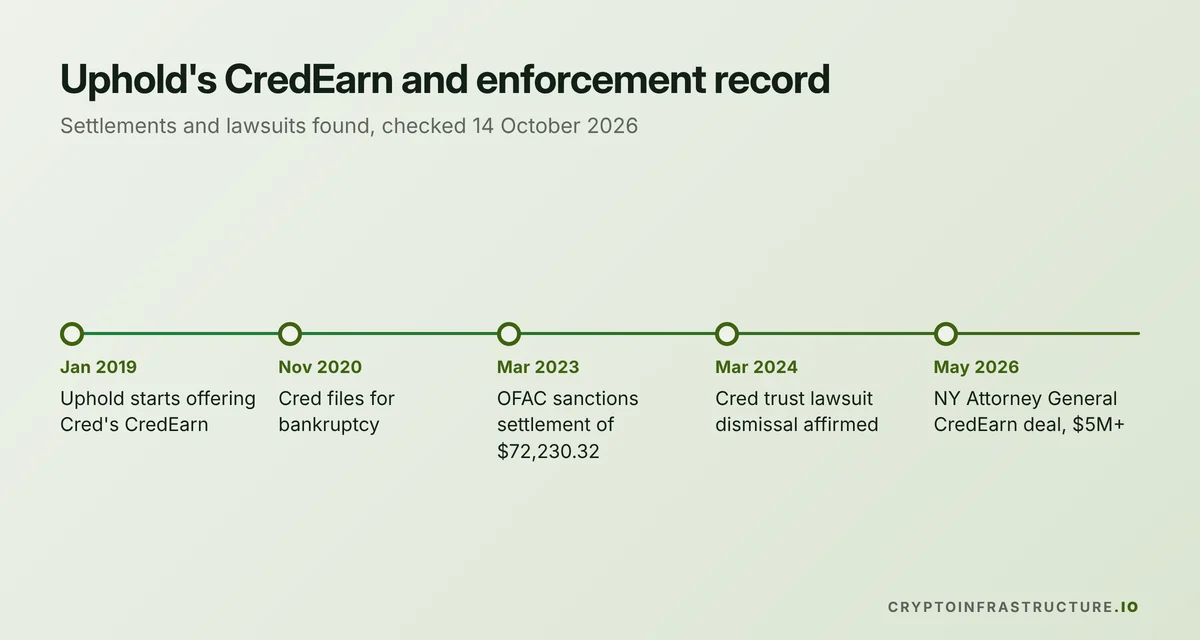
Uphold has faced two regulatory settlements and a bankruptcy lawsuit, all linked to sanctions screening or to CredEarn. None found that Uphold’s own reserves were missing.
| Date | Authority | What it was about | Outcome |
|---|---|---|---|
| November 2020 | (Cred bankruptcy) | Cred, whose CredEarn product Uphold offered to its users from January 2019 to October 2020, filed for bankruptcy. | More than 6,000 Uphold customers had invested about $50 million; losses exceeded $34 million (per the New York settlement coverage). |
| 31 March 2023 | OFAC, US Treasury | 152 transactions worth $180,575.80 for users in Iran and Cuba and for employees of the Venezuelan government. Uphold did not screen free-text address fields and ID documents. | $72,230.32 settlement; violations voluntarily self-disclosed and treated as non-egregious |
| 13 April 2023 and 27 March 2024 | US Bankruptcy Court and District Court, Delaware | Cred Inc. Liquidation Trust sued Uphold for aiding and abetting breaches of fiduciary duty by Cred’s officers. | Complaint dismissed with prejudice; dismissal affirmed by the District Court on 27 March 2024 |
| Early May 2026 (reported 4 May 2026) | New York Attorney General, under the Martin Act | Uphold promoted CredEarn as a safe savings-style product, repeated a false claim of “comprehensive insurance” and did not disclose that returns came from risky loans in China. The AG also said Uphold operated without the required broker registration. | Uphold to pay more than $5 million to affected customers, pass on its $545,189 Cred bankruptcy recovery, strengthen due diligence and register before promoting similar products. Uphold says it was a victim of Cred’s fraud. |
Checked 14 October 2026 against the OFAC release and the Delaware District Court opinion. The New York settlement is as reported by Cointelegraph (4 May 2026) and Crypto News Australia; the Attorney General’s release itself could not be retrieved for this article.
The CredEarn case is the one to weigh. A New York regulator found that Uphold promoted a third-party yield product as safe and insured when it was neither. If Uphold offers you a yield or “earn” product now, treat it as a separate risk with its own terms, not as part of the exchange.
Is Uphold a trusted exchange? What users say
User reviews split sharply. As of 14 October 2026, Uphold’s Trustpilot profile shows a TrustScore of 4.6 from 27,579 reviews, with 67% five-star and 17% one-star. Trustpilot notes that Uphold invites customers to review, flags that it “may be associated with high-risk investments”, and shows Uphold replying to 0% of negative reviews. Recent one-star reviews describe frozen accounts, blocked withdrawals and unanswered tickets. Finder reported a BBB rating of F, 1.0 out of 5 from 23 reviews and 270 complaints, as of 31 March 2026. Reviews are signals, not evidence, but the pattern of complaints is about account access and support, not missing funds.
How do I get my money out of Uphold?
US users can withdraw cash by ACH for free, which Yahoo Finance reports takes up to five business days, or instantly to a debit card for 1.75% per Finder and Yahoo. Crypto can be sent to an external wallet for the network fee, plus a $0.99 Uphold fee on most networks according to Yahoo Finance. If a withdrawal is stuck, the usual causes are a compliance review or an account restriction, which the user agreement allows Uphold to impose. Check the VASP licence guide for why exchanges must run these checks.
How can I contact Uphold customer service?
Through the help centre at support.uphold.com, and by email at [email protected], the address on the FCA register. NerdWallet’s review reports email and a 24/7 automated chat, with no live phone support. UK customers have no Financial Ombudsman route, so keep written records of every ticket.
Are there any issues with Uphold today?
Check Uphold’s own status page at status.uphold.com, which is linked from its site footer, before assuming your account has a problem.
Is Uphold better than Coinbase?
Neither is better in one word. Uphold suits you if you want crypto, metals and foreign currencies under one login and a 2-of-3 Vault. Its spread pricing is costly for frequent trading, and its reserve evidence is weaker than the dated, checkable reports some rivals publish. Compare the same six points side by side using the Coinbase review and the Exchanges section.
How to reduce the risk you control
- Turn on 2FA with an authenticator app rather than SMS where your region allows.
- Treat contact from “Uphold” as suspect, especially requests to move funds.
- Read the fee before each trade. Altcoin spreads reach 3.8%, and the $0.99 fee hits small buys hardest.
- Keep long-term holdings off the exchange, in Vault or a wallet you control, if you can manage the keys.
- Check your country’s entity and its rules, especially in the EU after the MiCA deadline.
What this means for you
Uphold is a legitimate, licensed company with no platform hack found in the sources reviewed. As of 14 October 2026, the weaker points are specific: reserve claims with no named auditor and figures behind a login, a 2026 New York settlement over how it sold CredEarn, a 2023 sanctions settlement, no MiCA authorisation in its own disclosures, and no insurance or compensation scheme behind your crypto. If you are served by the Bahamas entity, legal title to your coins passes to Uphold. The remaining risk is counterparty risk: you are trusting Uphold’s solvency and judgement with whatever you leave on it, so size that balance to match.
For the same evidence check on other platforms, see the Exchanges section, including the Kraken and Crypto.com reviews.