As of 14 October 2026, the only Lithuania crypto licence available is a MiCA crypto-asset service provider (CASP) licence from the Bank of Lithuania (Lietuvos bankas). The old VASP registrations with the Centre of Registers stopped giving any right to operate when the transitional period ended on 31 December 2025, and the Centre of Registers removed the VASP entries on 2 January 2026.
The official state fee for issuing a CASP licence is EUR 2,425, but MiCA capital of EUR 50,000, EUR 125,000 or EUR 150,000 and real local substance cost far more. The licence can be passported to the rest of the EU. Only four firms hold a Lithuanian CASP licence so far, after nearly 50 companies applied in 2025.
For years, a Lithuania crypto license meant a quick, cheap VASP registration that hundreds of exchange and wallet companies used as their EU address. That model is over. If you are planning a crypto business in Lithuania now, or you hold one of the old registrations, the questions are different: what the Bank of Lithuania actually checks, what a CASP licence really costs, how long it takes, and what the record of approvals says about your chances. This guide answers those from the Bank of Lithuania, the Financial Crime Investigation Service (FNTT), the Government’s state fee list, MiCA itself and ESMA’s register, all checked on 14 October 2026. Consultant figures are labelled as consultant figures.
Lithuania’s crypto licence at a glance (as of 14 October 2026)
| Item | What applies now | Source |
|---|---|---|
| Licence | MiCA crypto-asset service provider (CASP) licence | Regulation (EU) 2023/1114 (MiCA), Title V |
| Licensing authority | Bank of Lithuania (Lietuvos bankas); AML/CFT supervision shared with the FNTT | Bank of Lithuania |
| Old VASP registration | No longer valid for crypto services since 1 January 2026 | FNTT notice, 10 December 2025 |
| State fee to issue the licence | EUR 2,425 (EUR 272 to amend it) | Government Resolution No 1458, item 3.157 |
| Minimum capital | EUR 50,000, EUR 125,000 or EUR 150,000 by service class, or a quarter of last year’s fixed overheads if higher | MiCA Article 67 and Annex IV |
| Statutory review clock | 25 working days for completeness, then 40 working days to assess a complete file, with one pause of up to 20 working days | MiCA Article 63, Bank of Lithuania |
| Licences granted | 4 CASP licences, plus 2 e-money institutions offering crypto services for their own e-money tokens under Article 60 | Bank of Lithuania licence list and ESMA interim MiCA register |
| EU reach | Passport to other EU and EEA states by notification | MiCA Article 65 |
All figures checked 14 October 2026. This is a summary, not legal advice.
What happened to Lithuania’s VASP registrations?
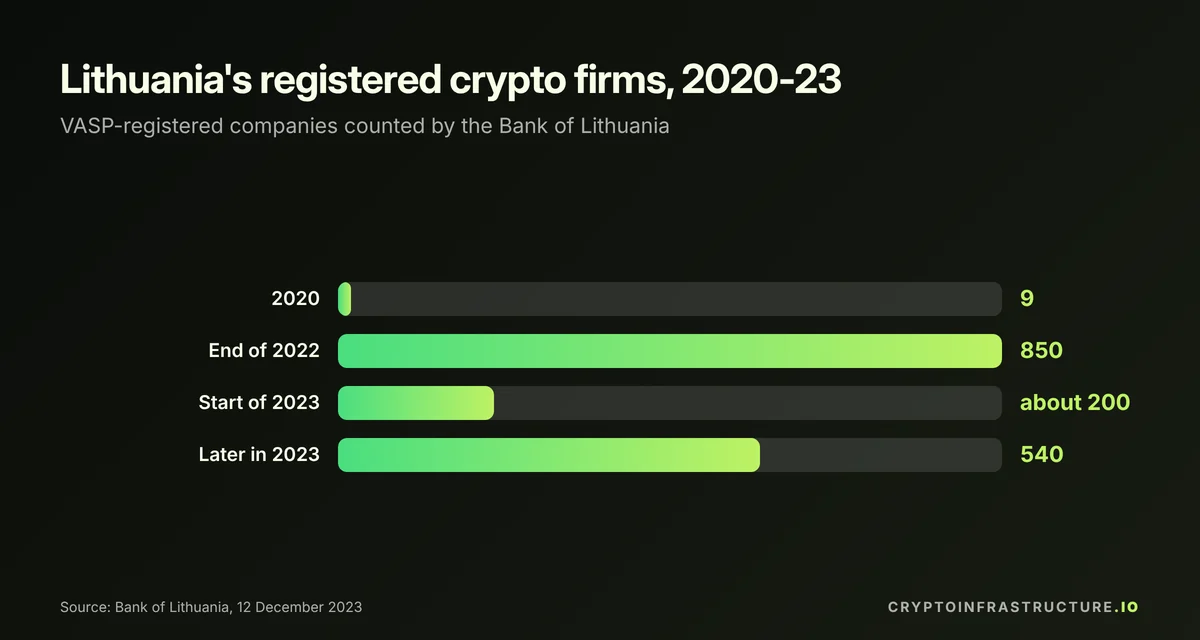
Before MiCA, Lithuania did not license crypto firms. Exchange operators and depository wallet operators registered with the State Enterprise Centre of Registers and were supervised for anti-money-laundering purposes by the FNTT. It was fast, which is why the sector grew so quickly. The Bank of Lithuania counted 9 such companies in 2020 and 850 at the end of 2022. After rules were tightened in 2022, the number fell to about 200 at the start of 2023 and climbed back to 540 later that year (Bank of Lithuania, 12 December 2023).
MiCA let member states keep pre-MiCA firms running “until 1 July 2026” at most, or shorten that period (Article 143(3)). Lithuania chose a shorter window. In early May 2025 the Seimas extended it so that firms had until the end of 2025 to get a licence (Bank of Lithuania, 30 May 2025). Consultant pages ranking for this keyword, including Legal Nodes and Prifinance, say the original cut-off had been 1 June 2025.
The end date held. On 10 December 2025 the FNTT published a notice that operators without a CASP licence by 31 December 2025 could no longer provide crypto services in Lithuania from 1 January 2026, and would have to change their activity, reorganise or liquidate. The FNTT notice (in Lithuanian) also set out what came next:
- On 2 January 2026 the Centre of Registers deregistered the VASP activity data in the Register of Legal Entities and stopped publishing the VASP lists.
- Former VASPs must keep anti-money-laundering records: 8 years for transaction and client-relationship records, 5 years for client correspondence.
- They had three extra months from 1 January 2026 to file outstanding suspicious transaction reports and reports on crypto transactions of EUR 15,000 or more, after which their access to the FNTT reporting system was revoked.
- Providing financial services without a licence is a crime under Article 202 of the Criminal Code, punishable by up to four years in prison, or up to seven years where the damage to the state is very large. Companies can be liable too.
The scale of the shake-out was large. In July 2025 the Bank of Lithuania said more than 370 companies had declared crypto services to the Centre of Registers, but only about 120 actually operated, meaning they earned revenue and filed financial statements. About 30 had applied for a CASP licence at that point. It told the rest to start winding down early, return client assets before losing the right to operate, and give clients step-by-step instructions for moving funds and crypto to another provider or a self-hosted wallet.
Was there an automatic conversion from VASP to CASP?
No. A VASP registration was an anti-money-laundering registration, not an authorisation, and nothing in the Bank of Lithuania or FNTT material converts one into the other. Every former VASP that wanted to continue had to apply for a CASP licence from scratch. Some vendor pages still describe VASP licences as “being converted” to CASP authorisations, or still sell VASP-registered shelf companies. As of 14 October 2026, a Lithuanian company whose only status is a former VASP registration has no right to provide crypto services in Lithuania or anywhere else in the EU.
Who needs a CASP licence in Lithuania?
Under MiCA Article 59, a business may provide crypto-asset services in the EU only if it is authorised as a CASP, or if it is an already-regulated financial institution allowed to provide them under Article 60. The services include custody and administration of crypto-assets for clients, operating a trading platform, exchanging crypto for funds or for other crypto, executing, receiving and transmitting orders, placing, transfer services, advice and portfolio management.
There are two routes in Lithuania (Bank of Lithuania, authorisation of CASPs):
- Licence (most new businesses): a company applies to the Bank of Lithuania and may start only once licensed.
- Notification (Article 60): banks, investment firms, e-money institutions, fund managers, central securities depositories and market operators already licensed for their core business notify the Bank at least 40 working days before starting crypto services, within the limits Article 60 sets for each type. For an e-money institution, that covers custody and transfer of the e-money tokens it issues itself. Two Lithuanian e-money institutions appear on ESMA’s register on this basis.
MiCA also requires a CASP to have its registered office in a member state where it carries out at least part of its services, its place of effective management in the EU, and at least one director resident in the EU (Article 59(2)).
Lithuania crypto licence requirements
The legal minimums come from MiCA, the Republic of Lithuania Law on Markets in Crypto-Assets and the Bank of Lithuania’s CASP licensing rules (Board resolution No 03-157). What decides an application in practice is the Bank’s own expectations.
Company and substance
Applicants set up a Lithuanian company, usually a UAB (uždaroji akcinė bendrovė), the private limited liability company that is Lithuania’s equivalent of an LLC. The Bank of Lithuania says licences go only to firms with a real operating centre in Lithuania, not “empty-shell” companies. In its published expectations (first issued 22 August 2024) it says it will check whether an applicant has no real activity, has outsourced most key operational and control functions, or could not control those processes.
A question-and-answer document from Invest Lithuania’s Kurk Lietuvai programme (August 2024), based on a roundtable with Bank of Lithuania representatives, gives more detail on what the Bank expects. Treat it as guidance, not law:
- As many staff as possible hired in or living in Lithuania, especially in AML and compliance, risk and IT security.
- At least some key managers with decision-making power living in Lithuania, or equivalent governance and reachability shown another way.
- At application stage, at least a head of the management board or administration, an MLRO and a chief compliance officer (or chief risk officer), with a CISO recommended. No fixed headcount: it depends on the business model and scale.
- A management board is mandatory under the Lithuanian law.
Capital
MiCA sets permanent minimum capital by the heaviest service you are licensed for (MiCA, Article 67 and Annex IV):
- Class 1, EUR 50,000: executing orders, placing, transfer services, receiving and transmitting orders, advice and portfolio management.
- Class 2, EUR 125,000: class 1 plus custody and administration, and exchanging crypto for funds or other crypto.
- Class 3, EUR 150,000: class 2 plus operating a trading platform.
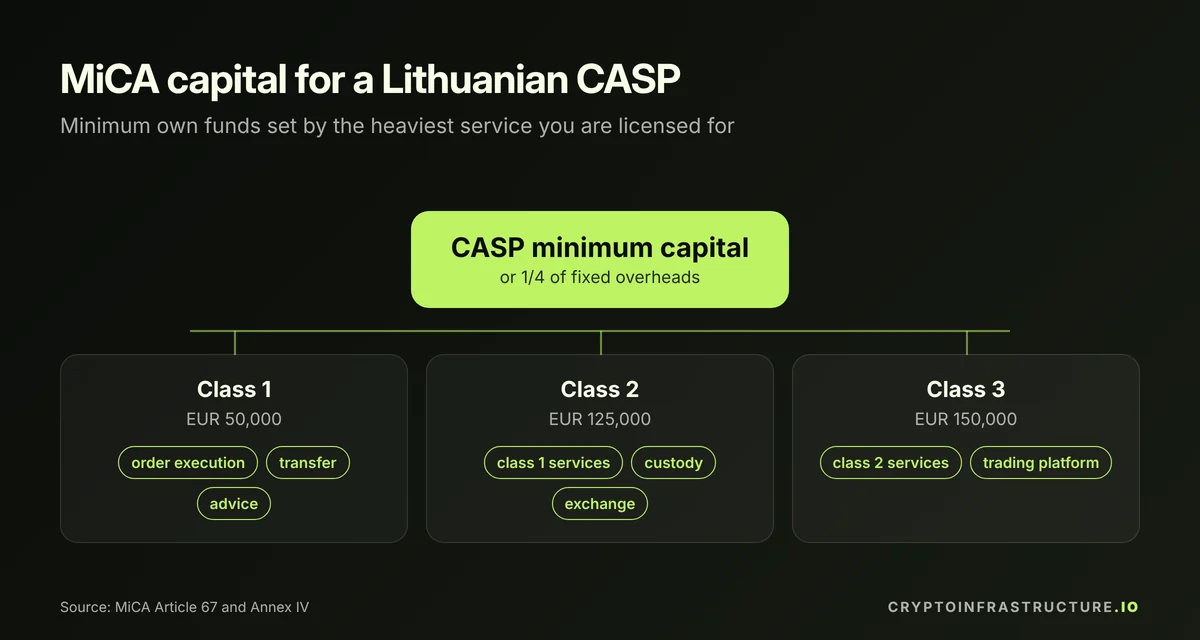
The requirement is the higher of that figure or a quarter of the previous year’s fixed overheads (projected overheads in year one). The Invest Lithuania document stresses that the test is on own funds, not paid-up share capital: share capital does not have to sit frozen in a bank account, but you must stay above the requirement as losses eat into equity. The Bank asks for prudential tables with three-year forecasts. Some ranking pages still quote EUR 125,000 as a flat “Lithuania crypto licence” capital figure (Icon.Partners calls it the previous VASP-era minimum). Under MiCA it is only the class 2 floor.
Policies and documents
The Bank of Lithuania’s licensing rules list seven annexes to the application: the application form, programme of operations, organisational structure and internal control, AML prevention, ICT risk management, outsourcing and ICT risk, and (for trading platforms) the operation of the platform. Financial data goes in on the Bank’s Excel prudential and reporting templates, some of them only in Lithuanian. The Bank says it focuses on the shareholder structure and good repute, the source of shareholders’ funds, the financing structure, and the repute and qualifications of managers. For the tooling side of AML, Travel Rule and sanctions screening, see the crypto compliance guide.
How much does a crypto licence cost in Lithuania?
Separate what goes to the state, what you must hold, and what you pay advisers.
| Cost layer | Amount (as of 14 October 2026) | Status |
|---|---|---|
| State fee to issue a CASP licence | EUR 2,425 | Official: Resolution No 1458, item 3.157.1, consolidated version in force from 3 October 2026 |
| State fee to amend the licence | EUR 272 | Official: item 3.157.2 |
| Annual supervisory contribution | Set each year by Bank of Lithuania resolution (No 03-115 of 14 October 2024 covered 2025) | Amount not verified for this article |
| Minimum capital (held, not spent) | EUR 50,000 / 125,000 / 150,000, or a quarter of fixed overheads if higher | Official: MiCA |
| Turnkey licensing package | EUR 10,000 to EUR 25,000 | Consultant quote (Icon.Partners) |
| Shelf company “with crypto licence” | EUR 12,500 without a bank account, EUR 15,000 with one | Consultant quote (Baltic Legal); describes the old model, see red flags |
The Bank of Lithuania’s FAQ confirms the state fee is set in Resolution No 1458, and Inteliumlaw’s page gives the same EUR 2,425 figure. Most of your real budget sits elsewhere: local senior staff, compliance and IT security officers, an office, audited financial statements, systems for DORA and the Travel Rule, and the capital above. A worked minimum for a custody-and-exchange business, using only official figures: EUR 2,425 paid to the state plus at least EUR 125,000 held as own funds, before a single salary.
Is there a free crypto licence in Lithuania?
No. Issuing a CASP licence carries a EUR 2,425 state fee, and MiCA capital applies to every licensed firm. Offers of a “free” or ready-made Lithuanian crypto licence usually refer to old VASP-registered companies, which gave no right to operate after 31 December 2025.
How long does it take?
MiCA Article 63 sets the clock, and the Bank of Lithuania repeats it: 25 working days to check whether your application is complete, then 40 working days to assess a complete application and issue a reasoned decision. The Bank can ask for more information until the 20th working day of the assessment, which pauses the clock for up to 20 working days. The clock only starts on a complete file, so the statutory total of roughly three to four months is a floor, not a forecast.
Consultant estimates are longer: Prifinance says 5 to 7 months in practice, Inteliumlaw 6 to 12 months. These are vendor estimates, not regulator commitments.
What the approval record shows
This is the part most ranking pages leave out. Lithuania was home to hundreds of registered crypto firms, yet the Bank of Lithuania has licensed very few:
| Firm (brand) | Licence date | Services on the ESMA register (summary) |
|---|---|---|
| Robinhood Europe, UAB (Robinhood) | 29 May 2025 | Custody, order execution, reception and transmission, transfer |
| UAB “Decentralized” (CoinGate) | 16 December 2025 | Custody, crypto-to-funds and crypto-to-crypto exchange, transfer |
| Nuvei Liquidity, UAB (Simplex) | 16 December 2025 | Custody, crypto-to-funds and crypto-to-crypto exchange, transfer |
| UAB Micar assets (Myriad Capital) | 26 February 2026 | Custody, exchange, order execution and other services |
Bank of Lithuania licence list and ESMA interim MiCA register, both checked 14 October 2026. ESMA’s CASP file had 370 entries across the EU and EEA that day, 6 of them with Lithuania as home state (the 4 above plus BLUE EMI and Newrails, which provide crypto services for their own e-money tokens under Article 60(4)). By comparison it listed 103 for Germany and 36 for France.
The rejection pressure is explicit. On 27 October 2025 the Bank said nearly 50 companies had applied that year, some several times after being refused, and only one had been licensed. Arūnas Raišutis, director of its Legal and Licensing Department, said most applicants arrived without being sufficiently prepared, and that recent applications did not meet even minimum requirements (Bank of Lithuania, translated). Robinhood, the first licensee, had received a Bank of Lithuania Category A financial brokerage licence in early April 2025, weeks before its CASP licence. The Robinhood ownership guide covers the group behind it.
The lesson for applicants: Lithuania is no longer the volume route into Europe. It rewards firms with real local teams and a finished application, and it refuses the rest.
Passporting: what a Lithuanian CASP licence lets you do in the EU
A Bank of Lithuania CASP licence is a full MiCA authorisation, so it can be used across the EU. Under MiCA Article 65 you notify the Bank which member states you want to serve, which services, the start date, and any other activities not covered by MiCA. The Bank passes this to the host countries, ESMA and the EBA within 10 working days, and you may start from the date it tells you it has done so, or at the latest from the 15th calendar day after your notification. The Bank of Lithuania publishes a template for these cross-border notifications.
Three of the four Lithuanian CASPs list passport notifications covering the other EU and EEA states on ESMA’s register. Two limits apply: the passport covers only the services in your licence, and host countries can still enforce their own consumer, marketing and tax rules. Firms outside the EU cannot use a Lithuanian licence held by someone else; reverse solicitation under Article 61 is narrow.
Crypto tax in Lithuania, in brief
The licence does not settle tax. Ranking pages disagree on Lithuania’s corporate income tax rate: Prifinance says 17% from 2026 (16% in 2025), Icon.Partners says 15% as of 2025, and Inteliumlaw gives 16% in its text and “6 to 17%” in a table. For individuals, Legal Nodes cites a EUR 2,500 annual exemption for non-business gains and progressive rates from 2026. None of these figures was confirmed against the State Tax Inspectorate (VMI) for this article, so confirm current rates with VMI or a Lithuanian tax adviser before you model the business. For how tax treatment differs between countries, see how crypto is taxed.
Step by step: applying to the Bank of Lithuania
- Decide your services and class. Custody or exchange puts you in class 2; a trading platform puts you in class 3. Check whether you could use the Article 60 notification route instead.
- Build substance first. Hire the board, MLRO, compliance and risk leads, and line up an office in Lithuania before you file.
- Set up the UAB and fund it. Plan own funds above the MiCA minimum for three years, under a realistic and a pessimistic scenario.
- Prepare the full file. The seven annexes, Excel prudential and reporting tables, fit-and-proper questionnaires, and AML, ICT and outsourcing policies.
- Submit and answer questions. Expect the 25 plus 40 working-day clock to stop for information requests.
- Pay the EUR 2,425 state fee and receive the decision.
- Notify passports under Article 65 for each EU country you will serve.
Red flags when someone sells you a Lithuanian crypto licence
- Shelf companies “with a crypto licence”. A former VASP registration gives no right to operate since 1 January 2026. Buying one buys a company, not a licence.
- “VASP licences convert to CASP”. They don’t. Every licence is a new application.
- FCIS registration as the licence. The FNTT supervises AML; the Bank of Lithuania issues the licence.
- EUR 125,000 quoted as the only capital figure. MiCA uses three classes and an overheads test.
- Timelines in weeks or guaranteed approval. The statutory clock alone is 65 working days after a complete file, and by late October 2025 the Bank had licensed one of nearly 50 applicants that year.
- Undated fee tables. Ask for the Resolution No 1458 line and the date checked.
What this means for you
If you held a Lithuanian VASP registration and did not get a CASP licence, that status ended on 31 December 2025, and serving clients without a licence now carries criminal risk. If you are choosing Lithuania for a new EU crypto business, budget for a real Vilnius team and MiCA capital first, treat the EUR 2,425 state fee as a rounding error, and read the approval record before you commit: four licences since May 2025 is a regulator screening hard, not a closed door.
Compare Lithuania with other EU and non-EU routes in the VASP licence guide, and find compliance providers in the KYC/AML & Compliance section, assessed under the site’s methodology. Regulatory deadlines that move month to month are tracked in the regulation roundup.