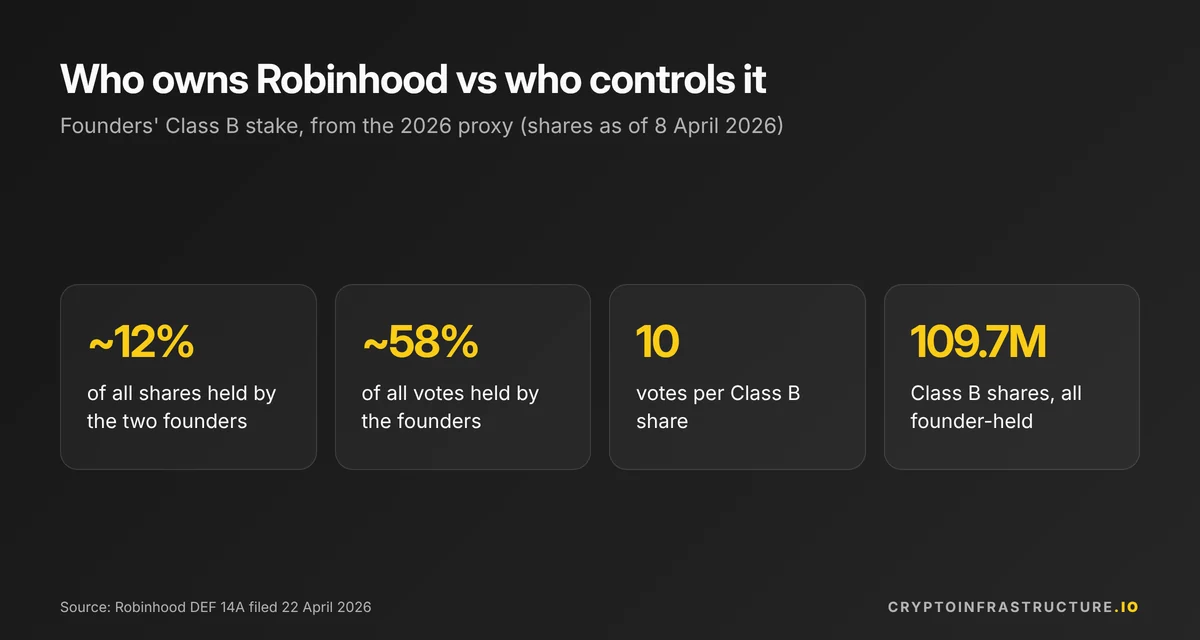
Robinhood is owned by its public shareholders, but it is controlled by its two co-founders. Robinhood Markets, Inc. trades on Nasdaq as HOOD and has two voting share classes. In the 2026 proxy statement (share data as of 8 April 2026), Vlad Tenev and Baiju Bhatt hold every one of the 109.7 million Class B shares, which carry ten votes each.
That gives them about 12% of the shares but 58% of the votes, tied together by a Founders’ Voting Agreement. Vanguard (about 11.9% of Class A) and BlackRock (7.0% of Class A) are the largest outside holders. The crypto business runs through Robinhood Crypto, LLC in the US, a MiCA-licensed Lithuanian subsidiary in the EU, Bitstamp (bought 2 June 2025) and WonderFi in Canada (bought 1 June 2026).
If you use Robinhood for crypto, “who owns Robinhood?” is a practical question. Who controls the company decides how it treats customers, how it answers regulators and which crypto products it builds. Many explainers stop at “it’s a public company” or list institutional holders from a data feed. The figures below come from Robinhood’s own SEC filings, each dated to the filing it comes from.
Last updated 14 October 2026. Ownership figures are dated to the filing they come from. This is not investment advice and says nothing about whether HOOD shares are worth buying.
Who owns Robinhood? The short answer
Robinhood Markets, Inc. is a publicly traded company owned by its shareholders, and its co-founders Vlad Tenev (Chairman, CEO and President) and Baiju Bhatt (director) control the shareholder vote. According to the 2026 proxy statement, filed with the SEC on 22 April 2026, Robinhood had 791,086,666 Class A shares and 109,745,620 Class B shares outstanding on 8 April 2026, and no Class C shares.
- Class A shares trade on Nasdaq and carry one vote each.
- Class B shares carry ten votes each and do not trade. The founders and their related entities hold all of them.
- Class C shares are authorised but none were outstanding. They would carry no vote.
So Robinhood is not owned by one person or one fund. Economic ownership is spread across index funds, other institutions, insiders and individual investors. Voting control sits with two people.
Is Robinhood owned by Citadel?
No. Citadel Securities is one of the market makers that Robinhood routes customer orders to and that pays Robinhood for that order flow. It is a trading counterparty, not a controlling owner, and it does not appear among the principal stockholders in Robinhood’s 2026 proxy.
Robinhood ownership table (2026 proxy)
The table shows the holders named in the proxy’s beneficial ownership table, plus Vanguard, which the proxy covers in a separate note. “% of class” means that holder’s share of Class A or Class B. “% of votes” is the proxy’s own figure, except where marked as calculated.
| Holder | Class A shares | Class B shares | % of votes | Data as of |
|---|---|---|---|---|
| Baiju Bhatt, co-founder and director | 3,579 | 61,076,048 (55.7% of Class B) | 32.0% | 8 April 2026 |
| Vlad Tenev, co-founder, Chairman, CEO and President | 6,907 | 49,234,651 (44.9% of Class B) | 26.1% | 8 April 2026 |
| All 14 current directors and executive officers as a group | 11,689,215 (1.5%) | 109,745,620 (100%) | 58.6% | 8 April 2026 |
| Vanguard Group subsidiaries (combined) | about 94,436,459 (11.9%) | None | about 5.0% (calculated) | Company estimate in the April 2026 proxy |
| BlackRock, Inc. | 55,763,578 (7.0%) | None | 3% | 30 September 2025, per its 13G/A filed 17 October 2025 |
| Meyer “Micky” Malka, director (founder of Ribbit Capital) | 10,153,086 (1.3%) | None | 0.5% | 8 April 2026 |
Source: Robinhood Markets, Inc. DEF 14A filed 22 April 2026, “Beneficial Ownership of Principal Stockholders and Management”. Vanguard’s voting share is calculated here from the proxy’s share counts (Class A votes plus ten votes per Class B share). The 565,079 Class B shares held by the Bhatt Family LLC appear in both founders’ rows, because Tenev votes them and Bhatt’s side holds the investment power.
Why Vanguard shows up only in a footnote
Vanguard filed a Schedule 13G/A on 27 March 2026 reporting zero voting and dispositive power as of 13 March 2026, after an internal realignment. Its subsidiaries now report their holdings separately. Robinhood says it believes those subsidiaries together own about 94.4 million Class A shares, or 11.9% of that class. That makes Vanguard the largest outside economic holder, even though no single Vanguard entity appears in the main table. Index funds like these generally hold shares on behalf of their own fund investors.
How much of Robinhood do the founders own?
About 12% of the shares and over half the votes. Robinhood’s 10-K for 2025 says that as of 31 December 2025 “our founders and their related entities hold approximately 12% of our outstanding common stock” and over 50% of the voting power. Using the proxy’s April 2026 share counts, the 109.7 million Class B shares are about 12.2% of all shares but about 58% of all votes. Individually, Bhatt’s shares work out to roughly 6.8% of the company and Tenev’s to roughly 5.5% (calculated from the proxy).
The Class B count fell slightly to 108,452,039 by 23 July 2026, according to the cover of the 10-Q for the quarter to 30 June 2026. Class A stood at 790,630,234. Class B shares convert to Class A when sold or transferred (with some permitted exceptions), so founder share sales slowly reduce their voting weight.
How the founders keep control: the Founders’ Voting Agreement
Tenev and Bhatt signed a voting agreement in connection with Robinhood’s IPO, and the company is a party to it. Under the agreement, as described in the 2026 proxy, the founders and their related entities agree to:
- vote all their shares to elect each co-founder to the board and against removing either of them;
- vote together on other directors, deferring to the board’s Nominating and Corporate Governance Committee if the two disagree;
- make sure all their shares are present and voted at stockholder meetings.
Some family trusts and estate-planning vehicles have given irrevocable proxies to one founder or the other. For example, Bhatt holds sole voting power over 6,230,731 Class B shares in The Tenev 2017 Irrevocable Trust, and Tenev votes the Bhatt Family LLC’s shares. Each founder has also granted the other a voting proxy that takes effect on his death or permanent disability. The proxy says the parties “may be deemed to constitute a group” under securities law.
The control has limits built into the charter, as described in the 10-K. A founder’s Class B shares convert to Class A nine months after his death or total disability, a delay that the independent directors can extend to up to 18 months. Transfers outside the permitted list also trigger conversion.
What dual-class control means for you as a customer
Ordinary shareholders cannot outvote the founders on board seats or strategy while the Class B shares stay at roughly 58% of the vote. The board that oversees strategy, including crypto, prediction markets and tokenised stocks, is elected with the founders’ votes. That does not change your legal relationship as a customer. Your account sits with a regulated subsidiary, not with the parent’s shareholders, so the next sections cover those subsidiaries.
Who are the people behind Robinhood?
Who is the CEO of Robinhood? Vlad Tenev. The proxy lists him as Chairman, CEO and President. Forbes lists Tenev and Bhatt as the founders, in 2013, with headquarters in Menlo Park, California.
Is Baiju Bhatt still at Robinhood? He stepped back from his executive role in March 2024, according to Forbes (29 July 2025), and he remains a director and the largest holder of Class B votes in the 2026 proxy.
Is Baiju Bhatt a billionaire? Forbes put his net worth at $6.7 billion and Tenev’s at $6.1 billion in its 29 July 2025 feature. Those figures move with the share price, so treat them as a snapshot from that date.
Micky Malka, founder and managing partner of Ribbit Capital, sits on the board with 1.3% of Class A as of 8 April 2026. Forbes estimated in July 2025 that Malka had profited by more than $5 billion on his Robinhood stake.
What kind of company is Robinhood?
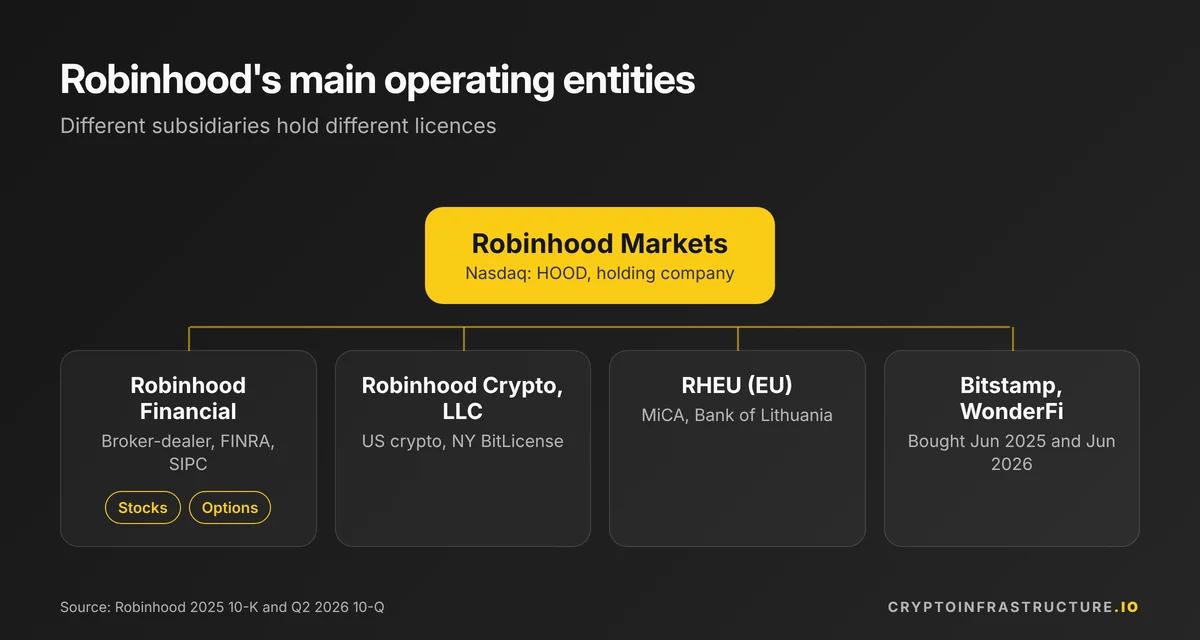
Robinhood Markets, Inc. is a holding company. Different subsidiaries hold different licences, which matters when you want to know who is responsible for your money or your coins. The first three entities below are named on Robinhood’s US legal page; the rest come from its SEC filings:
| Entity | What it does | Main regulation |
|---|---|---|
| Robinhood Financial LLC | Stock and options brokerage | Registered broker-dealer, FINRA and SIPC member |
| Robinhood Securities, LLC | Clearing | Registered broker-dealer, SIPC member |
| Robinhood Crypto, LLC | US crypto trading and custody | State money transmitter licences and a New York virtual currency licence (see below) |
| Robinhood’s EU subsidiary (RHEU in the 10-K) | Crypto and brokerage services in the EU | Bank of Lithuania (MiCA crypto-asset service provider licence), per the 2025 10-K |
| Bitstamp | Crypto exchange for retail and institutional customers | Acquired 2 June 2025, per the 2025 10-K |
| WonderFi | Canadian digital asset products | Acquired 1 June 2026, per the Q2 2026 10-Q |
SIPC membership is listed for the broker-dealers, not for Robinhood Crypto, LLC. For how protections differ at a crypto-native exchange, see Is Coinbase Safe?
Is Robinhood Crypto FDIC or SIPC insured?
No. SIPC protects securities and cash held at SIPC-member broker-dealers, and Robinhood lists that membership for Robinhood Financial and Robinhood Securities only. Crypto held with Robinhood Crypto, LLC is not a security held at those broker-dealers and is not a bank deposit, so neither SIPC nor FDIC cover applies to it.
Robinhood’s crypto arm: entities, licences and acquisitions
Robinhood Crypto, LLC (United States)
Robinhood Crypto’s licences and disclosures document (dated 28 October 2025, checked 14 October 2026) lists licences in 31 states and territories, including:
- New York: Virtual Currency License 0000012 (the BitLicense) and Money Transmitter License MT104190;
- Louisiana: Virtual Currency Business Activity License 1702840;
- money transmitter or equivalent licences in states including Florida, New Jersey, Washington, Ohio and Georgia, plus Washington DC and Puerto Rico.
Many states, including California and Texas, do not appear on that list. The document does not say whether Robinhood is exempt there or relies on another arrangement, so check your own state in the app’s disclosures. The 2025 10-K also says Robinhood expects to apply for a licence under California’s Digital Financial Assets Law for its crypto trading there.
Robinhood in the EU (via Lithuania)
The 10-K filed on 18 February 2026 says Robinhood’s EU subsidiary, RHEU, “holds a MiCA license issued by the Bank of Lithuania” and is regulated there as a financial brokerage firm and crypto-asset service provider. It offers crypto services to eligible customers in select EU jurisdictions. The same filing says EU customers could trade 74 cryptocurrencies, where available, with staking on selected assets and perpetual futures for eligible traders.
Bitstamp
Robinhood “acquired all outstanding equity of Bitstamp” on 2 June 2025, according to the 10-K. The fair value of what it paid was about $224 million in cash after purchase price adjustments. Some press coverage, including Forbes in July 2025, uses the earlier $200 million headline figure. Bitstamp brought institutional crypto services such as on-exchange lending, off-exchange settlement and perpetual futures, and the 10-K flags new credit risk from some of its liquidity-provider customers.
WonderFi (Canada)
Robinhood acquired WonderFi on 1 June 2026, describing it in its 10-Q as “a Canadian leader in digital asset products and services”. WonderFi’s completion announcement gives the price as C$0.36 a share, about C$250 million; The Block reported it as about US$180 million on 1 June 2026.
How does Robinhood make money on crypto?
Mainly through what it calls Transaction Rebates. Robinhood’s Q2 2026 10-Q explains that it routes customers’ crypto orders to market makers and other liquidity providers, and “With respect to cryptocurrency trading, currently we receive ‘Transaction Rebates.'” For stocks and options the same arrangement is called payment for order flow. Since June 2025 the crypto figures also include Bitstamp.
| Period | Crypto transaction revenue | Share of total net revenues |
|---|---|---|
| Q2 2025 (three months to 30 June 2025) | $160 million | 16% |
| Q2 2026 (three months to 30 June 2026) | $100 million | 8% |
| First half of 2026 | $234 million (down from $412 million) | 10% |
Source: Robinhood 10-Q for the quarter ended 30 June 2026, filed 30 July 2026.
Robinhood gave three reasons for the drop: lower rebate rates from crypto market makers, fewer users placing crypto trades (down 16% year on year in Q2) and lower average volume per trader, partly offset by Bitstamp. Event contracts (prediction markets) brought in $156 million in the same quarter, more than crypto. Customer crypto held on the platform was $26.3 billion at 30 June 2026, against $41.1 billion a year earlier.
How much does Robinhood charge to sell crypto?
The filings describe US crypto revenue as rebates paid by the liquidity providers that fill your orders, not as a separate commission line. In practice, that means your cost is built into the price you are quoted rather than listed as a fee next to the order. Before you confirm a trade, compare the quoted price with prices elsewhere. To see how that compares with fee-based exchanges, see the best crypto exchanges in the USA.
Regulation and enforcement record
Robinhood’s record includes several large settlements, one of them against the crypto subsidiary itself. These are the main actions found for this article, checked 14 October 2026.
| Date | Regulator | Entity | What it was about | Outcome |
|---|---|---|---|---|
| 2 August 2022 | NYDFS | Robinhood Crypto, LLC | Weak anti-money-laundering programme, an inadequate manual transaction monitoring system, cybersecurity gaps and improper compliance certifications | $30 million penalty plus an independent consultant |
| Q2 2024 to 21 February 2025 | SEC | Robinhood Crypto, LLC | Wells Notice after staff questioned whether some listed tokens were securities, proposing action for alleged violations of Sections 15(a) and 17A of the Exchange Act | Investigation closed on 21 February 2025 with no action recommended, per the 10-K |
| December 2024 | Nebraska Department of Banking and Finance; Massachusetts Division of Banks | Robinhood (unnamed subsidiary in the 10-K) | Prior unlicensed activity | Fines and consent orders, per the 10-K |
| 13 January 2025 | SEC | Robinhood Securities and Robinhood Financial | Late suspicious activity reports, identity-theft controls, a 2021 data breach response, record-keeping and Regulation SHO failures | $45 million combined penalties |
| 7 March 2025 | FINRA | Robinhood Financial and Robinhood Securities | “Collaring” market orders, anti-money-laundering and identity checks, supervision of clearing technology and paid influencers | $29.75 million: $26 million fine and $3.75 million customer restitution, without admitting or denying |
| 15 September 2026 | US Attorney, Southern District of New York | Two former Robinhood engineers (not the company) | Alleged trading of perpetual futures on Hyperliquid ahead of Robinhood Crypto listing announcements | Charged with commodities fraud and wire fraud; Robinhood said it reported the matter and is cooperating (The Block, 15 September 2026) |
FINRA settlement as reported by WealthManagement.com, 7 March 2025.
The Q2 2026 10-Q lists open inquiries too. The New York Attorney General is looking into brokerage execution quality and order “collaring”. The Massachusetts Securities Division is examining customer complaint supervision, the 4 to 5 August 2024 overnight trading outage, and Robinhood’s presidential election and sports event contracts. FINRA is also investigating that outage, and the FDIC is looking at compliance with the Electronic Fund Transfer Act. None of these had a published outcome in the filing. For the wider US rule changes that will shape Robinhood’s crypto products, see the CLARITY Act explainer and the October 2026 regulation roundup.
What this means for you
As of 14 October 2026, Robinhood is a public company that two founders control through ten-vote Class B shares: about 12% of the equity and about 58% of the votes. Vanguard and BlackRock are the largest outside holders, with no say over board control. For your crypto, ownership matters less than the entity that holds it. In the US that is Robinhood Crypto, LLC, licensed in New York and dozens of states and fined $30 million by NYDFS in 2022.
In the EU it is Robinhood’s Lithuanian subsidiary under a MiCA licence from the Bank of Lithuania. Bitstamp and WonderFi serve other markets. Robinhood earns most of its crypto revenue from market-maker rebates, so check the quoted price, not just the absence of a fee. When the founders’ share sales or the next proxy change these numbers, the dates above tell you how current they are.
Compare how other US platforms are licensed and run in the Exchanges section.