In the US, UK, India, Canada and Australia, crypto is taxed as an asset, not as money. Two things create tax: disposing of crypto (selling it, swapping it for another coin, spending it or, in most places, giving it away) and receiving crypto as income (pay, staking, mining, many airdrops). Buying and holding is not taxed in any of the five. What differs is the rate: as of 14 October 2026 the US taxes long-term gains at 0%, 15% or 20%, the UK at 18% or 24% above a £3,000 allowance, India at a flat 30% with no loss relief, Canada on half of each capital gain, and Australia at your marginal rate with a 50% discount after 12 months.
You bought some crypto, maybe swapped it, maybe earned a little from staking, and now you want to know what you owe. The confusing part is that most pages ranking for “how is crypto taxed” answer only for the US, quote 2022 to 2024 tax brackets, and say nothing about Form 1099-DA, the broker form that arrived for 2025 transactions. This guide starts with the principles all five countries share, then gives a dated section and a summary table for the US, UK, India, Canada and Australia, each built from the tax authority’s own guidance checked on 14 October 2026.
How is crypto taxed? The short answer
Crypto is taxed as property or as an asset. You pay tax when you dispose of it at a gain, and you pay income tax when you receive it as income. The IRS puts it plainly: “For U.S. tax purposes, digital assets are considered property, not currency.” The UK, India, Canada and Australia reach the same place by different routes, which is why the same three ideas work everywhere: disposal events, income events and cost basis.
The three principles that apply in all five countries
1. Disposal events trigger tax on gains
A disposal is any time crypto leaves your ownership in exchange for something. The tax authorities’ own lists overlap almost exactly:
- Selling for cash (dollars, pounds, rupees or any other currency).
- Swapping one crypto for another. This catches many people. Trading Bitcoin for Ether is a disposal of the Bitcoin even though no cash reaches your bank. So yes, you pay tax on crypto if you reinvest the profit into another coin.
- Spending crypto on goods or services.
- Giving it away, with exceptions (the UK, for example, exempts gifts to a spouse, civil partner or charity).
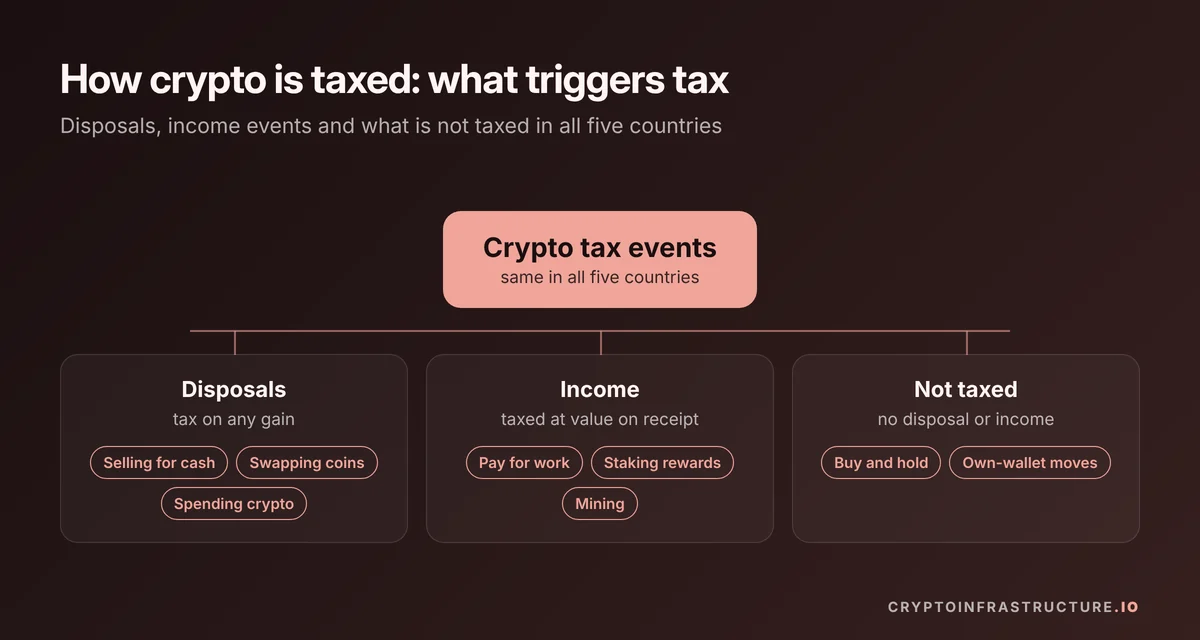
Moving coins between wallets you own is not a disposal in the IRS or CRA guidance, though the IRS notes that paying a network fee in crypto can itself be a disposal.
2. Income events are taxed when you receive the crypto
Crypto you are paid for work, or earn from staking or mining, is generally income at its market value when it arrives. The IRS lists payment for services, rewards, mining, staking and hard fork airdrops as income. HMRC taxes the sterling value of non-trading staking rewards “at the time of receipt” as miscellaneous income. The ATO says staking rewards are “ordinary income at the time you receive the tokens.” The CRA treats rewards from a centralized platform as income when they are credited to your wallet.
The value you were taxed on then becomes your cost. If you later sell those tokens for more, the increase is a capital gain, so the same token can be taxed twice in two different ways.
3. Cost basis decides how big your gain is
Your gain is what you received minus what the crypto cost you (the cost basis, or cost base, or adjusted cost base, depending on the country). Each country has its own rules for which coins you are treated as selling: the UK pools each token type at an average cost and adds same-day and 30-day matching rules, and Canada uses an adjusted cost base made up of what you paid plus acquisition expenses. Get the cost wrong and every number after it is wrong.
Do you pay taxes on crypto if you don’t sell?
Not on price rises alone. In all five countries, buying crypto with cash and holding it creates no tax, however much it goes up. You can still owe tax without selling for cash if you swapped coins, spent crypto, or received crypto as income from staking, mining, airdrops or your job. Tax is also triggered by the disposal, not by withdrawing cash to your bank: if you sold inside an exchange, the gain arose on the day of the sale.
Crypto tax rates by country (as of 14 October 2026)
| Country | Tax on gains | Tax-free amount or discount | Losses | Income (staking, mining, pay) |
|---|---|---|---|---|
| United States | Short-term (held 1 year or less): ordinary income rates. Long-term: 0%, 15% or 20% | 0% long-term band up to $48,350 taxable income (single, 2025) | Offset gains, then up to $3,000 a year against other income, rest carried forward | Ordinary income at fair market value on receipt |
| United Kingdom | Capital Gains Tax at 18% or 24% | £3,000 annual exempt amount (2025-26 and 2026-27) | Reduce gains; claim rules in the UK guide | Income Tax on sterling value at receipt |
| India | Flat 30% plus surcharge and cess on each transfer | None for the gain; only cost of acquisition is deductible | Cannot be set off against any income or carried forward | Not set out on the department’s VDA page; see the India guide |
| Canada | Half of the capital gain is added to income and taxed at your marginal rate; full profit if you are trading as a business | The other half of the gain is not taxed | Allowable capital losses only against taxable capital gains | Business income in most mining cases; platform staking rewards are income when credited |
| Australia | Net capital gain taxed at your marginal rate | 50% CGT discount if held at least 12 months; narrow personal use asset exemption under $10,000 | Offset capital gains only, not other income | Ordinary income at market value on receipt |
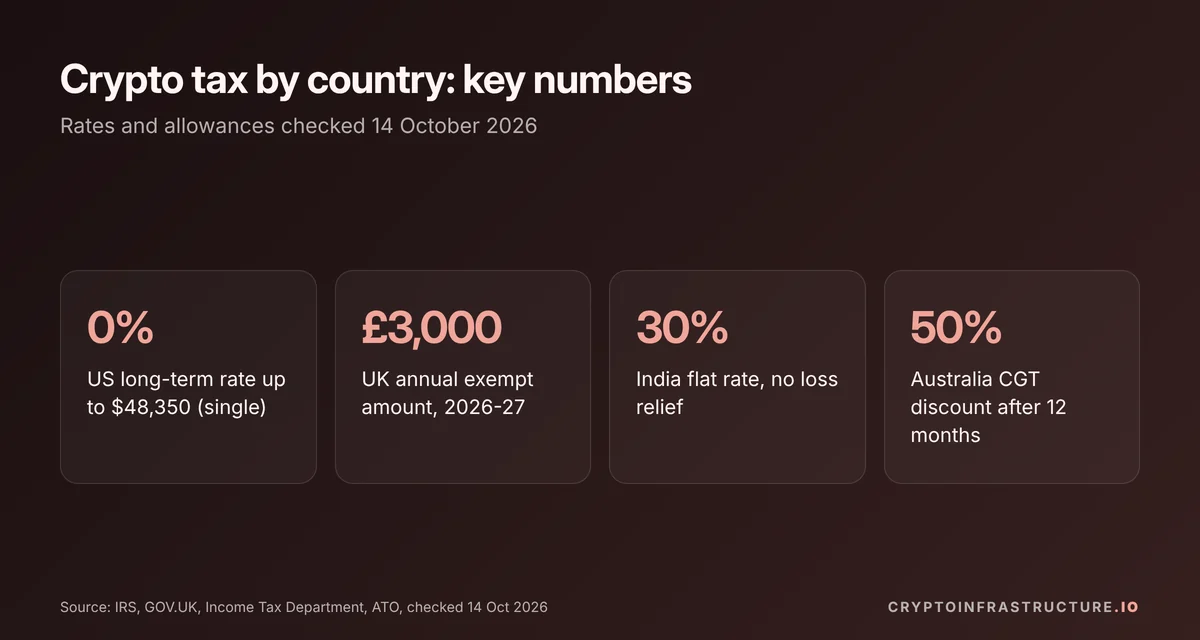
Sources: IRS, HMRC and GOV.UK, Income Tax Department of India, Canada Revenue Agency and Australian Taxation Office guidance pages, checked 14 October 2026. Rates are for individuals; companies follow different rules.
Will you be taxed on $1,000 of crypto profit?
It depends where you live, and the gap is wider than most people expect. Assume a 1,000 gain in your local currency, no other gains or losses, and no business activity:
- US: held over a year and your taxable income is under the 0% band, possibly nothing. Held a year or less, it is taxed at your ordinary income rate.
- UK: no CGT, because £1,000 is inside the £3,000 annual exempt amount.
- India: 30% of the gain plus cess (and surcharge at higher incomes), from the first rupee.
- Canada: 500 is added to your taxable income.
- Australia: held at least 12 months, 500 is added to your taxable income; held less, the full 1,000.
United States: IRS rules (checked 14 October 2026)
According to the IRS digital assets page (last reviewed 2 September 2026), digital assets are property. Selling, exchanging for other crypto or currency, spending, and paying a transfer fee in crypto can all be reportable disposals. Payment for services, rewards, mining, staking and hard fork airdrops are income.
How much tax do you pay on crypto in the US?
Gains on crypto held one year or less are short-term and taxed as ordinary income. Gains on crypto held more than one year are long-term. IRS Topic 409 (last updated 24 September 2026) gives these long-term thresholds for the 2025 tax year:
| Filing status (2025) | 0% up to | 15% up to | 20% above |
|---|---|---|---|
| Single | $48,350 | $533,400 | $533,400 |
| Married filing jointly | $96,700 | $600,050 | $600,050 |
| Married filing separately | $48,350 | $300,000 | $300,000 |
| Head of household | $64,750 | $566,700 | $566,700 |
Several of the top-ranking pages still show 2022, 2023 or 2024 thresholds. Topic 409 did not list 2026 thresholds when checked, so use the 2025 table for the return you filed in 2026 and check the IRS again before filing for 2026.
Net capital losses reduce other income by up to $3,000 a year ($1,500 if married filing separately), and the rest carries forward.
Form 1099-DA: does Coinbase report to the IRS?
Yes, the reporting has changed. Under the broker rules on the IRS page, brokers must report gross proceeds on Form 1099-DA for digital asset transactions on or after 1 January 2025, and cost basis for certain transactions on or after 1 January 2026. US custodial exchanges such as Coinbase fall under these broker rules, so expect a 1099-DA for sales made through them from 2025. Basis reporting only starts for certain transactions from 2026, so for 2025 sales your own records still decide the gain you report.
Do you have to report crypto on taxes, even small amounts?
Yes. Every Form 1040 asks the digital asset question, and you answer Yes if you received crypto as payment or reward, or sold, exchanged or otherwise disposed of it. The IRS says: “If you have digital asset transactions, you must report them whether or not they result in a taxable gain or loss.” There is no $600 (or any other) floor for reporting a gain. Gains and losses go on Form 8949, staking and mining income on Schedule 1, and business or contractor income on Schedule C.
United Kingdom: HMRC rules (checked 14 October 2026)
HMRC treats crypto as an asset. You dispose of it when you sell it, exchange it for a different cryptoasset, use it to pay for goods or services, or give it away (gifts to a spouse, civil partner or charity excepted), according to HMRC’s selling guidance last updated 5 October 2026.
| Tax year | CGT rates | Annual exempt amount |
|---|---|---|
| 2025-26 | 18% and 24% | £3,000 |
| 2026-27 | 18% and 24% | £3,000 |
Source: GOV.UK, Capital Gains Tax rates and allowances, checked 14 October 2026.
The rate you pay depends on your income. Each token type is pooled at an average cost, and tokens bought on the same day as a sale or within 30 days after it are matched first. Self Assessment returns have had a dedicated cryptoasset section from 2024-25 onwards, and HMRC runs a Cryptoasset Disclosure Service for unpaid tax from earlier years. Worked examples, the SA108 boxes and the draft 2027 DeFi and stablecoin rules are in the full UK crypto tax guide.
India: Income Tax Department rules (checked 14 October 2026)
India taxes crypto, NFTs and other virtual digital assets (VDAs) more harshly than the other four countries. The Income Tax Department’s VDA page sets income from transferring a VDA at “30% plus surcharge and cess,” with no deduction except the cost of acquisition. Holding period does not matter.
- No loss relief: a loss on one VDA cannot be set off against gains on another or against other income, and cannot be carried forward (as summarised by Taxguru, 26 November 2025, from section 115BBH).
- 1% TDS: the department’s TDS page says tax is deducted “at the rate of 1%” of the sale consideration, with no deduction where yearly consideration is up to Rs 10,000, or Rs 50,000 for a specified person. TDS is a credit against your final bill, not an extra tax.
- Platform reporting: the department publishes a guidance note on crypto-asset reporting obligations under section 509 of the Income-tax Act, 2025.
The full India crypto tax guide covers the old and new section numbers, worked examples and how to fill Schedule VDA.
Canada: CRA rules (checked 14 October 2026)
The CRA first asks whether your crypto activity is a business or a capital investment. Frequent trading, short holding periods, market knowledge and borrowing to trade point to business income, in which case the full profit is taxable. Otherwise a disposal is capital, and the CRA’s crypto transactions guidance (modified 3 December 2025) says “you must include half of your capital gains (known as taxable capital gains) in your income for the year.”
- Disposals: trading crypto for government currency or another crypto-asset, using it to buy goods or services (treated as barter), and gifting or donating it.
- Cost: the adjusted cost base is usually what you paid plus acquisition expenses.
- Losses: allowable capital losses reduce taxable capital gains only, not income from other sources.
- Mining and staking: the CRA says mining is “in most cases” a business, with income included when earned, and staking rewards from a centralized platform are income “at the time the rewards are credited.”
- Records: keep transaction-level records, including Canadian dollar values and wallet addresses, for at least six years from the end of the last tax year they relate to.
Australia: ATO rules (checked 14 October 2026)
The ATO lists these as disposals that trigger a CGT event: selling crypto, gifting it, trading or swapping it for another crypto asset, converting it to Australian or foreign currency, and buying goods or services with it (ATO crypto asset transactions, last updated 22 June 2026).
- Discount: resident individuals can reduce a capital gain by 50% if they held the asset for at least 12 months (ATO CGT discount page, 29 June 2026).
- Losses: “You can’t deduct a net capital loss from your other income.” Losses reduce capital gains only.
- Personal use exemption: a gain is exempt only if the crypto is a personal use asset and cost under $10,000. It does not apply if you held it mainly as an investment, or if you converted it to dollars or used a gift card, prepaid card or payment gateway to buy things.
- Staking and airdrops: staking rewards are ordinary income on receipt. Airdrops depend on why you got them: a reward for goods or services is income, while other airdrops may only create a CGT event when you dispose of the tokens (ATO, 19 August 2026).
- Data matching: the ATO matches what you report against crypto transaction and account data from designated service providers.
Common questions the ranking pages skip
Is crypto trading gambling for tax purposes?
No, not in the guidance from these five tax authorities. The IRS treats digital assets as property, and HMRC, the CRA and the ATO tax crypto disposals under capital gains or business income rules. In Canada, frequent trading can make your profits business income rather than capital gains, which is a different outcome, not a gambling exemption.
NFT taxes
NFTs follow the same disposal and income logic. India includes NFTs in its VDA definition, so the 30% rule applies. Whether a specific NFT sale is capital or business income depends on how often you trade, so creators and active traders should check the business income rules in their country.
Crypto tax loss harvesting
Selling at a loss to offset gains works in the US, UK, Canada and Australia within each country’s loss rules, and not at all in India. Watch the repurchase rules: in the UK, coins of the same type bought within 30 days of a sale are matched to that sale, so selling and buying straight back does not lock in the loss you expected.
How to avoid crypto taxes (legally)
There is no legal way to dispose of crypto at a gain without it counting, and not reporting is the expensive option now that brokers report to the IRS and the ATO matches exchange data. What you can do is use the rules as written: hold for more than a year in the US or at least 12 months in Australia, use the UK’s £3,000 allowance, offset losses where your country allows it, and keep records so you are not taxed on a gain you did not make. For which exchanges issue tax forms and how they compare on licensing, see the best US crypto exchanges guide.
How to work out your crypto tax: five steps
- Export every transaction from every exchange and wallet: buys, sells, swaps, spends, transfers, rewards and fees, with dates and local-currency values.
- Separate income from disposals. Staking, mining, airdrops and pay go in the income column at their value on receipt.
- Apply your country’s cost rules (for example UK pooling and 30-day matching, or the Canadian adjusted cost base).
- Apply rates, allowances and loss rules from the table above for the right tax year.
- Reconcile with what platforms report: Form 1099-DA in the US, the 1% TDS already deducted in India, and the data your tax authority already holds. Mismatches are easy for them to spot.
If you use DeFi lending or liquidity pools, look for your tax authority’s specific DeFi guidance (the ATO, for example, publishes a separate page on DeFi and wrapped tokens). The DeFi explainer covers how those protocols work.
What this means for you
The principles are the same in all five countries as of 14 October 2026: holding is free, swapping and spending are disposals, rewards are income, and your cost basis decides the gain. The rates are not. The same profit can cost nothing in the UK, a 0% long-term rate in the US, half-inclusion in Canada, a 50% discount in Australia, or a flat 30% with no loss relief in India. Reporting has also tightened, with US 1099-DA forms for 2025 onwards and platform data flowing to tax authorities elsewhere. If your situation involves business-level trading, DeFi or several countries, a local tax professional can check your figures before you file.
For the detail on two of these regimes, read Crypto Tax in the UK and Crypto Tax in India. To compare platforms on licensing and transparency, browse the Exchanges section, and see the site’s methodology for how sources are checked.


