Updated 14 October 2026, covering 15 September to 14 October 2026. The biggest change: the US Senate rejected cloture on the CLARITY Act (H.R. 3633) 49-50 on 15 September 2026, so US crypto market structure is now being set by the SEC and CFTC instead of Congress. In the EU, ESMA told regulators on 8 October 2026 that licensed crypto firms must wind down services in non-MiCA-compliant stablecoins within three months. The UK FCA opened its crypto authorisation gateway on 30 September 2026, with a 28 February 2027 application deadline. Dubai’s VARA licensed Kraken’s Payward FZCO on 6 October 2026, and India’s FIU-IND named 15 more unregistered offshore platforms on 9 September 2026.
Crypto regulation news moves faster than most summaries of it. If you run a crypto business, or you just want to know whether the platform you use is about to change, a list of headlines is not enough. You need to know what a regulator actually published, what is still only reported, and what date to put in your calendar. This monthly roundup covers the site’s six regions (US, EU, UK, UAE, Singapore and India) plus a short “other” section. Each item says what happened, what is confirmed and what is only claimed, why it matters, and what to watch next.
Updated 14 October 2026. Window covered: 15 September to 14 October 2026. Every item was checked against the regulator’s own release, register or vote record where one could be accessed; anything sourced only from press reports is labelled as reported.
Crypto regulation news at a glance (15 September to 14 October 2026)
| Region | Date | What happened | Status | Next date to watch |
|---|---|---|---|---|
| US | 15 Sep 2026 | Senate cloture vote on the CLARITY Act (H.R. 3633) fails 49-50 | Confirmed (Senate roll call vote 234) | Lame-duck session after the November 2026 midterms |
| US | 5 Oct 2026 | CFTC advance notice of proposed rulemaking on Regulation CTX and Regulation CAM | Confirmed (CFTC release 9307-26) | Comments close 60 days after Federal Register publication |
| EU | 1 to 2 Oct 2026 | ESMA response to the European Commission’s MiCA review consultation | Confirmed (ESMA document) | Commission’s MiCA review proposal |
| EU | 8 Oct 2026 | ESMA opinion: CASPs to wind down services in non-MiCA-compliant stablecoins | Confirmed (ESMA opinion) | About 8 January 2027 (three months after publication) |
| EU | 1 Oct 2026 | EU regulators said to be examining Binance’s EU set-up | Reported only | Any national regulator statement |
| UK | 30 Sep 2026 | FCA authorisation gateway for cryptoasset firms opens | Confirmed (FCA press release) | Apply by 28 Feb 2027; regime starts 25 Oct 2027 |
| UAE | 5 and 6 Oct 2026 | VARA licences for Rain MENA FZE and Payward FZCO (Kraken) | Confirmed (VARA register) | Kraken’s UAE launch “in the coming weeks” |
| Singapore | None in window | No new MAS crypto rule found in the window; stablecoin consultation reported on 1 Sep 2026 pending | Reported | Final MAS stablecoin framework |
| India | 9 Sep 2026 (just before window) | FIU-IND notices and takedown directions to 15 unregistered offshore VDA service providers | Confirmed (PIB release) | Standing Committee on Finance report on VDAs |
| Hong Kong | Early Oct 2026 | Government says a bill for four new crypto licence types will go in before end-2026 | Reported only | Bill text |
United States: Congress stalls, regulators move
Did the crypto legislation pass? No. The CLARITY Act failed in the Senate
What happened: On 15 September 2026 the Senate voted 49-50 on cloture on the motion to proceed to H.R. 3633, the Digital Asset Market Clarity Act. Cloture needs 60 votes, so the motion was rejected and the bill did not reach floor debate. The Senate roll call record lists it as vote 234, result “Rejected” (checked 14 October 2026). The bill would have set a federal framework for the offer and sale of digital commodities split between the SEC and CFTC.
Confirmed vs. claimed: The vote and tally are confirmed by the Senate record. Headlines calling the bill “dead” are a political judgement, not a procedural fact: the bill passed the House in July 2025 and has not been withdrawn. On 7 October 2026, House Financial Services Chair French Hill told Fox Business, as reported by Decrypt, that he still hopes to pass it in the lame-duck session, and that agency rules “fall short of what we have to do, which is have a legislative solution”.
Why it matters: Without a statute, the line between SEC and CFTC jurisdiction rests on agency interpretations and rulemaking that a future commission can revise. If your business model depends on a token being treated as a commodity rather than a security, that position is less durable than it would be under a law.
What to watch: Whether the bill returns in the lame-duck session after the November 2026 midterms.
CFTC opens rulemaking on crypto trading platforms
What happened: On 5 October 2026 the CFTC announced an advance notice of proposed rulemaking (ANPRM) on Regulation Crypto Asset Transactions (CTX) and Regulation Crypto Asset Markets (CAM). The release says it seeks “to establish a comprehensive regulatory framework comprised of fit-for-purpose rules” for leveraged, margined or financed retail commodity transactions involving crypto assets. One topic is codifying a subcategory of designated contract market called a “crypto asset market”. CoinDesk reported on 5 October 2026 that the ideas include proof-of-reserves requirements for platforms holding customer assets in omnibus accounts, and that Chairman Mike Selig is currently the sole commissioner.
Confirmed vs. claimed: This is an ANPRM, the step before a proposed rule. Several outlets called it “proposed rules”, which overstates it. Comments are due within 60 days of Federal Register publication; the CFTC release links a Federal Register notice dated 13 October 2026, which would put the close in mid-December 2026. Confirm the exact date in the notice before you plan around it. The CFTC also has no authority over spot crypto markets, so spot trading stays under state money transmission rules.
Why it matters: If you run or plan a US platform offering leverage or margin on crypto, this is the earliest point to shape the rules. Developers get a specific signal too: CoinDesk quotes Selig saying “a person should not have to register as an introducing broker simply because that person shipped code.”
What to watch: The comment deadline, then a formal proposed rule.
The SEC’s Regulation Crypto Assets is still out for comment
Outside this month’s window but still live: on 18 August 2026 the SEC proposed “Regulation Crypto Assets”, with a one-time offering exemption of up to $5 million over four years, a second exemption of up to $75 million per 12 months, and a conditional safe harbour from the “investment contract” definition. Comments run for 60 days from Federal Register publication (file S7-2026-27).
Is XRP a regulated crypto?
The factual part: in early October 2026 several outlets presented the SEC and CFTC as having just classified Bitcoin, Ether, Solana, Stellar, Tezos and XRP as “digital commodities”. The underlying document is an older joint interpretive release from March 2026, which Crypto Briefing reports labelled 16 assets as digital commodities; the SEC’s August 2026 release also refers to a March 2026 interpretation. It is not new this month, and it is an agency interpretation, not law. Being called a commodity also does not mean a token’s spot market is regulated by the CFTC, as the CFTC item above shows.
European Union: stablecoin deadline and the MiCA review
ESMA gives platforms three months to drop non-MiCA stablecoins
What happened: On 8 October 2026 ESMA published an opinion to national regulators stating that “CASPs should not provide crypto-asset services in relation to ARTs or EMTs that are not compliant” with MiCA, and should not “maintain, introduce or facilitate access” to them for EU clients. During a wind-down, only “the liquidation, conversion, withdrawal, transfer or safekeeping of existing holdings” is allowed. National regulators should require legacy exposures to be cleared “no later than three (3) months following the date of publication”.
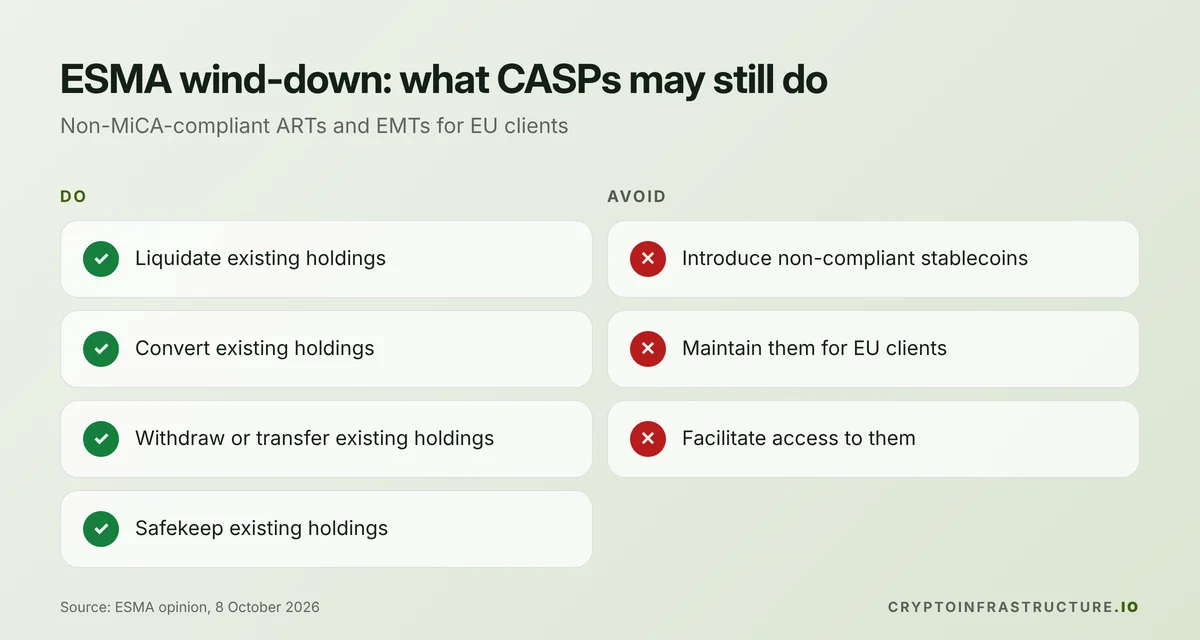
Confirmed vs. claimed: The opinion names no tokens. Press coverage, including CoinDesk on 8 October 2026, names Tether’s USDT as the obvious example and says PayPal USD is also unauthorised; that is the outlets’ reading, not ESMA’s text. The “8 January 2027” deadline in headlines is three months from publication, which is how ESMA frames it. An ESMA opinion is addressed to national regulators, so enforcement will come from your national competent authority.
Why it matters: If you are a CASP, check every stablecoin you list, custody or allow transfers in against MiCA authorisation status now. If you are a user in the EU holding a non-compliant stablecoin on a regulated platform, expect to be able to sell, convert or withdraw it but not buy more. For how stablecoins differ by design and issuer, see the stablecoin explainer.
What to watch: Your national regulator’s implementing statement and platform delisting notices before early January 2027.
ESMA’s wish list for the MiCA review
ESMA also published its response to the European Commission’s MiCA review consultation (the document is dated September 2026 and was covered on 2 October 2026 by The Paypers). Proposals include a new regulated service for firms giving users access to DeFi protocols, proportionate rules for staking, lending and borrowing, powers to freeze crypto-assets where market abuse or terrorist financing is suspected, more power to block fraudulent websites, and stricter marketing rules including for influencers. These are proposals only. Nothing changes until the Commission tables amendments and they pass.
Binance’s EU set-up under scrutiny (reported)
Euronews reported on 1 October 2026, citing the Financial Times, that ESMA and regulators in France, Germany and Greece are examining how Binance serves EU users without MiCA authorisation, including reliance on the “reverse solicitation” exemption. ESMA declined to comment on Binance specifically. No regulator has announced an investigation or enforcement, so treat this as unconfirmed. Binance said it is seeking MiCA authorisation.
United Kingdom: the FCA gateway is open
What happened: The FCA opened its authorisation gateway for cryptoasset firms on 30 September 2026. Firms that intend to keep operating in the UK “should apply by 28 February 2027, ahead of the new regime coming into force on 25 October 2027”. The FCA says “authorisation is not automatic”. Firms that apply within the window can keep providing services, including taking on new business, while their application is pending.
Confirmed vs. claimed: All dates above are from the FCA’s release. Some older guides, including Britannica’s (last updated 26 September 2026), say only that the regime takes effect in October 2027; the exact date is 25 October 2027. Linklaters’ 30 September 2026 note adds that late applicants may be restricted from taking on new UK business after commencement until their application is decided.
Why it matters: This replaces the money-laundering registration that UK crypto firms rely on today with full authorisation, assessed on consumer protection, safeguarding of client assets, market integrity and financial resilience. Being registered with the FCA now is not the same as being authorised later. Kraken’s UK entities, for example, are listed under the current registration regime in the Kraken evidence review.
What to watch: 28 February 2027. If your business serves UK users and misses it, you risk being unable to onboard UK clients from 25 October 2027.
UAE: two new VARA licences
What happened: The VARA public register (checked 14 October 2026) shows two licences issued in the window:
- Rain MENA FZE: licence VL/26/10/001, issued 5 October 2026, active, for exchange and broker-dealer services.
- Payward FZCO: licence VL/26/10/002, issued 6 October 2026, active, for broker-dealer and management and investment services.
Confirmed vs. claimed: The register does not mention Kraken by name. Kraken’s parent is Payward, and Finance Magnates reported on 12 October 2026 that Payward had received full market approval, after preliminary approval in May 2026. The register’s issue date (6 October) is earlier than the press date (12 October), most likely because the announcement came after the licence was issued. Kraken’s plans to go live “in the coming weeks” with dirham pairs, and to add derivatives later subject to further approval, are company statements.
Why it matters: In Dubai, a VARA licence is activity-specific. Check that the activities on the register match the service you are using: Payward’s licence covers broker-dealer and management and investment services, not derivatives.
What to watch: Kraken’s actual UAE launch date and any derivatives approval.
Singapore: quiet month, stablecoin rules pending
No new MAS crypto licence decision, rule or enforcement action dated within the window was found in the sources checked for this roundup (MAS’s own site could not be accessed on 14 October 2026). The open item is a consultation that FinTech Global reported on 1 September 2026: amendments to the Payment Services Act to bring MAS’s single-currency stablecoin framework into force, including rules that only licensed issuers may call their tokens “MAS-regulated stablecoins”, redemption at par, and a ban on paying interest. Watch for the final rules.
India: enforcement continues, no new law
What happened: Just before the window, on 9 September 2026, a Ministry of Finance release on PIB said FIU-IND had issued non-compliance notices under Section 13 of the Prevention of Money Laundering Act to 15 VDA service providers, including Weex, Blofin, Bitunix, DigiFinex, XT.com, Pionex, ChangeNow, WhiteBIT and Guardarian, plus takedown notices for their apps and URLs under the IT Act. It restated that these obligations “are activity-based and are not contingent on physical presence of the entity in India”.
Confirmed vs. claimed: The notices are confirmed. The release does not mention Binance or the Travel Rule; Binance’s Travel Rule procedures for Indian users date from June 2026, as covered in the Binance in India guide. Separately, The420.in reported on 4 October 2026, citing The Economic Times, that Parliament’s Standing Committee on Finance is preparing a report on VDAs that “may” recommend stronger transaction monitoring. The article itself says the recommendations “have not yet been finalised and do not amount to a new law”.
Why it matters: If you serve Indian users from offshore, FIU-IND registration is the line between operating and being blocked. If you are a user, an app that vanishes from the Indian stores is usually a takedown, and funds can be stuck while it is resolved.
What to watch: The Standing Committee report and any further FIU-IND lists.
Other markets
Hong Kong (reported): Altcoin Buzz reported on 6 October 2026 that the government will submit an amendment bill before the end of 2026 creating licences for digital asset trading, custody, advisory and management services. No government text was available to the outlet, so treat the scope as provisional until the bill is published.
Is crypto going to be regulated?
It already is, in every region covered here, just not in the same way. As of 14 October 2026, the EU has MiCA in force and is tightening it; the UK has a full authorisation regime starting 25 October 2027; Dubai licenses each activity through VARA; India regulates crypto through anti-money-laundering registration and tax rather than a dedicated law; and the US relies on SEC and CFTC rulemaking because the CLARITY Act stalled. The question for your business is not whether rules apply but which regulator’s deadline comes first.

What this means for you
- Running a platform in the EU: audit every stablecoin you support against MiCA status before early January 2027.
- Serving UK users: plan an FCA application before 28 February 2027.
- Offering leveraged crypto products in the US: read the CFTC ANPRM and comment before the deadline in mid-December 2026.
- Serving India from offshore: confirm FIU-IND registration, KYC and reporting are in place before launch, not after a notice.
- Using an exchange: check the regulator’s register for the exact entity and activities, not the exchange’s marketing page.
This page is refreshed each month at the same address. For provider-side help with these deadlines, see the KYC/AML & Compliance section, and for how this site checks claims, the methodology.


