MetaMask vs Trust Wallet has no single winner. Both are self-custody software wallets: your keys live on your device, and neither company can freeze or lend your coins. As of 14 October 2026 they differ in ways that matter to different users. MetaMask covers Ethereum and EVM networks plus Bitcoin, Solana and TRON, works in five desktop browsers, and charges a 0.875% fee on swaps. Trust Wallet says it supports more than 100 networks (after dropping 24 on 15 September 2026), lists a 0.7% swap fee on its own comparison page, and charges 0% on same-chain stablecoin swaps on seven networks other than Ethereum. Trust Wallet’s core library is Apache 2.0 open source; MetaMask’s code is public but under a restrictive Consensys licence. Both have had security incidents, and Trust Wallet’s December 2025 malicious extension update cost users about $8.5 million. MetaMask’s owner is renaming itself MetaMask; Trust Wallet has not been owned by Binance since 15 May 2025.
If you are choosing between MetaMask and Trust Wallet, most comparison pages will tell you MetaMask is “for Ethereum” and Trust Wallet is “for everything else”, and several still say Binance owns Trust Wallet. Both points are out of date. MetaMask now handles Bitcoin and Solana natively, Trust Wallet dropped 24 networks in September 2026, and both wallets changed owners or corporate structure in the past 18 months. This MetaMask vs Trust Wallet comparison puts the two side by side on what actually decides it: who controls the software, which chains and devices each supports, how each stores and backs up your keys, what the code licence allows, what has been audited, what has gone wrong, and what each charges for a swap, all dated. It does not pick a winner.
MetaMask vs Trust Wallet: the short answer
MetaMask and Trust Wallet are both non-custodial wallets, so the core risk is the same: your recovery phrase is the only backup, and you trust the publisher to ship clean updates. As of 14 October 2026, MetaMask is the stronger fit if you work mainly in a desktop browser on Ethereum and EVM networks, want a wider choice of hardware wallets, or use Snaps to reach other chains. Trust Wallet fits better if you hold assets on many non-EVM chains from your phone, swap stablecoins often on networks other than Ethereum, or want an open-source core library you can inspect and reuse. Neither is safe outright; the incident tables below show why.
Side-by-side: MetaMask vs Trust Wallet at a glance
Each row summarises evidence set out in the sections below. Read the section before relying on any one cell.
| Criterion | MetaMask | Trust Wallet |
|---|---|---|
| Custody model | Self-custody; keys on your device | Self-custody; keys on your device |
| Company | Consensys Software Inc., announced 9 September 2026 it will rename itself MetaMask | Trust Wallet; not owned or controlled by Binance since 15 May 2025 |
| Platforms | Browser extension (Chrome, Firefox, Brave, Edge, Opera), iOS, Android | Browser extension (Chrome, Brave, Edge, Opera), iOS, Android |
| Networks | Ethereum and EVM networks, plus Bitcoin, Solana and TRON by default; other non-EVM chains through Snaps | “More than 100” by its own count, after 24 networks were dropped on 15 September 2026 |
| Backup options | Secret Recovery Phrase, or social login with Google, Apple or Telegram | Recovery phrase, or a SWIFT smart wallet recovered with a passkey stored in iCloud or Google |
| Code licence | Public code under a custom Consensys licence (non-commercial use only) | Wallet Core library under Apache 2.0 |
| Published audits | No dated audit list for the core wallet found | Ten third-party reports listed (2023 to 2025) |
| Bug bounty | HackerOne since June 2022, $731,105 paid; paused, not accepting new submissions | No public bounty programme named on its security overview; vulnerability disclosure policy |
| Swap fee (wallet’s own cut) | 0.875% | 0.7% (Trust Wallet’s comparison page); 0% on eligible same-chain stablecoin swaps outside Ethereum |
| Hardware wallets | Ledger, Trezor, Lattice and nine air-gapped devices on the extension; Keystone, Ledger and NGRAVE ZERO on mobile | Hardware wallet support on the browser extension; devices not named on the pages checked |
| Biggest incident found | 30 September 2026 infrastructure incident hitting its staking validators; no indication wallets were affected (MetaMask, 1 October 2026) | Malicious extension v2.68, 24 to 26 December 2025: 2,520 addresses drained of about $8.5 million |
All entries checked 14 October 2026 against each wallet’s help centre, blog, GitHub licence files and bug bounty page.
How this comparison works
The criteria come from the site’s methodology: track record, transparency, security practices, pricing clarity and jurisdiction coverage. For two self-custody wallets that becomes seven checks, applied in the same order to both, the same structure used in the MetaMask and Trust Wallet safety reviews:
- Ownership: who controls the company and the updates
- Platforms and chains: where each runs and what it supports natively
- Key storage and backup options
- Open code and licence
- Audits and bug bounty
- Incident history, dated, with losses and reimbursements
- Fees, from each wallet’s own pages with the date checked, and a worked example
There was no hands-on testing, and neither company paid to be included. There are no affiliate links on this page.
MetaMask at a glance
MetaMask is a browser extension and mobile wallet built originally for Ethereum and EVM networks. Its help centre describes its Swaps feature as an aggregator: MetaMask pulls quotes together but “does not provide the liquidity, execute the trade, or give you any advice” on what to swap.
Trust Wallet at a glance
Trust Wallet is a mobile-first wallet with a browser extension. Its homepage, checked 14 October 2026, describes it as a self-custody wallet for iOS, Android and your browser across “100+ blockchains” with private keys kept on your device.
Who owns MetaMask and Trust Wallet?
MetaMask: Consensys, becoming MetaMask
MetaMask is developed by Consensys Software Inc., whose name still appears in the copyright line on MetaMask’s FAQ page as of 14 October 2026. On 9 September 2026 Consensys announced it will split in two: the existing company will be renamed MetaMask, with founder Joseph Lubin as chairman and CEO, while the protocol and institutional business, including the Linea network and the Besu and Teku Ethereum clients, moves to a new company that keeps the Consensys name. The split is expected to complete by the end of 2026 (The Block, 9 September 2026, as reported by PANews).
Trust Wallet: no longer Binance
Trust Wallet was bought by Binance in 2018, and many ranking pages, and the Messari profile Google’s AI Overview cites for this search, still describe it that way. Binance’s own acquisition announcement now carries this note: “As of 15 May 2025, Trust Wallet is no longer owned or controlled by the Binance Exchange Group.” Binance does not name the new owner. The Trust Wallet review covers press reports on who controls it now.
Why ownership matters for a self-custody wallet
Neither company holds your keys, so a problem at the parent company does not freeze your wallet. What the owner does control is the code that creates and stores your keys and the updates pushed to your device. Trust Wallet’s December 2025 incident, below, shows what happens when a release is compromised: the custody model did not change, yet users still lost funds.
Platforms and supported chains (checked 14 October 2026)
| Item | MetaMask | Trust Wallet |
|---|---|---|
| Mobile | iOS and Android | iOS and Android |
| Browser extension | Chrome, Firefox, Brave, Edge and Opera (MetaMask FAQ) | Chrome, Brave, Edge and Opera (Trust Wallet extension guide, updated 17 July 2026); Firefox not listed |
| Native networks | Ethereum and EVM networks; Bitcoin and Solana “natively”; TRON “by default” | “More than 100 blockchain networks” (Trust Wallet, updated 2 September 2026) |
| Swap networks | 19 listed: Ethereum, Bitcoin, Linea, Base, Solana, TRON, Polygon, BNB Chain, Arbitrum, Monad, Robinhood Chain, OP, Sei, Avalanche, zkSync Era, MegaETH, HyperEVM, Arc and Tempo | Swaps available “across 100+ blockchains” per Trust Wallet’s swap fees guide (14 August 2026) |
| Other chains | Through Snaps, third-party add-ons, for networks such as Algorand, Cosmos, Hedera, NEAR, Polkadot, Starknet, Sui, Tezos and XRP | Custom networks can be added manually |
| Recent removals | None found | 24 networks removed on 15 September 2026 |
Sources: MetaMask FAQ and help centre (swaps user guide, Bitcoin, TRON and non-EVM network pages); Trust Wallet homepage, extension guide and network sunset notice.
Does MetaMask support Bitcoin and Solana?
Yes. As of 14 October 2026 MetaMask’s help centre says Bitcoin and Solana are supported “natively”. A new MetaMask account now generates EVM, Bitcoin and Solana addresses together, and Bitcoin accounts use the Native SegWit derivation path only, so an imported Bitcoin wallet on a different path will not show its funds. Comparison pages written before late 2025, and some from 2026, still say MetaMask cannot hold Bitcoin.
Which networks did Trust Wallet drop?
Trust Wallet removed support for 24 networks on 15 September 2026: Agoric, Aurora, Boba, Conflux, Decred, FIO, Firo, Flux, GoChain, IoTeX, KuCoin Community Chain, Manta, Merlin Chain, Meter, Moonbeam, Moonriver, MultiversX, Nano, Neon, Nimiq, Polygon zkEVM, Stride, Viction and Wanchain. Its sunset notice says assets on those chains stay on their blockchains, but you can no longer view, send or swap them in Trust Wallet unless you add the network manually or import your phrase into another wallet that supports it. Trust Handles, which ran on FIO, stopped working on 7 September 2026. If you chose Trust Wallet for one of these chains, check before you rely on it.
Chain counts also vary between Trust Wallet’s own pages: its homepage and sunset notice say more than 100, while its security overview, last updated 20 January 2026, still says 70+. Treat any single chain count as approximate and check the specific network you need.
Key storage and backup options
Both wallets create your keys on your device and say they never store them on their servers. The detailed storage designs are set out in the MetaMask review and the Trust Wallet review. Where they now differ is in backup options beyond the classic recovery phrase.
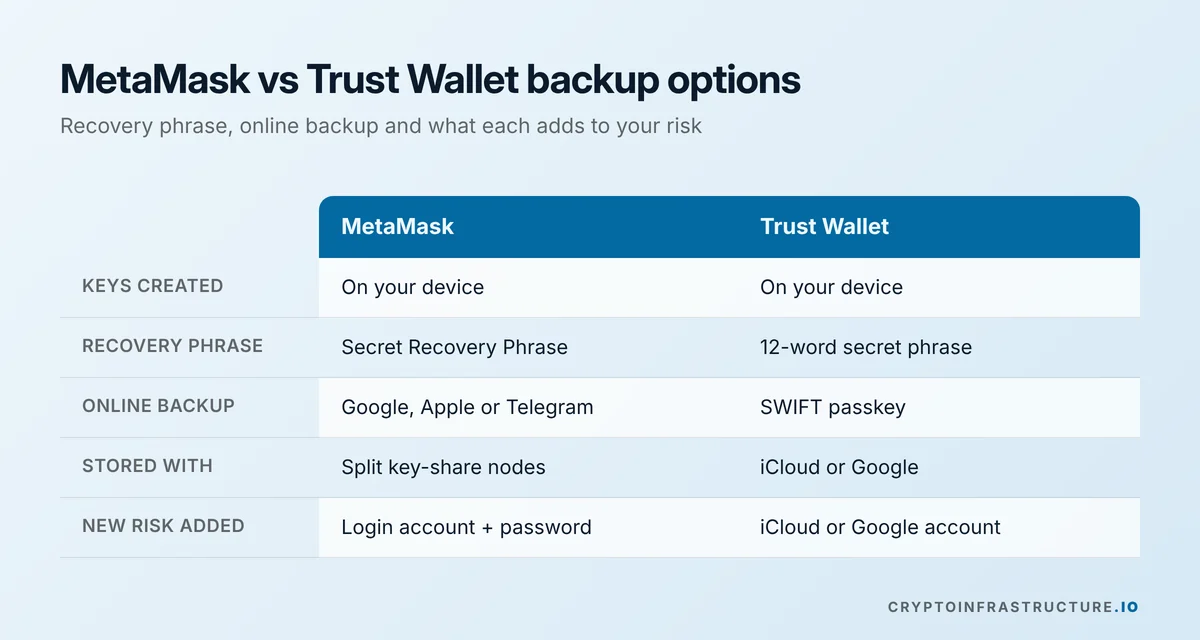
| Backup method | MetaMask | Trust Wallet |
|---|---|---|
| Recovery phrase | Secret Recovery Phrase; only you hold it | 12-word secret phrase for a standard wallet; only you hold it |
| Online backup option | Social login with Google, Apple or Telegram: the phrase is backed up as encrypted ciphertext, the encryption key is split across several key-share nodes, and a full phrase exists only on your device after you sign in and enter your password | SWIFT smart wallet: a passkey linked to your iCloud or Google account replaces the phrase for protecting and recovering the wallet |
| What it adds to your risk | Your Google, Apple or Telegram account plus your MetaMask password become part of your wallet’s security | Your iCloud or Google account becomes the recovery route; Trust Wallet warns that editing or deleting the passkey may lose you access |
Checked 14 October 2026 on MetaMask’s social login help page and Trust Wallet’s SWIFT passkeys guide (updated 17 July 2026).
Both online options remove the paper backup, but they move part of your security into a big-tech account. If you use either, protect that account with a unique password and strong two-factor authentication. The seed phrase guide explains how to store a classic recovery phrase offline.
Is MetaMask or Trust Wallet open source?
Only Trust Wallet’s core is open source in the strict sense, and most ranking pages blur this.
- MetaMask: the browser extension’s code is public on GitHub, but its LICENSE file (checked 14 October 2026) is a custom Consensys licence, not an open-source one. It allows only non-commercial use, caps any resulting program at 10,000 monthly active users, and bars copying, modifying or redistributing the code beyond that grant. Anyone can read and test the code; few can reuse it.
- Trust Wallet: its Wallet Core library, which handles low-level key and signing functions, is published on GitHub under the Apache 2.0 licence. Trust Wallet’s own comparison page names Wallet Core as the open-source part; the pages checked do not say the mobile app or extension themselves are open source.
For you as a user, both give security researchers code to inspect. Open code is not a guarantee: Trust Wallet’s 2022 flaw, below, sat in the open-source library itself.
Audits and bug bounties
| Control | MetaMask | Trust Wallet |
|---|---|---|
| Published audit list | No dated list of audit reports with firms and scopes for the core extension and mobile app found on MetaMask’s security pages. | Ten reports listed on its security overview (updated 20 January 2026): CertiK and Cure53 on the browser extension (2023), CertiK and Halborn on the SWIFT smart wallet (June 2023), Kudelski (September 2023), Salus penetration test (April 2024), Halborn on the swap contract (May 2024), Quantstamp on the ERC-4337 paymaster and smart account (March 2025), Halborn on the smart account (April 2025) |
| Bug bounty | HackerOne, launched June 2022. Wallet-tier critical rewards $3,000 to $50,000; $731,105 paid in total; 389 reports resolved. The page states MetaMask “is taking a break and is not accepting new submissions”. | No bounty programme named on the security overview. Trust Wallet describes a vulnerability disclosure policy under which reports are published once fixed and users are secure. |
Checked 14 October 2026 against MetaMask’s HackerOne programme page (rewards last updated 4 September 2026) and Trust Wallet’s security overview.
Neither record is complete. Trust Wallet publishes more dated audits, but most cover smart contracts and add-on features, and the newest extension audit listed predates its December 2025 incident. MetaMask has the longer public bounty record, but the programme is paused with no end date given, and it publishes no dated audit list for the wallet itself.
Incident history
Neither company has held user funds that were stolen from its servers. Both have had real security problems in their software or infrastructure.
MetaMask
| Date | What happened | Outcome |
|---|---|---|
| 15 June 2022 | “Demonic” (CVE-2022-32969), disclosed by Halborn: browsers’ session-restore feature could save a recovery phrase typed into a non-password field to disk unencrypted. Users who imported a phrase on MetaMask 10.11.2 or earlier, with “Show Secret Recovery Phrase” ticked, were at risk. | Exploitation needed access to an unencrypted disk on a lost or compromised device. Halborn’s disclosure reports no losses and advised affected users to move to new accounts. |
| 30 September 2026 (ongoing) | MetaMask disclosed an “ongoing security incident affecting part of our infrastructure” and began exiting validators in its non-custodial staking operations. | MetaMask’s 1 October update: “there is no indication that MetaMask wallets or customer funds have been affected.” Root cause not disclosed as of 14 October 2026. |
Trust Wallet
| Date | What happened | Losses | Reimbursement |
|---|---|---|---|
| Wallets created 14 to 23 November 2022; exploited late December 2022 and late March 2023 | A WebAssembly flaw in Wallet Core weakened key generation for browser-extension wallets created on versions 0.0.172 and 0.0.182. | About $170,000 across two exploits | One-to-one; claims closed 30 June 2023 with 47 victim wallet claims processed |
| 24 to 26 December 2025 | A malicious extension version 2.68 was published to the Chrome Web Store using a leaked API key, which Trust Wallet links to the November 2025 Sha1-Hulud supply-chain attack. It harvested recovery phrases. | 2,520 addresses drained of about $8.5 million | Voluntary, case by case; more than 5,000 claims received, many likely duplicate or fraudulent. Trust Wallet’s update (last updated 17 July 2026) still calls the process a work in progress. |
Checked 14 October 2026 against Halborn’s disclosure, MetaMask’s user update page (latest dated text 1 October 2026), Trust Wallet’s 2022 vulnerability disclosure and its v2.68 incident update.
Both Trust Wallet incidents hit the browser extension only; the mobile app was not affected. MetaMask’s 2026 incident hit staking infrastructure, not the wallet software that holds your keys, according to MetaMask. Fuller tables, including phishing and fake-extension campaigns aimed at both wallets, are in the two safety reviews.
MetaMask vs Trust Wallet fees (checked 14 October 2026)
Neither wallet charges you to download it, hold crypto or receive it. Sending costs only the network fee (gas), which goes to the blockchain’s validators, not the wallet. The difference is in swaps, where each wallet adds its own fee on top of gas and the swap provider’s price.
| Fee | MetaMask | Trust Wallet |
|---|---|---|
| Wallet swap fee | 0.875%, built into the quote (MetaMask help centre and FAQ) | 0.7%, per Trust Wallet’s own MetaMask comparison page (October 2026); Trust Wallet’s swap help pages checked do not state a percentage |
| Stablecoin swaps | No exception found on the pages checked | 0% Trust Wallet fee on swaps between eligible stablecoins (USDT, USDT0, USDC, USDC.e, EURC, USDS, DAI, U) on the same chain, on BNB Chain, Solana, Arbitrum, Polygon, Base, Optimism and Avalanche; not on Ethereum, and not across chains (announced 27 August 2026) |
| Cross-chain swaps (bridging) | Through MetaMask Swaps, sourced via aggregators Li.fi and Socket and bridges including Across, Stargate, Relay, Mayan and CCTP | Available in the app; cross-chain stablecoin swaps do not qualify for the 0% fee |
| Network fee | Extra, varies with congestion; gasless swaps on some networks fold gas into the quote | Extra, varies with congestion |
| Buying with a card or bank | Through third-party providers; their fees apply | Through third-party providers; their fees apply |
The 0.7% Trust Wallet figure comes from a vendor comparison page, not a fee schedule, and Trust Wallet runs promotional 0% pairs from time to time. Check the fee line in the quote screen before you confirm.
Worked example: $100, $1,000 and $10,000 swaps
Assumptions: a same-chain token swap on a network both wallets support, using each wallet’s in-app swap, with the wallet fee as stated above on 14 October 2026. Network fees, provider spread and price impact are extra and the same order of size in both wallets, so they are left out.
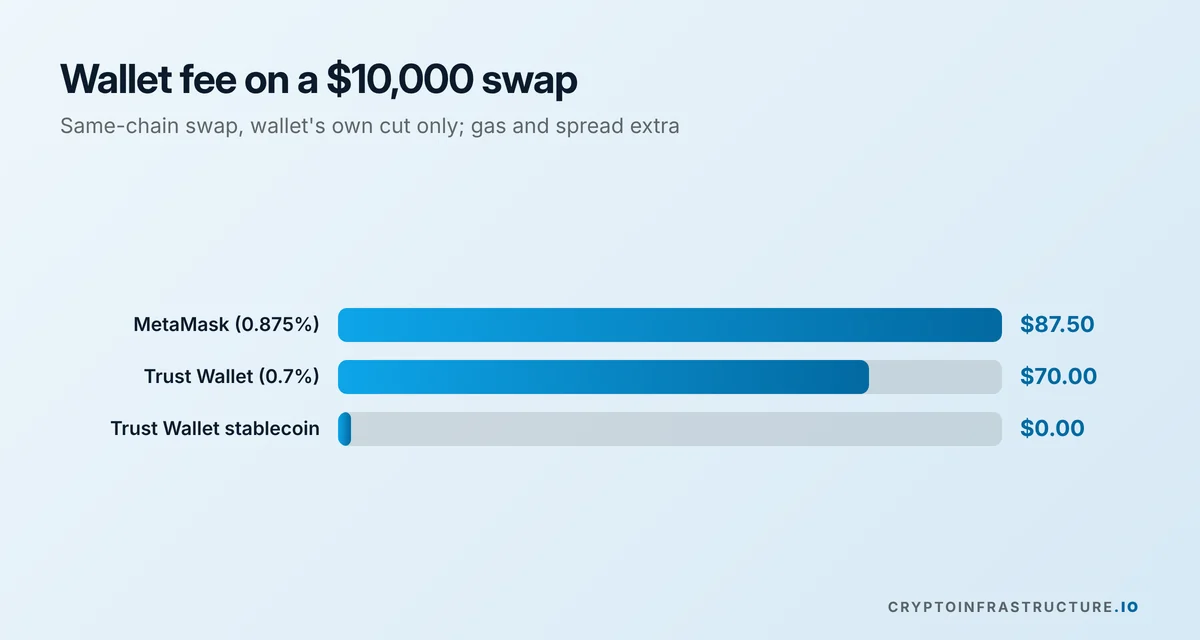
| Swap | MetaMask (0.875%) | Trust Wallet (0.7%) | Trust Wallet, eligible stablecoin pair off Ethereum (0%) |
|---|---|---|---|
| $100 | $0.88 | $0.70 | $0.00 |
| $1,000 | $8.75 | $7.00 | $0.00 |
| $10,000 | $87.50 | $70.00 | $0.00 |
On a $10,000 swap the wallet-fee gap is $17.50; on a stablecoin swap that qualifies on Trust Wallet, it is the full $87.50. On Ethereum mainnet, gas can outweigh either wallet fee on small swaps, so for a $100 trade the network matters more than the wallet. If you swap rarely, the difference is small; if you swap stablecoins often on BNB Chain, Base or Solana, it adds up.
Is Trust Wallet cheaper than MetaMask?
On the wallet’s own swap fee, yes, on the figures checked: 0.7% against 0.875%, and 0% on eligible same-chain stablecoin swaps outside Ethereum. Ranking pages that say Trust Wallet swaps are “free” are wrong outside those promotions, and pages that list no fee for either are missing the biggest cost difference. Network fees are the same whichever wallet you use.
Hardware wallet support
- MetaMask: its hardware wallet guide lists Ledger, Trezor and Lattice as direct-connection wallets and AirGap Vault, Arculus, CoolWallet, D’Cent, imToken, Keycard Shell, Keystone, NGRAVE ZERO and OneKey as air-gapped wallets, all on the extension. On mobile, only Keystone, Ledger and NGRAVE ZERO are supported (checked 14 October 2026).
- Trust Wallet: its security overview says the browser extension introduced hardware wallet support for moving assets to cold storage. The pages checked do not list which devices.
If you plan to pair a hardware wallet, MetaMask’s list is the longer and more clearly documented one as of 14 October 2026. With either, the key stays on the device and every transaction needs a physical confirmation, but you can still approve a malicious transaction on the device itself. The Ledger vs Trezor comparison covers the two most common devices.
What are the downsides of MetaMask?
From the evidence above, as of 14 October 2026: the highest wallet swap fee of the two (0.875%), a restrictive code licence rather than an open-source one, no published dated audit list for the core wallet, a bug bounty that is currently paused, an unexplained infrastructure incident in September 2026, and non-EVM chains beyond Bitcoin, Solana and TRON only through third-party Snaps. Its corporate structure is also changing until the split completes at the end of 2026.
Is Trust Wallet 100% safe?
No wallet is. Trust Wallet’s software has twice been the route by which users lost funds, about $170,000 in 2022 to 2023 and about $8.5 million in December 2025, both through the browser extension, and the second loss came from a compromised release, not from your own mistake. Against that it publishes ten dated audits and detailed post-mortems, and it reimbursed or committed to reimburse victims in both cases. The Trust Wallet review sets out the full evidence.
Which wallet is better than MetaMask, and what is the most trusted crypto wallet?
There is no ranking that holds for every user. “Trusted” for a self-custody wallet comes down to the checks in this article: who ships the updates, what you can inspect, what has been audited, what went wrong and how the company responded. If you mainly use Solana, the Phantom review applies the same checks. For larger balances, a hardware wallet removes the risk of a compromised app or extension reading your key, which is the failure behind Trust Wallet’s 2025 losses.
Can you withdraw or sell crypto from MetaMask or Trust Wallet?
You can swap tokens inside either wallet, but neither is a bank or an exchange. MetaMask’s help centre says it acts as an information aggregator and does not provide the liquidity or execute the trade. To turn crypto into cash you send it to an exchange or use a third-party sell provider, which sets its own fees, limits and identity checks. If a swap or sale fails, the usual causes are not enough of the network’s token to pay gas, a token the swap providers do not list, or a provider unavailable in your country.
Which fits which user
| If you… | The evidence points to | Why |
|---|---|---|
| Use DeFi mainly from a desktop browser on Ethereum and EVM networks | MetaMask | Five supported browsers, including Firefox; the wallet most EVM apps integrated first, as even Trust Wallet’s comparison page concedes |
| Hold assets on many non-EVM chains from your phone | Trust Wallet | More than 100 networks by its count, but check yours was not among the 24 dropped on 15 September 2026 |
| Swap stablecoins often on BNB Chain, Base, Solana or other L2s | Trust Wallet | 0% wallet fee on eligible same-chain pairs off Ethereum |
| Pair a hardware wallet, especially on mobile | MetaMask | Longer documented device list; three devices on mobile |
| Want an open-source core you can audit or build on | Trust Wallet | Wallet Core under Apache 2.0; MetaMask’s licence bars most reuse |
| Want an independent bounty record | MetaMask | Public HackerOne history since 2022, though currently paused |
| Use the browser extension for holdings you care about | Either, with care | Both Trust Wallet incidents hit the extension; MetaMask’s 2022 flaw was extension-side too. Consider the mobile app or a hardware wallet. |
| Need Bitcoin alongside Ethereum | Either | Both now support Bitcoin natively; MetaMask accepts Native SegWit accounts only |
Many users run both, for example MetaMask on desktop for EVM apps and Trust Wallet on mobile for other chains. If you do, each wallet has its own recovery phrase unless you import the same one, and importing one phrase into two apps doubles the software you are trusting with it.
What this means for you
As of 14 October 2026, MetaMask vs Trust Wallet is a choice between different strengths, not a contest with a winner. Both give you real self-custody, and in both the biggest remaining risk is yours: the recovery phrase, the device, and what you sign. MetaMask is browser-first and EVM-first, now with native Bitcoin, Solana and TRON, the longer hardware wallet list and a public bounty history, but it charges the higher swap fee, licenses its code restrictively, publishes no dated audit list and has a paused bounty and an open incident. Trust Wallet covers more chains and costs less to swap, especially for stablecoins, and publishes more audits and an open-source core, but it dropped 24 networks in September 2026 and its extension was the route for an $8.5 million loss in December 2025. Before moving funds, check that your network is supported, compare the fee line in the quote, and back up your phrase offline. Wallet comparisons on this site are reviewed monthly, and sooner after a hack, rebrand or network change.
For the full evidence on each wallet, read Is MetaMask Safe? and Is Trust Wallet Safe?. Before you create either wallet, read the seed phrase guide, and for larger balances see the Ledger vs Trezor comparison.