A stablecoin is a cryptocurrency built to hold a steady price, usually $1, by tying its value to a reserve asset such as dollars and short-term government debt, to crypto collateral, or to a hedged trading position. The peg holds when approved firms can mint and redeem at $1 and profit from any gap, and it breaks when people doubt the reserves or cannot redeem. Stablecoins carry no deposit insurance, and in the UK issuing them only becomes a regulated activity when the new crypto regime starts on 25 October 2027.
You hold a token that says it is worth one dollar. Most days it is. But the dollar in your bank account is backed by a regulated bank and, up to a limit, by deposit insurance, while the dollar on a blockchain is backed by whatever the issuer says it holds, plus your ability to swap it back. That gap is the whole story of stablecoins. This guide explains what a stablecoin is, the four main types, how the peg is actually kept, which stablecoins have lost it and why, and what the rules look like in the UK, EU and US as of 13 October 2026.
What is a stablecoin?
A stablecoin is a cryptocurrency designed to keep a stable value by tying it to another asset, most often the US dollar at one token to one dollar. It moves on a blockchain like any other token, so it can be sent 24 hours a day, but its price is meant to stay flat rather than float.
The word “designed” matters. A stablecoin is not cash and not a bank deposit. It is a claim, or sometimes only a market expectation, that the token can be swapped back for $1. How strong that claim is depends on three things: what backs the token, who is allowed to redeem it, and which law (if any) governs the issuer.
Most stablecoins track the US dollar. Others track the euro (Circle’s EURC, for example), and a few track gold, such as Paxos Gold (PAXG), where each token represents one fine troy ounce of gold held in a vault.
How is a stablecoin different from Bitcoin?
Bitcoin’s price is set entirely by the market, with no reserve behind it and no one promising to buy it back. A stablecoin aims for a fixed price and usually has an issuer, a reserve and a redemption process behind it. That makes the two useful for different things: Bitcoin is a volatile asset in its own right, while a stablecoin is mainly a way to hold or move a currency value on a blockchain.
| Bitcoin, Ether and similar | Fiat-backed stablecoin (e.g. USDC) | |
|---|---|---|
| Price | Floats freely with supply and demand | Aims to stay at $1 |
| Issuer | None (Bitcoin) or a protocol | A company that mints and redeems tokens |
| Backing | None | Cash, bank deposits, short-term government debt |
| Can the issuer freeze tokens? | No | Usually yes, at the smart contract level |
| Main use | Held as a volatile asset; settlement on its own network | Trading pairs, payments, moving dollars across borders |
Is XRP a stablecoin? No. XRP is the floating-price native token of the XRP Ledger. The stablecoin linked to Ripple is a separate token, Ripple USD (RLUSD), which aims for $1.
What is the point of stablecoins?
The point is to get a currency value onto a blockchain, where it can move at any hour and plug into other crypto software. In practice that covers:
- Trading. Most crypto trading is priced against USDT or USDC. Traders park value in a stablecoin between trades without cashing out to a bank.
- Cross-border transfers. A stablecoin can reach another wallet anywhere in minutes, outside banking hours. The recipient still needs a way to turn it into local currency, which is where fees and exchange spreads come back in.
- Dollar access. People in countries with high inflation or capital controls use dollar stablecoins as a way to hold dollars.
- DeFi. Lending, borrowing and payment apps on blockchains need a unit of account that does not swing 10% in a day.
- Business settlement. Payment companies, exchanges and treasury teams use stablecoins to settle with each other. If you run a platform that needs this, the Exchanges section covers the operator side.
The four types of stablecoins
Stablecoins are grouped by what sits behind the $1. The type tells you most of what can go wrong.
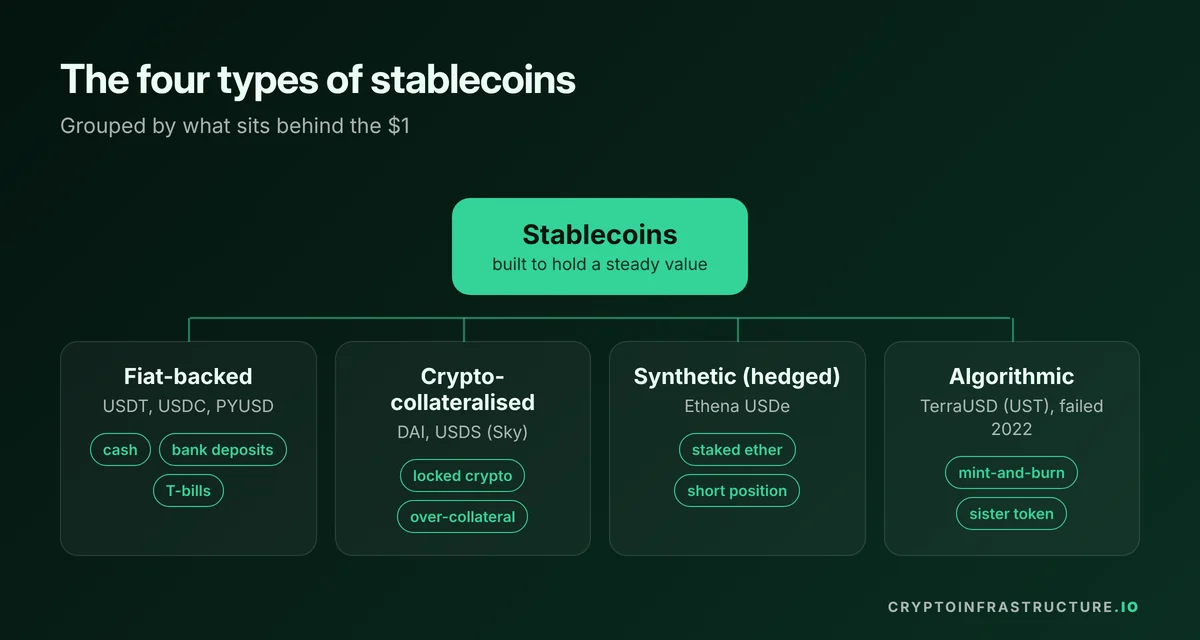
| Type | What backs it | Examples | Main way it can fail |
|---|---|---|---|
| Fiat-backed | Cash, bank deposits, short-term government bills, held by the issuer | USDT, USDC, PYUSD, RLUSD, USD1, EURC | Reserves lost, frozen or not as described; issuer failure; redemption paused |
| Crypto-collateralised | More crypto than the stablecoins issued, locked in smart contracts | DAI, USDS (Sky) | Collateral crashes faster than it can be sold; smart contract bugs |
| Synthetic (hedged) | Crypto held alongside an offsetting short derivatives position | Ethena USDe | Derivatives venue or custody failure; funding rates turning negative for long periods |
| Algorithmic | A mint-and-burn link to a second, floating token, with little or no outside collateral | TerraUSD (UST), failed in 2022 | Confidence breaks, the second token collapses, and nothing is left to redeem against |
Commodity-backed tokens such as PAXG work like fiat-backed ones, with gold in a vault instead of dollars in a bank. Their price follows gold, so they are “stable” only relative to gold.
According to DefiLlama’s stablecoin dashboard, the large majority of stablecoin value sits in the fiat-backed group: USDT and USDC alone account for about $257 billion of a roughly $306 billion market (checked 13 October 2026).
How do stablecoins keep their peg?
A stablecoin keeps its peg when someone can always make money by pushing the price back to $1. The mechanism differs by type.
Fiat-backed: mint, redeem and arbitrage
The issuer creates (mints) new tokens when an approved customer deposits dollars, and destroys (burns) them when a customer hands tokens back for dollars. That two-way door is what holds the price.
A simple worked example, ignoring fees:
- A stablecoin slips to $0.99 on exchanges because many holders are selling.
- An approved trading firm buys 1,000,000 tokens for $990,000.
- It redeems them with the issuer for $1,000,000, a $10,000 gain.
- That buying pushes the market price back toward $1.
The reverse works too. If the token trades at $1.01, a firm deposits $1,000,000, mints 1,000,000 tokens and sells them for $1,010,000, adding supply until the premium disappears.
Two caveats the ranking explainers tend to skip. First, most issuers only let verified business customers mint and redeem directly, often with minimum amounts, so a retail holder usually relies on selling on an exchange at whatever the market pays. Second, arbitrage only works while traders trust that redemption will be honoured in full. If they doubt it, they stop buying the dip, and the price can fall well below $1.
Crypto-collateralised: over-collateral and liquidation
To mint DAI or USDS, a user locks up crypto worth more than the stablecoins they take out, often 150% or more depending on the collateral type. If the collateral’s value falls toward a set minimum, the system sells (liquidates) it to repay the debt. The buffer absorbs normal price drops; the risk is a crash so fast that liquidations cannot keep up.
Synthetic: a hedged position
Ethena’s USDe holds crypto such as staked ether and opens a short position of the same size on derivatives exchanges. If ether falls, the short gains and the two roughly cancel out. It also lets authorised parties mint and redeem, which supports the peg the same way as above. Its risks sit with the exchanges and custodians holding the hedge.
Algorithmic: the design that failed
TerraUSD (UST) promised that one UST could always be swapped for $1 worth of a sister token, LUNA. That worked while people valued LUNA. In May 2022, heavy UST selling forced the system to mint huge amounts of LUNA, LUNA’s price collapsed, and UST fell to less than one cent. Kraken’s explainer puts the combined value lost at around $60 billion. Pure algorithmic designs have largely disappeared from the top of the market since.
Is USDC always $1?
No. USDC is designed to redeem at $1, and on 13 October 2026 DefiLlama showed it within 0.02% of the peg. But its market price has broken before (see the next section), and no stablecoin’s price is guaranteed. The same is true of USDT, which DefiLlama showed 0.08% below $1 on the same date.
The largest stablecoins in October 2026
| # | Stablecoin | Type | Issuer | Market cap |
|---|---|---|---|---|
| 1 | Tether (USDT) | Fiat-backed | Tether | $184.0bn |
| 2 | USD Coin (USDC) | Fiat-backed | Circle | $72.9bn |
| 3 | Sky Dollar (USDS) | Crypto-collateralised | Sky (formerly MakerDAO) | $7.0bn |
| 4 | Ethena USDe | Synthetic | Ethena | $4.8bn |
| 5 | Dai (DAI) | Crypto-collateralised | Sky (formerly MakerDAO) | $4.7bn |
| 6 | USD1 | Fiat-backed | World Liberty Financial | $4.3bn |
| 7 | Global Dollar (USDG) | Fiat-backed | Paxos | $3.0bn |
| 8 | PayPal USD (PYUSD) | Fiat-backed | Paxos, for PayPal | $2.9bn |
| 9 | Ripple USD (RLUSD) | Fiat-backed | Ripple | $2.4bn |
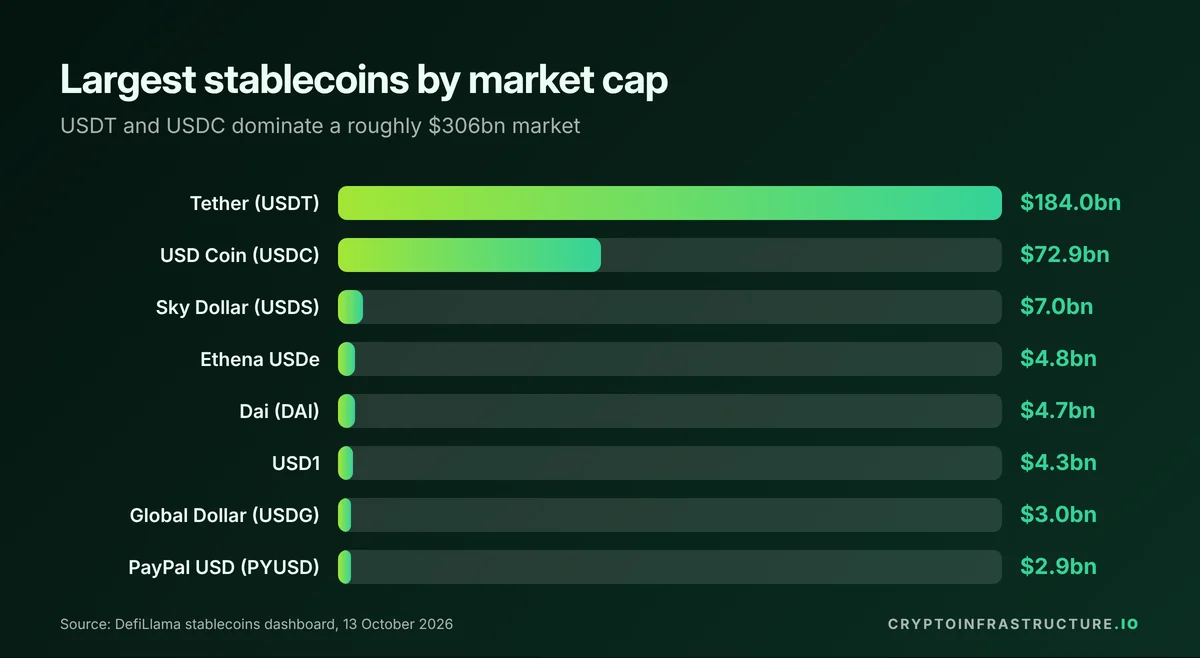
Source: DefiLlama stablecoins dashboard, total market about $305.9 billion with USDT at 60.15% share (checked 13 October 2026). Market cap is not a measure of safety.
Some older explainers still list Binance USD (BUSD) and TrueUSD in the top five. Paxos stopped minting new BUSD in February 2023, and neither appears near the top today.
Does the Trump family own a stablecoin? USD1 is issued by World Liberty Financial, a crypto venture linked to the Trump family, and was the sixth-largest stablecoin by market cap on 13 October 2026, per DefiLlama. The ownership ties and the political questions around them are covered widely in the press; for your purposes, judge USD1 the way you would any fiat-backed coin: on its reserve reports, its custodian, its redemption terms and its regulator.
Whether USDT or USDC is the better fit depends on what you use it for, and a separate guide on USDT vs USDC compares their reserves, attestations and regulatory status in detail.
Which stablecoins have lost their peg?
Depegs are the clearest test of how a stablecoin really works. Here are the cases most worth knowing, each for a different reason.
| Date | Stablecoin | Low | What happened | Lesson |
|---|---|---|---|---|
| May 2022 | TerraUSD (UST) | Below $0.01 | Algorithmic link to LUNA failed under heavy redemptions; never recovered | No outside collateral means nothing to fall back on |
| 10 to 13 March 2023 | USDC | Below $0.87 (CNBC, citing CoinDesk data) | Circle disclosed $3.3 billion of its roughly $40 billion reserves (about 8%) was stuck at the failed Silicon Valley Bank. The peg returned once US authorities said SVB depositors would be made whole | “Fully backed” still depends on where the cash sits |
| March 2023 | DAI | Below $1 | A large share of DAI’s collateral was USDC, so it followed USDC down | Crypto-backed coins can inherit a fiat-backed coin’s risk |
| 10 October 2025 | Ethena USDe | $0.65 on Binance only | During a market-wide crash, Binance’s order book thinned and liquidations fed on its own price. On-chain markets and Ethena’s mint and redeem stayed near $1; the Binance gap closed in about 40 minutes (21Shares analysis, 20 October 2025) | One venue’s price is not the peg, but it is the price your liquidation uses |
| 15 October 2025 | PayPal USD (PYUSD) | No depeg | Paxos accidentally minted 300 trillion PYUSD in an internal technical error and burned it within about 30 minutes (The Block). It said customer funds were not affected | Operational controls at the issuer are part of the risk |
The pattern: fiat-backed coins depeg when the reserve or the redemption route is in doubt, crypto-backed coins when their collateral is, and every type can trade off-peg on one exchange during a liquidity crunch.
Are stablecoins safe? The risks to understand
Stablecoins swing far less than Bitcoin, but “less volatile” is not the same as “safe”. These are the risks that matter, roughly in order of how often they bite.
- No deposit insurance. A stablecoin is not a bank deposit. In the UK, cryptoassets are not covered by the FSCS, and in the US stablecoins are not FDIC-insured. If the issuer fails, you are a creditor, not an insured depositor.
- Reserve risk. The backing may be less liquid, less complete or held somewhere less sound than claimed. USDC’s 2023 depeg came from a reserve stuck in one bank, not from fraud.
- Redemption access. If you cannot redeem directly with the issuer, your exit is the market price on an exchange, which can drop below $1 exactly when you want out.
- Freezing and blacklisting. Issuers of USDT, USDC and most fiat-backed coins can freeze tokens at specific addresses, usually at the request of law enforcement. That helps against theft, and it also means your tokens can be frozen if they pass through a flagged address.
- Smart contract and bridge risk. Crypto-backed coins depend on contract code, and a stablecoin moved to another chain through a bridge depends on that bridge. Bridge exploits have historically been among the largest crypto hacks.
- Venue and custody risk. Stablecoins held on an exchange are only as safe as the exchange. That is a separate risk from the coin itself.
- Currency risk for non-US holders. If you live in the UK and hold a dollar stablecoin, your value in pounds moves with the GBP/USD rate, even when the token sits exactly at $1.
- Regulatory risk. A coin can be restricted or delisted in your region when new rules land, as happened to USDT for European users of several large exchanges as MiCA took effect.
What is the risk with the collateral backing stablecoins?
The main collateral risk is that the backing cannot be turned into cash fast enough, or at full value, when many holders redeem at once. This is a classic bank run, just on a blockchain. Short-dated government bills and central bank deposits reduce it; longer bonds, commercial paper, loans, bitcoin or gold in the reserve increase it. For crypto-backed coins, the risk is a price crash that outruns liquidations.
Attestation is not an audit
Most issuers publish monthly or quarterly attestations: an accounting firm confirms that, on one date, the reserves matched what the issuer reported. That is useful, but it is narrower than a full financial statement audit, which tests controls and the whole balance sheet over a period. When an issuer says its coin is “audited”, check which of the two it actually publishes, the firm’s name, the date of the latest report and what assets it lists.
Is PayPal USD safe?
No stablecoin is risk-free, so the useful question is what stands behind PYUSD. It is issued by Paxos Trust Company, a New York-chartered trust company supervised by the New York State Department of Financial Services, which publishes reserve reports for its stablecoins. Its reserves are described as US dollar deposits, US Treasuries and similar cash equivalents. Against that, Paxos’s October 2025 300 trillion token minting error shows that operational mistakes can happen even at a regulated issuer. The remaining risks are the ones above: no deposit insurance, redemption through PayPal or Paxos rather than a bank, and the safety of the platform where you hold it.
Which stablecoins are the safest?
There is no ranking that makes one coin safe. A more useful checklist for any stablecoin: Is the issuer licensed, and by whom? Are reserves held in cash and short-dated government debt? Are attestations frequent, recent and from a named firm? Can holders, or at least licensed intermediaries, redeem at $1? How did the coin behave in past stress events? The answers change over time, so recheck them before relying on any coin.
How are stablecoins regulated?
Rules are arriving fast and differ by region. The short version, checked 13 October 2026:
| Jurisdiction | Framework | Status (13 October 2026) | Key points for holders |
|---|---|---|---|
| United Kingdom | FSMA cryptoasset regime; FCA rules (PS26/10, 30 June 2026); Bank of England regime for systemic stablecoins | FCA authorisation gateway opened 30 September 2026; regime starts 25 October 2027 | UK issuers must fully back tokens from minting, hold reserves on statutory trust for holders, redeem by T+1 after checks, and may not pay holders interest. Systemic sterling coins: up to 70% in short-term gilts, the rest at the Bank of England, and an initial £40 billion issuance guardrail per coin |
| European Union | MiCA, Regulation (EU) 2023/1114 | Stablecoin rules applied from 30 June 2024 | Single-currency stablecoins are “e-money tokens” that only authorised banks and e-money institutions may issue, with redemption at par and no interest to holders |
| United States | GENIUS Act (S.1582) | Signed 18 July 2025; takes effect on 18 January 2027 or 120 days after final regulations, whichever comes first. Implementing rules were still being finalised | 1:1 reserves in cash, deposits and short-dated Treasuries; monthly reserve reports examined by a registered accounting firm; issuers may not pay interest or yield to holders |
For the UK, the Bank of England dropped the per-person holding limits it consulted on in 2025 in favour of the issuance guardrail, according to its 22 June 2026 policy statement. Until 25 October 2027, issuing a stablecoin is not yet an FCA-regulated activity in the UK, so the protections above do not apply to coins you hold today. A dedicated guide on stablecoin regulation covers the GENIUS Act, MiCA and the UK regime in depth, and regional detail sits in the site’s topic and regional guides.
How do stablecoin issuers make money?
Mainly from interest on the reserves. When you hand an issuer $1, it buys short-term government debt or places the cash on deposit and keeps the interest, while you hold a token that pays you nothing. Under the GENIUS Act, MiCA and the UK’s final rules, issuers may not pass that interest on to holders. Some issuers also charge fees for minting, redeeming or business services. The economics, including revenue sharing with exchanges and the “rewards” some platforms offer instead of interest, are covered in a separate guide.
How do you buy stablecoins?
Most people buy them on a crypto exchange or in a payment app that supports them, by swapping pounds, euros or dollars, or another cryptocurrency, for the stablecoin. You can then keep it on the platform or withdraw it to a self-custody wallet. If you move it to your own wallet, the wallet’s recovery words become your only backup; the site’s guide to seed phrases explains how to store them.
In the UK, check that the platform appears on the FCA’s register of cryptoasset firms. Before your first purchase, UK-registered platforms are required to show risk warnings, run an appropriateness check and apply a 24-hour cooling-off period for new customers. Also check which network (Ethereum, Tron, Solana and others) the platform uses for withdrawals, because sending a stablecoin on the wrong network is a common way to lose it.
What this means for you
A stablecoin is a useful tool for moving and holding a currency value on a blockchain, but it is only as good as the promise behind it. Before you rely on one, check four things: what backs it, whether those reserves are reported recently by a named firm, who can redeem at $1, and which regulator, if any, oversees the issuer. Treat any stablecoin you hold as uninsured, keep in mind that a peg can break on one exchange even when the coin itself is sound, and remember that UK protections for issuers only start on 25 October 2027.
For how articles on this site are researched and sourced, read the methodology, and browse more plain-English explainers in Guides.