
Yes, as of 14 October 2026 Binance can legally serve users in India. It is registered with the Financial Intelligence Unit-India (FIU-IND) as a reporting entity under the Prevention of Money Laundering Act, 2002 (PMLA), after paying an FIU penalty of Rs 18.82 crore in June 2024. That registration is an anti-money-laundering registration, not a licence and not investor protection. Your gains are still taxed at 30% with 1% TDS, and since June 2026 Binance asks Indian users for sender and receiver details on every crypto deposit and withdrawal.
If you are in India and want to use Binance, the question is not abstract. Binance was blocked in India in early 2024, then came back seven months later, and the rules around it keep shifting: new FIU crackdowns on unregistered exchanges, Travel Rule checks on transfers, and a new Income-tax Act from April 2026. Most pages answering “is Binance legal in India” still describe the 2024 return and stop there. This guide sets out what the law actually requires, what Binance did to comply, what changed in 2026, how your trades are taxed in brief, and what risk remains after registration.
Is Binance legal in India?
Yes. As of 14 October 2026, Binance operates in India as a virtual digital asset service provider (VDA SP) registered with FIU-IND. Using it as an Indian resident is legal, and your income from it is taxable.
The legal basis is narrow and worth understanding. India has no crypto licensing law for exchanges. What it has is an anti-money-laundering rule: since March 2023, VDA SPs have been brought under the PMLA, and any VDA SP serving users in India, offshore or onshore, must register with FIU-IND as a reporting entity. The Ministry of Finance restated this in a PIB release of 9 September 2026, adding that these obligations are activity-based and do not depend on having a physical presence in India.
So “legal” here means: Binance is registered with the authority that the law requires it to register with. It does not mean the Reserve Bank of India (RBI) or SEBI supervises it, and it does not mean your deposits are protected the way bank deposits are.
Is Binance banned in India?
Not now. Binance was effectively blocked from January to August 2024, and that is where the “banned” searches come from. Here is the sequence, with sources.

| Date | What happened | Source |
|---|---|---|
| March 2023 | VDA SPs brought under the PMLA anti-money-laundering framework | PIB release, 9 September 2026 |
| 28 December 2023 | FIU-IND issues a notice to Binance under Section 13 of the PMLA | FIU-IND order No. 10/DIR/FIU-IND/2024 |
| Late December 2023 to January 2024 | Show-cause notices to nine offshore exchanges, including Binance, KuCoin, Kraken, Gate.io, Bitfinex and MEXC; the finance ministry asks the IT ministry to block their URLs, and websites are blocked from 12 January 2024 as reported at the time | Press reports (The Hindu headline; reports reposted on Binance Square) |
| 19 June 2024 | FIU-IND imposes a total penalty of Rs 18,82,00,000 (Rs 18.82 crore) on Binance | FIU-IND order No. 10/DIR/FIU-IND/2024 |
| 15 August 2024 | Binance registers with FIU-IND as a reporting entity; apps return to Google Play and the Apple App Store after a seven-month absence | Binance statement; Cointelegraph via Yahoo Finance |
| 1 October 2025 | FIU-IND issues notices to 25 more offshore VDA SPs and directs takedown of their apps and URLs; 50 VDA SPs registered with FIU-IND by then | FIU-IND release as summarised by Taxmann |
| 19 to 23 June 2026 | Binance publishes Travel Rule procedures; Indian users must give sender and receiver details for crypto transfers | Binance announcement |
| 9 September 2026 | FIU-IND issues non-compliance notices and takedown notices to 15 more unregistered VDA SPs | PIB release |
All entries checked 14 October 2026. Binance does not appear on the 9 September 2026 list.
Why was Binance blocked in the first place?
Because it served Indian users without registering under the PMLA. The FIU-IND penalty order dated 19 June 2024 treats Binance as a reporting entity under Section 2(1)(wa) of the PMLA as a VDA SP, and finds three contraventions of Section 12(1) of the Act read with the PML (Maintenance of Records) Rules (Rules 3(1)(D), 7(1), 7(3) and 8(2)). The penalty was imposed under Section 13.
Some ranking pages mix this fine up with a separate tax matter. Partner content published on Business Standard in December 2024 says Binance offered a $2 million fine and the “required amount later rose to $86 million”. The $86 million figure was reported in August 2024 as a goods and services tax (GST) demand from tax authorities, not an FIU penalty. The FIU penalty itself is the Rs 18.82 crore in the order. No public copy of the GST demand was found when this article was checked.
What FIU-IND registration means, and what it does not
A lot of pages present FIU registration as if it were a licence that makes Binance “fully regulated”. It is narrower than that.
| FIU-IND registration means | It does not mean |
|---|---|
| Binance is a reporting entity under the PMLA and must follow its record-keeping, KYC and reporting duties | A licence from RBI or SEBI, or supervision of Binance’s trading, custody or solvency |
| FIU-IND can penalise it and order its apps and URLs taken down if it stops complying | Deposit insurance or a compensation scheme if the exchange fails or is hacked |
| Binance must verify who you are and keep records of your transactions | That every product on the global platform is approved for Indian users |
Binance’s own India notices reflect these duties. After registering, it asked Indian users to re-verify accounts and, later, to provide source-of-funds information, as Binance and KuCoin both did in October 2024 according to reports reposted on Binance Square. The 2026 Travel Rule checks below are the latest step.
The political backdrop has not softened either. Inc42 reported in June 2026 that the government had described VDAs as “high risk” to Parliament’s standing committee on finance the month before, and Moneycontrol reported on 20 May 2026 that the committee met Binance, WazirX and ZebPay on crypto regulation and taxation. There is still no dedicated crypto law, so the PMLA and income tax rules are the framework you are working within.
What changed in 2026
Travel Rule details on every crypto deposit and withdrawal
Binance published a “Travel Rule: Crypto Transfer Procedures” announcement on 19 June 2026 (updated 23 June 2026). Coinpedia reported the requirements applied to Indian users from 22 June 2026. In practice:
- Withdrawals to another exchange or a self-hosted wallet: you give the beneficiary’s full name, country of residence, city or town, and the receiving exchange’s name if there is one. Sending to your own account on another exchange needs only the exchange name.
- Deposits from another exchange or a self-hosted wallet: you give the sender’s full name, PAN or national ID number, country, state, city or town, pin code and address before the deposit is credited.
- Any amount: the announcement applies to crypto deposits and withdrawals of any size.
- Not affected: the announcement says it “only affects crypto deposits and withdrawals”. Coinpedia adds that trading inside Binance and fiat transactions are unaffected.
If you receive crypto from someone else, including through peer-to-peer (P2P) deals, expect to need their PAN or ID details. Inc42 notes that P2P VDA transactions are not explicitly illegal in India but sit in a grey area, which is one reason these checks matter.
More enforcement against unregistered exchanges
FIU-IND’s pressure on offshore platforms has continued since Binance came back. On 1 October 2025 it issued notices to 25 offshore VDA SPs and directed takedown of their apps and URLs under Section 79(3)(b) of the Information Technology Act, 2000, saying 50 VDA SPs had registered so far. On 9 September 2026 it named 15 more, including Weex, Blofin, Bitunix, DigiFinex, Toobit, XT.com, LATOKEN, WOO X, Pionex, ChangeNow, SimpleSwap, FixedFloat, WhiteBIT and Guardarian. FIU-IND’s compliance orders page also lists orders concerning KuCoin’s operator Peken Global, Bybit Fintech and Coinbase India alongside the Binance order (checked 14 October 2026).
The lesson for you is practical: an exchange that is reachable from India today can be blocked tomorrow if it is not registered, and your funds can get stuck while it sorts that out. Binance’s 2024 history is the clearest example.
A new Income-tax Act
The Income-tax Act, 2025 replaced the Income-tax Act, 1961 from 1 April 2026. The Income Tax Department’s Income-tax Act, 2025 page also lists a guidance note on crypto-asset reporting obligations under Section 509 of the new Act. Tax guides published in April 2026 say the VDA rules carry over with the same rates under renumbered sections. Older pages that only cite sections 115BBH and 194S are describing the 1961 Act.
How Binance trades are taxed in India (in brief)
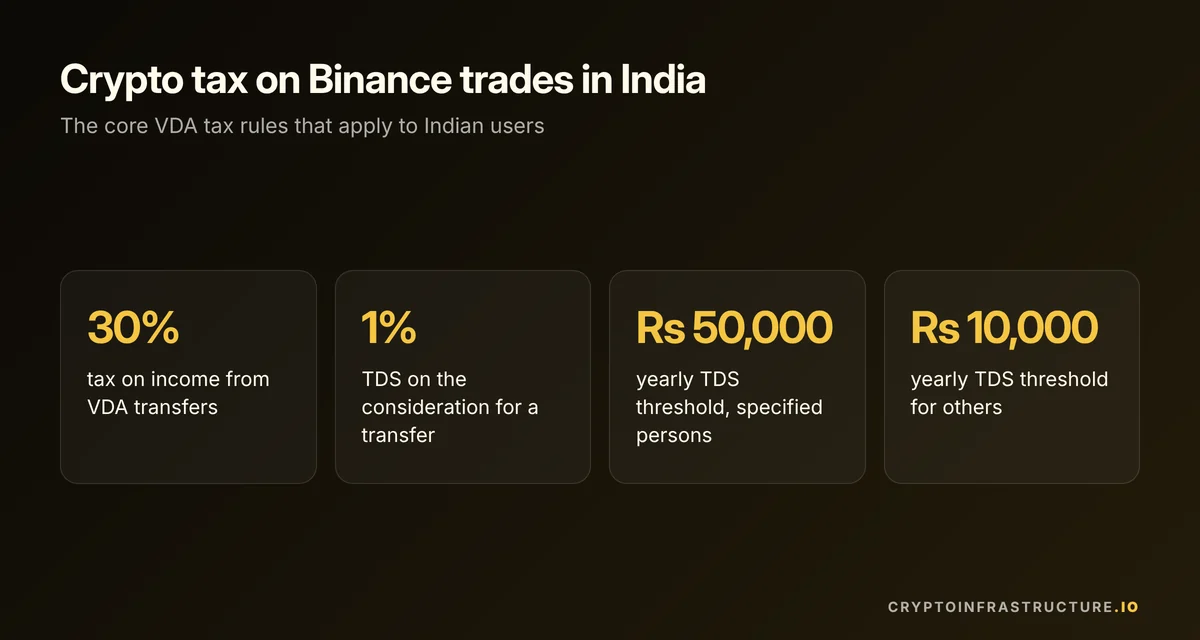
Using Binance does not change how your crypto income is taxed. The core rules, introduced by the Finance Act, 2022 as sections 115BBH and 194S of the 1961 Act and carried into the 2025 Act, are:
- 30% tax on income from transferring a VDA, plus applicable surcharge and cess. The only deduction allowed is the cost of acquisition.
- No loss set-off: a loss on one VDA cannot be set off against a gain on another VDA or against any other income, and it cannot be carried forward.
- 1% TDS on the consideration for a VDA transfer, deducted by the payer (the buyer). Thresholds are Rs 50,000 a year for specified persons and Rs 10,000 a year for others.
- Reporting: VDA income goes in Schedule VDA of ITR-2 or ITR-3, transaction by transaction.
Two points matter specifically for an offshore platform. First, keep your own transaction records, since you report each transfer yourself. Second, check whether TDS was actually deducted on your trades; if it was not, the obligation does not disappear. A full walkthrough of crypto tax in India, including how to calculate gains and file, is a separate guide.
Which crypto platforms are legal in India?
Any exchange or VDA service that is registered with FIU-IND as a reporting entity can legally serve Indian users. FIU-IND said 50 VDA SPs had registered by 1 October 2025. Binance is one of them. Coinbase also relaunched in India in June 2026, according to Inc42.
FIU-IND’s website did not show a public list of registered VDA SPs when checked on 14 October 2026, so the reliable checks are:
- Ask the platform for its FIU-IND registration and look for it in the platform’s own Indian terms or announcements.
- Search the platform’s name against FIU-IND press releases and the compliance orders page. Being named in a non-compliance notice is a red flag.
- Be wary of any app that has recently disappeared from the Indian Play Store or App Store. That is usually what an FIU takedown looks like from the user side.
Which 25 crypto exchanges have been banned in India?
The “25” in this popular search refers to FIU-IND’s 1 October 2025 action, when it issued PMLA notices to 25 offshore VDA SPs and directed the takedown of their apps and URLs. The summary of that release checked for this article does not name the 25 entities. The later 9 September 2026 release does name its 15 entities (listed above). Binance is not on that list. Strictly, these are takedown directions for operating without registration, not a ban on crypto itself.
Is Binance safe to use in India?
Registration answers “is it legal”, not “is it safe”. The evidence you can actually check:
- Regulatory standing: registered with FIU-IND since August 2024, after a Rs 18.82 crore penalty for past PMLA non-compliance (order dated 19 June 2024).
- Compliance controls: KYC with PAN, re-verification and source-of-funds requests, and Travel Rule checks on crypto transfers since June 2026.
- What is missing in India: no RBI or SEBI supervision of the exchange, and no Indian compensation scheme if the platform fails, is hacked, or freezes withdrawals.
- Offshore risk: your account sits with a global entity, so a dispute or an insolvency would not be handled like a claim against an Indian bank.
Before you decide, judge any exchange on the same points this site uses for all providers: track record, transparency, security practices, pricing clarity and jurisdiction coverage. The methodology explains each one.
If you run a crypto business serving India
The Binance case is also the clearest precedent for offshore operators. FIU-IND’s position, restated on 9 September 2026, is that PMLA obligations attach to the activity, not the office location. If your exchange, wallet, OTC desk or swap service serves Indian users, plan for FIU-IND registration, KYC, record-keeping, reporting to FIU-IND and Travel Rule data before launch, not after a notice. If you are evaluating a white label exchange for India, check that the vendor’s KYC and Travel Rule tooling fits these requirements. The KYC/AML & Compliance and Crypto Law Firms sections cover the providers that handle this work.
What this means for you
As of 14 October 2026, you can use Binance in India legally, but on India’s terms: verified identity with PAN, sender and receiver details on crypto transfers, 30% tax on gains with no loss set-off, and 1% TDS. Treat FIU registration as the minimum, not a safety certificate. Keep your own records for tax, watch FIU-IND releases for changes, and keep in mind that the 2024 block showed how quickly access can change.
For other exchanges and India coverage, browse the Exchanges section and the site’s India guides.


