A Bitcoin halving is a rule in Bitcoin’s code that cuts the number of new bitcoins paid to miners in half every 210,000 blocks. It has happened four times (2012, 2016, 2020 and 20 April 2024), the reward is now 3.125 BTC per block, and the fifth halving is due at block 1,050,000, estimated for around March to April 2028. Bitcoin’s price rose in the 18 months after each past halving and then fell by more than half from each peak. Four data points, with other big events in the mix, are not a pattern you can forecast from.
Every few years, “the halving” takes over crypto news, usually alongside price charts and countdown clocks. Most explainers either stop at “the miner reward gets cut in half” or jump straight to what it supposedly means for the price. This guide explains what a Bitcoin halving actually is in the code, lists every halving with block heights and times checked against a block explorer, says how many are left, and sets out what the price did after each one, including the falls that most halving charts leave out.
What is Bitcoin halving?
A Bitcoin halving is the point, every 210,000 blocks, at which the number of new bitcoins a miner can create in each block is cut in half. It slows the rate at which new coins enter circulation and is how Bitcoin’s total supply stays just under 21 million.
The new coins paid in each block are called the block subsidy. Together with the transaction fees in that block, it makes up the block reward a miner collects for adding a block to the chain. A halving cuts only the subsidy. It does not touch fees, existing coins or anyone’s balance.
In plain English, “halving” just means cutting something in half. In Bitcoin it always refers to this scheduled cut, sometimes nicknamed “the halvening”.
How the Bitcoin halving works
The halving is not a decision anyone makes. It is a few lines of code that every Bitcoin node runs. In Bitcoin Core, the main node software, the function that sets the subsidy (GetBlockSubsidy in validation.cpp, checked 14 October 2026) works like this:
- Count the halvings so far. It divides the block’s height (its position in the chain) by 210,000, the value of
nSubsidyHalvingIntervalin Bitcoin’s mainnet settings, and keeps the whole number. - Start from 50 BTC. The subsidy began at 50 BTC per block when Bitcoin launched in January 2009.
- Halve once per halving. It shifts that amount right by the number of halvings, which divides it by two each time and drops any fraction smaller than one satoshi (0.00000001 BTC).
Any block that pays its miner more than the allowed subsidy plus fees is rejected by every node, so the schedule is enforced by the whole network rather than by miners’ goodwill. Changing it would take a change to the consensus rules that the people running nodes would have to adopt.
The idea goes back to the Bitcoin whitepaper, which describes new coins as the incentive for block creators and says that “once a predetermined number of coins have entered circulation, the incentive can transition entirely to transaction fees.”
Why halvings are not exactly every four years
You will often read that the halving happens “every four years”. That is an approximation. The code targets one block every 10 minutes (nPowTargetSpacing), and 210,000 blocks at 10 minutes each comes to about 3.99 years. Mining difficulty is recalculated every 2,016 blocks (a two-week target) to pull the pace back towards 10 minutes, but when computing power keeps growing, blocks arrive a little faster than that between adjustments.
The real gaps have been shorter than four years: about 3.9 years from Bitcoin’s launch on 3 January 2009 to the first halving, then 3.6, 3.8 and 3.9 years between the halvings that followed (calculated from the block times below).
Bitcoin halving dates and block heights
Each halving happens at an exact block height, not on a calendar date. The times below are the timestamps of the halving blocks themselves, read from the mempool.space block explorer (checked 14 October 2026). The subsidy figures match the miner payouts recorded in those blocks.
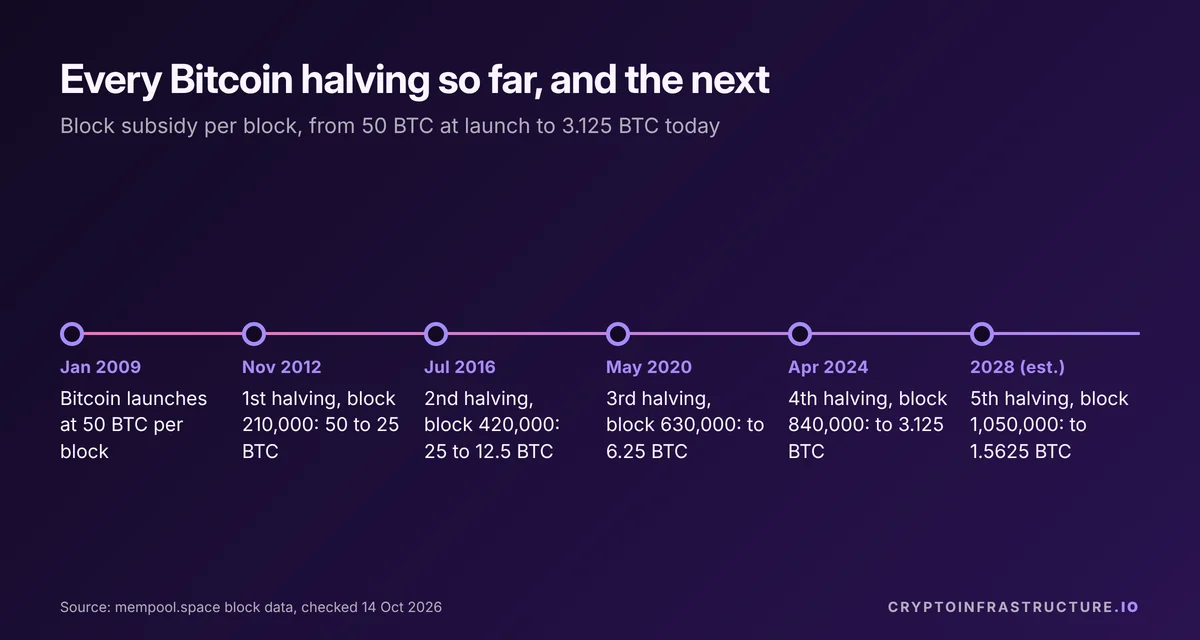
| Halving | Block height | Block time (UTC) | Subsidy before | Subsidy after |
|---|---|---|---|---|
| 1st | 210,000 | 28 November 2012, 15:24 | 50 BTC | 25 BTC |
| 2nd | 420,000 | 9 July 2016, 16:46 | 25 BTC | 12.5 BTC |
| 3rd | 630,000 | 11 May 2020, 19:23 | 12.5 BTC | 6.25 BTC |
| 4th | 840,000 | 20 April 2024, 00:09 | 6.25 BTC | 3.125 BTC |
| 5th (next) | 1,050,000 | Estimated March to April 2028 | 3.125 BTC | 1.5625 BTC |
Sources: block data from mempool.space; subsidy rule from Bitcoin Core source code (both checked 14 October 2026). Block timestamps are set by miners and can differ from wall-clock time by a few minutes.
The current block subsidy is 3.125 BTC, and it will stay at that level until block 1,050,000.
When is the next Bitcoin halving?
The fifth halving will happen at block 1,050,000. Only the block height is fixed; the date is an estimate that moves as mining speed changes.
On 14 October 2026, the chain tip was block 971,276, leaving 78,724 blocks to go (mempool.space, checked 14 October 2026). Two simple estimates:
- At the 10-minute target: 78,724 blocks take about 547 days, which lands around mid-April 2028.
- At the recent pace: mempool.space showed an average block time of about 9.5 minutes (572 seconds) in the current difficulty period, which brings it forward to around the second half of March 2028.
Countdown sites will give you a precise day and hour. Treat those as running estimates, not appointments.
How many Bitcoin halvings are left?
There are 29 halvings left after the four that have already happened, for 33 in total. Some popular pages, and Google’s own AI summary when this article was written, say there are 32 halvings in total, or “28 left”. The code says otherwise.
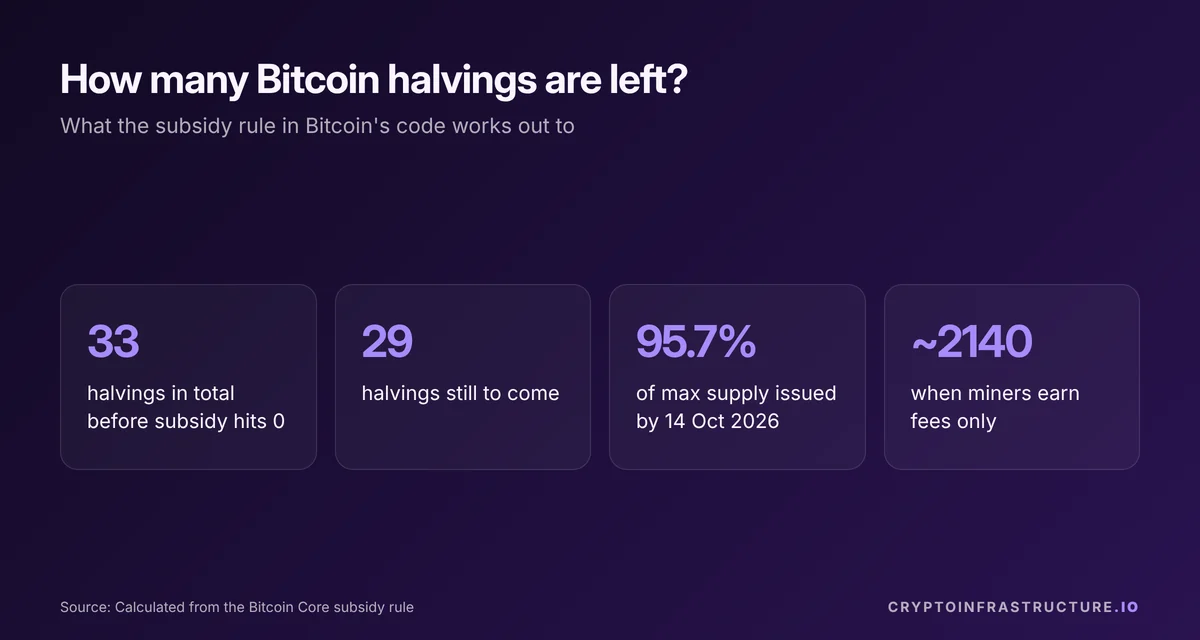
Here is the arithmetic. The starting subsidy is 50 BTC, which is 5,000,000,000 satoshis. Halving that number and dropping fractions reaches 1 satoshi after 32 halvings, at block 6,720,000. The 33rd halving, at block 6,930,000, takes it from 1 satoshi to 0. From then on, miners earn transaction fees only. At roughly 10 minutes a block, block 6,930,000 is about 113 years away, which is where the familiar “around 2140” date comes from.
Two related numbers worth getting right:
- The cap is just under 21 million. Adding up every subsidy in the schedule gives a maximum of 20,999,999.9769 BTC, slightly less than 21 million because of the rounding at each halving.
- About 95.7% is already issued. By block 971,276 the schedule had allowed about 20.1 million BTC (calculated from the subsidy rule, as of 14 October 2026). The remaining 4.3% or so will trickle out over more than a century.
Bitstamp’s explainer says no new BTC is issued “after 64 halvings”. The 64 in the code is a safety guard against an invalid shift, not the real end point: the subsidy is already zero from the 33rd halving.
What happens to miners after a halving?
Overnight, every miner earns half as many new bitcoins for the same work. Their costs (hardware, electricity, hosting) do not halve, so a halving squeezes mining margins unless something else makes up the gap: a higher bitcoin price in their local currency, higher transaction fees, cheaper power or more efficient machines.
Fees are the part of the reward that a halving does not touch, and they can matter a lot on specific days. The fourth halving block itself, block 840,000, paid its miner 40.75 BTC: the 3.125 BTC subsidy plus 37.63 BTC in transaction fees (mempool.space, checked 14 October 2026). The block just before it paid 7.29 BTC in total. That was an extreme one-off, driven by demand to get transactions into the halving block, not a sign of normal fee levels.
Over the long run, the whitepaper’s design means fees have to carry more and more of the cost of securing the network as the subsidy shrinks. How well that works when the subsidy is small is an open question that researchers and developers still debate. It is one of the genuine long-term design questions in Bitcoin, and no halving so far has answered it.
Bitcoin halving market effect: what the price did after past halvings
This section describes what happened. It is not a prediction of what the next halving will do, and nothing here is a reason to buy or sell.
The figures below use Coin Metrics’ daily USD reference price for bitcoin (Coin Metrics community data, checked 14 October 2026). “Highest” is the highest daily price within 18 months of each halving.
| Halving | Price on halving day | Price one year later | Change after one year | Highest within 18 months (date) | Days from halving to that high |
|---|---|---|---|---|---|
| 28 Nov 2012 | $12.33 | $1,007.39 | +8,069% | $1,134.93 (4 Dec 2013) | 371 |
| 9 Jul 2016 | $651.94 | $2,506.17 | +284% | $19,640.51 (16 Dec 2017) | 525 |
| 11 May 2020 | $8,591.65 | $56,612.10 | +559% | $67,541.76 (8 Nov 2021) | 546 |
| 20 Apr 2024 | $64,907.99 | $85,101.75 | +31% | $124,824.45 (6 Oct 2025) | 534 |
Source: Coin Metrics daily PriceUSD reference rate (checked 14 October 2026). Percentages are calculated from those prices. Other data providers show slightly different prices for the same days.
The falls that halving charts usually leave out
Every one of those highs was followed by a large decline. Using the same Coin Metrics data:
- After the December 2013 high, the price was $310.44 on 30 December 2014, about 73% lower.
- After the December 2017 high, it was $5,858.64 on 28 June 2018, about 70% lower.
- After the November 2021 high, it was $28,612.04 on 27 May 2022, about 58% lower.
- After the October 2025 high, it was $58,525.08 on 30 June 2026, about 53% lower, and below the price on the day of the 2024 halving.
The months straight after a halving were not smooth either. After the 2016 halving the price dropped to $526.98 on 2 August 2016, 19% below the halving-day price. After the 2024 halving it dropped to $53,838.95 on 6 September 2024, 17% below.
Why this history is not a forecast
- Four data points is a tiny sample. Any “pattern” built on four events, in a market that was tiny for the first two, carries very little statistical weight.
- The effect has shrunk each time. The one-year change fell from about +8,000% after 2012 to +31% after 2024, and the gain to the 18-month high fell from about +9,100% to +92%. Whatever role the halving played, it has not been a constant.
- Other big events overlap the halvings. The most recent example: the US SEC approved the listing and trading of spot bitcoin exchange-traded products on 10 January 2024 (SEC statement), about three months before the fourth halving. Interest rates, regulation, exchange failures and new products all move the price, and they do not line up neatly with block heights.
- The supply change is known years ahead. Everyone can read the schedule, so there is no surprise on the day for markets to react to.
- The new supply being cut is small. The fourth halving cut new issuance by 3.125 BTC per block, roughly 450 BTC a day at 144 blocks a day. That is small next to the roughly 20.1 million BTC already issued and the amounts that change hands every day.
The honest summary: past halvings were followed by price rises and then by deep falls, and nobody can separate the halving’s own effect from everything else that was happening at the time.
What is a “Bitcoin supercycle”?
“Supercycle” is a term from market commentary for the idea that Bitcoin is breaking away from the boom-and-bust rhythm that has roughly lined up with halvings, and moving into a longer, less cyclical phase. It is a narrative about price behaviour, not a feature of the protocol, and there is no agreed test that would confirm or rule it out in advance. The halving schedule is the same whichever story turns out to fit the data.
If you own bitcoin, does anything change at a halving?
No. Your balance, your addresses and your keys stay exactly the same, whether your coins are on an exchange or in a self-custody wallet. You do not need to do anything, move anything or update anything. The halving changes only how many new coins miners can create in each future block.
That gives you a simple test for any message tied to the halving: no halving requires any action from holders. A “halving bonus”, a “halving airdrop” or a request to “verify” or “upgrade” your wallet before the halving is not part of Bitcoin, and anything that asks for your seed phrase is a scam.
Common misconceptions about the halving
- “The halving halves the supply.” It halves the rate of new issuance. The coins that already exist are untouched.
- “It happens every four years on a set date.” It happens every 210,000 blocks. So far the gaps have been between 3.6 and 3.9 years.
- “The halving cuts transaction fees.” Fees are set by users competing for block space and are not affected by the subsidy rule.
- “There are 32 halvings in total.” The subsidy reaches zero at the 33rd halving, so 29 are left.
- “Price always goes up after a halving.” In four cases it rose for a while and then fell by more than half from each high. That is history, not a rule.
What this means for you
If you want to understand Bitcoin, the halving is worth knowing for what it is: a fixed, public, code-enforced issuance schedule that makes Bitcoin’s supply predictable decades ahead. That predictability is a real and unusual design choice. What the halving does not give you is a price signal you can rely on; the record is four events, each tangled up with other forces, each followed by a deep fall. If you see a halving countdown attached to a “buy now” message, you are looking at marketing, not analysis.
For how articles on this site are researched and sourced, read the methodology, and browse more plain-English explainers in Guides, including what a stablecoin is and how it keeps its peg.