A white label crypto exchange is exchange software (matching engine, wallets, user interface and admin panel) that you license from a provider and run under your own brand. Vendor quotes for the software start at around $5,000 and reach $250,000 for an enterprise build, with some hosted enterprise subscriptions priced far higher, but the software is the cheap part: you still need your own licence in every market you serve, banking and liquidity arrangements, compliance staff and security work. Before you sign, check four things: who holds the licence, who controls the private keys, where the liquidity comes from, and what you can take with you if you leave.
If you are planning to launch a crypto exchange or add trading to an existing fintech, broker or wallet, a white label platform looks like the shortcut: a working exchange, your logo, live in weeks. The quotes you collect will range from a few thousand dollars to six figures a month, and most of the pages that rank for this topic are written by the vendors selling it. This guide explains what a white label crypto exchange actually includes, the three commercial models behind it, what it costs once you add the parts the quotes leave out, how the main providers compare on what they publish, and the licensing and lock-in questions to settle before you sign.
What is a white label crypto exchange?
A white label crypto exchange is a ready-built trading platform that a provider licenses to you, which you rebrand and operate as your own exchange. The provider supplies and usually maintains the technology. You supply the brand, the customers, the licence and the operating company.
The phrase covers very different deals. At one end you buy a copy of the source code and run it yourself. At the other, a regulated partner holds the licences and custody, and your app is a branded front end on its infrastructure. Most quotes sit somewhere in between, which is why two “white label exchange” offers can differ by a factor of fifty in price and in what you are actually responsible for.
A turnkey crypto exchange is the same idea, used mostly for packages that bundle the software with hosting, liquidity connections and setup services, so you can switch it on with little technical work. “Turnkey” describes how much is pre-configured. It does not mean the package includes a licence. (Turnkey is also the name of an unrelated wallet infrastructure company, which is why that search shows wallet results.)
What you actually get, and what you don’t
Vendor feature lists look similar: trading engine, wallets, KYC, admin panel, liquidity. The difference is in whether each item is included and operated by the provider, integrated (a connector to a third party you contract and pay separately), or left to you. Ask every vendor to fill in this table in writing.
| Component | Usually included in the software | Usually your job or a separate contract |
|---|---|---|
| Matching engine and order types | Yes | Performance limits, uptime commitment (ask for an SLA) |
| Web and mobile front end | Template you rebrand | Custom design, app store accounts, translations |
| Admin panel and back office | Yes | Staff to run it: support, finance, risk |
| Wallets (hot, warm, cold) | Wallet module or a connector to a custody provider | Key management policy, custody provider fees, insurance |
| KYC and AML screening | Integration with an identity or analytics vendor | The vendor contracts, per-check fees, your compliance officer and policies |
| Liquidity | Connectors to liquidity providers, sometimes a shared order book | Liquidity and market making agreements, credit lines, prefunding |
| Fiat deposits and withdrawals | Payment gateway connectors | Banking relationships and payment processor approval |
| Licence or registration | No (except in crypto-as-a-service, see below) | Applications, capital requirements, legal fees, ongoing reporting |
| Security testing | Vendor’s own controls and certifications | Independent penetration tests and audits of your deployment |
The pattern across the vendor pages reviewed for this guide (checked 13 October 2026) is consistent: none of the exchange software providers includes a licence. Shift Markets says clients must obtain licences in their region. B2Broker says it works with licensing partners and can help you choose a licence tier. ChainUp describes its exchange software as built to help you secure licences and lists licensing support as a separate service. If a sales deck implies otherwise, ask for it in the contract.
The three white label models
Most offers fall into one of three models. Which one you choose decides your cost structure, your regulatory exposure and how hard it is to leave.
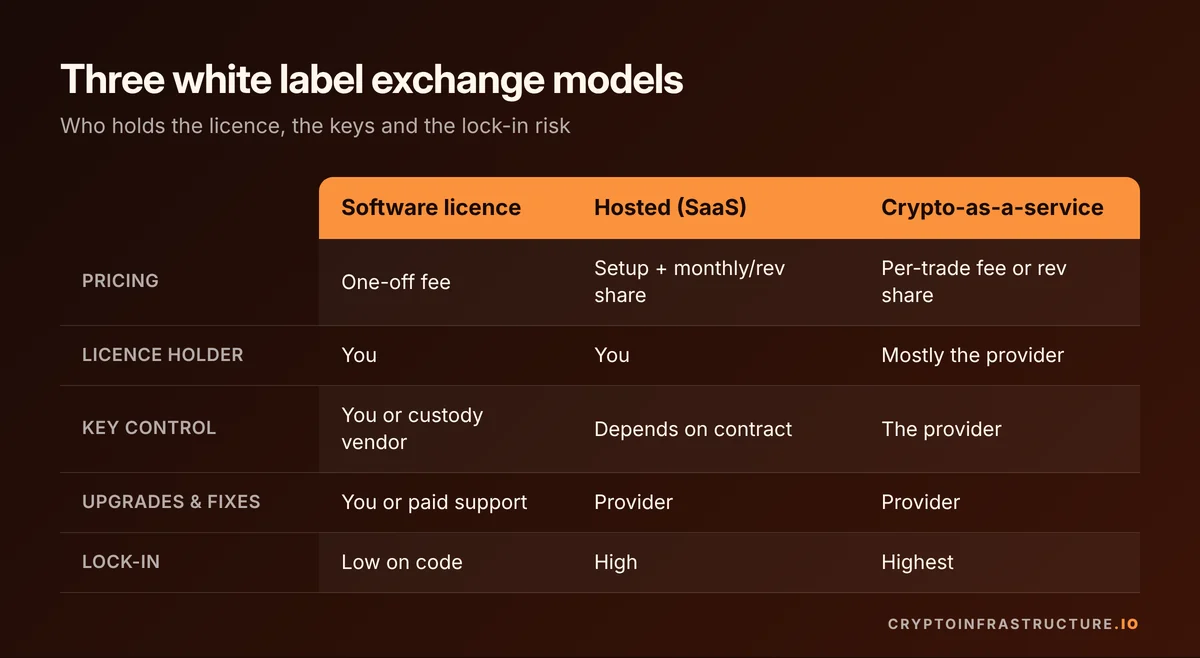
| 1. Software licence or source code | 2. Hosted platform (SaaS) | 3. Crypto-as-a-service (licensed partner) | |
|---|---|---|---|
| What you buy | A copy of the exchange code, often a “clone” script, plus setup | Access to a platform the provider hosts and updates | APIs to a regulated provider’s trading, custody and ledger |
| Typical pricing | One-off fee plus optional maintenance | Setup fee, monthly fee and/or revenue share | Per-transaction fees or revenue share, plus integration |
| Who holds the licence | You | You | Mostly the provider, in the markets it is licensed for |
| Who controls keys | You (or your custody vendor) | Depends on the contract: check | The provider |
| Upgrades and security fixes | You, or paid vendor support | Provider | Provider |
| Lock-in | Low on code, high on the team that knows it | High: data, users and uptime sit on their servers | Highest: customers’ assets and records sit with the provider |
| Fits | Teams with engineers and a licence plan | Operators who want speed and accept a revenue share | Banks, brokers, neobanks and apps adding crypto trading to an existing product |
The third model is often left out of white label comparisons, but it is the route many established fintechs take. Zero Hash is an example: its documentation says its US entity is a FinCEN-registered money services business with money transmitter licences in 51 US jurisdictions, and that both its operating entities are licensed by the New York Department of Financial Services for virtual currency business (Zero Hash docs, checked 13 October 2026). You trade licensing work for dependence on one partner, and you do not run an exchange in the order book sense: your customers trade through the partner.
How much does a white label crypto exchange cost?
For the software alone, published vendor ranges run from about $5,000 for a basic package to $250,000 for an enterprise build, and hosted enterprise platforms can cost far more on a subscription. Google’s AI Overview quotes “$5,000 to $50,000+” for setup. That range is accurate for the software line item only. It leaves out the licence, liquidity, banking, compliance staff and security work, which usually cost more than the software in the first year.
What vendors publish (checked 13 October 2026)
| Provider | Model | Published price or range | What the price covers |
|---|---|---|---|
| HollaEx | Hosted (SaaS) with open-source kit | Free 2-week trial (subject to approval); Enterprise Cloud with “15% revenue sharing”; no list price for the subscription | Hosting, exchange wallet, KYC/AML plugins, “liquidity included for the largest markets” |
| Hashcodex | Development company | Basic $5,000 to $15,000+; advanced $15,000 to $50,000; enterprise $100,000 to $250,000 | Software and customisation only; hosting, audits and maintenance described as extra |
| Dappfort | Development company (“clone” scripts) | Typically $15,000 to $50,000 | Software build; licensing, liquidity and support terms not stated |
| ChainUp | Enterprise platform | No list price; enquiry form brackets of under $100,000, $100,000 to $500,000, and over $500,000 | Quote-based |
| AlphaPoint | Enterprise platform | No list price; its own blog says some white label subscriptions exceed “hundreds of thousands of dollars per month” | Quote-based |
| Shift Markets, B2Broker | Enterprise platform | No list price; pricing “depends on the scope” (Shift); B2Broker bills hosting pay-per-use | Quote-based |
Sources: each provider’s pricing, product or blog page, checked 13 October 2026. Prices are the vendors’ own statements, exclude tax and are not independently verified. HollaEx terms are from its pricing page.
The costs the quotes leave out
- Licensing: legal fees, application fees, minimum capital and the time to approval, per jurisdiction. This is usually the longest item on the plan, not the software.
- Liquidity: a new exchange has no order book. You need a liquidity provider or market maker, and that means fees, spreads, prefunded balances or credit lines. See Market Makers & Liquidity.
- Compliance operations: per-check KYC fees, blockchain analytics, Travel Rule tooling, and a named compliance officer. See KYC/AML & Compliance.
- Custody: custody provider fees, insurance if you can get it, and the internal controls to run hot and cold wallets.
- Banking and payments: crypto businesses often struggle to keep bank accounts; budget time and fees for payment processors. The site’s guide to choosing a crypto payment gateway or on-ramp covers the on-ramp side.
- Security: independent penetration testing of your deployment, bug bounty, monitoring. A vendor certificate covers the vendor, not your configuration.
- People: support, operations, finance and marketing. These run every month whether or not trading volume arrives.
Worked example: what a 15% revenue share means
Revenue-share pricing is easy to underestimate because it grows with you. Here is the arithmetic, using illustrative assumptions only (not a forecast):
- Monthly trading volume: $20 million
- Average fee you charge (maker and taker blended): 0.10%
- Your gross fee revenue: $20,000,000 × 0.001 = $20,000 a month
- Platform revenue share at 15%: $20,000 × 0.15 = $3,000 a month, or $36,000 a year
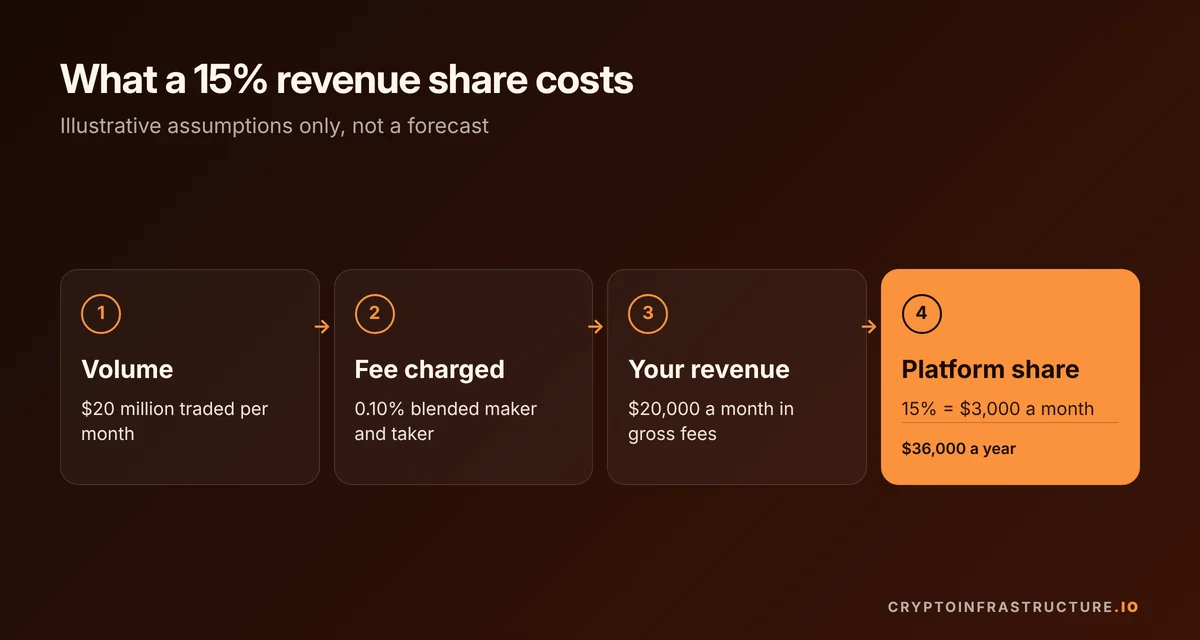
At ten times the volume, the share is ten times larger, $360,000 a year, while a fixed-fee licence would stay flat. Model both at your realistic volume and at your target volume before you choose. Also check whether the share is calculated on gross fees or on fees after rebates and liquidity costs, since that changes the number.
How long does it take to launch?
Vendors quote weeks: “weeks rather than months” (Shift Markets), “a few weeks” (ChainUp), 4 to 8 weeks for most clients “depending on regulatory steps and PSP onboarding” (B2Broker), and 7 days to 6+ weeks depending on customisation (Hashcodex), all checked 13 October 2026. Those figures describe the technical setup. Your real launch date is set by the slowest of three things: licence approval, a bank or payment processor saying yes, and signed liquidity. In most regulated markets that is months, not weeks.
Licensing: the part white label does not solve
A white label licence is a software licence. It is not a licence to operate an exchange. In almost every market the site covers, running a platform where customers buy, sell or hold crypto requires your own authorisation or registration, and the rules have tightened in the last year.
| Region | What an exchange operator needs (checked 13 October 2026) |
|---|---|
| European Union | MiCA authorisation as a crypto-asset service provider (CASP). The transitional period for firms operating under older national regimes ended on 1 July 2026; ESMA expected unauthorised firms to have executed wind-down plans by then, and non-EU firms may not serve EU clients except under narrow reverse solicitation (AMF on ESMA’s statement, 23 June 2026). |
| United States | FinCEN registration as a money services business (FinCEN’s May 2019 guidance on convertible virtual currency treats exchangers as money transmitters), plus state money transmitter licences, plus a BitLicense or trust charter from the NYDFS to serve New York. |
| United Kingdom | Today: FCA registration under the Money Laundering Regulations. Next: authorisation under the Financial Services and Markets Act 2000 (Cryptoassets) Regulations 2026. The FCA application window runs 30 September 2026 to 28 February 2027 and the new regime starts 25 October 2027 (per TLT LLP, 28 May 2026). |
| UAE | A licence from VARA for virtual asset activities in or from Dubai (outside the DIFC), or from the FSRA in Abu Dhabi Global Market. |
| Singapore | A Payment Services Act licence to serve Singapore customers. Since 30 June 2025, Part 9 of the Financial Services and Markets Act 2022 also covers Singapore firms serving only overseas customers, and MAS said on 6 June 2025 it would generally not grant those licences. |
| India | Registration with the Financial Intelligence Unit (FIU-IND) as a reporting entity under the Prevention of Money Laundering Act, following the March 2023 notification bringing virtual asset service providers into scope. |
This is a summary, not legal advice. Check the current position with the regulator and a specialist crypto law firm before you commit to a market. The regional guides on this site cover each market in more depth.
Two practical consequences follow. First, pick your market before you pick your vendor: a platform that cannot produce the reporting, Travel Rule data or audit trail your regulator expects is the wrong platform at any price. Second, if you cannot or will not get a licence, the honest options are a crypto-as-a-service partner that holds the licences, or not launching in that market. Running an unlicensed exchange on white label software is still running an unlicensed exchange.
White label vs building from scratch
The comparison most guides make (cheap and fast versus expensive and slow) is true for the software and misleading for the business, because licensing, liquidity and compliance cost the same either way.
- Choose white label if your advantage is distribution (an existing customer base, brand or region), you need to be live within a year, and you accept the vendor’s roadmap.
- Consider a custom build only if the exchange itself is your product, you need features no vendor offers, and you can fund an engineering and security team permanently. AlphaPoint, a vendor, puts a from-scratch build at more than a million dollars in its own cost article.
- Consider crypto-as-a-service if you are adding crypto to an existing financial product and do not want to become a licensed exchange yourself.
White label only answers the software question. For the full launch roadmap (business model, licence, liquidity, banking and launch order), see how to start a crypto exchange. If you go down the custom route, compare crypto exchange development companies and use the checklist in How to Vet a Blockchain Development Studio.
White label crypto exchange providers compared
How this comparison was built: from each provider’s own product, pricing and documentation pages and its public code where available, checked 13 October 2026, against the site’s criteria of track record, transparency, security practices, pricing clarity and jurisdiction coverage. None of the providers was tested hands-on, and none paid to be included. Client counts and certifications are the vendors’ own claims unless stated otherwise.
| Provider | Model | Published pricing | Licence included | Notable from public sources |
|---|---|---|---|---|
| 1. HollaEx | Hosted, open-source kit | Yes (revenue share 15%) | No | Kit on GitHub, but trading needs a connection to the HollaEx Network |
| 2. Shift Markets | Enterprise platform | No | No | Claims “150+ exchanges launched” |
| 3. AlphaPoint | Enterprise platform | No | No | Says it retains software IP; you own your exchange, not the code |
| 4. B2Broker | Enterprise platform | Partial (hosting pay-per-use) | No (licensing partners) | Liquidity agnostic, AWS hosting, 4 to 8 week launches claimed |
| 5. ChainUp | Enterprise platform | Budget brackets only | No (separate licensing service) | Claims 500 exchanges launched; liquidity and custody sold as separate products |
| 6. Zero Hash | Crypto-as-a-service | No | Yes, in its licensed US jurisdictions | FinCEN MSB, money transmitter licences in 51 US jurisdictions, NYDFS licensed |
1. HollaEx
- Model: hosted exchange on HollaEx cloud, with an “open source white label crypto software suite” (HollaEx Kit) on GitHub.
- Pricing (13 October 2026): free 2-week operator trial, subject to approval; Enterprise Cloud at a 15% revenue share, subscription price not listed.
- Included: hosting, exchange wallet, KYC/AML plugins (Sumsub and iDenfy named), liquidity “for the largest markets”.
- Watch for: the kit is open source, but its README says trading and blockchain functions require connecting to the HollaEx Network. Open code does not mean you can run independently; ask what works if you disconnect.
- Best for: small operators who want the most transparent pricing in this comparison and accept a revenue share.
2. Shift Markets
- Model: enterprise white label exchange, also selling derivatives and prediction market software.
- Pricing: not published; depends on scope, integrations and support level.
- Included: trading engine, back office, KYC/AML tooling, pre-configured liquidity provider connections. Custody and hosting are not described on the product page.
- Track record: its own page claims “150+ Exchanges Launched”; a January 2026 article published by a competitor quotes “more than 200”. The figures conflict and neither is independently verified. No named clients on the page.
- Best for: operators who want a managed launch and will negotiate a bespoke quote.
3. AlphaPoint
- Model: enterprise exchange software for institutions and regulated markets.
- Pricing: not published. Its own cost article says some white label subscriptions exceed hundreds of thousands of dollars a month.
- Ownership terms: AlphaPoint states plainly that the software developer owns the rights to the software and you own only your exchange. That is standard, and useful to see in writing: plan your exit around it.
- Best for: banks, brokers and larger operators with procurement teams.
4. B2Broker
- Model: turnkey crypto exchange with its own back office (B2CORE) and liquidity arms.
- Pricing: no list price; hosting on AWS billed pay-per-use; you set client-facing fees.
- Included: wallets with hot, warm and cold segregation, KYC in the back office, liquidity connectors (PrimeXM, OneZero and its own B2CONNECT, plus your own providers over FIX).
- Licence: not included; B2Broker says it works with licensing partners.
- Best for: brokers already in the forex and CFD world who want one vendor for platform and liquidity.
5. ChainUp
- Model: exchange software for centralised, decentralised and hybrid exchanges, with a large catalogue of add-ons.
- Pricing: no list price; its enquiry form uses budget brackets from under $100,000 to over $500,000.
- Included: spot and futures trading, admin console, fiat on-ramp connections. Liquidity (Bitwind), MPC wallets and KYT appear as separate products, so confirm what is in your package.
- Track record: claims 500 exchanges launched and 8 years of experience; certification logos are shown but not described in text, so request the reports.
- Best for: operators who want many trading products from one catalogue and can manage a modular contract.
6. Zero Hash (a different model)
- Model: crypto-as-a-service APIs and SDKs for buy and sell, custody, on and off ramps and payouts.
- Licence: the provider holds them: FinCEN MSB registration, money transmitter licences in 51 US jurisdictions and NYDFS licensing, per its documentation (checked 13 October 2026).
- Trade-off: you do not run your own order book or custody, and your customers’ assets and records sit with the provider. Leaving means migrating customers to a new partner.
- Best for: US fintechs, brokers and neobanks adding crypto to an existing product.
Other names that appear in rankings for this keyword include Hashcodex, Dappfort, Antier, Coinsclone, PayBito, Simplify Labs and BTSE’s enterprise arm. Several of the most visible “top providers” lists are published by providers that rank themselves first; read them as marketing.
Vendor lock-in: what to settle before you sign
Switching exchange platforms after launch means migrating user accounts, balances, KYC records and wallet keys while customers keep trading. Most operators never do it, which is why the exit terms are worth more negotiating time than the setup fee.
- Code and escrow: do you get source code, a source code escrow (released if the vendor fails), or only access? AlphaPoint, for example, retains the software rights.
- Data export: can you export users, KYC files, order and trade history and ledger balances in a documented format, at any time, at no extra cost?
- Keys and custody: who generates and holds the private keys? If the vendor holds them, how are assets moved to your new custodian on exit, and in what timeframe?
- Liquidity: is liquidity tied to the vendor’s network or shared order book? If you leave, does your order book go empty overnight?
- Network dependence: for “open source” platforms, does the code work without the vendor’s network or licence server?
- Revenue share and minimums: is the share on gross or net fees, are there monthly minimums, and how is it audited?
- Termination: notice period, transition support, and what happens to your exchange if the vendor is acquired, shuts down or loses a licence.
- Security responsibility: who is liable for a breach in the vendor’s code versus your configuration, and what incident notification timeline is in the contract?
Red flags when choosing a provider
- “Licence included” or “compliance guaranteed” from a software vendor. Only a regulator grants a licence, and only to you or a named entity.
- Guaranteed profits or “earn from day one” claims. Exchange revenue depends on volume you have to win.
- “Clone” scripts with no update or security commitment. Copying a big exchange’s interface is not the same as copying its security.
- Liquidity that is only a logo wall. Ask for the contract terms, not the partner logos.
- No independent security evidence. Ask for recent penetration test summaries and SOC or ISO reports, not just badges.
- Vendor “top 10” lists as due diligence. Check the publisher before you trust the ranking.
Third-party software is a real attack surface, not a theoretical one. In February 2025 attackers stole about $1.5 billion in Ether from Bybit by manipulating a transaction in the multisig wallet software it used, and the FBI attributed the theft to North Korea on 26 February 2025. Whatever platform you license, its wallet and signing stack is part of your security perimeter, and the contract should say who tests it.
What this means for you
A white label crypto exchange buys you working software quickly. It does not buy you a licence, liquidity, banking or a security team, and those decide whether you can launch and stay open. Start with the market and licence you can realistically obtain, then pick the model (software, hosted or crypto-as-a-service) that fits it, and only then compare vendors. Get every quote broken down against the “what you get” table above, model the revenue share at your target volume, and negotiate data export, key control and exit terms before price.
For more on the pieces around the platform, browse Exchanges, Market Makers & Liquidity and KYC/AML & Compliance, and read how this site researches providers in the methodology.