Checked 14 October 2026. Stablecoin regulation now follows the same basic pattern almost everywhere: you need a licence to issue, every token must be backed one to one by cash-like reserves held apart from your own money, holders must be able to redeem at par, you must publish reserve reports, and you may not pay holders interest. What differs is timing.
The EU’s MiCA stablecoin rules have applied since 30 June 2024 and ESMA has just given platforms three months to drop non-compliant tokens. The US GENIUS Act takes effect on 18 January 2027 at the latest, but almost all of its implementing rules are still proposals. Hong Kong and the UAE are live, the UK starts on 25 October 2027, and Singapore is still legislating.
Stablecoin regulation used to be a question of whether rules would come. As of October 2026 it is a question of which deadline hits your business first. If you issue a stablecoin, list one on an exchange, or build payments on top of one, you now face at least six regimes with similar goals and different dates, licence types and reserve lists.
Most guides ranking for this topic were written in 2025 and stop at “the GENIUS Act was signed”. This guide covers what the GENIUS Act and MiCA actually require of issuers, what is final and what is still proposed as of 14 October 2026, how the UK, Singapore, Hong Kong and UAE regimes compare, and ends with a dated issuer-obligations checklist by jurisdiction.
Checked 14 October 2026 against the GENIUS Act (Public Law 119-27), Federal Register rule documents, the MiCA Regulation text, ESMA’s 8 October 2026 opinion, FCA and Bank of England releases, the HKMA register, the CBUAE rulebook and the VARA rulebook. Where a point comes from a law firm or press summary rather than the regulator’s own text, it says so. This is an education guide, not legal advice.
What is stablecoin regulation?
Stablecoin regulation is the set of laws that decide who may issue a token that promises a stable value, usually one unit of a currency, and on what terms. In practice it covers five things: a licence to issue, reserves that back every token one to one, a legal right for holders to redeem at par, regular public disclosure of those reserves, and a ban on paying holders interest. Most regimes add anti-money laundering duties and a requirement that the issuer can freeze tokens on lawful orders.
The rules mostly target the issuer. Exchanges, brokers and wallets come in a second wave: once a regime is live, they are told which stablecoins they may offer to local customers. That is why the EU’s newest step, covered below, lands on trading platforms rather than on Tether or Circle directly. If you need a refresher on how stablecoins work and why they depeg, start with the stablecoin explainer.
Stablecoin regulation at a glance (14 October 2026)
| Jurisdiction | Law or framework | Status on 14 October 2026 | Key date |
|---|---|---|---|
| United States | GENIUS Act (S.1582, Public Law 119-27) | Law signed 18 July 2025; implementing rules mostly proposed, one procedural Treasury rule in force | Takes effect 18 January 2027 at the latest |
| European Union | MiCA, Regulation (EU) 2023/1114, Titles III (ARTs) and IV (EMTs) | In force | Applied from 30 June 2024; ESMA wind-down for non-compliant tokens within three months of 8 October 2026 |
| United Kingdom | FSMA cryptoasset regime; FCA PS26/10; Bank of England systemic regime | FCA rules final (30 June 2026); Bank of England code still draft | Regime starts 25 October 2027; apply by 28 February 2027 |
| Singapore | MAS single-currency stablecoin (SCS) framework | Framework announced August 2023; law amendments out for consultation | Consultation closes 16 October 2026 |
| Hong Kong | Stablecoins Ordinance (Cap. 656) | In force; two licensed issuers | Commenced 1 August 2025; first licences 10 April 2026 |
| UAE | CBUAE Payment Token Services Regulation; VARA FRVA rules (Dubai) | In force | CBUAE regulation effective 31 August 2024 |
What is the GENIUS Act?
The GENIUS Act (Guiding and Establishing National Innovation for U.S. Stablecoins Act, S.1582) is the US federal law for “payment stablecoins”, signed on 18 July 2025 as Public Law 119-27. It makes it unlawful for anyone other than a “permitted payment stablecoin issuer” to issue a payment stablecoin in the US (section 3(a)), and it sets the reserve, redemption, disclosure and conduct rules those issuers must follow. Some ranking pages still give a June 2025 signing date; the correct date is 18 July 2025.
A permitted payment stablecoin is also carved out of securities and commodities law: it is not a “security” under federal securities laws or a “commodity” under the Commodity Exchange Act, according to Latham & Watkins’ summary of the Act. That ends the old debate about whether the SEC regulates fully reserved dollar stablecoins, but only for coins from permitted issuers.
What the GENIUS Act requires of issuers
- Reserves, at least 1 to 1 (section 4(a)(1)(A)). Permitted reserve assets are US coins and currency, insured deposits, Treasury bills, notes or bonds with 93 days or less to maturity, certain repo and reverse repo, registered government money market funds, other similarly liquid assets the regulator approves, and tokenised forms of these. Gold, bitcoin and corporate loans are not on the list.
- Redemption policy (section 4(a)(1)(B)). You must publish “clear and conspicuous procedures for timely redemption”, disclose fees in plain language, and give at least 7 days’ notice before changing them.
- Monthly reserve reports (section 4(a)(1)(C) and 4(a)(3)). Publish the composition of your reserves on your website every month, have each month-end report examined by a registered public accounting firm, and have your CEO and CFO certify it.
- Audited accounts above $50 billion (section 4(a)(10)). An issuer with more than $50 billion outstanding that does not already report to the SEC must publish annual audited financial statements.
- No interest or yield (section 4(a)(11)). Neither permitted nor foreign issuers may pay holders “any form of interest or yield”.
- Freeze capability (section 4(a)(5) and 4(a)(6)). You need the technical ability to block, freeze and reject specific transactions and to comply with lawful orders.
- State or federal route (section 4(d)). Issuers with up to $10 billion outstanding may choose a state regime that is “substantially similar” to the federal one. Above $10 billion, a state issuer must move to federal oversight within 360 days or stop issuing new coins, unless it gets a waiver.
- Insolvency priority. Holders rank ahead of all other claims on the issuer in insolvency, per Latham & Watkins’ summary.
When does the GENIUS Act take effect?
On the earlier of 18 months after enactment or 120 days after the regulators issue final implementing rules, which puts the outside date at 18 January 2027. One competitor guide, Paxos’s March 2026 explainer, lists the Act as “Effective July 2025”; July 2025 is the signing date, not the effective date.
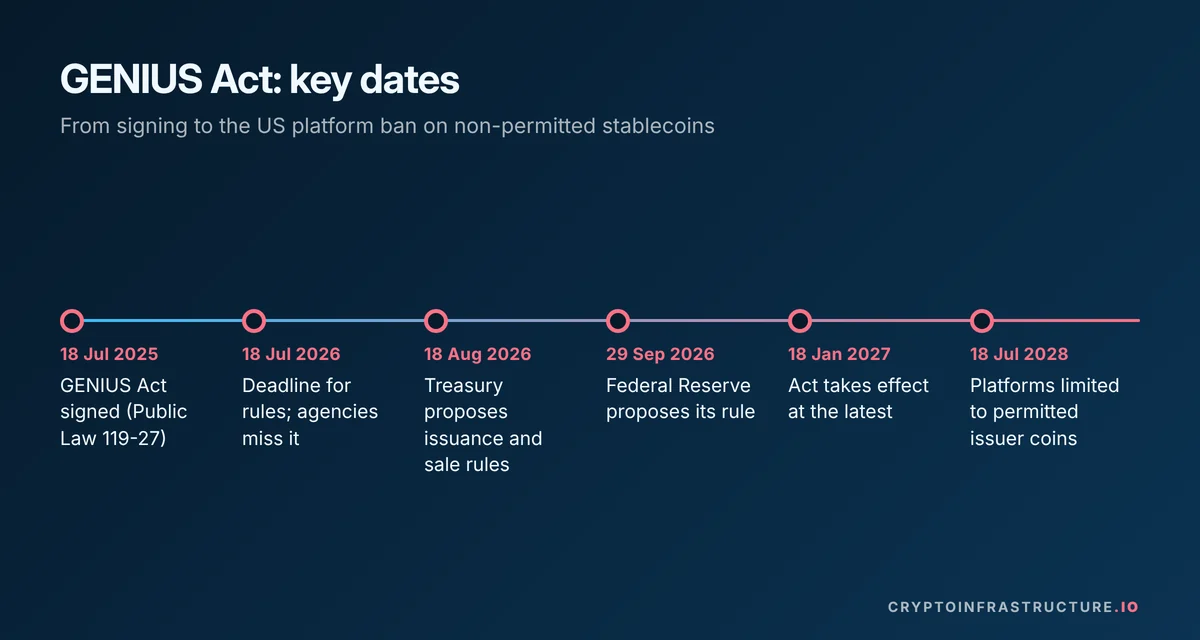
A second, later date matters for exchanges and wallets. From 18 July 2028, three years after enactment, a digital asset service provider may not offer or sell a payment stablecoin to a person in the US unless it comes from a permitted issuer or a foreign issuer that qualifies under section 18. Treasury’s August 2026 proposal repeats that date.
GENIUS Act rules: what is final and what is proposed (14 October 2026)
The Act told regulators to finish their rules within one year, by 18 July 2026. Yahoo Finance reported on 1 October 2026 that seven federal agencies missed that deadline. Here is where each rule stands:
| Agency | Rule | Published | Status | What it covers |
|---|---|---|---|---|
| NCUA | Licensing for credit union issuer subsidiaries | 12 February 2026 (per KPMG) | Proposed | Joint applications by credit union and issuer; credit unions may invest only in NCUA-licensed issuers |
| OCC | Implementing rule for OCC-supervised issuers (91 FR 10202) | 2 March 2026 | Proposed; comments closed 1 May 2026 | Licensing, reserves held at eligible institutions, custody, capital, and a presumed yield-ban breach where an issuer funds yield paid through an affiliate or third party |
| FinCEN and OFAC | AML/CFT and sanctions programme rule | 8 April 2026 | Proposed | Anti-money laundering and sanctions compliance programmes for permitted issuers |
| FDIC | Requirements for FDIC-supervised issuers | 10 April 2026 (per KPMG) | Proposed | Reserve deposits insured as the issuer’s corporate deposits, not passed through to holders; ban on lending to customers to buy stablecoins |
| Treasury | Issuance, offer and sale rules (91 FR 53368) | 18 August 2026 | Proposed; comments close 19 October 2026 | Who may issue “in the US”, the July 2028 platform ban, the foreign-issuer route and safe harbours |
| Federal Reserve | Implementing rule (91 FR 61580) | 29 September 2026 | Proposed; comments close 30 November 2026 | Permissible activities, reserves, redemptions, risk management, audits, capital, custodians, an anti-tying rule for all issuers |
| Treasury | Stablecoin Certification Review Committee procedures | 30 September 2026 (reported) | Interim final rule, in force on publication (reported); comments to 30 November 2026 | How state regimes are certified as “substantially similar” |
Sources: Federal Register documents 2026-04089, 2026-16796 and 2026-19860; OFAC recent actions, 8 April 2026; KPMG regulatory alert on the FDIC, NCUA and OCC proposals; Yahoo Finance, 1 October 2026, for the Treasury interim final rule and missed deadlines. Checked 14 October 2026.
The practical reading: on 14 October 2026 the only binding GENIUS Act regulation is procedural. The substantive rules on capital, reserves and redemption are all proposals. The OCC and FDIC proposals set an initial minimum capital of $5 million, adjustable during a three-year start-up period, plus an operational backstop of liquid assets kept separate from reserves, according to KPMG’s summary. According to Yahoo Finance, the OCC has committed to a final rule by November 2026. Plan your build around the Act’s own text, and treat the proposed numbers as likely but not settled.
Can a foreign issuer such as Tether operate under the GENIUS Act?
Only through section 18. A foreign issuer is exempt from the section 3 prohibitions if Treasury finds its home regime “comparable” and the issuer registers with the OCC; Latham & Watkins adds that it must hold enough reserves at a US financial institution and show it can comply with US lawful orders. Treasury’s proposal also offers a conditional safe harbour for foreign issuers that take reasonable steps to keep their coins away from US recipients. No comparability finding had been published as of 14 October 2026. How this plays out for USDT and USDC specifically is covered in USDT vs USDC.
What are the new laws on cryptocurrency in the US? Is the CLARITY Act going to pass?
The GENIUS Act is the one federal crypto law in force. The CLARITY Act (H.R. 3633), which would split oversight of “digital commodities” between the SEC and CFTC, passed the House but stalled in the Senate: on 15 September 2026 a cloture vote on the motion to proceed failed 49-50 (Senate roll call vote 234). It has not been withdrawn, but it cannot move without 60 votes. CLARITY is a market-structure bill; it would not replace the GENIUS Act’s stablecoin rules. The October 2026 regulation roundup covers the vote and the SEC and CFTC rulemaking that is filling the gap.
How does MiCA regulate stablecoins?
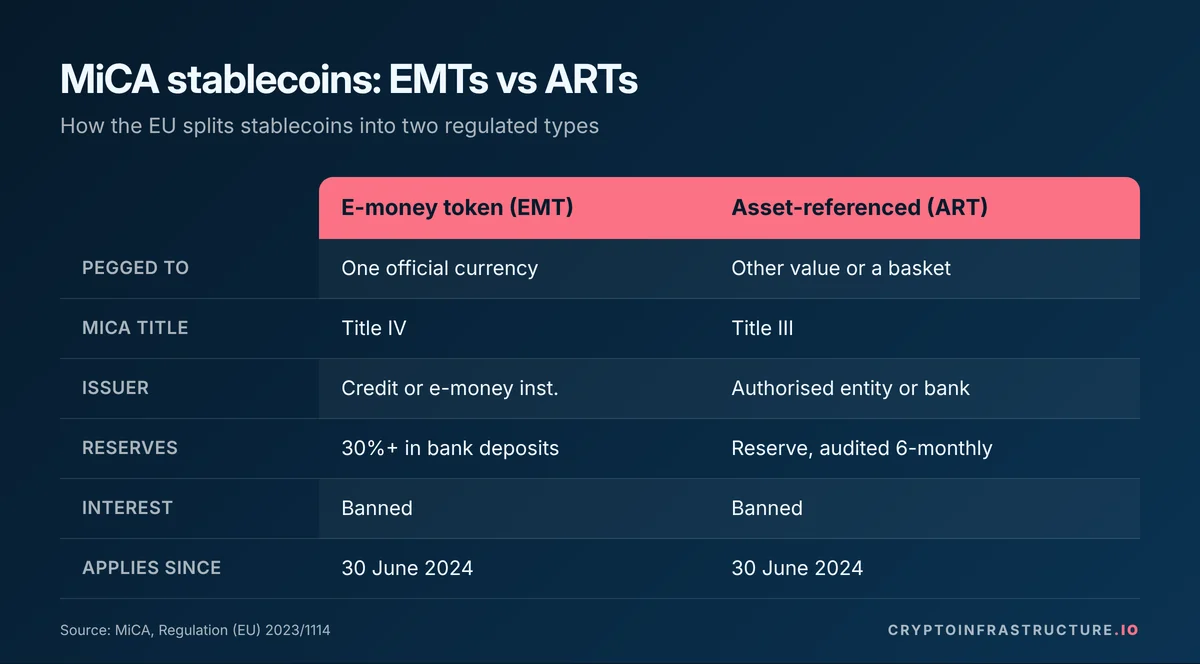
The EU’s Markets in Crypto-Assets Regulation (MiCA) splits stablecoins into two types. A token pegged to a single official currency, such as a dollar or euro stablecoin, is generally an e-money token (EMT), governed by Title IV. A token referencing another value, a basket or a mix of assets is an asset-referenced token (ART), governed by Title III. Both titles have applied since 30 June 2024 (Article 149(3)), six months before the rest of MiCA, which applied from 30 December 2024. Pages saying MiCA’s stablecoin rules took effect “in 2025” have the date wrong.
E-money tokens (Title IV): what issuers must do
- Licence (Article 48). Only the issuer may offer an EMT to the public or seek its admission to trading in the EU, and only if it is authorised as a credit institution or an electronic money institution and has notified and published a crypto-asset white paper. Others may offer it with the issuer’s written consent.
- Redemption (Article 49). Holders can redeem “at any time and at par value”, paid in funds other than e-money, and redemption “shall not be subject to a fee”. The conditions must be stated prominently in the white paper.
- No interest (Article 50). Issuers may not grant interest, and neither may crypto-asset service providers (CASPs) when providing services related to EMTs. Any benefit tied to how long someone holds the token counts as interest.
- Reserves (Article 54). At least 30% of funds received must always sit in separate accounts at credit institutions, with the rest in secure, low-risk, highly liquid instruments in the same currency the token references.
- Usage caps for non-EU currencies (Articles 23 and 58). For an EMT in a currency that is not an EU official currency, such as a US dollar coin, the ART usage caps apply: if estimated daily use as a means of exchange within a single currency area exceeds 1 million transactions and EUR 200 million, the issuer must stop issuing and file a plan within 40 working days to bring usage back under the thresholds.
Asset-referenced tokens (Title III)
ART issuers must be either an EU-established legal person authorised under Article 21 or a credit institution complying with Article 17 (Article 16). They must maintain a reserve of assets at all times and have it independently audited every six months (Article 36), and neither issuers nor CASPs may pay interest on ARTs (Article 40). Very few ARTs have been launched; for most businesses, the EMT rules are the ones that matter.
ESMA’s 8 October 2026 opinion: three months to drop non-compliant stablecoins
The newest EU step targets platforms, not issuers. In an opinion dated 8 October 2026, ESMA states that “CASPs should not provide crypto-asset services in relation to ARTs or EMTs that are not compliant” with MiCA. Residual services are limited to liquidating, converting, withdrawing, transferring or safekeeping existing holdings, and national regulators should require legacy exposures to be remediated as soon as possible and no later than three months. The opinion names no tokens; press coverage pointing at specific coins is the outlets’ reading. If you run an EU exchange or broker, check every stablecoin you list against MiCA authorisation status now, and plan for sell-only and withdraw-only modes before early January 2027.
United Kingdom: final FCA rules, regime from 25 October 2027
The FCA published its final stablecoin issuance rules in PS26/10 on 30 June 2026. Some 2025 guides still describe the UK framework as “proposed”; it is now final, though it only applies once the regime starts on 25 October 2027. The FCA opened its authorisation gateway on 30 September 2026, and firms that want to keep operating should apply by 28 February 2027.
The main issuer rules, from law firm summaries of PS26/10 (Simmons & Simmons, 22 July 2026; A&O Shearman):
- Backing: fully backed at all times from minting. Core backing assets are short-term deposits and short-term government debt; longer-dated government debt, certain money market fund units and repo are allowed only for issuers that notify the FCA and show competence. At least 5% must be in on-demand bank deposits.
- Statutory trust: the backing pool is held on statutory trust for holders, outside the issuer’s insolvency estate, with a separate pool for each stablecoin product.
- Redemption: every holder has a right to redeem by T+1, with the clock starting once the issuer receives the token, after know-your-customer checks.
- No interest: issuers may not pay holders interest or pass on yield from the backing assets; third parties may pay rewards but not pass that yield through.
- Disclosure: value and composition of the backing pool and the number of tokens in circulation at least quarterly, with an annual independent review.
Sterling stablecoins that become systemic for payments move to the Bank of England. Its 22 June 2026 policy statement and draft code of practice raised the maximum share of backing held in short-term gilts from 60% to 70%, with the rest at the Bank of England, dropped the holding limits it proposed in 2025, and set a temporary issuance guardrail of £40 billion per systemic stablecoin. Consultation closed on 22 September 2026, and the Bank intends to finalise the code by the end of 2026.
Singapore: the MAS framework is still not law
MAS finalised its single-currency stablecoin (SCS) framework in August 2023, but it has not yet been given legal force. On 1 September 2026 MAS published draft amendments to the Payment Services Act to do that, with consultation closing on 16 October 2026 and no enactment date set, according to Fireblocks’ 3 September 2026 summary. Some competitor pages describe the framework as finalised and in operation; the policy is settled, the law is not.
Under the proposals, only MAS-licensed issuers could call their tokens “MAS-regulated stablecoins”, through a new standalone stablecoin issuance licence; the label is opt-in, and other stablecoins remain digital payment tokens. Proposed requirements include reserves that fully back the coin at all times in segregated trust accounts, redemption at par within prescribed timeframes, a ban on paying interest, the ability to trace, freeze and burn coins used illicitly, and recognition of comparable foreign regimes (Fireblocks; The Paypers, 2 September 2026). Detailed reserve and redemption rules will come in subsidiary legislation later.
Hong Kong: Stablecoins Ordinance in force, two licences issued
Hong Kong’s Stablecoins Ordinance (Cap. 656) took effect on 1 August 2025, making issuance of fiat-referenced stablecoins a licensed activity. The HKMA register of licensed stablecoin issuers listed two licensees on 14 October 2026, both effective 10 April 2026: Anchorpoint Financial Limited (FRS01) and The Hongkong and Shanghai Banking Corporation Limited (FRS02). Fintechlaw.ai reports that the HKMA received 36 applications.
Key requirements, from the HKMA’s guideline as summarised by Charltons (18 August 2025):
- Paid-up share capital of at least HK$25 million, or an approved equivalent.
- Reserve assets whose market value always equals or exceeds the par value of tokens in circulation, in high-quality, liquid, low-risk assets, segregated from the issuer’s own assets.
- Redemption at par, less any reasonable fee, within one business day of a valid request unless the HKMA approves otherwise.
- No “interest or interest-like incentives in any form” to holders.
- Daily statements of tokens outstanding and reserves, reported to the HKMA weekly and published, plus regular independent attestation of reserves and a white paper for each token.
The perimeter is wide: retail offers in Hong Kong are limited to stablecoins from licensed issuers, and issuing a Hong Kong dollar-referenced stablecoin from outside Hong Kong is also covered.
UAE: CBUAE payment tokens and Dubai’s VARA rules
The UAE has two layers. The Central Bank’s Payment Token Services Regulation (Circular 2/2024, in force since 31 August 2024) governs payment tokens across the country outside the financial free zones. Its main rules, from the CBUAE rulebook:
- Only licensed Dirham Payment Token Issuers, incorporated in the UAE (DIFC and ADGM excluded), may issue dirham payment tokens, and only to UAE residents. Banks must use a subsidiary or related entity.
- Redemption at par in fiat, by the same time on the next business day unless the Central Bank permits otherwise; any fee must be proportionate to actual cost.
- No interest or other benefit tied to how long a customer holds the token, whether paid directly or arranged through someone else (Article 12(3)).
- Foreign-currency payment tokens may only be transferred, and accepted by merchants, as a means of paying for virtual assets or virtual asset derivatives.
In Dubai, VARA’s Virtual Asset Issuance Rulebook treats issuing a fiat-referenced virtual asset (FRVA) as a Category 1 activity: you need that licence and VARA’s approval before issuing each token. Reserves must back the token at least 100% in reference-currency cash, cash equivalents or highly liquid low-risk instruments, segregated and not pledged; a monthly independent audit of circulation and reserves is required; redemption is at par, within one working day and free of fees; and anything claiming a stable value against the dirham stays under the CBUAE’s sole purview. The linked rulebook file is labelled as a 19 May 2025 version.
Stablecoin issuer obligations checklist by jurisdiction (14 October 2026)
| Obligation | US (GENIUS Act) | EU (MiCA EMTs) | UK (FCA PS26/10) | Singapore (MAS SCS, proposed) | Hong Kong (Cap. 656) | UAE (CBUAE / VARA) |
|---|---|---|---|---|---|---|
| Licence | Permitted issuer: bank subsidiary, OCC-approved nonbank, or state-qualified issuer up to $10bn | Credit institution or e-money institution, plus notified white paper | FCA authorisation for UK qualifying stablecoin issuance | New standalone issuance licence to use the “MAS-regulated” label (opt-in) | HKMA licence; HK$25m paid-up capital | CBUAE Dirham Payment Token Issuer licence; VARA Category 1 licence plus per-token approval |
| Reserves | At least 1:1 in cash, insured deposits, Treasuries of 93 days or less, repo, government MMFs | At least 30% in credit institution deposits, rest in low-risk liquid assets in the same currency | Fully backed from minting; core assets plus approved expanded assets; at least 5% on-demand deposits; statutory trust | Full backing at all times in segregated trust accounts | Market value at least par, high-quality liquid assets, segregated | VARA: at least 100% in cash, equivalents or liquid low-risk instruments, segregated |
| Redemption | Published policy, “timely” redemption, fees disclosed with 7 days’ notice of change | At any time, at par, no fee | T+1 after receipt of the token | At par within prescribed timeframes (detail pending) | At par within one business day; reasonable fee allowed | CBUAE: next business day; VARA: one working day, no fee |
| Disclosures | Monthly reserve report, examined by a registered accounting firm, CEO/CFO certified; audited accounts above $50bn | White paper; redemption terms stated prominently | Backing pool and circulation at least quarterly; annual independent review | Disclosure rules proposed | Daily statements, weekly to HKMA; regular attestation; white paper | VARA: monthly backing disclosure and independent audit; white paper |
| Interest to holders | Banned | Banned for issuers and CASPs | Banned; third parties may not pass on reserve yield | Ban proposed | Banned, including interest-like incentives | CBUAE: banned, including via others |
| Timing | Effective by 18 Jan 2027; platform ban on non-permitted coins from 18 Jul 2028 | Applied from 30 Jun 2024; ESMA wind-down within 3 months of 8 Oct 2026 | Apply by 28 Feb 2027; regime from 25 Oct 2027 | Consultation closes 16 Oct 2026; no enactment date | In force since 1 Aug 2025 | CBUAE in force since 31 Aug 2024 |
Checked 14 October 2026. Singapore entries are proposals; US entries describe the Act, not the still-proposed implementing rules. Recheck before relying on any row, because five of the six regimes changed in 2026.
What does stablecoin regulation mean for exchanges and fintechs?
Even if you never issue a token, these rules decide what you can list and how you can market it:
- Listing: in the EU, only MiCA-compliant EMTs and ARTs from early January 2027 under ESMA’s opinion; in the US, only permitted or qualifying foreign coins for US persons from 18 July 2028; in Hong Kong, only licensed issuers’ coins for retail.
- Rewards programmes: MiCA bans CASPs from granting interest on EMTs, the UK bars third parties from passing on reserve yield, and the OCC’s proposal presumes a breach where an issuer funds yield paid through an affiliate or partner. A “rewards” product that is really a share of reserve income is the first thing a regulator will look at.
- Customer messaging: stablecoin reserves are not deposit insurance. The FDIC proposal treats reserve deposits as the issuer’s corporate deposits, not pass-through cover for holders, and VARA requires marketing to say FRVAs are not covered by deposit guarantee schemes.
- Freezes: the GENIUS Act requires issuers to be able to block and freeze transactions, and MAS’s proposals add trace, freeze and burn powers, so a customer’s coins can be frozen if they pass through a flagged address.
Is XRP a stablecoin, and what about the four types?
No. XRP is the floating-price native token of the XRP Ledger, so none of the stablecoin regimes above apply to it; Ripple’s dollar stablecoin is a separate token, RLUSD. Of the four common stablecoin types (fiat-backed, crypto-collateralised, synthetic and algorithmic), only fiat-backed coins fit the reserve lists in the GENIUS Act, MiCA’s EMT rules and the Hong Kong and UAE regimes, because all of them require backing in cash and short-dated government debt. Crypto-backed, synthetic and algorithmic designs cannot meet those reserve rules as built. The stablecoin explainer covers how each type works and fails.
What this means for you
- Issuing in or into the US: build to the Act’s text now (reserve list, monthly examined reports, no yield) and watch for the OCC final rule, expected in November 2026, before 18 January 2027.
- Running an EU platform: audit every stablecoin you support against MiCA authorisation status and prepare wind-down modes before early January 2027.
- Serving UK users: if you plan to issue a UK qualifying stablecoin or keep providing crypto services, apply through the FCA gateway before 28 February 2027.
- Asia and the Gulf: Hong Kong and the UAE already require licences; Singapore’s label is opt-in and still awaiting law, so track the post-consultation text.
- Everyone: drop any product that pays holders yield on a stablecoin until you have legal advice for each market you serve.
For this month’s changes across all regions, see the October 2026 regulation roundup. If you need outside help with licensing or AML programmes, the KYC/AML & Compliance section covers providers, and the methodology explains how this site sources and dates its facts.


