Coinbase vs Kraken has no single winner, and which one costs less depends on where you live. As of 14 October 2026, a new US customer pays 0.40% maker and 0.80% taker on Kraken Pro, against 0.50% and 0.90% on Coinbase Advanced, so Kraken is slightly cheaper in the US. In the EU and UK, Coinbase’s entry tier is 0.25% maker and 0.50% taker, which undercuts Kraken’s published entry rates.
Kraken publishes a Merkle-tree proof of reserves (latest snapshot 30 June 2026); Coinbase does not, and relies on its audited accounts and quarterly SEC filings instead. Both have had insider-linked customer data exposures: Coinbase disclosed one in May 2025 and estimated $180 million to $400 million in costs, and Kraken disclosed an extortion attempt over leaked support data in April 2026. Kraken does not serve New York or Maine residents; Coinbase holds a New York BitLicense. Neither exchange’s crypto balances are insured like a bank deposit.
If you are choosing between Coinbase and Kraken, most pages you will read say Kraken is the cheaper one for active traders and Coinbase the easier one for beginners. The fee half of that is out of date. Coinbase changed its Advanced fee schedule on 16 September 2026, Kraken’s own fee page now starts new accounts at higher rates than most comparisons quote, and the answer now flips depending on your country.
This comparison puts the two exchanges side by side on the criteria in this site’s methodology: licences by region, proof of reserves and filings, custody claims, dated fees with a worked example, and every incident and enforcement action checked. It does not pick a winner. It shows which one fits which kind of user, and why.
Coinbase vs Kraken: the short answer
Coinbase and Kraken are both long-running, US-headquartered exchanges regulated as money transmitters in most US states and licensed under MiCA in the EU. As of 14 October 2026, Kraken is a little cheaper at the entry tier in the US, Coinbase is cheaper at the entry tier in the EU and UK, Kraken publishes a proof of reserves you can check your balance against, and Coinbase, as a listed company, publishes audited quarterly accounts.
Coinbase serves New York; Kraken does not. Coinbase’s record includes the larger anti-money-laundering penalties and the larger 2025 data theft. Kraken’s includes an SEC staking settlement and a 2026 extortion attempt over leaked client data. Which matters more depends on where you live, how you trade and what you want to see before you trust an exchange with your balance.
Side-by-side: Coinbase vs Kraken at a glance
Each row summarises evidence set out in the sections below. Read the section before relying on any one cell.
| Criterion | Coinbase | Kraken |
|---|---|---|
| US operating entity | Coinbase, Inc. (NMLS 1163082) | Payward Interactive, Inc. (NMLS 1843762) |
| New York | Virtual currency licence 122466 and money transmitter licence MT 103755 | Not served (New York and Maine residents excluded) |
| EU | MiCA licence from Luxembourg’s CSSF, June 2025 | Crypto-asset service provider regulated by the Central Bank of Ireland |
| UK | FCA cryptoasset registration, announced February 2025 | FCA cryptoasset registration since 22 November 2021; FCA e-money authorisation |
| Entry-tier advanced fee, US | 0.50% maker, 0.90% taker | 0.40% maker, 0.80% taker |
| Entry-tier advanced fee, EU and UK | 0.25% maker, 0.50% taker | 0.40% maker, 0.80% taker on the published schedule |
| Proof of reserves | None published; states it holds assets 1:1 and files quarterly accounts with the SEC | Merkle tree; snapshot 30 June 2026, 100.3% to 102.9% on the main coins listed |
| Biggest recent incident | May 2025 insider data theft; $180 million to $400 million estimated cost | April 2026 extortion attempt after two insider-linked data exposures, about 2,000 clients |
| Largest penalty checked | $50 million NYDFS penalty (2023), plus $50 million compliance spend | $30 million SEC settlement (2023) |
All entries checked 14 October 2026 against each exchange’s licence, fee and security pages, Coinbase’s SEC filing of 15 May 2025, and regulator releases.
How this comparison works
The criteria come from the site’s methodology: track record, transparency, security practices, pricing clarity and jurisdiction coverage. For an exchange comparison they become six checks, applied to both exchanges in the same order:
- Licences and regulators by region, from each exchange’s own licence pages and regulator registers
- Proof of reserves and filings: what each one publishes and its limits
- Custody and insurance, labelled as company statements
- Fees, from each exchange’s own fee page or announcement, with a worked example at $100 and $10,000
- Where you can use each one, across the US, EU, UK, UAE, Singapore and India
- Incident and enforcement history, dated and sourced
There was no hands-on testing, and neither exchange paid to be included. There are no affiliate links on this page. The same structure is used in the Coinbase vs Gemini and Kraken vs Binance comparisons.
Coinbase vs Kraken fees (checked 14 October 2026)
Both exchanges run two pricing systems. The simple buy screens (the Coinbase app’s buy button, the Kraken app) price your order with a fee plus a spread built into the quote. The order-book platforms (Coinbase Advanced, Kraken Pro) charge published maker and taker rates. A maker order adds liquidity, usually a limit order that rests on the book; a taker order removes it, usually a market order.
| Fee | Coinbase | Kraken |
|---|---|---|
| Entry-tier maker / taker, US | 0.50% / 0.90% | 0.40% / 0.80% ($0+ 30-day volume) |
| Entry-tier maker / taker, EU and UK | 0.25% / 0.50% | 0.40% / 0.80% (same published schedule) |
| Entry-tier, Brazil, India and other international markets | 0.09% / 0.10% | 0.40% / 0.80% (same published schedule) |
| Next tiers | Advanced tiers start at $10,000 of qualifying volume; rates shown after sign-in | $2,500+: 0.30% / 0.60%; $10,000+: 0.22% / 0.38%; $25,000+: 0.20% / 0.35% |
| Stablecoin and FX pairs | Shown after sign-in | 0.20% / 0.20% at entry tier |
| Simple buy screen | Variable fee set at order time plus spread, shown before you confirm | 1% on instant and recurring buys, 1.5% on custom orders, plus spread; Kraken+ members pay no trading fee on up to $10,000 a month |
| Date on the source | Effective 16 September 2026 | None shown |
From Coinbase’s announcement “We’re lowering fees for many active traders on Coinbase Advanced” (16 September 2026) and the Kraken fee schedule, both checked 14 October 2026. Kraken’s page shows no effective date and sets tiers in US dollar volume; confirm the rate shown in your own account before you trade.
Worked example: $100 and $10,000
Assumptions: a new customer with no 30-day trading volume, buying bitcoin with cash already in the account, so no deposit fee applies. The figures are the trading fee only. On the order book there is no added spread, but the price you get depends on market depth; withdrawal network fees are extra.
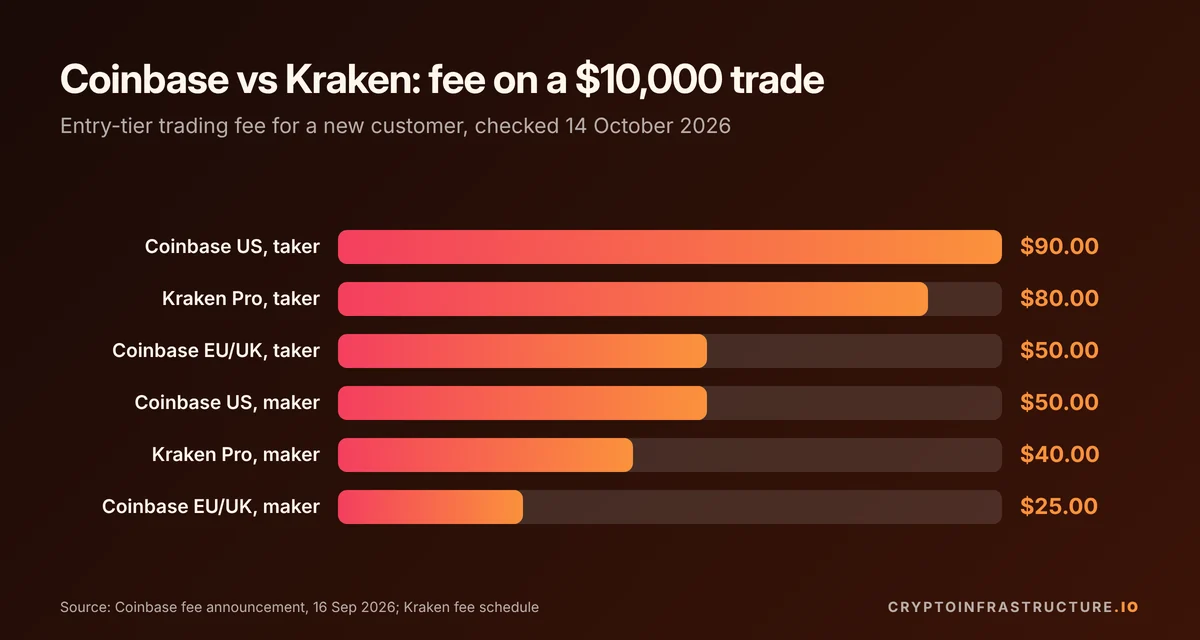
| Order | Coinbase Advanced (US) | Kraken Pro | Coinbase Advanced (EU/UK) |
|---|---|---|---|
| $100 market order (taker) | $0.90 | $0.80 | $0.50 |
| $100 resting limit order (maker) | $0.50 | $0.40 | $0.25 |
| $10,000 market order (taker) | $90.00 | $80.00 | $50.00 |
| $10,000 resting limit order (maker) | $50.00 | $40.00 | $25.00 |
The gap widens after your first large trade. A $10,000 trade takes your Kraken Pro volume into the $10,000+ tier, so a second $10,000 market order that month costs $38 (0.38%). Coinbase also moves you up a tier at $10,000, but publishes that rate only after sign-in, so you cannot compare it in advance. Through the Kraken app’s instant buy, $100 costs $1.00 plus spread and $10,000 costs $100 plus spread, unless you pay for Kraken+. Coinbase does not publish a fixed simple-buy rate; read the total in the order preview.
Is it cheaper to buy crypto on Coinbase or Kraken?
In the US, Kraken is slightly cheaper at the entry tier on the order-book platforms: 0.80% against 0.90% for a market order, as of 14 October 2026. In the EU and UK, Coinbase’s entry tier (0.25% maker, 0.50% taker) is lower than Kraken’s published 0.40% and 0.80%. Google’s AI Overview and several ranking pages quote Kraken Pro at 0.25% maker and 0.40% taker or lower and Coinbase at 0.40% maker and 0.60% taker. Neither matches the exchanges’ own current figures for a new account.
Does Kraken charge fees?
Yes. Kraken Pro charges 0.40% maker and 0.80% taker at the entry tier, falling with 30-day volume. The Kraken app charges 1% on instant and recurring buys and 1.5% on custom orders, plus a spread. Kraken+ waives the app trading fee on up to $10,000 of monthly volume, though payment fees and spreads still apply, per its fee page on 14 October 2026.
Licences and regulators by region (checked 14 October 2026)
For many readers this table decides more than fees do. It shows the entity that serves each region and who supervises it.
| Region | Coinbase | Kraken |
|---|---|---|
| United States | Coinbase, Inc. lists money transmitter licences in 45 states plus DC and Puerto Rico. California, Hawaii, Massachusetts, Montana and Wyoming are not in its licence table, and its Indiana, Louisiana, Tennessee and Virginia licences say they do not cover virtual currency. Coinbase Derivatives, LLC is a CFTC-registered designated contract market. | Payward Interactive, Inc. is a FinCEN-registered money services business with state money transmitter licences. Its California application under the Digital Financial Assets Law is pending, and it may operate there while it is reviewed. Payward Financial, Inc. holds a Wyoming special purpose depository institution charter. |
| New York | Virtual currency licence 122466 and money transmitter licence MT 103755. Coinbase Custody Trust Company, LLC is a NYDFS-chartered limited purpose trust company. | Not served. Kraken’s restrictions article (updated 30 September 2026) excludes New York and Maine residents. |
| European Union | MiCA crypto-asset service provider licence from Luxembourg’s CSSF, announced June 2025, passportable across the 27 member states | Payward Europe Solutions Limited is a crypto-asset service provider regulated by the Central Bank of Ireland; Payward Europe Digital Solutions (CY) Limited holds CySEC licence 342/17 |
| United Kingdom | FCA cryptoasset (VASP) registration, reported 3 February 2025 | Payward Limited registered with the FCA as a cryptoasset business from 22 November 2021; Payward Services Limited is an FCA e-money institution (FRN 1010381) |
| UAE | No Coinbase entity on the VARA public register | Payward FZCO holds VARA licence VL/26/10/002, active, issued 6 October 2026, for broker-dealer and management and investment services |
| Singapore | Major Payment Institution licence from the Monetary Authority of Singapore, announced 2 October 2023 | Kraken states it “is not licensed or regulated in Singapore” |
| India | Registered with FIU-IND in March 2025; retail services relaunched by October 2025 (CCN, 3 October 2025) | No Indian entity in Kraken’s disclosures |
Sources: Coinbase’s US licences page; Kraken legal disclosures (last updated 11 August 2026) and Kraken’s geographic restrictions article; the VARA public register; Decrypt (23 June 2025) on Coinbase’s MiCA licence; FinanceFeeds (3 February 2025) on Coinbase’s FCA registration; Yahoo Finance (2 October 2023) on Coinbase’s MAS licence. All checked 14 October 2026.
Is Kraken safe for US citizens?
Kraken is regulated in the US as a money transmitter, not as a bank or broker for your crypto, and it serves residents of every state except New York and Maine as of 30 September 2026. That gives state regulators and FinCEN oversight of the company. It does not insure your balance. The Kraken safety review sets out its full licence list, terms and enforcement record. Coinbase, by contrast, is licensed in New York, which matters if you live there.
Is Coinbase available in all 50 states?
Google’s AI Overview says so, but Coinbase’s own licence table, checked 14 October 2026, lists 45 states plus DC and Puerto Rico and does not list California, Hawaii, Massachusetts, Montana or Wyoming. The page does not explain the gaps. Check availability for your state in the Coinbase app before you sign up.
Security: proof of reserves, filings and custody
Neither exchange’s security can be tested from outside. What you can compare is what each one publishes, and the two take different approaches.
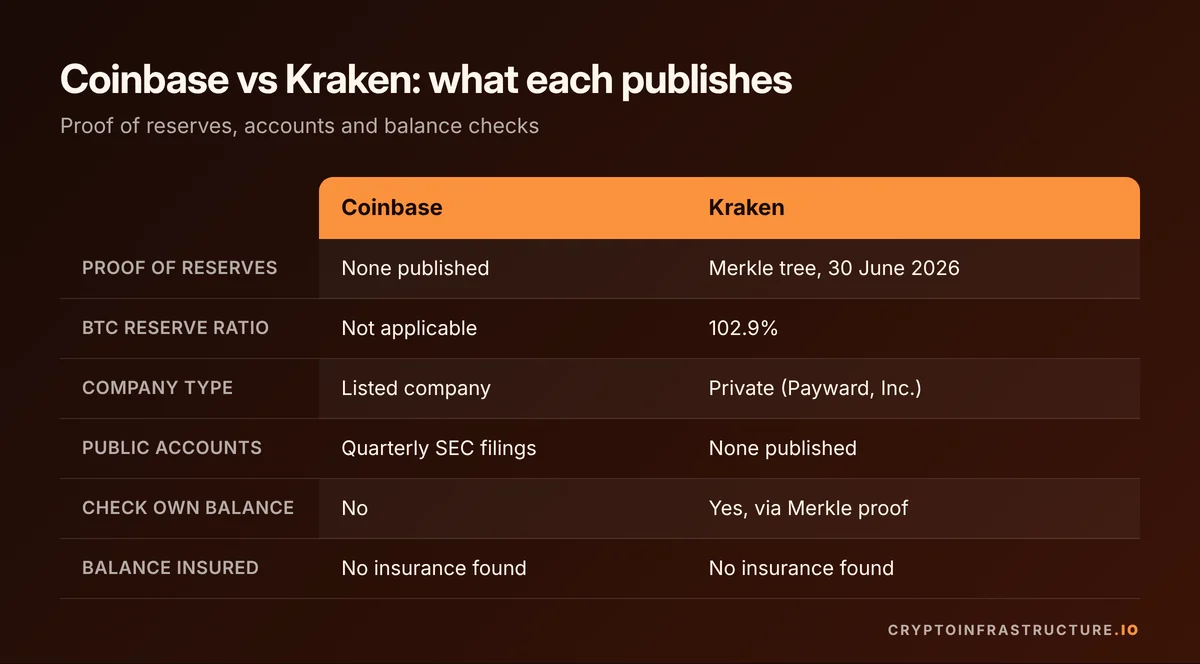
| Item | Coinbase | Kraken |
|---|---|---|
| Proof of reserves | None published. Kraken’s own comparison page notes Coinbase does not publish one you can verify. | Merkle-tree proof by an unnamed “independent 3rd party accountant”, with signed messages proving control of on-chain addresses |
| Latest snapshot | Not applicable | 30 June 2026: BTC 102.9%, ETH 100.5%, SOL 100.6%, XRP 102.3%, ADA 100.3%; USDC, USDT and USDG 105%+ |
| Financial reporting | Listed company; publishes financial statements each quarter and is “audited annually by an independent third-party as required by law” | Private company (Payward, Inc.); no public quarterly accounts |
| Reserve statement | “We hold our customers’ assets 1:1” | Reserve ratios above, for listed assets on the snapshot date |
| Lending | “Coinbase doesn’t lend or take any action with your assets without your permission” | See the Kraken safety review for its terms on lending and pledging |
| Security claims | “Multifaceted risk management programs” (security page) | “No breach of a Kraken-managed custodial wallet since 2011” (Kraken’s comparison page) |
From Coinbase’s security page, the Kraken proof of reserves page and Kraken’s “Kraken vs. Coinbase” page dated 23 September 2026, checked 14 October 2026. All rows are company statements.
The two approaches cover different things. Kraken’s proof lets you confirm your own balance was counted and that Kraken controlled at least that much of the listed coins on 30 June 2026. Kraken itself says the check “cannot identify any hidden encumbrances” and cannot show that funds were not borrowed to pass it. Coinbase’s audited accounts cover the whole company, including its debts, but you cannot use them to check your own balance. Neither is a guarantee about today.
Is Kraken safer than Coinbase?
Neither can be called safe outright, and the answer depends on which evidence you trust. Kraken gives you a dated, account-level proof of reserves. Coinbase gives you audited public accounts and a New York licence. Both have had customer data leaked through people with internal access, Coinbase on a larger scale. Neither has lost customer crypto from its own wallets in the incidents found for this article. Google’s AI Overview describes Kraken’s record as having “no major platform hacks”; that leaves out the April 2026 data exposure covered below. The same caution applies to any “safest crypto platform” list: check the six points in this comparison rather than a one-word ranking.
Can you lose your crypto on Kraken or Coinbase?
Yes, on either. Crypto held on an exchange is not a bank deposit, and the pages checked for this article show no insurance that covers your individual exchange balance against theft or the exchange failing. Kraken’s comparison page mentions insurance for its separate Kraken Custody product, not for exchange accounts; Coinbase’s security page does not mention insurance at all. You can also lose funds to account takeover, to scams that use leaked personal data, or by sending to the wrong address or network. The Coinbase safety review and Kraken safety review cover each company’s terms on what happens in an insolvency.
Incident and enforcement history
Coinbase
| Date | What happened | Outcome |
|---|---|---|
| 4 January 2023 | NYDFS found weak customer due diligence and more than 100,000 unreviewed transaction monitoring alerts by late 2021 | $50 million penalty plus $50 million in compliance spending over two years |
| Disclosed 15 May 2025 | Criminals paid overseas support contractors and employees to copy customer data, including names, addresses, masked Social Security and bank numbers, ID images and balance snapshots, then demanded money. Coinbase says passwords and private keys were not compromised and the staff could not access funds. About 69,000 customers were affected, per Kraken’s comparison page. | Demand not paid. Coinbase estimated $180 million to $400 million in remediation and voluntary reimbursement of customers tricked into sending funds (8-K) |
| 6 November 2025 | Central Bank of Ireland: more than 30 million Coinbase Europe transactions, worth over €176 billion, were not properly monitored | Fine of about €21.5 million (Decrypt, 6 November 2025) |
Kraken
| Date | What happened | Outcome |
|---|---|---|
| 9 February 2023 | SEC: Payward Ventures, Inc. and Payward Trading Ltd. sold a staking-as-a-service programme advertising returns of up to 21% without registering it | $30 million paid; agreed to stop offering the programme |
| 12 December 2024 | ASIC: Bit Trade, Kraken’s Australian operator, offered a margin extension product to more than 1,100 customers without a target market determination | A$8 million penalty plus costs; the judge pointed to “a seriously deficient compliance system” |
| 13 April 2026 | Kraken said criminals were trying to extort it after “two instances of inappropriate access to limited client support data” since February 2025, one involving a support team member. About 2,000 clients, 0.02% of the total, were affected. | Kraken refused to pay. Its chief security officer said systems were not breached and funds were never at risk (Cybernews, 14 April 2026) |
Checked 14 October 2026 against the NYDFS release of 4 January 2023, Coinbase’s 8-K of 15 May 2025, Decrypt’s report on the Central Bank of Ireland fine, SEC press release 2023-25, ASIC media release 24-274MR and Cybernews. Older actions against each exchange are listed in the Coinbase and Kraken safety reviews.
The two records point to similar risks at different scale. Both exchanges’ biggest recent incidents came from people inside or around support teams selling access to customer data, not from wallet hacks. Coinbase’s affected far more customers and cost far more. Kraken’s own “Kraken vs. Coinbase” page cites Coinbase’s 2025 breach but does not mention Kraken’s 2026 incident, which is one reason to read a vendor’s comparison with care. Leaked account data does not move your coins, but it makes you an easier target for scammers posing as support staff, so treat any unexpected call or email from either exchange as suspect.
Withdrawals and limits
Why can’t I withdraw my crypto from Kraken?
Often because of a security hold. Kraken’s withdrawal holds article (updated 4 March 2026) says that if you change your password without sign-in two-factor authentication or a Master Key enabled, withdrawals to new addresses are held for 24 hours. Other holds can apply after some deposit methods and account reviews; the Kraken safety review lists them. If a hold does not explain it, contact Kraken support through its own site, never through a number or link someone sends you.
Can I withdraw $1,000,000 from Coinbase?
Coinbase does not publish a single maximum. Its help article on limits, checked 14 October 2026, says limits vary by location and payment method, selling crypto to your Coinbase cash balance is generally not capped, and cashing out depends on your payment method. You can see your own limits in the app under Profile and Settings, then Limits, or on the web under Settings, then Account limits. Very large withdrawals may also trigger extra checks.
Which fits which user
- You live in New York: Kraken does not serve you; Coinbase holds a BitLicense.
- You live in Maine or one of the five states missing from Coinbase’s licence table: check both apps for availability before you sign up.
- You trade on the order book in the US: Kraken Pro is 0.10 percentage points cheaper at the entry tier, and its published tiers fall faster with volume.
- You trade on the order book in the EU or UK: Coinbase Advanced’s entry rates (0.25% and 0.50%) are lower than Kraken’s published 0.40% and 0.80%.
- You want to check your own balance was counted: Kraken publishes a Merkle-tree proof of reserves; Coinbase does not.
- You want audited public accounts: Coinbase files quarterly with the SEC; Kraken’s parent is private.
- You live in the UAE: Kraken holds a VARA licence from 6 October 2026; no Coinbase entity appears on the VARA register.
- You live in Singapore or India: Coinbase holds a MAS licence and an FIU-IND registration; Kraken is not licensed in Singapore and lists no Indian entity.
If neither fits, the best US crypto exchanges ranking applies the same criteria to six exchanges.
What this means for you
As of 14 October 2026, Coinbase vs Kraken is not a contest with a winner. Kraken is a little cheaper at the US entry tier, publishes a dated proof of reserves, and holds a new Dubai licence, but does not serve New York or Maine and disclosed a client data exposure in April 2026. Coinbase is cheaper in the EU and UK, licensed in New York, Singapore and India, and publishes audited quarterly accounts, but has the heavier anti-money-laundering record and the larger 2025 data theft.
Neither exchange insures your crypto balance. Before you deposit, check which entity will hold your account in your country, read the fee page on the day you trade, and keep only what you are actively trading on any exchange. If you move coins to your own wallet, learn how to store a seed phrase first. Exchange comparisons on this site are reviewed monthly, and sooner after a hack, delisting or enforcement action.
For the full evidence on each platform, see Is Coinbase Safe? and Is Kraken Safe?, the Coinbase vs Gemini and Kraken vs Binance comparisons, or browse the Exchanges section.