
As of 14 October 2026, crypto tax in India works the same way it has since 2022: gains from transferring crypto and other virtual digital assets (VDAs) are taxed at a flat 30% plus surcharge and cess, the only deduction is the cost of acquisition, losses cannot be set off or carried forward, and the buyer’s side (usually the exchange) deducts 1% TDS on the sale value. What changed is the law around it. The Income-tax Act, 2025 replaced the 1961 Act on 1 April 2026 and renumbered the sections, and Budget 2026 added penalties for platforms that misreport crypto transactions. Returns for FY 2025-26 (filed in 2026) still use the old Act and Schedule VDA in ITR-2 or ITR-3.
If you trade, hold or get paid in crypto in India, the 30% figure is the easy part. The hard part is everything around it: which section applies now that the Income-tax Act, 1961 is gone, why your exchange took 1% of a trade that lost money, whether a loss on one coin can reduce tax on another, and where all of it goes in your return.
Most of the pages ranking for this topic still cite only sections 115BBH and 194S and say nothing about the new Act or Budget 2026. This guide covers the rules as they stand on 14 October 2026, both sets of section numbers, worked examples with stated assumptions, how to file for AY 2026-27, and what Indian crypto businesses now have to do.
How much is crypto tax in India?
Income from transferring a VDA is taxed at a flat 30%, plus applicable surcharge and cess, whatever your income slab and however long you held the asset. The Income Tax Department’s VDA page says income from these transfers “is computed without any deduction except for the cost of acquisition” (checked 14 October 2026).
The health and education cess is 4% of the tax, so before any surcharge the effective rate is 31.2%. Surcharge depends on your total income, so higher earners pay more than 31.2%.
A VDA covers cryptocurrencies, NFTs and other crypto assets. The department’s page excludes Indian currency, central bank digital currencies (CBDCs), foreign currency and digital assets the government notifies as excluded.
The three rules that make India’s regime strict
| Rule | What it means for you |
|---|---|
| Flat 30% on gains | No slab benefit and no lower long-term rate. A gain held for three days and a gain held for three years are taxed the same way. |
| Only cost of acquisition is deductible | Trading fees, internet, hardware and advisory costs do not reduce the taxable gain. |
| No loss set-off or carry forward | A loss on one VDA cannot reduce a gain on another VDA or any other income, and it cannot be carried to a later year. This was written into the 1961 Act by the Finance Act, 2022 (section 115BBH(2)(b)). |
What changed in 2026: the new Income-tax Act and Budget 2026
The Income-tax Act, 2025 replaced the 1961 Act
The CBDT announced on 1 April 2026 that the Income-tax Act, 2025 “comes into force from 1st April, 2026”, replacing the Income-tax Act, 1961. The government’s PIB explainer on the new Act says it was drafted on a principle of not changing tax rates, defines VDAs including cryptocurrencies, consolidates TDS provisions under section 393, and replaces “previous year” and “assessment year” with a single “tax year”: the twelve-month financial year starting on 1 April.
So the 30% rate, the 1% TDS and the no-set-off rule carried over. Tax guides published in 2026 by CoinDCX (updated 22 September 2026) and TDSMAN (24 August 2026) both describe the VDA provisions as restructured and renumbered, not changed in substance.
Old and new section numbers
This is where most pages are out of date. Use the old numbers for transfers up to 31 March 2026 (and for the return you file in 2026), and the new ones for transfers from 1 April 2026.
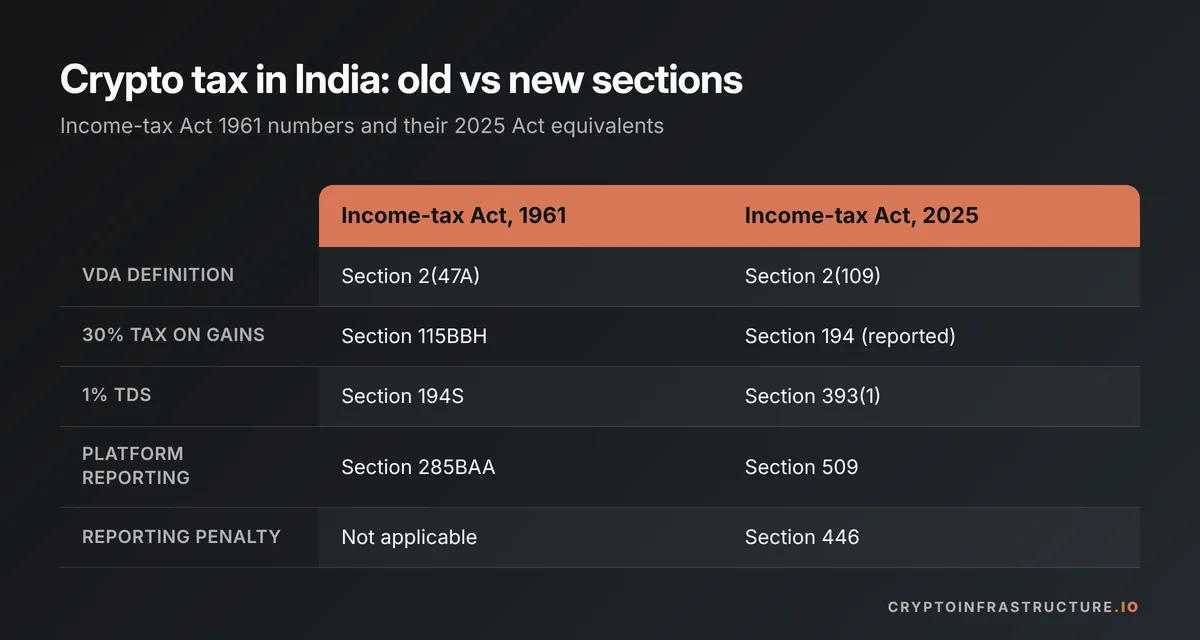
| Provision | Income-tax Act, 1961 | Income-tax Act, 2025 | How firmly confirmed (14 October 2026) |
|---|---|---|---|
| Definition of VDA | Section 2(47A) | Section 2(109) | Reported by CoinDCX; not found on a government page |
| 30% tax on VDA income, no deductions, no loss set-off | Section 115BBH | Section 194 (table entry S. No. 4 in the Bill) | Reported by CoinDCX and TaxTMI; not found on a government page |
| 1% TDS on transfer of a VDA | Section 194S | Section 393(1), Table Sl. No. 8(vi) | PIB confirms TDS moved to section 393; the table entry is reported by TDSMAN |
| Crypto-asset reporting by platforms | Section 285BAA | Section 509 | Confirmed: the department publishes a guidance note on reporting obligations under section 509 |
| Penalty for platform reporting failures | Not applicable | Section 446 (amended by the Finance Act, 2026) | Reported by CoinDesk from the Finance Bill, 2026 |
One trap: section 194 of the 1961 Act is the TDS rule on dividends. If you see “section 194” in a crypto context, check which Act is meant. The department’s official mapping utility did not return data when checked, so treat the 2025 Act numbers above as reported, not government-confirmed, until you or your CA check them against the Act text.
Budget 2026: no rate cut, new reporting penalties
Budget 2026 left the crypto tax framework where it was. CoinDesk reported on 2 February 2026 that the Finance Bill “leaves the existing tax and TDS framework untouched” and instead added penalties for entities that must report crypto-asset transactions under section 509:
- Rs 200 per day for failing to furnish the required statement, for as long as the default continues.
- A flat Rs 50,000 for inaccurate information, or for errors not corrected after being flagged.
These apply to reporting entities such as exchanges from 1 April 2026, not to individual traders. Industry requests to cut TDS from 1% to 0.01% were not adopted. The practical effect for you is indirect but real: Indian platforms now report your transactions to the department, so mismatches between your return and their data are easier to spot. CoinDCX also reports that India has committed to the OECD Crypto-Asset Reporting Framework (CARF), with cross-border exchange of data planned from 1 April 2027.
How the 1% TDS works
TDS (tax deducted at source) is not a separate tax. It is an advance collection that you claim back as a credit against your final liability. The department’s TDS on VDA page (checked 14 October 2026) sets out the rules:
- Rate: 1% of the consideration, with no surcharge or cess added. GST and the deductor’s own service charges are excluded from the base.
- Thresholds per financial year: no TDS if the total paid by a person is up to Rs 50,000 for a “specified person”, or Rs 10,000 for anyone else.
- Specified person: an individual or HUF with no business or professional income, or with business turnover up to Rs 1 crore or professional receipts up to Rs 50 lakh in the previous year.
- Without PAN: the department’s page gives a 20% rate where PAN is not furnished.
Note the direction of those thresholds. At least one exchange guide in the current results, CoinSwitch’s futures tax page, states them the other way round. The government text gives the higher Rs 50,000 limit to specified persons.
Who deducts the TDS?
| How you sell | Who deducts |
|---|---|
| On an Indian exchange, no broker | The exchange |
| Through a broker | The exchange and the broker, unless a written agreement makes the broker alone responsible |
| Peer-to-peer or OTC, where buyer and seller know each other | The buyer |
| Crypto-for-crypto swap | Both buyer and seller, unless the exchange agrees in writing to deduct on both legs |
Because TDS is charged on the sale value, it is deducted even when a trade loses money. That is the complaint you see most often from traders: the 1% locks up working capital on every exit, and you only get it back as a credit (or refund) when you file.
Does CoinDCX (or any exchange) deduct the 30% tax?
No. An Indian exchange deducts the 1% TDS on your sales. It does not deduct the 30%. You calculate your total VDA gains, work out the 30% plus cess and any surcharge, subtract the TDS already deducted (it shows in Form 26AS and your Annual Information Statement), and pay the balance yourself.
How to calculate crypto tax: worked examples
Assumptions for every example: you are a resident individual, the trades are on an Indian exchange that deducts TDS, your yearly sales exceed the TDS thresholds, your total income is below the level where surcharge applies, and cess is 4% of tax. Figures are illustrations, not tax advice.
Example 1: one profitable sale
| Item | Amount (Rs) |
|---|---|
| Bought Bitcoin for | 2,00,000 |
| Sold it for | 3,00,000 |
| Taxable gain (sale minus cost; fees not deductible) | 1,00,000 |
| Tax at 30% | 30,000 |
| Cess at 4% of tax | 1,200 |
| Total tax | 31,200 |
| TDS already deducted (1% of 3,00,000) | 3,000 |
| Balance you pay | 28,200 |
Example 2: a gain and a loss in the same year
Add a second trade: you bought Ether for Rs 1,60,000 and sold it for Rs 1,00,000, a loss of Rs 60,000. In most tax systems that loss would cut your taxable gain to Rs 40,000. In India it does not.
- Bitcoin gain: Rs 1,00,000, taxed at Rs 31,200 as above.
- Ether loss: Rs 60,000, ignored. It cannot be set off against the Bitcoin gain and cannot be carried forward.
- TDS: 1% of both sale values, so Rs 3,000 plus Rs 1,000, a Rs 4,000 credit.
- Balance payable: Rs 31,200 minus Rs 4,000, which is Rs 27,200.
Your real profit across both trades was Rs 40,000. Your tax bill was Rs 31,200, about 78% of it. That is the result of the no-set-off rule, and it is the main reason the regime is called strict.
Example 3: a crypto-to-crypto swap
Swapping one coin for another is a transfer, so it is taxable even though no rupees reach your bank. If you swap Ether that cost you Rs 1,00,000 for Solana worth Rs 1,50,000 at the time, you have a Rs 50,000 gain and Rs 15,600 of tax (30% plus cess). TDS also applies; on a swap the department’s guidance makes buyer and seller responsible unless the exchange agrees to deduct for both legs.
Do you pay tax if your crypto profit is small?
Yes. There is no separate tax-free amount for VDA income: the 30% applies from the first rupee of gain, regardless of your slab. Only the TDS has thresholds, and those decide whether 1% is deducted, not whether the gain is taxable.
Crypto tax calculators from exchanges and tax software firms follow the same arithmetic as the examples above. Check that any calculator you use ignores losses across coins and treats TDS as a credit, not a cost.
Are crypto losses tax deductible in India?
No. A VDA loss cannot be set off against VDA gains, against salary, business or capital gains income, and cannot be carried forward to a future year. In Schedule VDA a loss transaction is reported as nil, according to the department’s Schedule VDA guidance. The only deduction for each transfer is that asset’s own cost of acquisition.
Other crypto income: gifts, airdrops, staking and futures
| Event | How it is taxed (as reported, 14 October 2026) |
|---|---|
| Selling crypto for rupees | 30% on the gain plus cess and surcharge; 1% TDS |
| Swapping one crypto for another | Taxable transfer at 30%; TDS applies |
| Spending crypto on goods or services | A transfer, taxed at 30% on the gain |
| Receiving crypto as a gift | Taxable for the receiver as income from other sources at slab rates if gifts from non-relatives exceed Rs 50,000 in value; gifts from relatives, on marriage or by inheritance are exempt (VDAs were added to the definition of property by the Finance Act, 2022) |
| Airdrops, staking, mining, crypto salary | Taxed as income on receipt at slab rates according to CoinDCX; the value at receipt becomes your cost, and a later sale is taxed at 30% |
| Crypto futures and options | Unsettled. CoinSwitch (29 May 2026) says the CBDT has not issued definitive guidance; the conservative position treats gains as VDA income at 30%, and treating them as business income at slab rates carries more audit risk |
| Simply holding crypto | No tax until you transfer it |
If you received crypto as a gift and later sell it, the cost you can deduct follows the Schedule VDA instructions for gifted assets. That calculation is a common error, so check it with your CA.
How to file crypto tax in India for AY 2026-27
The return most people are filing or correcting in 2026 covers income earned from 1 April 2025 to 31 March 2026. That is FY 2025-26, assessment year (AY) 2026-27, and it is governed by the 1961 Act. Trades from 1 April 2026 fall in tax year 2026-27 under the new Act and will be reported in the return you file in 2027.
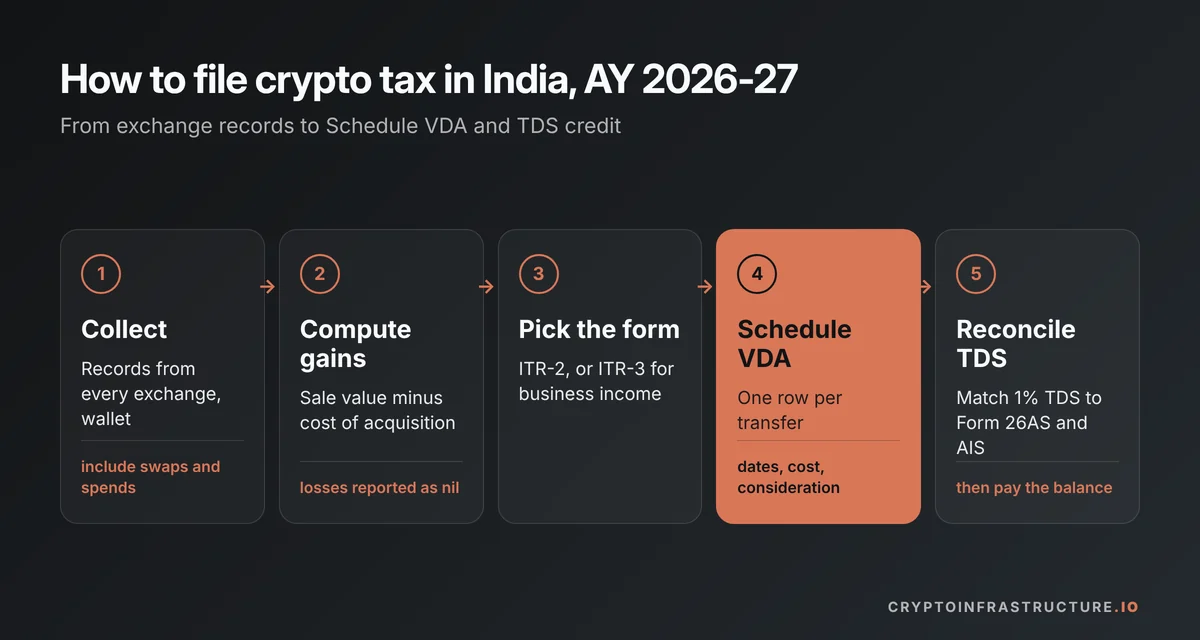
- Collect every record. Download trade, deposit and withdrawal histories from every Indian and foreign exchange and from your self-custody wallets. Include swaps, spends and transfers between platforms.
- Compute gains per transaction. For each transfer: sale consideration minus cost of acquisition. Losses are reported as nil.
- Pick the form. Individuals with VDA gains use ITR-2. If you report VDA income as business income, use ITR-3. The department lists Schedule VDA under ITR-2, ITR-3, ITR-5, ITR-6 and ITR-7, so firms, companies and trusts report it too.
- Fill Schedule VDA. One row per transfer: date of acquisition, date of transfer, head of income, cost of acquisition and consideration received. The total flows into the capital gains or business schedule.
- Reconcile TDS. Match the 1% deductions against Form 26AS and your Annual Information Statement (AIS), then claim the credit.
- Declare foreign holdings. CoinDCX notes that crypto held on foreign platforms belongs in Schedule FA, and that undisclosed foreign holdings can attract Black Money Act penalties.
- Pay the balance and file. Pay tax due after TDS credit before filing, and check the due date for your category on the e-filing portal.
For tax year 2026-27 returns (filed in 2027), the forms will be issued under the Income-tax Rules, 2026. Whether the VDA schedule keeps the same name and layout had not been published when this article was checked.
Penalties for getting it wrong
Under-reporting is expensive. CoinDCX summarises the general penalty as 50% of the tax on under-reported income, rising to 200% for deliberate misreporting. Because Indian platforms now report to the department, and data will start flowing across borders under CARF, assume the department can see your transactions.
If you run a crypto business in India
The rules above apply to companies and firms as well as individuals: section 115BBH (section 194 under the new Act, as reported) charges VDA income at 30% for any person, and Schedule VDA sits in the business return forms. Businesses also carry obligations individuals do not:
- Exchanges and brokers deduct the 1% TDS, deposit it, and file quarterly statements in Form 26Q (specified persons use Form 26QE). The department’s page sets interest at 1% a month for failing to deduct and 1.5% a month for failing to deposit, plus penalties.
- Reporting platforms must report crypto-asset transactions under section 509 of the new Act. The department has published a guidance note on these obligations on its Income-tax Act, 2025 page, and Budget 2026 penalties apply from 1 April 2026.
- Anyone paid in crypto should know that VDA TDS overrides other TDS sections. The department’s example: a client paying an architect in Bitcoin deducts VDA TDS, and may also have to deduct the usual professional-fee TDS.
Tax is only one layer. Exchanges and other VDA service providers serving Indian users must also register with FIU-IND under anti-money-laundering rules, as the Binance case showed. The Binance India guide covers that registration and the 2024 block, and the KYC/AML & Compliance section covers providers that handle Travel Rule and reporting work.
What this means for you
As of 14 October 2026, the economics of crypto tax in India have not moved: 30% on each gain, nothing for losses, 1% TDS on sales. What has moved is the paperwork and the visibility. File your FY 2025-26 return under the old section numbers and Schedule VDA, expect the new Act’s numbering from tax year 2026-27, keep transaction-level records from every platform and wallet, and assume your Indian exchange’s data is already with the department. Your situation may differ from the examples, especially for futures, staking, gifts or business income, so it is worth having a chartered accountant review your figures before you file.
For the legal side of using offshore exchanges from India, read Is Binance Legal in India?. To compare platforms on licensing and transparency, browse the Exchanges section, and see the site’s methodology for how providers are assessed.


