A Hong Kong crypto licence for an exchange is a virtual asset trading platform (VATP) licence from the Securities and Futures Commission (SFC). In practice you apply for two sets of licences in one filing: Types 1 and 7 under the Securities and Futures Ordinance and a virtual asset service licence under the Anti-Money Laundering Ordinance (AMLO).
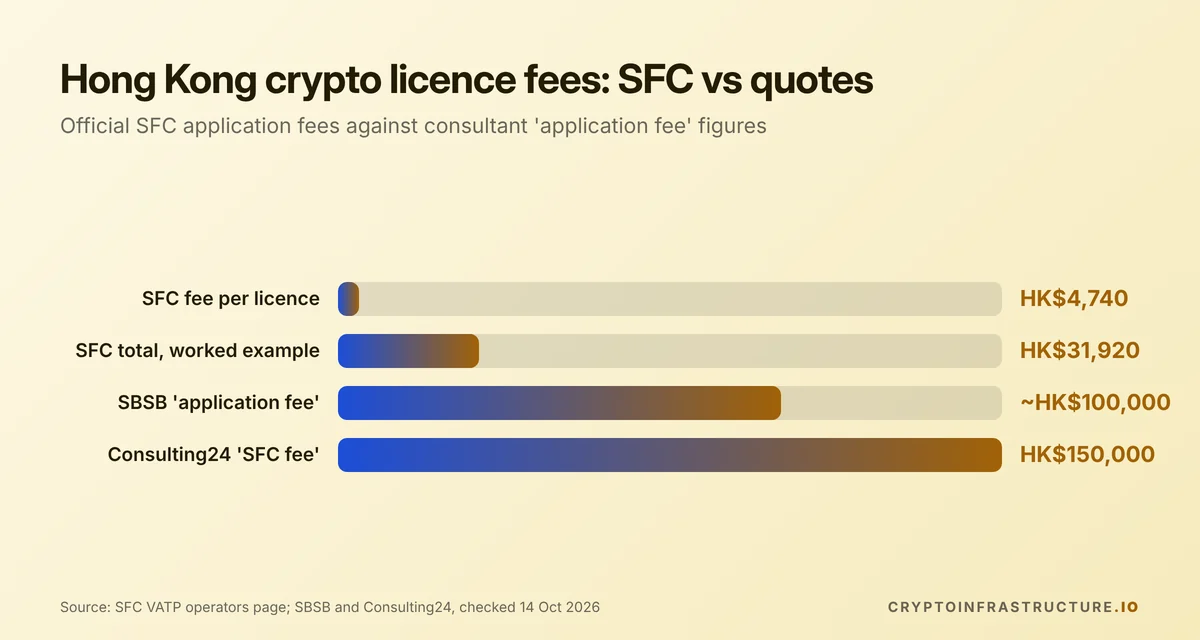
The SFC’s own application fees are small, HK$4,740 per licence or regulated activity, but its VATP guidelines require HK$5 million paid-up share capital, liquid capital of at least HK$3 million and liquid assets covering 12 months of operating expenses. As of 12 October 2026 the SFC lists 13 licensed platforms. The real cost is capital, senior staff, an external assessor and advisers, and the SFC sets no fixed decision deadline.
If you run a crypto exchange and want Hong Kong customers, the first question is not “how fast can we get licensed” but “can we carry the cost of being supervised like a securities firm”. Many explainers on the Hong Kong crypto licence (also searched as “Hong Kong crypto license”) stop at a package price, and some quote application fees that do not match the SFC’s published schedule. This guide separates the official numbers from consultant estimates, sets out who needs the licence, what the SFC asks for, how long it has taken in practice, and what changed in 2025 and 2026. Every figure carries the date it was checked.
What is a VATP licence?
VATP stands for virtual asset trading platform. Under the Securities and Futures Ordinance (SFO) and the AMLO, a centralised trading platform that operates in Hong Kong, or actively markets to Hong Kong investors, must be licensed and regulated by the SFC (SFC, VATP operators page, last updated 16 January 2025).
There are two regimes, because tokens fall into two legal buckets:
- Security tokens come under the SFO. A platform trading them needs a Type 1 (dealing in securities) and Type 7 (providing automated trading services) licence.
- Non-security tokens come under Part 5B of the AMLO, which created a licence to provide a virtual asset service (operating a virtual asset exchange).
The SFC says that because a token’s classification can change, “it would be appropriate for virtual asset trading platforms to apply for licences under both the SFO and AMLO regimes”. You file one consolidated application through the SFC’s WINGS portal and tick both. When people say “Hong Kong crypto licence”, “VATP licence”, “SFC crypto licence” or “Hong Kong VASP licence”, this dual licence is usually what they mean.
Does cryptocurrency count as a security in Hong Kong?
Some tokens are securities and some are not. The answer depends on each token’s terms, which is exactly why the SFC asks platforms to hold both licences. Security tokens are regulated under the SFO; other virtual assets that a platform trades fall under the AMLO licence.
Is cryptocurrency legal in Hong Kong?
Hong Kong does not ban owning or trading crypto. What it regulates is the businesses that serve the public. The AMLO licensing system for virtual asset service providers started on 1 June 2023. Platforms already operating had to apply by 29 February 2024, and those that did not apply, or received a “no-deeming” notice, had to wind down by 31 May 2024 (Financial Services and the Treasury Bureau blog, 2 February 2024). So as of 14 October 2026, using an unlicensed exchange that markets to Hong Kong residents means using a platform that is breaking Hong Kong law, with none of the custody and conduct protections the licence brings.
The JPEX case is the reason this matters locally: by January 2024 the investigation into the JPEX platform had led to 69 arrests, with no charges at that point (DL News, 5 February 2024).
Who needs a Hong Kong crypto licence (VATP)?
You need it if you operate a centralised virtual asset exchange in Hong Kong, or if you operate elsewhere and actively market to Hong Kong investors. The SFC publishes a separate FAQ on what “actively markets” means under section 115 of the SFO and section 53ZRB of the AMLO. An offshore exchange with a Hong Kong-language website, local promotions or Hong Kong-targeted advertising should read that FAQ before assuming it is out of scope.
The VATP licence does not cover every crypto business. Issuing a fiat-referenced stablecoin needs a separate licence from the Hong Kong Monetary Authority (HKMA), and new regimes for dealers, custodians, advisers and managers are still being legislated (see the 2025 and 2026 changes below).
SFC requirements for a VATP licence
The core rulebook is the SFC’s Guidelines for Virtual Asset Trading Platform Operators (June 2023 edition, checked 14 October 2026). The requirements that drive cost are:
Capital and financial resources
- Paid-up share capital: at least HK$5,000,000, maintained at all times (paragraph 6.2).
- Liquid capital: not less than “the higher of HK$3,000,000 and the basic amount” under the Financial Resources Rules (paragraph 6.3).
- Liquid assets: assets “equivalent to at least 12 months of its actual operating expenses calculated on a rolling basis”, held in Hong Kong and not in virtual assets (paragraph 6.1).
The third test is the one that grows with you. A platform with HK$30 million a year in operating costs must hold HK$30 million in non-crypto liquid assets in Hong Kong, far more than the headline HK$5 million.
People
Licensed platforms need SFC-approved responsible officers (ROs) to supervise each regulated activity, and ROs carry higher continuing training obligations (paragraph 4.14 of the guidelines). One licensing consultant (Vantegris) says a VATP needs at least two ROs; the SFC pages fetched for this article did not restate a number, so confirm the headcount with the SFC’s general licensing handbook before you hire.
Custody
Client assets are held through an “associated entity”, which the guidelines define as a wholly owned subsidiary of the platform operator. Custody, cold storage and compensation arrangements are set out in Part X of the guidelines, which you should read in full: they shape your wallet architecture and insurance budget.
Conduct, AML and systems
The SFC lists requirements covering know-your-client processes, AML/CFT, conflicts of interest, token admission criteria, market manipulation, accounting and auditing, risk management and cybersecurity. AML obligations sit in a separate SFC guideline for licensed corporations and SFC-licensed VASPs. If you are building that stack, the crypto compliance guide covers KYC, transaction monitoring and Travel Rule tooling.
External assessment
Your application must show that you have identified a suitable external assessor (EA) and include its capability statement. Since 16 January 2025 the SFC expects the EA to be an independent professional accounting firm regulated by the Accounting and Financial Reporting Council, with the work “performed as a direct assurance engagement, and signed off by a certified public accountant (practising)”. The EA cannot supply any system it assesses, and the SFC may return an application if it finds the EA unsuitable.
Hong Kong crypto licence cost: official vs consultant figures
The table separates what the SFC itself publishes from what licensing consultants estimate. Treat the second group as marketing until a regulator document confirms it.
| Cost item | Figure | Source type | Checked |
|---|---|---|---|
| Licence application: SFO Types 1 and 7 (corporation) | HK$4,740 per regulated activity | Official (SFC) | 14 Oct 2026 |
| Licence application: AMLO VA service (corporation) | HK$4,740 | Official (SFC) | 14 Oct 2026 |
| Responsible officer approval | HK$2,950 per regulated activity (SFO) and HK$2,950 (AMLO) | Official (SFC) | 14 Oct 2026 |
| Licensed representative | HK$1,790 per regulated activity (SFO) and HK$1,790 (AMLO) | Official (SFC) | 14 Oct 2026 |
| Paid-up share capital | HK$5,000,000 minimum | Official (VATP guidelines 6.2) | 14 Oct 2026 |
| Liquid capital | Higher of HK$3,000,000 and the basic amount | Official (VATP guidelines 6.3) | 14 Oct 2026 |
| Liquid assets in Hong Kong | 12 months of actual operating expenses, rolling | Official (VATP guidelines 6.1) | 14 Oct 2026 |
| “Application fee” | About HK$100,000 | Consultant (SBSB, page updated 10 Oct 2026) | 14 Oct 2026 |
| “SFC application fee” / “annual licence fee” | HK$150,000 / HK$500,000 | Consultant (Consulting24, page updated 13 Jun 2026) | 14 Oct 2026 |
| Legal and compliance advisory | HK$1,000,000 to HK$3,000,000 | Consultant (Consulting24) | 14 Oct 2026 |
| External audit and internal controls | HK$500,000 to HK$1,500,000 | Consultant (Consulting24) | 14 Oct 2026 |
| Insurance | HK$200,000 to HK$500,000 a year | Consultant (Consulting24) | 14 Oct 2026 |
Official fees from the SFC’s VATP operators page (last updated 16 January 2025); capital from the SFC VATP guidelines (June 2023). Consultant figures are their own estimates and were not confirmed by any SFC document fetched for this article. The SFC’s annual licensing fee page could not be loaded when checked, so no official annual fee is given here. This is a summary, not legal advice.
The gap is worth noticing. The SFC’s published application fee for a corporate licence is HK$4,740, not HK$100,000 or HK$150,000. If a provider quotes a six-figure “SFC application fee”, ask which SFC document it comes from.
Worked example: official fees for a dual-licensed platform
Assume one corporation applying for Types 1 and 7 plus the AMLO VA service licence, with two responsible officers each approved for all three, as of 14 October 2026:
- Corporation: 3 × HK$4,740 = HK$14,220
- Two ROs: 2 × (3 × HK$2,950) = HK$17,700
- Total paid to the SFC to apply: HK$31,920, plus HK$1,790 per regulated activity for each licensed representative.
Against that, the same firm must hold at least HK$5 million paid-up capital and 12 months of operating costs in Hong Kong liquid assets. In other words, the fee is well under 1% of the money the licence ties up, before you pay for staff, the external assessor, audit, insurance and advisers.
How long does a Hong Kong VATP licence take?
The SFC does not publish a decision deadline for VATP applications on the pages checked, and the clock in practice has been long. The SFC’s own list (updated 12 October 2026) shows licence dates spread across six years:
| Platform | Operator | Licensed |
|---|---|---|
| OSL Exchange | OSL Digital Securities Limited | 15 Dec 2020 |
| HashKey Exchange | Hash Blockchain Limited | 9 Nov 2022 |
| HKVAX | Hong Kong Virtual Asset Exchange Limited | 3 Oct 2024 |
| HKbitEX | Hong Kong Digital Asset EX Limited | 18 Dec 2024 |
| Accumulus | Accumulus GBA Technology (Hongkong) Co., Limited | 18 Dec 2024 |
| DFX Labs | DFX Labs Company Limited | 18 Dec 2024 |
| EX.IO | EXIO Limited | 18 Dec 2024 |
| PantherTrade | Panthertrade (Hong Kong) Limited | 27 Jan 2025 |
| YAX | YAX (Hong Kong) Limited | 27 Jan 2025 |
| Bullish | Bullish HK Markets Limited | 18 Feb 2025 |
| BGE | Hong Kong BGE Limited | 17 Jun 2025 |
| VDX | Victory Fintech Company Limited | 13 Feb 2026 |
| Bixin.com | NewBX Limited | 18 May 2026 |
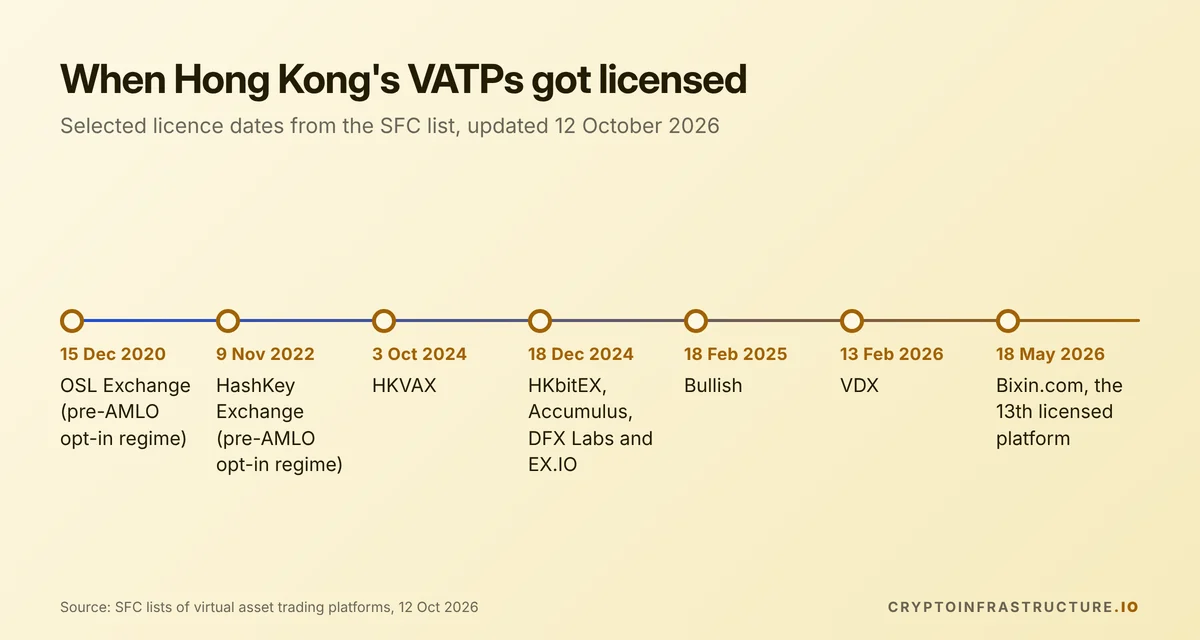
Source: SFC lists of virtual asset trading platforms, last updated 12 October 2026, checked 14 October 2026. Licence dates before 1 June 2023 (OSL and HashKey) come from the earlier opt-in arrangement under the SFO, before the AMLO regime started.
Fourteen firms had applied by early February 2024 (DL News, 5 February 2024). The approvals granted since the 29 February 2024 filing deadline came roughly 7 to 27 months after it, and five applicants were still waiting when the list was checked. Consultant estimates vary just as widely: SBSB says 4 to 6 months, Consulting24 says 12 to 18 months including 3 to 6 months of preparation. Neither is a regulator commitment.
The same SFC list also shows how many applications do not succeed: 18 entries on its “returned, refused or withdrawn” list, five applicants still pending (two of them, Foris DAX HK, which runs Crypto.com, and Whalefin Markets, marked “deemed to be licensed”), and one platform, Matrixport HK, that must close by 12 January 2027.
How many crypto exchanges are licensed in Hong Kong?
Thirteen, on the SFC list checked 14 October 2026 (shown in the table above). Of the large global brands, Bullish holds a licence through Bullish HK Markets Limited. Foris DAX HK, which runs Crypto.com in Hong Kong, is listed as deemed to be licensed, which the SFC says is not the same as being formally licensed, and Binance does not appear among the 13 licensed platforms. Check the SFC list itself before you open an account, because it is updated as decisions are made.
How to apply: the steps
- Confirm scope. Decide whether you operate in or actively market to Hong Kong, and whether you need the VATP licence only or a stablecoin or future dealing/custody licence as well.
- Set up the Hong Kong company and associated entity. The custody subsidiary must be wholly owned by the platform operator.
- Fund capital. HK$5 million paid-up, at least HK$3 million liquid capital, and 12 months of operating expenses in Hong Kong liquid assets.
- Hire responsible officers and senior management who meet the SFC’s competence requirements.
- Write policies and build systems to the VATP and AML guidelines: KYC, token admission, surveillance, custody, cybersecurity.
- Appoint an external assessor that meets the January 2025 criteria and get its capability statement.
- File one consolidated application on WINGS for SFO Types 1 and 7 and the AMLO VA service licence, with the fees above.
- Answer SFC questions and complete the external assessment before the licence is granted. After licensing, financial returns, audit questionnaires and breach notifications all go to the SFC on a fixed cycle.
What are the new crypto regulations in Hong Kong? (2025 and 2026)
| Change | Status as of 14 October 2026 | What it means for you |
|---|---|---|
| Staking by VATPs | SFC guidance issued 7 April 2025; staking needs the SFC’s prior written approval and licence conditions | Budget for client-asset protection and disclosure before offering it |
| Shared order books with overseas affiliates | SFC circular issued November 2025; needs prior written SFC approval, fully pre-funded orders, a Hong Kong reserve fund and an overseas affiliate licensed in a FATF-member jurisdiction | Global groups can tap affiliate liquidity, with retail clients opting in explicitly |
| Token track record | Reported 3 November 2025: the 12-month track-record requirement eased for products offered to professional investors | Faster listings for professional-only products; retail rules stay stricter |
| VA dealing and VA custody licensing | Consultation conclusions published 24 December 2025; government aims to introduce an AMLO amendment bill in 2026; no enacted law found when checked | OTC dealers and custodians outside the VATP regime should prepare, but cannot apply yet |
| VA advisory and VA management licensing | Consultation conclusions published 26 May 2026; proposed HK$100,000 liquid capital for firms not holding client assets, HK$5 million paid-up and HK$3 million liquid for firms that do; bill targeted for 2026 | Proposed, not in force |
| Stablecoin issuers | Stablecoins Ordinance in force since 1 August 2025; issuing a fiat-referenced stablecoin needs an HKMA licence; HKMA issued a press release on granting stablecoin issuer licences on 10 April 2026 | A separate HKMA licence, not part of the SFC VATP regime |
Sources: SFC circular summaries from law firms Timothy Loh (staking) and Legalink (shared order books, 16 December 2025); The Paypers (3 November 2025); MyComplianceOffice (March 2026) and The Block (26 May 2026) on the consultation conclusions; HKMA stablecoin issuers page (last revised 13 July 2026). Items marked as proposed are not law as of 14 October 2026.
For how Hong Kong’s stablecoin regime compares with the US GENIUS Act and the EU’s MiCA, see the stablecoin regulation guide.
Is it legal to buy USDT in Hong Kong?
No rule found for this article bans an individual from holding USDT. What changed on 1 August 2025 is the issuer side: issuing a fiat-referenced stablecoin in Hong Kong now needs an HKMA licence. Whether a licensed platform can offer a given stablecoin to retail clients depends on the SFC’s token-admission rules, so check the platform’s own list of tokens rather than assuming.
Red flags when buying a Hong Kong licence service
- Six-figure “SFC application fees”. The SFC’s published application fee is HK$4,740 per licence or regulated activity (as of 14 October 2026). Large figures are adviser fees.
- Timelines promised in weeks. The SFC sets no fixed deadline, and its list shows approvals arriving roughly 7 to 27 months after the February 2024 filing deadline.
- “Deemed licensed” sold as licensed. The SFC lists deemed applicants separately and says they have not been formally licensed.
- Capital quoted as HK$5 million and nothing else. The 12-month operating expense test can be the larger number.
What this means for you
Hong Kong supervises crypto exchanges under securities-style rules, and the licence costs reflect that. As of 14 October 2026, the official application fees for a dual-licensed platform come to a few tens of thousands of Hong Kong dollars, while capital, liquid assets, responsible officers, the external assessor and advisers run into the millions. Only 13 platforms hold the licence. Build your budget from the SFC guidelines and fee table, not from a provider’s package price, and plan for a review measured in many months.
To compare Hong Kong with the EU, UK, UAE, Singapore and offshore regimes in one table, see the VASP licence guide. Providers that help with licensing and ongoing compliance are covered in the KYC/AML & Compliance section, and month-to-month rule changes are tracked in the regulation roundup.
This guide is general information, not legal advice. Licensing requirements change and depend on your structure; take advice from a regulated lawyer before acting. See the site’s disclaimer.