USDT and USDC both aim to stay at $1, but the risks behind them differ. USDC’s reserve was about 85% a government money market fund and 13% bank cash on 31 August 2026, checked monthly under US accounting standards, and its issuer holds EU, New York and federal US approvals. USDT’s reserve was about 75% Treasury bills, repo and cash on 30 June 2026, with the rest in gold, bitcoin, secured loans and other investments, checked quarterly by BDO, from an issuer incorporated in El Salvador with no EU authorisation. Neither is insured, both issuers can freeze tokens, and both have lost the peg before.
If you hold dollars on a blockchain, you are almost certainly holding USDT or USDC. Together they made up about $257 billion of the roughly $306 billion stablecoin market on 14 October 2026, according to DefiLlama. Most comparisons stop at “USDC is regulated, Tether is opaque”. That was roughly true in 2021, but the details have moved a lot since. This guide puts the two side by side using each issuer’s latest reserve report, Circle’s SEC filings and the EU and US regulator records, and shows where the risks actually differ. If stablecoins are new to you, start with the stablecoin explainer.
USDT vs USDC: the short answer
USDT (Tether) and USDC (USD Coin) are both fiat-backed stablecoins that the issuer promises to redeem at $1. USDC holds a narrower, more liquid reserve, is checked monthly and is authorised in the EU; USDT is far larger and more widely traded, holds a broader reserve that includes gold, bitcoin and loans, is checked quarterly and is not authorised in the EU. Neither is a bank deposit, and neither can be called risk-free.
| USDT (Tether) | USDC (Circle) | |
|---|---|---|
| Issuer | Tether International, S.A. de C.V. (El Salvador), per the 30 June 2026 BDO report | Circle Internet Financial, LLC (US); Circle Internet Financial Europe SAS for the EU |
| Parent | Privately held Tether group | Circle Internet Group, Inc., which files reports with the US SEC |
| Market cap (14 October 2026, DefiLlama) | $184.0 billion (60.15% of all stablecoins) | $72.9 billion |
| Latest reserve report | Quarterly, as of 30 June 2026 (BDO, published 31 July 2026) | Monthly, as of 31 August 2026 (published September 2026) |
| Main reserve assets | US Treasury bills, reverse repo, plus gold, bitcoin, secured loans, equities | Circle Reserve Fund (government money market fund) and bank cash |
| EU MiCA status | Not on ESMA’s e-money token issuer register | Authorised e-money token issuer (France, ACPR) since 1 July 2024 |
| Direct redemption | Verified customers, $100,000 minimum, fee of the greater of $1,000 or 0.1% | Circle Mint account holders; no minimum stated in the USDC terms |
| Can the issuer freeze tokens? | Yes | Yes |
| Worst depeg | About $0.95 (May 2022) | Below $0.87 (March 2023) |
Sources: DefiLlama stablecoins dashboard (checked 14 October 2026); Tether’s BDO assurance report for 30 June 2026; Circle’s USDC examination report for August 2026; ESMA interim MiCA register (last updated 7 October 2026); Tether fee page and Circle USDC terms (checked 14 October 2026).
Who owns USDT and USDC?
USDT is issued by Tether International, S.A. de C.V., a company incorporated in El Salvador, according to the notes in its June 2026 assurance report. Older articles, including several of the pages ranking for this search, still describe the issuer as “Hong Kong-based Tether Limited”. The Tether group is privately held and does not publish audited financial statements; its Q2 2026 release says a “Big Four audit process continued” during the quarter, with no completion date.
USDC is issued by Circle Internet Financial, LLC, part of Circle Internet Group, Inc., which files quarterly reports with the SEC (its Q2 2026 Form 10-Q covers the period to 30 June 2026). Some ranking pages still say USDC is governed by the Centre Consortium with Coinbase; Circle’s own terms now name Circle as the issuer. A separate guide covers who owns Circle in more detail.
Reserves: what actually backs each coin
Both issuers say every token is backed one to one. The useful question is what the backing is made of, because that decides how quickly it turns into dollars when many holders want out at once.
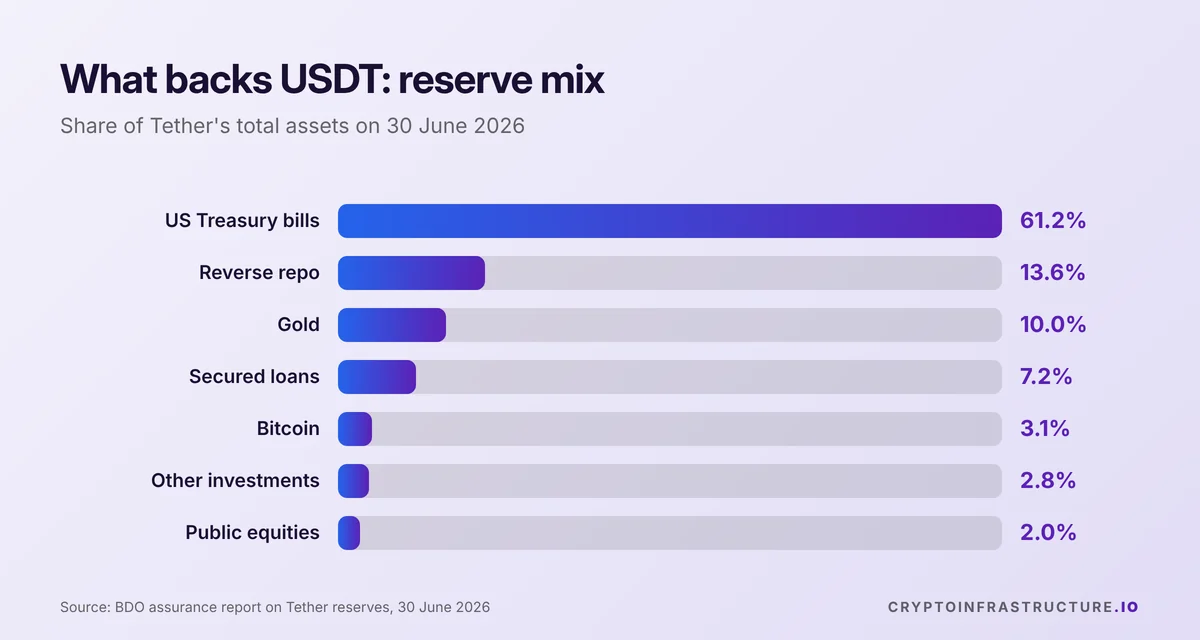
USDT reserves (30 June 2026)
| Asset | Amount | Share of total assets |
|---|---|---|
| US Treasury bills | $114.96bn | 61.2% |
| Overnight and term reverse repo | $25.62bn | 13.6% |
| Cash, deposits, non-US T-bills | $0.06bn | under 0.1% |
| Precious metals (gold) | $18.84bn | 10.0% |
| Secured loans | $13.45bn | 7.2% |
| Bitcoin | $5.80bn | 3.1% |
| Other investments | $5.24bn | 2.8% |
| Public equities | $3.76bn | 2.0% |
| Corporate bonds | $0.01bn | under 0.1% |
| Total assets | $187.75bn | |
| Total liabilities | $183.64bn | |
| Excess reserves | $4.11bn | 2.2% of liabilities |
Source: BDO assurance report on Tether International’s Financial Figures and Reserves Report, 30 June 2026. Shares calculated from the reported figures.
About three quarters of USDT’s reserve (74.9%) sat in Treasury bills, repo and cash. The other quarter, about $47 billion, was in assets whose value moves or that take time to sell: gold, bitcoin, loans, equities and “other investments”, a residual category the report does not break down. Tether’s excess reserve buffer roughly halved from $8.23 billion at the end of March to $4.11 billion at the end of June 2026, according to ForkLog’s comparison of the two quarterly reports.
A simple stress check using the June figures: gold and bitcoin together were worth $24.64 billion. A combined fall of about 17% in those two holdings ($4.11bn ÷ $24.64bn) would wipe out the whole buffer, before any loss on loans or other investments. That does not mean USDT would fail at that point, but it shows the buffer is thin relative to the volatile part of the reserve.
USDC reserves (31 August 2026)
| Asset | Amount | Share of reserves |
|---|---|---|
| Circle Reserve Fund (government money market fund, managed by BlackRock) | $62.32bn | 84.9% |
| Cash held at regulated financial institutions | $9.59bn | 13.1% |
| Other USDC reserve assets | $1.49bn | 2.0% |
| Total reserves | $73.40bn | |
| USDC in circulation | $73.32bn |
Source: Circle USDC examination report, August 2026 (measurement dates 11 and 31 August 2026). BlackRock as fund manager per Circle’s transparency page and Q2 2026 10-Q.
Circle’s transparency page says the Circle Reserve Fund can hold only cash, short-dated US Treasuries and overnight Treasury repo, and its 10-Q says the fund has kept a $1.00 net asset value in every period reported. There is no gold, bitcoin or lending in the reserve. The trade-off is a much smaller cushion: reserves exceeded circulation by about $78 million on 31 August 2026, roughly 0.1%. USDC relies on the reserve being cash-like rather than on a buffer of extra capital.
Bank concentration is USDC’s known weak point. In March 2023, Circle disclosed that $3.3 billion of its roughly $40 billion reserve, nearly 8%, was stuck at the failed Silicon Valley Bank, and USDC fell below 87 cents (CNBC, citing CoinDesk data). The August 2026 report still had $9.59 billion in bank cash, so that risk is smaller in share but not gone.
Attestation vs audit: what each issuer publishes
Neither coin’s reserve report is a full audit of the issuer’s financial statements, and several ranking pages blur this.
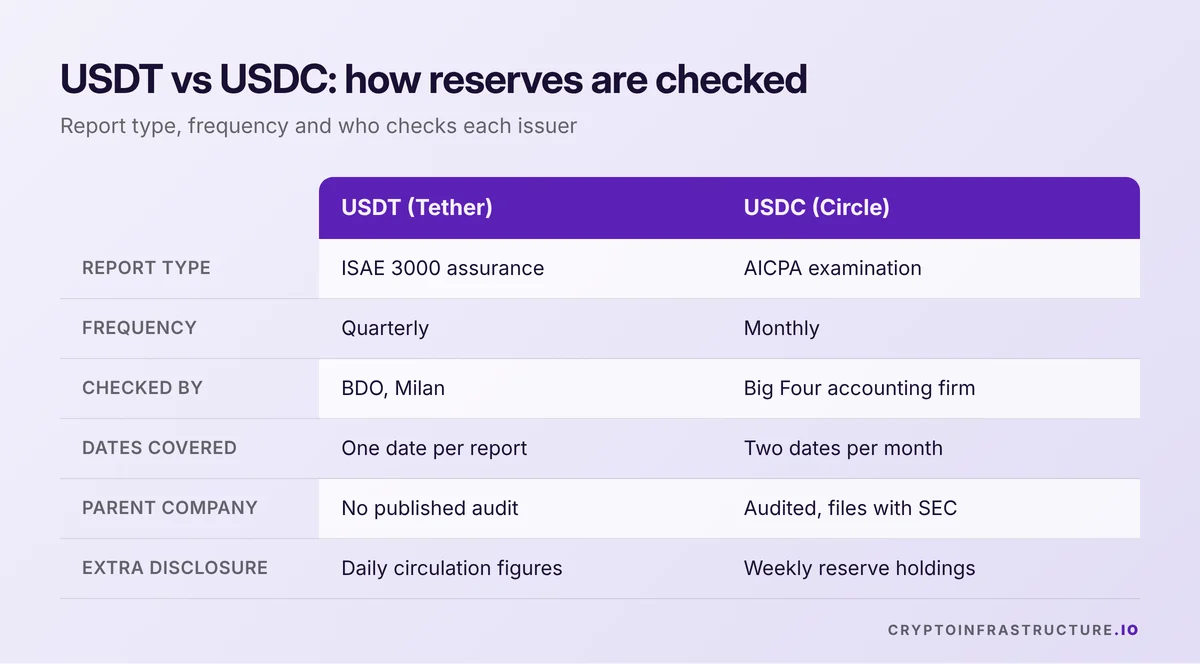
- Tether: a quarterly reasonable-assurance report under ISAE 3000 by BDO Advisory Services S.r.l. in Milan, on a single date (30 June 2026, 11:59 pm UTC). BDO gave an unmodified conclusion on the reserves report but expressly no assurance on going concern or on the notes. Tether also publishes circulation figures daily.
- Circle: a monthly examination under AICPA attestation standards, covering two dates per month, by what Circle’s transparency page calls a “Big Four accounting firm”. Circle also publishes reserve holdings weekly. Separately, Circle Internet Group’s company accounts are audited (Deloitte has been its auditor since fiscal 2022, per the same page), and it files with the SEC.
So the practical gap is frequency (monthly vs quarterly), the type of assets checked, and whether the parent company’s own finances are public. Under the GENIUS Act (Public Law 119-27), US-permitted issuers will need monthly reserve reports examined by a registered public accounting firm, certified by the CEO and CFO.
Regulation: where each coin stands
Checked 14 October 2026. Stablecoin rules by country are covered in depth in a separate guide, so this section sticks to the two coins.
| Jurisdiction | USDT | USDC |
|---|---|---|
| European Union (MiCA) | Tether is not on ESMA’s register of authorised e-money token issuers. In a 17 January 2025 statement, ESMA asked national regulators to ensure platforms comply on non-MiCA-compliant stablecoins by the end of Q1 2025 | Circle Internet Financial Europe SAS is listed as an authorised e-money token issuer for USDC and EURC, supervised by the ACPR (France), since 1 July 2024 |
| United States (GENIUS Act) | USDT is not a US-permitted payment stablecoin. Tether launched a separate US coin, USAT, issued through the OCC-supervised Anchorage Digital on 27 January 2026 (Decrypt) | Circle expects USDC to fall under the Act’s rules for permitted issuers, and says it received final OCC approval for Circle National Trust (Q2 2026 results, 5 August 2026) |
| New York | Tether and Bitfinex agreed in February 2021 to stop trading with New Yorkers as part of an $18.5 million settlement with the New York Attorney General | Circle Internet Financial, LLC holds NYDFS money transmitter and virtual currency licences; NYDFS also approved Circle New York Trust |
| Bermuda | No licence found in the sources checked | Circle International Bermuda Limited is licensed by the Bermuda Monetary Authority |
| El Salvador | Issuer incorporated there (per the BDO report) | Not applicable |
Sources: ESMA interim MiCA register (EMT file, last updated 7 October 2026); ESMA statement of 17 January 2025; Circle Q2 2026 results; New York Attorney General, 23 February 2021.
The US timeline matters for USDT. The GENIUS Act was signed on 18 July 2025 and takes effect on the earlier of 18 January 2027 or 120 days after final rules. In August 2026 the OCC said it was aiming for final rules “by November” (PYMNTS, 20 August 2026). Three years after enactment, so from July 2028, US platforms may not offer payment stablecoins that are not permitted under the Act to US persons.
Foreign issuers can qualify through a “comparable regime” route; Treasury’s rules for it were still at the advance-notice stage in June 2026, according to Chapman’s GENIUS Act rulemaking tracker. Whether USDT itself ends up permitted in the US is not settled; Decrypt reported in January 2026 that Tether describes USDT as “progressing towards GENIUS Act compliance”, while USDT’s current reserve mix (gold, bitcoin, loans) does not match the Act’s list of permitted reserve assets. For this month’s changes, see the regulation roundup for October 2026.
Redemption: who can swap back to dollars, and on what terms
The peg holds only if someone can turn tokens into dollars at $1. For both coins, that “someone” is usually a business, not you.
- USDT: Tether’s fee page lists a $150 verification fee, a minimum redemption of $100,000, and a redemption fee of the greater of $1,000 or 0.1%. Redeeming $100,000 therefore costs $1,000, or 1%.
- USDC: Circle redeems 1 USDC for 1 USD for holders with a Circle Mint account in good standing in a supported jurisdiction. The USDC terms (last updated 12 December 2025) state no minimum and no fee for receiving or redeeming, though on-chain sends out of Circle Mint and bank fees can apply. Circle’s 10-Q adds that it does not redeem for holders who are not Circle Mint customers, except where rules such as the EU’s require it.
For most people, the real exit is selling on an exchange. That is why a depeg can happen on one venue even when the issuer is redeeming normally.
Freezing and blacklisting
Both issuers can freeze tokens at specific addresses, and both use that power.
- Tether said in September 2026 that it had helped freeze more than $4.9 billion in assets with authorities worldwide, including more than $2.4 billion connected to US authorities and nearly $550 million linked to Iran in 2026 (Cointelegraph, 29 September 2026).
- Circle’s USDC terms reserve the right to block addresses it believes are linked to illegal activity, freeze USDC temporarily or permanently, and freeze or surrender funds under a valid government order.
The GENIUS Act will require US-permitted issuers to have the technical ability to seize, freeze or burn tokens under lawful orders, so this is a feature of regulated stablecoins rather than a quirk of one issuer. For you, it means a transfer from an address that is later flagged can leave your tokens frozen, whichever coin you use.
Depeg and enforcement history
| Date | Coin | What happened | Source |
|---|---|---|---|
| 2016 to 2018 | USDT | The CFTC found Tether held enough fiat reserves to back USDT on only 27.6% of days in a 26-month sample | CFTC order, 15 October 2021 ($41 million penalty) |
| 2017 to 2018 | USDT | The New York Attorney General found tethers were at times not fully backed and that Bitfinex hid about $850 million in losses | NYAG settlement, 23 February 2021 ($18.5 million) |
| 12 May 2022 | USDT | Fell to about $0.95 after TerraUSD collapsed; more than $3 billion was withdrawn in a day and the peg returned the next day | CNBC, 12 and 13 May 2022 |
| 10 to 11 March 2023 | USDC | Fell below $0.87 after Circle disclosed $3.3 billion stuck at Silicon Valley Bank | CNBC, 11 March 2023 |
Primary source for the CFTC finding: CFTC press release 8450-21.
The pattern is worth noticing. USDT’s past problems were about whether the reserves existed; USDC’s was about where cash-like reserves were kept. USDT was back at $1 the next day, after Tether processed more than $3 billion of withdrawals.
Which is safer, USDT or USDC?
Neither is safe in the sense a bank deposit is: neither has deposit insurance, and both have broken the peg. What differs is which risks you carry. Score them on the criteria that matter, using the evidence above:
| Risk | USDT | USDC |
|---|---|---|
| Reserve quality | About 75% cash-like; 25% gold, bitcoin, loans, equities and other | About 98% money market fund and bank cash |
| Buffer above liabilities | $4.11bn (2.2%) on 30 June 2026 | About $78m (0.1%) on 31 August 2026 |
| Reporting | Quarterly ISAE 3000 assurance (BDO); no published group audit | Monthly AICPA examination; parent audited and SEC-reporting |
| Issuer jurisdiction and licences | El Salvador issuer; not MiCA-authorised; not US-permitted | US issuer with NYDFS licences and OCC trust charter; MiCA-authorised in France |
| Redemption access | $100,000 minimum, greater of $1,000 or 0.1% fee | Circle Mint account; no stated minimum |
| Freeze power | Yes, used widely | Yes, under its terms |
| Bank concentration | Low bank cash in the reserve | $9.59bn bank cash; the cause of the 2023 depeg |
| Depeg low | About $0.95 (2022) | Below $0.87 (2023) |
| Regulatory access risk | Higher: no EU authorisation; US status after July 2028 unsettled | Lower in the EU and US; still exposed to rule changes |
Read as a whole: USDC has the more liquid reserve, more frequent reporting and clearer licensing, but almost no capital buffer and some bank exposure. USDT has a capital buffer and deeper trading liquidity, but a quarter of its reserve is in assets that can fall in value, its reporting is less frequent, and its access in the EU and, later, the US depends on rules it does not currently meet. Which risk matters more depends on where you live and what you use the coin for.
How safe is USDT to store money?
Holding USDT exposes you to the reserve mix and buffer shown above, to Tether’s freeze power, and to regulatory access: in the EU it is not issued by an authorised e-money token issuer, so what your platform offers depends on how it applies MiCA. It is also only as secure as the place you hold it. Tokens on an exchange carry that exchange’s risk; tokens in a self-custody wallet depend on your seed phrase backup.
Is USDT going to be delisted?
In the EU, USDT has no MiCA-authorised issuer, and ESMA’s January 2025 statement asked regulators to bring platforms into line by the end of Q1 2025, so availability depends on your platform. In the US, nothing forces delisting before the GENIUS Act’s three-year deadline in July 2028, and the outcome depends on whether USDT qualifies through the foreign-issuer route. No delisting date has been set for the US as of 14 October 2026.
Is 1 USDC equal to 1 USDT?
Both aim for $1, and DefiLlama showed both at $1 on 14 October 2026, so on most days one USDC swaps for roughly one USDT. They are not the same token, though: market prices can differ by fractions of a cent, and much more during stress, as March 2023 showed. $100 buys about 100 USDT or 100 USDC before the platform’s fee and spread.
Can I convert USDT to USDC?
Yes, by trading one for the other on an exchange or a decentralised exchange (see the DeFi explainer). Check three things first: the fee and spread, that both tokens are on the same network (a USDT on Tron is not interchangeable with a USDC on Ethereum without a bridge or an exchange), and whether your platform lists USDT in your country.
How do Tether and Circle make money?
Mostly from interest on the reserves; you hold a token that pays you nothing. Tether reported about $1.5 billion of net operating profit for Q2 2026, which it said was led by Treasury and repo income. Circle reported $668 million of reserve income for Q2 2026 and $410 million in distribution and transaction costs for the same quarter, according to its 10-Q. A separate guide covers stablecoin business models in detail.
What this means for you
Do not pick a stablecoin on market cap or on a “safe” label. Pick it on the risks you can live with: reserve composition, how often it is checked, who regulates the issuer in your country, whether you or your platform can redeem, and what happens if your address is frozen. Recheck those facts before relying on either coin, because both issuers’ reserves, licences and US status changed during 2026 and will keep changing as the GENIUS Act takes effect.
For the basics of how pegs work and fail, read what a stablecoin is. For how this site sources and dates its facts, see the methodology, and browse more explainers in Guides.


