Nexo is a real company that has operated since 2018, but whether it is safe enough for you depends on how much counterparty risk you accept. As of 14 October 2026 the evidence is: a $45 million settlement with the SEC and US states in January 2023 over its unregistered interest product, a US exit and a return in April 2025 through a partnership with Bakkt; a Bulgarian criminal probe opened in January 2023 and closed in December 2023, followed by Nexo’s $3 billion arbitration claim against Bulgaria; no MiCA authorisation in Nexo’s own name, with EEA custody and trading run by two BaFin-authorised partners; and no live public attestation page found. Nexo’s terms say your account is not a deposit, has no government insurance or compensation scheme, and that Nexo may lend or re-hypothecate the crypto you hold with it.
“Is Nexo safe?” is usually asked by someone weighing whether to park crypto on the platform to earn interest or to borrow against it. The memory of Celsius and BlockFi hangs over that question, because both offered similar products and both ended badly for their customers. Most pages ranking for this question either give you a star rating or call Nexo a scam. Neither helps much. This guide sets out the evidence instead: licences by region, reserve attestations, custody and insurance as Nexo’s own terms describe them, enforcement and legal history, and the risk that stays with you.
Is Nexo safe and legit? The short answer
Nexo is legit in the sense that it is an operating, regulated-in-parts company with a long public record, not an anonymous scheme. It is not “safe” in the sense a bank account is. Nexo’s own Terms of Service (last updated 7 October 2026) state that “Nexo is not a banking institution, and the Nexo Accounts are not subject to any governmental insurance protection, nor are they covered by any compensation scheme.”
The bigger point is what Nexo can do with your coins. The same terms give Nexo the right to “pledge, re-pledge, hypothecate, re-hypothecate, sell, lend, stake” or otherwise use the digital assets in your account, and say that Nexo may at times not hold “a like amount” of them. That is the core risk of any crypto lending platform, and it is spelled out in writing.
This site checks every exchange and platform on the same six points, mapped to its methodology:
- Licences by region, from Nexo’s disclosures and regulator registers
- Reserve attestations: who checked, how, and when
- Custody, labelled as company claims
- Insurance, and what it really covers
- Enforcement and legal history, dated and sourced
- The risk that remains for you, including what the interest products really are
Who owns Nexo, and where is it based?
Nexo is a private company. It does not publish a shareholder list, so there is no public answer to who owns it beyond its founders and corporate entities. What the documents show:
- Nexo launched on 30 April 2018, according to a 2023 anniversary post signed by co-founder and managing partner Antoni Trenchev on Nexo’s blog.
- The SEC’s 2023 settlement was with Nexo Capital Inc. The Bulgarian arbitration claim was filed by Nexo AG, described in press coverage as a Swiss company and a subsidiary of Nexo Capital in the Cayman Islands.
- Nexo’s Terms of Service contract you with “any holding company, subsidiary, or entity belonging to the Nexo group of companies”, so the entity you deal with depends on where you live.
Nexo’s security page (checked 14 October 2026) claims “$7+ billion” in assets under management as of Q2 2026. That is a company figure, not an audited one.
Is Nexo regulated? Licences by region
Partly. Nexo lists a handful of named licences and registrations, and says it serves clients in more than 200 jurisdictions. Most of what it lists are anti-money-laundering registrations or narrow permissions, not full consumer-protection regimes.
| Region | Entity | Regulator and permission | Source |
|---|---|---|---|
| United States (California) | Nexo Financial LLC | California Financing Law licence, DFPI, ref. 60DBO-109416 | Nexo licences page |
| United States (other) | Partnership with Bakkt | Nexo’s US page says its US offering “runs through a partnership with Bakkt”, which provides trading infrastructure and custody. No other US licence is named. | Nexo US page |
| European Union / EEA | No Nexo entity listed | No Nexo company appears on ESMA’s interim MiCA register of crypto-asset service providers. EEA custody is provided by Tangany GmbH and trading by DLT Securities GmbH (DLT Finance), both on the register as BaFin-authorised CASPs (notified 8 August 2025 and 18 December 2025) | ESMA interim MiCA register; Nexo blog, 28 September 2026 |
| Argentina | Nexo Services SA | Virtual asset service provider, CNV, no. 159 | Nexo licences page |
| Australia | Nexo Australia Pty Ltd | Digital currency exchange provider registration, AUSTRAC, DCE100843695-001 | Nexo licences page |
| Poland | Nexo Services Sp. z o.o. | Virtual currency activity registration, Ministry of Finance, RDWW-533 | Nexo licences page |
| Hong Kong | Nexo Finance Limited | Trust or company service provider licence, Companies Registry, TC007556 | Nexo licences page |
| Seychelles | Nexo Markets Ltd | Securities dealer licence, FSA Seychelles, SD121 | Nexo licences page |
| United Kingdom, UAE, Singapore, India | None listed | Nexo’s licences page names no entity for these countries | Nexo licences page |
All entries checked 14 October 2026 against Nexo’s licences and registrations page and the ESMA interim MiCA register file. The non-EU entries are as Nexo lists them; confirm them on each regulator’s own register before relying on them.
Is Nexo MiCA licensed?
Not in its own name, as of 14 October 2026. Nexo’s own Q2 2026 update describes the change differently: it says it moved European clients “on stronger footing under MiCAR” by working with “two dedicated, MiFID- and MiCAR-licensed European partners”. In practice, the regulated MiCA activity in the EEA sits with Tangany (custody) and DLT Finance (brokerage and futures), not with a Nexo company. If you are in the EEA, it is worth reading which company your agreement is actually with.
Can US residents use Nexo?
Yes again, since April 2025. Nexo stopped its US interest product for new clients in 2022 and announced in December 2022 that it would phase out US products altogether, according to the SEC’s 2023 order. crypto.news reported on 28 April 2025 that Nexo was resuming US operations with savings accounts, credit lines, trading and institutional services. As of 14 October 2026, Nexo’s US page says US assets are held with Bakkt. It does not list which states are excluded, so check in the app for your state.
Does Nexo have proof of reserves?
Not one you can check today, as far as this review could find. The history:
| Date | What happened | Source |
|---|---|---|
| June 2021 | Nexo announced it had hired accounting firm Armanino to provide a real-time attestation of its custodial holdings | Business Wire, 10 June 2021 |
| November 2022 | After FTX’s collapse, Nexo published a proof-of-reserves page and said it had no FTX exposure | CryptoSlate, 29 November 2022 |
| December 2022 | Armanino was reported to be ending its crypto audit practice and dropping clients | Going Concern, 16 December 2022 |
| 14 October 2026 | Nexo’s former real-time attestation URL returns “Page not found”. Nexo’s security page lists SOC 2 Type 2, SOC 3, ISO/IEC 27001, 27017 and 27018, CSA STAR Level 1 and CCSS Level 3, but no reserve attestation or auditor name | Nexo website, checked 14 October 2026 |
The certifications Nexo does list are about information security and data handling. They say nothing about whether Nexo holds enough assets to cover what it owes clients. A reserve attestation, even when it exists, only shows assets at one moment and usually ignores liabilities. Without one, you are relying on Nexo’s own statements about its balance sheet.
Custody: what Nexo claims and what the terms say
Nexo’s security page (checked 14 October 2026) names four custody and wallet partners. These are company claims:
- Ledger Vault (global) for institutional custody
- Fireblocks (global) to “view, track, and manage assets”
- Bakkt for clients in the United States
- Tangany for the EEA, described as “MiCAR-licensed and BaFin regulated”
The Terms of Service add the detail that matters. Your crypto “may be held in custody with third parties” in a mix of online and offline storage, and Nexo has “no obligation to create a segregated blockchain address” for you. The terms also say third-party custody is “over which Nexo does not exercise control”, and that if such a third party defaults, “this may lead to a full loss of your Digital Assets”.
Do you own your crypto on Nexo?
Not in the way you own coins in your own wallet. Unlike exchanges whose terms promise that title stays with you, Nexo’s general terms (for clients outside the EEA, UK, US, Canada, UAE, Australia and New Zealand) grant Nexo the right to lend, pledge, re-hypothecate and sell the assets in your account, and say any action is taken “in Nexo’s name only”. Nexo says it may use funds for “institutional lending and liquidity provision” and for DeFi protocols, including ones built by its own team, and accepts no liability for losses from “DeFi Protocols exploits and exit scams”. If you want to understand what that last risk looks like, see the DeFi explainer.
Region-specific terms apply in the EEA, UK, US and the other excluded countries, and their wording may differ. Read the version for where you live.
Is Nexo insured?
Not in any way that protects your balance directly. The general terms say assets with Nexo’s custody partners “may be secured by theft and cyberattack insurance”. That is insurance held by the custodian against specific events, not cover for you if Nexo itself fails. The same terms say Nexo does not provide an account “covered by any deposit guarantee, insurance against losses, or investor compensation scheme”.
Some ranking pages still quote insurance totals from earlier years. No such figure appears on Nexo’s security page as of 14 October 2026. If any platform cites insurance, ask who the insurer is, what events are covered, and whether you are a named beneficiary.
What Nexo’s interest products actually are
This is the part most reviews skip. The interest you earn on Nexo is not bank interest, and your balance is not a deposit.
- Savings and Earn: under Exhibit III of the general terms, opting in means you “agree to lend the relevant Earn Provider, in exchange for Interest” the eligible assets in your account, for a 365-day opt-in term. The Earn Provider is defined as “a third-party entity”. In other words, you are a lender, and you carry the borrower’s credit risk.
- Rates are not fixed promises. The terms define interest as “subject to revision at any time”. As a snapshot only, Nexo’s US page advertised fixed-term yield of “up to 16% per year” and a credit line “from 0.9% per year” on 14 October 2026, with the footnote that the highest rates depend on “additional actions or fulfilment of certain criteria”. Those criteria include holding NEXO tokens under its loyalty programme.
- Your principal can be lost. Nexo’s US page states that “the principal amount invested is not guaranteed and may be lost in part or in full” and “no returns are guaranteed”.
- Borrowing: Nexo says each loan it grants is fully collateralised and that its system sells part of your collateral automatically when prices fall to a set threshold (Nexo blog, 11 February 2025). That protects Nexo’s loan book. It also means a fast market drop can sell your collateral at a low price.
If you hold stablecoins on Nexo to earn interest, two layers of risk stack up: the stablecoin issuer and Nexo itself. The stablecoin guide covers the first layer.
Nexo’s enforcement and legal history
| Date | Authority | What it was about | Outcome |
|---|---|---|---|
| 2022 | US state regulators | Eight states, including a lawsuit by the New York Attorney General, took action over Nexo’s interest product (Decrypt, 26 September 2022) | Followed by the January 2023 settlement with state regulators |
| 19 January 2023 | SEC and state regulators (US) | Unregistered offer and sale of the Earn Interest Product to US investors since about June 2020 | $22.5 million SEC penalty plus $22.5 million to states, $45 million in total. Nexo neither admitted nor denied the findings and agreed to stop offering the product in the US |
| January 2023 | Bulgarian prosecutors | Raid on Nexo’s offices and an investigation into the founders over alleged money laundering, tax and computer crimes | Investigation closed in December 2023; press reports cite a lack of evidence and no legal framework for crypto services in Bulgaria at the time |
| January 2024 to now | ICSID (World Bank) | Nexo AG’s claim against Bulgaria for $3 billion in damages, citing a cancelled US listing and lost business | Pending. IAReporter reported on 20 April 2026 that the tribunal split the case to hear Bulgaria’s preliminary objections first |
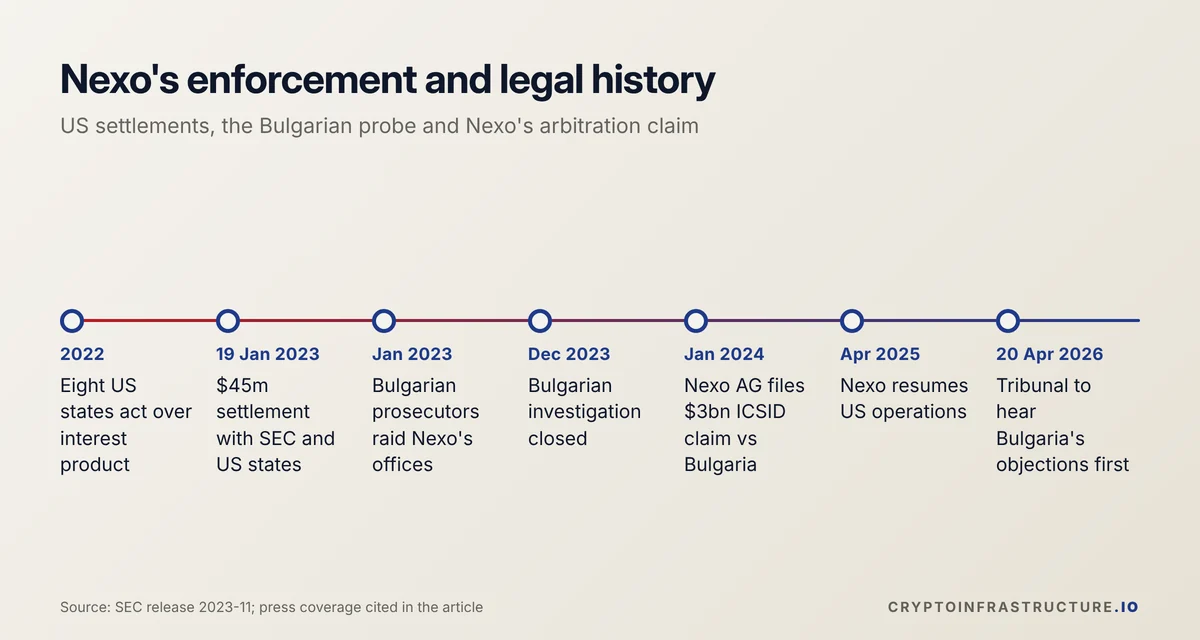
Checked 14 October 2026 against the SEC release and the press coverage named above. The outcome of the 2022 New York lawsuit was not confirmed for this article.
None of these actions found that client funds were missing. The SEC case was about registration: whether Nexo’s interest product was a security that needed registering. The Bulgarian case ended without charges, and the arbitration is Nexo’s claim, not a ruling in its favour.
Nexo vs Celsius and BlockFi
The comparison is fair because the products were similar, and the SEC treated them the same way. BlockFi settled with the SEC and 32 states for $100 million in February 2022 over its interest accounts. Celsius halted its platform on 12 June 2022, and the SEC later charged it and its founder with fraud and market manipulation, according to the SEC’s July 2023 release. Nexo paid a smaller settlement over the same type of product and, unlike the other two, kept operating. That track record counts for something. It does not change the terms: if Nexo were to fail, you would be an unsecured creditor in the same position Celsius customers faced.
What Nexo users say
On Trustpilot (checked October 2026), Nexo had a 4.4 out of 5 TrustScore from 18,796 reviews. Common praise: an easy app, fast transactions and borrowing without selling. Common complaints: frozen or closed accounts after flagged activity, slow document reviews, card fees and limited card availability in some regions. Trustpilot says it cannot verify individual reviews. Treat these as signals, not evidence.
How do you withdraw from Nexo?
Withdrawals go from your account to a personal wallet or, for some assets, to a bank account or card. Nexo’s terms let it set withdrawal limits and “temporarily or permanently” reduce them “to zero” at its “sole and absolute discretion”. Coins in a fixed-term product, or pledged as loan collateral, stay locked until the term ends or the loan is repaid. Plan around that before you move funds in.
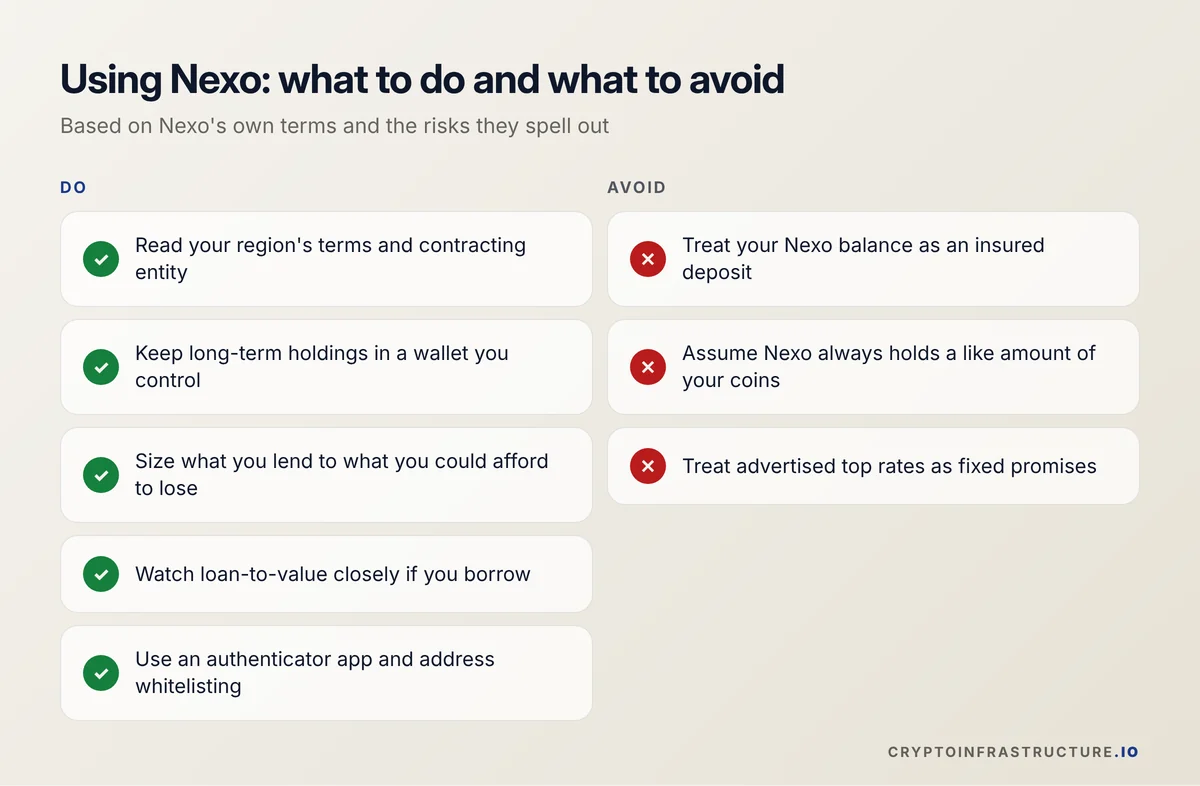
How to reduce the risk you control
- Read the terms for your region, especially who the contracting entity is and whether it can re-hypothecate your assets.
- Separate holding from earning. Keep long-term holdings in a wallet you control, and learn how to store a seed phrase first.
- Size what you lend to what you could lose if Nexo or a borrower failed.
- Watch loan-to-value closely if you borrow, since automatic repayments sell collateral in a falling market.
- Use an authenticator app and address whitelisting, both listed on Nexo’s security page, and its anti-phishing code to check official emails.
What this means for you
As of 14 October 2026, Nexo has survived the 2022 lender collapses, settled with US regulators and returned to the US, and saw a Bulgarian investigation closed without charges. Against that: no MiCA authorisation in its own name, no live reserve attestation found, and terms that let it lend and re-hypothecate your coins with no insurance or compensation scheme behind your balance. Earning interest on Nexo means lending to it or its Earn Provider. The question is not whether Nexo is “safe”, but whether you are comfortable being its creditor for the amount you put in.
For the same six-point check on exchanges, see Is Kraken safe? and the Exchanges section.