For most US beginners the best crypto exchange is Coinbase: it works in every state, lists 400+ coins and keeps a first purchase to a few taps, but the price of its simple buy includes a spread that is not published as a fixed rate. Kraken is the pick if you want the cost in writing: 1% on instant buys or 0.40% maker and 0.80% taker on Kraken Pro, though it does not serve New York or Maine. Gemini covers all 50 states under a New York trust charter. Robinhood and Fidelity Crypto suit people who already hold stocks there and both cost about 1% per trade. Crypto.com and Uphold add range with less predictable or higher costs. Crypto held on any of them is not covered by FDIC or SIPC insurance.
Your first crypto purchase is usually small, so the exchange you pick matters less for its coin count than for three plain things: what a $100 buy really costs, whether the platform is allowed to serve your state and how it has behaved when something went wrong. This guide ranks seven platforms open to US residents on exactly those points, using each company’s own fee schedule, licence pages and regulator records. No platform paid to be included.
The 7 best crypto exchanges for beginners compared
| # | Exchange | Best for | Cost of a simple buy | Lower-fee mode | Coins | US availability |
|---|---|---|---|---|---|---|
| 1 | Coinbase | A simple first purchase | Fee plus spread, shown at order preview | Coinbase Advanced (maker-taker, no spread) | 400+ | All 50 states |
| 2 | Kraken | Low fees in writing | 1% instant buy | Kraken Pro: 0.40% maker, 0.80% taker | 700+ | Not New York or Maine |
| 3 | Gemini | New York residents | Spread in the quoted price, no fixed rate published | ActiveTrader: 0.60% maker, 1.20% taker | 81 | All 50 states |
| 4 | Robinhood | People who already trade stocks there | No commission, about 0.96% inside the spread | Exchange routing: 0.50% maker, 0.95% taker | 91 | All 50 states |
| 5 | Fidelity Crypto | Cautious Bitcoin or Ether buyers | 1% per buy or sell | None | 4 plus a stablecoin | All 50 states, with limits in California and Oregon |
| 6 | Crypto.com | Wide coin choice in one app | Admin fee or spread, shown at order preview | Crypto.com Exchange: 0.25% maker, 0.50% taker | 400+ | 49 states, not New York |
| 7 | Uphold | Crypto, metals and stocks together | 2.05% to 2.2% on Bitcoin and Ether | None | 300+ | Not New York |
Coin counts use each platform’s own figure where it publishes one (Robinhood, Fidelity, Crypto.com, Uphold) and NerdWallet’s count for Coinbase, Kraken and Gemini.
How this list was ranked
Each platform was scored on five things a first-time buyer can check for free: whether the cost of a small purchase is published, whether a cheaper mode exists in the same account, which states it serves, what licences it holds and its public record of incidents or enforcement. Nothing here comes from hands-on testing. Every fee and licence below links to the page it was taken from.
What a $100 Bitcoin buy costs in published fees
This is the comparison most beginner lists leave out. The same $100 order costs between $0.40 and $2.20 depending on which button you press and three of the seven platforms do not publish a fixed rate for their simple buy at all.
| Route | Published rate | Fee on $100 |
|---|---|---|
| Kraken Pro, maker order | 0.40% | $0.40 |
| Crypto.com Exchange, taker order | 0.50% | $0.50 |
| Kraken Pro, taker order | 0.80% | $0.80 |
| Robinhood, default routing | 0.96% spread in Robinhood’s own example | $0.96 |
| Kraken instant buy | 1% | $1.00 |
| Fidelity Crypto | 1% | $1.00 |
| Gemini ActiveTrader, taker order | 1.20% | $1.20 |
| Uphold, Bitcoin or Ether | 2.05% to 2.2% | $2.05 to $2.20 |
| Coinbase simple buy | Not published as a fixed rate | Shown at preview |
| Gemini app instant buy | Not published as a fixed rate | Shown at preview |
| Crypto.com App | Not published as a fixed rate | Shown at preview |
Card fees, network fees and the gap between buy and sell prices on an order book are extra. Kraken’s schedule says small instant trades can carry a flat fee of up to $2 instead of 1%.
The best crypto exchanges for beginners, reviewed
1. Coinbase: best for a simple first purchase
Coinbase ranks first because it removes the two problems that stop most first-time buyers: it operates in every US state and its default app is built to finish a purchase in a few taps. It is not first on cost. The price of a simple buy includes a spread and a fee that Coinbase calculates when you place the order, so the only place to see the real cost is the preview screen.
- Fees: Simple buys carry a fee plus a spread, both shown before you confirm, per Coinbase’s fee disclosure. Coinbase Advanced, inside the same account, has no spread and uses maker-taker fees.
- Coins: 400+.
- Where it works: All 50 states.
- Regulation: Coinbase says it holds 43 state money transmitter licenses and a New York BitLicense. It is a public company, so its finances are filed with the SEC.
- Track record: In May 2025 Coinbase disclosed that bribed overseas support agents had copied data on less than 1% of its monthly transacting users. No passwords, keys or funds were taken, it refused a $20 million ransom and its annual report shows $311.2 million paid in 2025 for reimbursements and legal costs tied to the incident.
Watch out for: the simple buy is the expensive route. Coinbase One Basic costs $4.99 a month for zero trading fees on up to $500 a month, yet the spread still applies.
Pick it if you want the least friction on day one. Skip it if you want to know the fee before you open the order screen.
2. Kraken: best for low fees in writing
Kraken sits second because it publishes a flat price for its beginner button, which Coinbase and Gemini do not. That makes the cost of learning predictable, which matters more on a $100 order than a long coin list.
- Fees: 1% on instant and recurring buys and 1.5% on custom orders. Kraken Pro starts at 0.40% maker and 0.80% taker, dropping to 0.30% and 0.60% once you pass $2.5K in 30-day volume.
- Coins: 700+.
- Where it works: Every state except New York and Maine.
- Regulation: Registered with FinCEN as a money services business, licensed in 46 US jurisdictions and parent of Kraken Financial, a Wyoming-chartered special purpose depository institution.
- Track record: Kraken paid $30 million in February 2023 to settle SEC charges over its staking programme. A second SEC lawsuit was dismissed with prejudice on 27 March 2025.
Watch out for: payment-method fees sit on top of the 1%. Kraken+ at $4.99 a month waives trading fees on up to $10,000 a month, which only pays off if you buy often.
Pick it if you plan to buy regularly and want to graduate to an order book. Skip it if you live in New York or Maine.
3. Gemini: best for New York residents
Gemini earns third place on access and oversight. It is one of four platforms here open to New Yorkers and it runs as a New York limited purpose trust company supervised by the state’s Department of Financial Services, which Gemini says brings capital reserve, cybersecurity and banking compliance requirements.
- Fees: Gemini’s schedule for app and web orders builds a spread into the quoted price and lists no fixed percentage. ActiveTrader starts at 0.60% maker and 1.20% taker, falling to 0.40% and 0.80% at $10K in monthly volume.
- Coins: 81, the smallest range among the dedicated exchanges.
- Where it works: All 50 states.
- Regulation: New York trust charter under NYDFS.
- Track record: Its Earn lending product froze in 2022 when partner Genesis failed. Under a 2024 settlement with NYDFS Gemini paid a $37 million fine and customers got back 100% of their assets, worth more than $2.18 billion.
Watch out for: its entry-level trading fee is the highest published rate among the order-book platforms, 1.20% against Kraken Pro’s 0.80%.
Pick it if you are in New York or you rank regulatory status above price. Skip it if you want a wide list of smaller coins.
4. Robinhood: best for people who already trade stocks there
Robinhood places fourth because it is a broker first. If your stocks are already in the app, adding Bitcoin takes no new account and the cost is visible once you know where to look.
- Fees: No commission. Robinhood discloses that it receives $0.95 from its market maker for every $100 traded, taken from the spread. Its own example uses a 0.96% buy spread. An optional exchange-routing mode charges 0.50% maker and 0.95% taker at the first tier.
- Coins: 91, with some unavailable in New York.
- Where it works: All 50 states.
- Regulation: Robinhood Crypto holds a New York virtual currency licence. It states that crypto in the account is not FDIC insured or SIPC protected.
- Track record: California’s Attorney General secured a $3.9 million settlement in 2024 because customers could not withdraw their crypto between 2018 and 2022. Transfers out are now supported with no Robinhood fee beyond the network cost.
Watch out for: “commission-free” is not free. Roughly $0.96 on a $100 order is close to Kraken’s 1%.
Pick it if you want stocks and crypto on one screen. Skip it if you need coins outside its list of 91.
5. Fidelity Crypto: best for cautious Bitcoin or Ether buyers
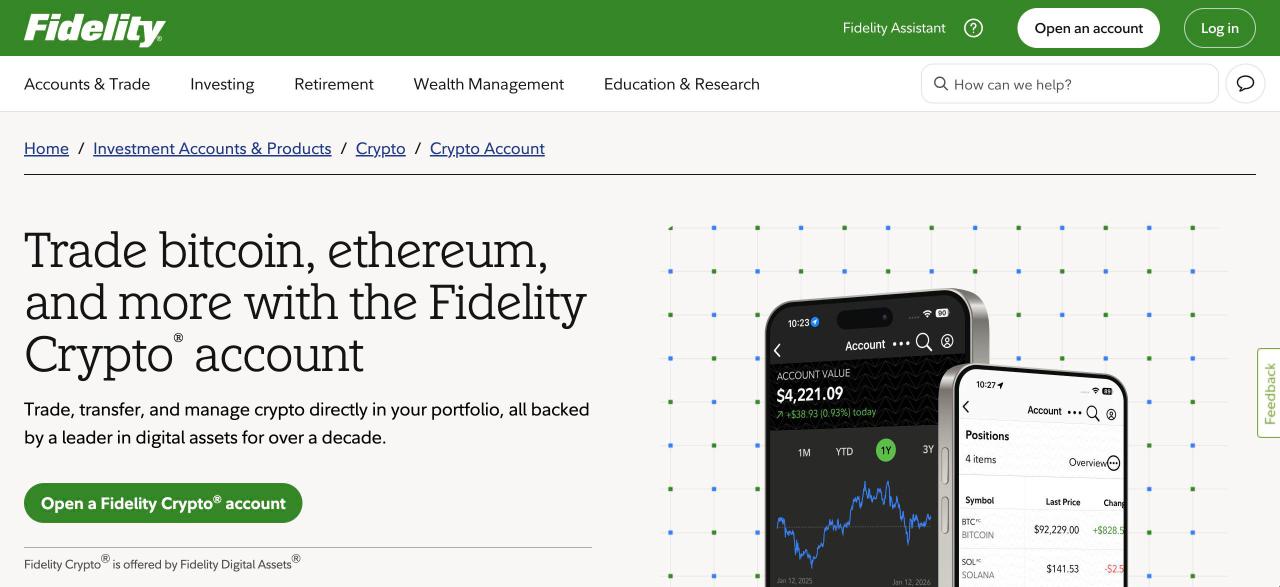
Fidelity Crypto is the narrowest product on this list, which is the reason it is here. It offers four coins, one flat fee and custody by a Fidelity company, a combination that suits someone who wants a small long-term position next to a retirement account.
- Fees: 1% on every buy and sell. You can start with $1.
- Coins: Bitcoin, Ether, Litecoin and Solana plus Fidelity’s own dollar stablecoin.
- Where it works: All 50 states for US citizens. Crypto IRAs are not offered in California or Oregon and Oregon customers cannot trade Solana.
- Regulation: Trading and custody are provided by Fidelity Digital Assets, National Association.
- Track record: California’s Attorney General reached a $500,000 settlement with Fidelity’s crypto arm over past limits on withdrawing certain coins.
Watch out for: there is no cheaper advanced mode, so the 1% never falls as you trade more.
Pick it if you already bank on Fidelity’s app. Skip it if you want to explore beyond the largest coins.
6. Crypto.com: best for wide coin choice in one app
Crypto.com ranks below the first five because its app pricing is the hardest to pin down in advance. What it offers in return is range: 400+ coins, a card and a separate exchange with the lowest published taker fee on this page.
- Fees: The app may add an admin fee that appears in the trade preview. Its US page advertises zero-fee trading for Level Up members with a spread still applied. The Crypto.com Exchange charges 0.25% maker and 0.50% taker at level 1.
- Coins: 400+.
- Where it works: 49 states. New York is excluded.
- Regulation: Money services business registration and state money transmitter licences in the US.
- Track record: A January 2022 hack took $34 million from 483 accounts. Crypto.com has since launched an account protection programme that restores up to $250,000 for eligible users who had multi-factor authentication switched on.
Watch out for: bank transfers by ACH are free with a $1 minimum, so avoid funding by card if you can.
Pick it if you want one app with a long coin list. Skip it if you live in New York or want a single flat rate.
7. Uphold: best for crypto, metals and stocks together
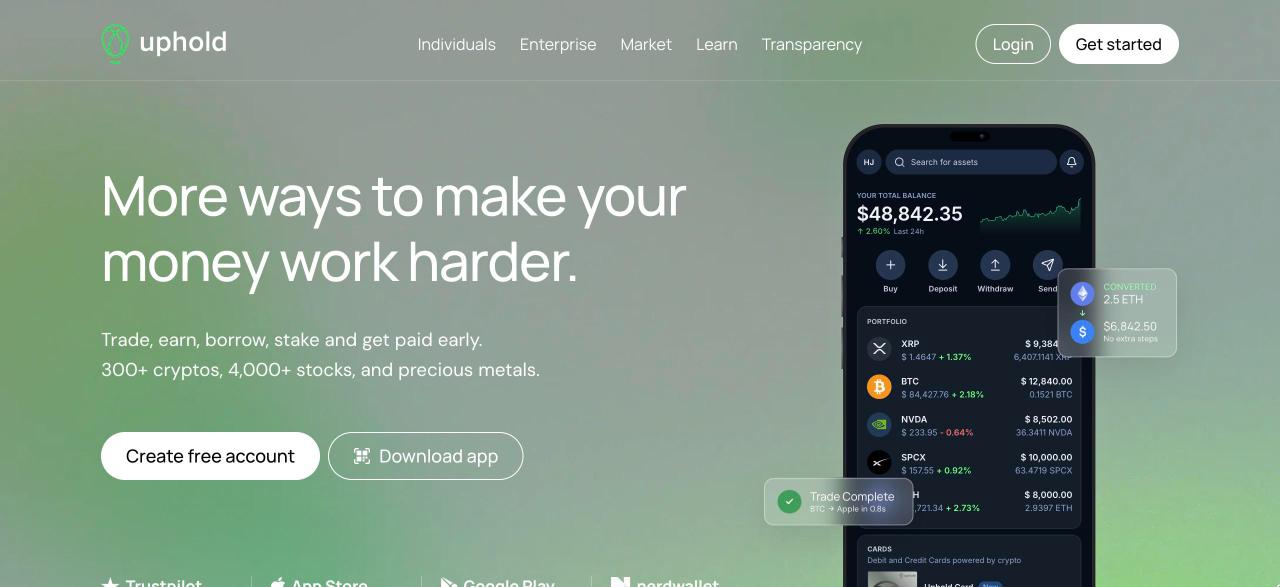
Uphold closes the list because it is the most expensive way to buy Bitcoin here, by its own published numbers. Its case is convenience: one balance that moves between dollars, 300+ coins, precious metals and US stocks at a price locked before you trade.
- Fees: 2.05% to 2.2% on Bitcoin and Ether and 2.85% to 3.8% on other coins. Swaps between dollars and dollar stablecoins cost 0%. Most crypto withdrawals carry a flat $0.99.
- Coins: 300+.
- Where it works: Not New York, where Uphold stopped supporting accounts on 31 July 2023.
- Regulation: Registered with FinCEN and licensed as a money transmitter in 46 states and territories.
- Track record: Uphold says it left New York because of a change in service provider and has not returned.
Watch out for: at 2.05% a $100 Bitcoin buy costs more than twice what Kraken or Fidelity charge.
Pick it if you want to hold several asset types in one place. Skip it if cost is your first filter.
What most beginner lists skip
The cheaper mode is already in your account
Coinbase, Kraken, Gemini and Robinhood each run two price lists under one login and Crypto.com runs a separate exchange. The simple button charges more for convenience and the order-book mode charges less for a slightly busier screen. On Kraken the difference on $100 is $1.00 against $0.80 or $0.40. Learning to place one limit order is the largest fee saving available to a new buyer.
Zero fee does not mean zero cost
Robinhood charges no commission and still earns $0.95 per $100 through the spread. Coinbase One and Crypto.com’s Level Up remove the trading fee and keep the spread. Compare the amount of crypto you receive, not the fee line.
Your state decides your shortlist
New Yorkers can use Coinbase, Gemini, Robinhood and Fidelity Crypto from this list, not Kraken, Crypto.com or Uphold. Maine residents lose Kraken. For brands outside this list, the exchange legality matrix shows which platforms accept US residents and why Binance.com does not.
Check that you can withdraw
Two of the settlements above, Robinhood’s and Fidelity’s, were about customers who could buy crypto and not move it out. Before you fund an account, confirm that the coin you want can be sent to an outside wallet and what the network fee will be.
What should a beginner check before signing up?
- The preview screen. Place a tiny test order up to the confirmation step and read the fee and the price per coin before you commit.
- Your state. Use the availability page linked in each review above.
- Two-factor authentication. Turn it on with an authenticator app. The Coinbase incident shows the common attack is a caller pretending to be support, so never share a code or move funds on someone’s instruction.
- Who regulates the entity. The US crypto regulation guide explains what a money transmitter licence, a BitLicense and a trust charter each cover.
New terms in this guide, such as maker, taker and spread, are defined in the crypto glossary. For evidence checks on individual platforms, see the Exchanges section.