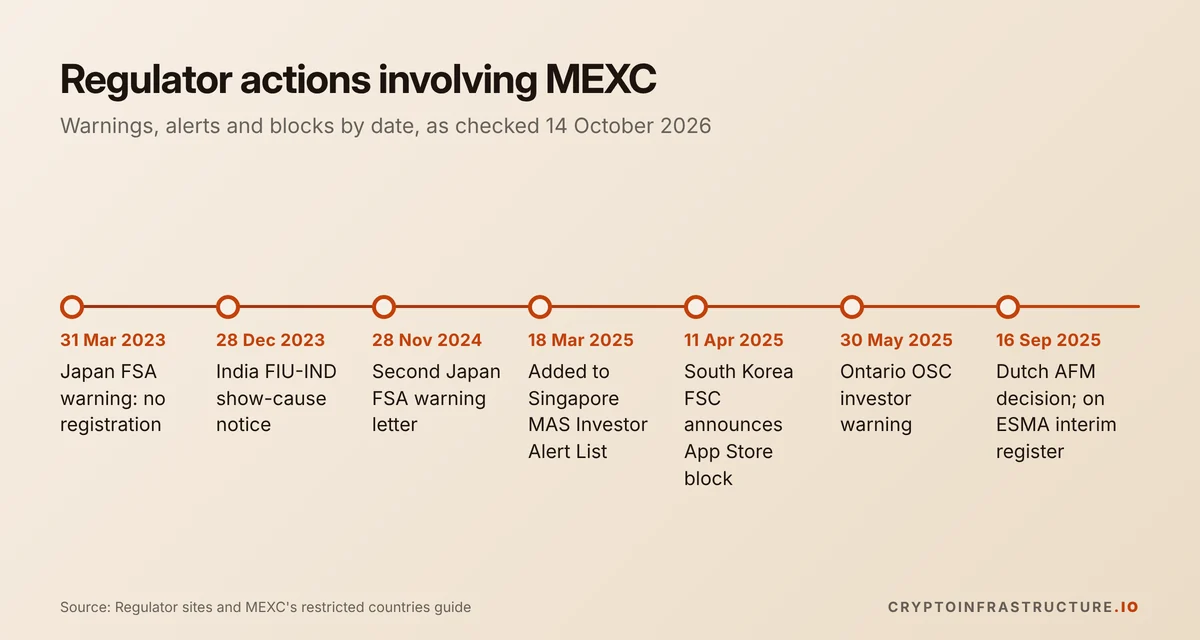
MEXC is a real, operating exchange, but it is not licensed in any major market and “safe” is not a word the evidence supports for any exchange. Its user agreement names MEXC (Comoros) Ltd, registered in Anjouan, Union of Comoros and names no licence. MEXC’s own country guide says it holds no MiCA authorisation in the EU and is not registered in Japan. Regulators in Japan, Singapore and Ontario have warned about it: Japan’s FSA (31 March 2023 and 28 November 2024), Singapore’s MAS (investor alert list, 18 March 2025) and the Ontario Securities Commission (30 May 2025). In the EU, MEXC says a Dutch AFM decision put it on ESMA’s list of non-compliant entities. It publishes a monthly proof of reserves, with Hacken named as the audit firm (October 2026 report: USDT 122%, BTC 294%). No exchange-wide hack has been reported. The main documented risk is frozen accounts: in 2025 a trader known as White Whale had about $3.1 million held until MEXC’s chief strategy officer apologised on 31 October 2025. Is MEXC legal in the US? No: the US is a prohibited jurisdiction in its terms and a VPN does not change that.
“Is MEXC safe?” usually comes from someone who has spotted a low-fee token listing, been sent a referral link, or read a thread about frozen withdrawals. The pages that rank for it tend to split two ways: affiliate reviews that call MEXC “reliable” because it has 2FA and cold storage and complaint threads with no dates. Neither tells you which company holds your money, which regulators have warned about it, or what happens if your account is flagged. This guide checks MEXC against the same six points this site uses for every exchange review, using regulator websites and MEXC’s own terms and answers the US question with dates.
Is MEXC safe and legit? The short answer
MEXC is legit in the narrow sense: it is a real exchange that has operated since 2018 and publishes a monthly proof of reserves. It is not regulated in the places where most readers live. Its terms name a Comoros company and no licence, it says itself that it holds no EU MiCA authorisation, regulators in Japan, Singapore and Ontario have warned about it and MEXC says a decision by the Dutch AFM put it on ESMA’s non-compliant list. Its terms let it freeze accounts and claw back profits it decides were gained in breach of its rules, with no fixed time limit. Whether that is acceptable depends on where you live, how much you would keep there and for how long.
The six checks this site uses for every exchange review:
- Licences by region, from regulator registers and warning lists
- Proof of reserves: method, who checked it and the snapshot date
- Custody, labelled as company claims
- Insurance and what it actually covers
- Incident and complaint history, dated and sourced
- The risk that remains for you
They follow the site’s methodology: track record, transparency, security practices and jurisdiction coverage. The same checks for other offshore platforms are in the KuCoin review and the OKX review.
Who runs MEXC and which country owns it?
No country owns MEXC. It is a privately held exchange that launched in 2018 as MXC Exchange and rebranded to MEXC Global in June 2021, according to its own announcement. The company that matters to you is the one your contract is with. MEXC’s user agreement names:
- Operator: MEXC (Comoros) Ltd, registered office in Mutsamudu, Anjouan, Union of Comoros. No company number and no licence are given.
- Governing law: England and Wales.
- Disputes: individual arbitration at the Hong Kong International Arbitration Centre, no class actions and only after you go through MEXC’s internal ticket process. Claims must be brought within one year.
Several ranking pages say MEXC is registered in Seychelles. That is not what the current agreement says. If you have an account today, the counterparty named in your contract is the Comoros company.
Is MEXC legal in the US?
No. The United States is on the prohibited list in clause 1 of MEXC’s user agreement, alongside the UK, Canada, Singapore, Hong Kong, mainland China, Malaysia, Kazakhstan and others. MEXC’s own restricted countries guide puts it plainly: US residents “cannot open or use a MEXC account”.
MEXC claims no US licence in its terms or country guide and no US enforcement action against it has been reported. The block comes from MEXC’s own terms. That matters less than it sounds: if you are a US resident on the platform, MEXC can close your account for breaching the agreement and you would have no US regulator to complain to.
Can people in the US use MEXC with a VPN?
Not legitimately. MEXC’s guide says access from a prohibited jurisdiction “breaches the User Agreement whether or not you use a VPN”, because a VPN changes your IP address, not where you live. Its terms allow it to suspend accounts without notice and hold funds until a dispute is resolved. Using a VPN puts your balance exactly in that position. If you are in the US and want a licensed option, see the best crypto exchanges in the US.
What about MEXC’s FinCEN MSB registration?
MEXC said in a June 2021 announcement that it had obtained “the MSB of the US license” from FinCEN in 2019, along with an Estonian licence and unnamed approvals in Australia, Canada and Switzerland in 2020. Treat that with care for three reasons. A FinCEN money services business (MSB) registration is a federal anti-money-laundering filing, not a licence to run an exchange for US customers; that needs state money transmitter licences. MEXC’s current terms ban US residents anyway. And whether any MEXC registration is still active in FinCEN’s MSB search has not been confirmed. MEXC’s own 2026 country guide does not claim any licence anywhere.
Is MEXC regulated? Licences and warnings by region
MEXC lists very few authorisations and its own country guide makes almost no positive licence claims. Here is what the record shows, with the source for each row.
| Region | Status | Source |
|---|---|---|
| Global platform (mexc.com) | MEXC (Comoros) Ltd; no licence named | MEXC user agreement, 13 October 2026 |
| United States | Prohibited jurisdiction; no US licence found | MEXC user agreement, clause 1 |
| Ontario, Canada | OSC investor warning, 30 May 2025: MEXC “is not registered in Ontario to engage in the business of trading in securities.” Canada is on MEXC’s prohibited list. | OSC investor warning |
| Japan | FSA warning letters to MEXC Global for operating without registration, 31 March 2023 and 28 November 2024. Not registered with the FSA (MEXC’s own guide). | Japan FSA crypto page |
| Singapore | On the MAS Investor Alert List, listed 18 March 2025. Singapore is on MEXC’s prohibited list. | MAS Investor Alert List |
| United Kingdom | No FCA authorisation or cryptoasset registration found under “MEXC” on the FCA Register. The UK is on MEXC’s prohibited list. | FCA Financial Services Register |
| European Union | No MiCA authorisation. MEXC says it appears on ESMA’s interim register of non-compliant entities following a decision by the Dutch AFM dated 16 September 2025. | MEXC restricted countries guide |
| Netherlands | Service closing: Dutch users had until 31 October 2026 to move assets and final offboarding is set for 16 November 2026. | MEXC restricted countries guide |
| South Korea | Limited: MEXC says the FSC announced an App Store block on 11 April 2025, after Google Play blocked new downloads in late March 2025. | MEXC restricted countries guide |
| India | Limited: MEXC says FIU-IND named MEXC Global in show-cause notices to nine offshore platforms on 28 December 2023 and its main website was temporarily unavailable in India from 26 January 2026. No FIU-IND registration is claimed. | MEXC restricted countries guide |
| Philippines | Limited: MEXC says the SEC named it in an August 2025 advisory on unregistered crypto platforms and telecom operators began blocking access that month. | MEXC restricted countries guide |
| Dubai (VARA) | Not on the VARA public register | VARA public register |
The Ontario, Japan, Singapore, UK and Dubai rows come from the regulators’ own sites. The EU, Netherlands, South Korea, India and Philippines rows are as MEXC itself describes them. Several review sites also cite 2023 warnings from Germany’s BaFin, Austria’s FMA and British Columbia’s BCSC, a revoked Estonian licence and a Hong Kong SFC listing; those could not be confirmed on the regulators’ own sites.
What these warnings mean
A warning or alert-list entry is not a finding that MEXC stole money. It means a regulator says MEXC was serving its residents without the registration that market requires. For you, the practical effect is the same either way: no regulator in those markets supervises MEXC’s handling of your money, no ombudsman will take your complaint and the platform can be blocked or wound down in your country at short notice, as Dutch users are seeing now. The country-by-country guide to crypto legality explains how these rules differ.
Does MEXC have proof of reserves?
Yes and it is more detailed than many. MEXC’s proof of reserves audit report page lists monthly reports with Hacken named as the audit firm, scope “Proof of Reserves” and a public GitHub repository for its Merkle tree code. MEXC publishes a new report each month, so check its page for the newest ratios. The October 2026 report showed:
| Item | What MEXC publishes |
|---|---|
| Method | Reserve rate = MEXC wallet assets divided by total user assets, with wallet addresses listed so balances can be checked on-chain, plus a Merkle tree check of your own balance |
| Audit firm named | Hacken, monthly; October 2026 report dated 9 October 2026 (earlier reports: 10 September, 10 August, 10 July 2026) |
| Snapshot | 8 October 2026, 22:00 UTC+8 |
| Reserve ratios | USDT 122% (1.68 billion held vs 1.37 billion owed), USDC 115%, BTC 294% (12,402.93 BTC held vs 4,220.56 owed), ETH 111% |
| Earn product | “Earn Plus” reserve rate 107% (snapshot 8 October 2026, 18:00 UTC+8) |
| Scope | Four main assets plus the Earn Plus pool. No total liabilities and no figure for the hundreds of other tokens MEXC lists. |
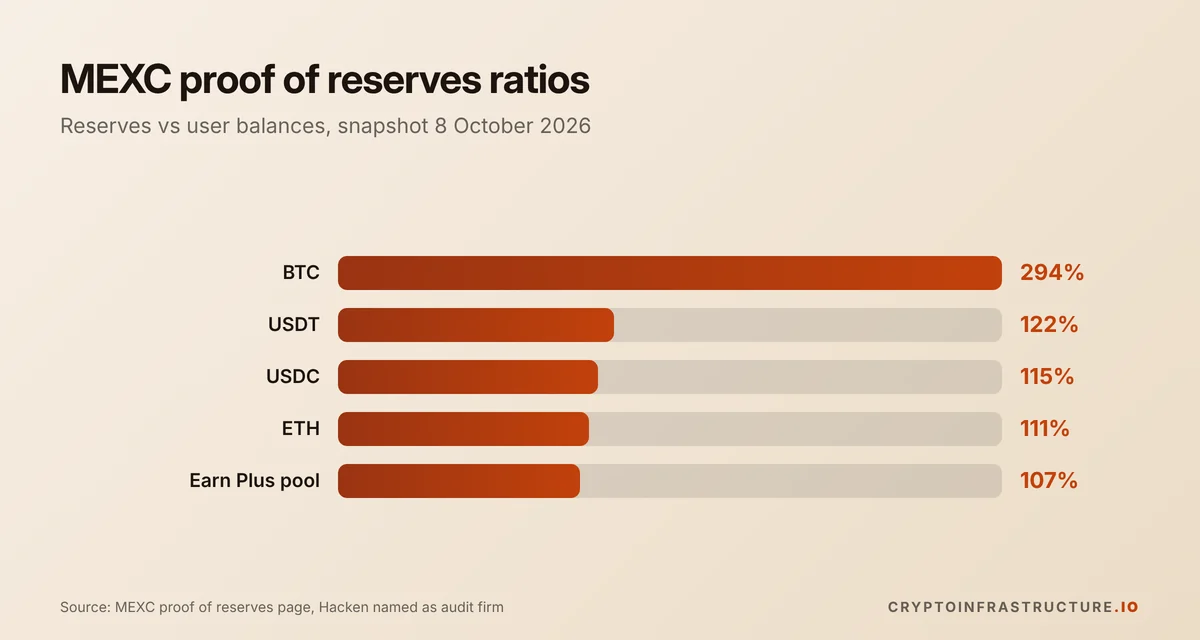
Read the limits before the ratios. A proof of reserves shows that on one day MEXC’s listed wallets held more of four coins than its records said users were owed. It does not show MEXC’s other debts, whether those coins were pledged elsewhere, or anything after the snapshot. The page itself goes further than any snapshot can, claiming reserves mean “Risk of bankruptcy eliminated”. Treat that line as marketing. Several ranking pages still quote older ratios (USDT 115%, BTC 118%) without a date; use the snapshot date, not a headline percentage.
Custody: what MEXC claims
Everything in this section comes from MEXC, not an independent check.
- Who holds the coins: the user agreement says “MEXC maintains full custody of the assets, funds and User data/information” (clause 36). It does not say you are the legal owner of the assets in your account and says nothing about segregating customer assets from MEXC’s own.
- Cold storage and wallet technology: review sites say most funds are in cold storage and that MEXC uses multi-signature and MPC wallet technology. MEXC’s own pages give no percentage.
- Liability cap: clause 29 caps MEXC’s liability at the trading fees you paid in the three months before the problem arose.
Do you own your crypto on MEXC?
The terms do not say so. Full custody sits with MEXC and if it failed, you would be an unsecured claimant against a Comoros company under an English-law contract with Hong Kong arbitration. Holding your own keys is the only way to remove that question and that means a self-custody wallet and a properly stored seed phrase.
Is MEXC insured?
Not in any way you can claim on. The user agreement does not mention insurance. MEXC’s “Proof of Trust” page advertises a “$100M Guardian Fund” for “Full compensation for platform issues” and a separate futures insurance fund. The page does not display a live balance for the Guardian Fund and the futures fund shows “Data unavailable”. Both are MEXC’s own funds, paid out at MEXC’s discretion. They are not deposit insurance, they do not cover trading losses and nothing in the terms gives you a right to them.
Has MEXC been hacked?
No exchange-wide theft of client funds at MEXC has been reported and none of the five ranking pages reviewed reports one. One ranking page lists a 2023 hack at HTX (formerly Huobi) as a MEXC risk, calling HTX “affiliated”; no source links that incident to MEXC users’ funds.
The absence of a big hack is a real point in MEXC’s favour. It does not mean the platform has never cost users money, which is the next section.
Frozen accounts and withdrawals: the main complaint
The most consistent complaint about MEXC is not theft. It is accounts frozen by “risk control”, often after profitable trades, with withdrawals held while MEXC reviews them. MEXC’s terms give it wide room to do this:
- It can act “without notifying such User and without assuming any responsibility” if it finds “any abnormal transaction” (clause 9).
- It can “seize illicit profits” and “retrieve any profits obtained in violation of this Agreement” (clauses 9 and 21).
- Holds continue “until such time as the dispute has been resolved” (clause 34), with no maximum period stated.
| Date | Case | What happened | Outcome |
|---|---|---|---|
| April 2025 | Trader Pablo Ruiz (named in Cointelegraph) | Said more than $2 million USDT was frozen under “risk control” and that support told him the review would take 365 days, to “Contact us again on 04/17/2026” | No outcome reported |
| August 2025 | Trader known as White Whale | Said about $3.1 million was frozen and that MEXC invited him to Malaysia for in-person verification before release. MEXC said it “does not freeze assets without valid reasons” and cited manipulation and wash-trading controls (Cointelegraph). | Funds still frozen after a 20 October 2025 meeting (AMBCrypto, 31 October 2025) |
| 31 October 2025 | White Whale, continued | MEXC’s chief strategy officer Cecilia Hsueh apologised publicly, said MEXC’s risk, operations and PR teams had not kept up with its growth and said his money was released (NewsBTC via TradingView). Analysts reported a spike in withdrawals that day; MEXC called solvency rumours “false and misleading”. | Funds released, per MEXC |
These cases are documented in crypto press; individual user claims are the users’ own accounts and were not independently verified.
Trustpilot reflects the same pattern. In October 2026, MEXC’s Trustpilot page showed no rating at all, with the notice “This company’s rating is unavailable due to a breach of our guidelines” and about 1,364 reviews. Recent reviews include a complaint dated 9 September 2026 about a “Risk Control” fee increase on an account that had not traded. Trustpilot does not fact-check reviews, so treat them as signals, not evidence.
MEXC’s own help article on frozen accounts (dated 12 October 2026) covers routine holds: 24 hours after changing security settings, 48 hours for mistaken deposits and anti-money-laundering reviews where you must “cooperate with MEXC officials for the review”. It warns users not to trust “any third parties offering account unfreezing services”. That warning is worth repeating: frozen-account forums attract fake recovery services.
How do you get money off MEXC?
You withdraw crypto to a wallet or another exchange you control. Review sites report that fiat cash-outs depend on your region and third-party providers rather than a universal bank withdrawal. Before you deposit, know the limits that apply to you. MEXC’s help article says primary KYC raises the 24-hour withdrawal limit to 80 BTC and new whitelist addresses face a 24-hour wait. If your account is frozen, use only the ticket system on mexc.com and keep records of every exchange with support.
Is MEXC a KYC exchange?
In practice, yes. Verification sets what you can withdraw and MEXC’s own frozen-account guide asks for a photo of you holding your ID to lift some withdrawal restrictions. If you are looking at MEXC because you want to avoid identity checks, read the guide to no-KYC exchanges first.
MEXC vs Binance: which is safer?
Don’t trust a one-word ranking. Run both through the same six checks. On MEXC’s side, the evidence above is: no licence named anywhere, no MiCA authorisation, regulator warnings in Japan, Singapore and Ontario, a monthly proof of reserves with a named audit firm, no exchange-wide hack reported, no claimable insurance and a record of long account freezes. Binance’s licences, enforcement history and reserves need the same check, not a reputation. The evidence for Binance is in Is Binance Safe? and all five large offshore exchanges are compared side by side, including fees, in the offshore exchange comparison.
How do you know if a crypto exchange is legit?
Use the same steps on MEXC or any other platform:
- Find the company your terms name and where it is registered.
- Search that name on your own regulator’s register and warning list (SEC, CFTC and state regulators in the US; FCA in the UK; MAS in Singapore; your national authority under MiCA in the EU).
- Check the restricted list in the terms for your country.
- Read the proof of reserves for the snapshot date and who checked it.
- Read the account-freeze and liability clauses before you deposit, not after.
Can you lose your crypto on MEXC?
Yes, in several ways none of the above removes:
- Frozen access: risk-control holds with no fixed end date and profit clawbacks under the terms.
- Exchange failure: full custody with MEXC, no ownership statement, no insurance, liability capped at three months of fees.
- Regional exits: Dutch users are being offboarded by 16 November 2026. If your country is next, you may only be able to withdraw.
- Account takeover and scams: phishing sites, fake support agents and “unfreezing” services target exchange users.
- Leverage: futures can lose more than you expect and none of the protections above cover trading losses.
How to reduce the risk you control
- Check you are allowed to use it. Read clause 1 of the terms for your country and don’t use a VPN to get around it.
- Type mexc.com yourself rather than following ads, referral links or messages.
- Use an authenticator app or passkey, an anti-phishing code and a withdrawal whitelist.
- Treat any “MEXC support” contact outside the official ticket system as suspect, especially if it asks for a fee to unlock funds.
- Withdraw profits and long-term holdings to a wallet you control rather than leaving them on the platform.
What this means for you
MEXC is a working exchange with a monthly proof of reserves that names Hacken as its audit firm and no exchange-wide hack on record. It is also an unlicensed offshore platform run by a Comoros company, warned about by regulators in Japan, Singapore and Ontario, without MiCA authorisation in the EU and with a documented history of freezing large balances under terms that let it hold funds with no end date. If you are in the US, the UK, Canada or Singapore, the answer is simple: its own terms say you can’t use it. Elsewhere, the risk that remains is counterparty risk with little regulatory backstop. Keep on MEXC only what you are actively trading and can afford to have held for weeks or months.
For the same evidence check on other platforms, see the offshore exchange comparison, the KuCoin review or the Exchanges section.