Bybit is a legitimate exchange with real licences, but “legit” is not the same as “safe”. Its global platform is run by an Abu Dhabi company that its terms describe as licensed by the UAE’s Capital Markets Authority, its Austrian company Bybit EU GmbH has held a MiCA authorisation since 28 May 2025 and in Dubai it holds only an in-principle approval. On 21 February 2025 it lost about $1.5 billion in ether to a North Korean hack, the largest exchange theft on record. Bybit says client assets stayed backed 1:1 and that it closed the ETH gap within 72 hours using loans, deposits and purchases. Its monthly proof of reserves (report #40, snapshot 23 September 2026) shows reserves above 100% for the coins listed, but names no auditor. Its terms say your assets are not covered by any deposit protection or insurance scheme. The global platform does not serve the US, UK, Canada, France and several other places; EU users, including in France, are served by Bybit EU and UK users have a separate spot service run with an FCA-authorised partner.
If you are asking “is Bybit safe?”, you have probably heard two things at once: that Bybit is one of the biggest exchanges in the world and that it was hacked for $1.5 billion in 2025. Some ranking pages still say Bybit “has never been hacked”. Others call it “regulated” without saying where or by whom. This review checks Bybit against the same six points this site uses for every exchange: licences by region, proof of reserves, custody terms, insurance, incident and enforcement history and the risk that stays with you. It also sets out where Bybit is legal and where its own terms say it will not serve you.
Is Bybit safe and legit? The short answer
Bybit is legit: it is a real company group with licences from named regulators in the EU and the UAE and a registration in India. No exchange can be called safe outright and Bybit’s record shows why. The evidence for Bybit is a MiCA authorisation, a UAE licence, monthly proof of reserves and a fast, well-documented response to the 2025 hack. The evidence against is that same hack, a proof of reserves no auditor signs, an Indian anti-money-laundering penalty and terms that offer you no deposit protection. Whether that is acceptable depends on how much you keep there and for how long.
The six checks used here, as in the OKX and Kraken reviews:
- Licences by region, from regulator registers where available
- Proof of reserves: method, snapshot date and who checked it
- Custody, labelled as company claims
- Insurance and what it really covers
- Incidents and enforcement, dated and sourced
- The risk that remains for you
They follow the site’s methodology: track record, transparency, security practices and jurisdiction coverage.
Is Bybit safe now? The February 2025 hack
On 21 February 2025, attackers took control of one of Bybit’s Ethereum multisignature cold wallets and moved out its contents. The asset values in Bybit’s own incident timeline add up to about $1.44 billion; Bybit and most reports give the loss as about $1.46 billion to $1.5 billion, depending on the ETH price used. It is the largest theft from a crypto exchange on record.
What was stolen
| Asset | Amount | Value given by Bybit |
|---|---|---|
| ETH | 401,347 | $1.12 billion |
| stETH | 90,375 | $253.16 million |
| cmETH | 15,000 | $44.13 million |
| mETH | 8,000 | $23 million |
| Total of the rows | about $1.44 billion |
Source: Bybit Security Incident: Timeline of Events and FAQs, 3 March 2025. Headline figures of $1.46 billion and $1.5 billion use different ETH prices.
How the hack happened
The attack did not break Ethereum or the Safe smart contracts. It went through the software Bybit’s signers used to approve transactions. Three primary accounts agree on the core facts:
- Safe{Wallet} said on 26 February 2025 that a forensic review found the attack “was achieved through a compromised machine of a Safe{Wallet} developer”, leading to “a disguised malicious transaction”. It said the review found no vulnerabilities in the Safe smart contracts or the source code of its frontend.
- Sygnia, one of two forensic firms Bybit hired, traced it to a Safe{Wallet} developer’s macOS workstation and that developer’s AWS access. The attackers changed JavaScript files on the AWS S3 bucket that serves the Safe{Wallet} web interface. The code activated only for Bybit’s cold wallet and swapped the transaction the signers thought they were approving for a call to a pre-deployed malicious contract. The attackers then removed it (Sygnia investigation).
- Bybit said on 26 February 2025 that both Sygnia and Verichains “found no indications of any compromise within Bybit’s infrastructure” and that it had moved most funds out of Safe-administered addresses on the day of the incident.
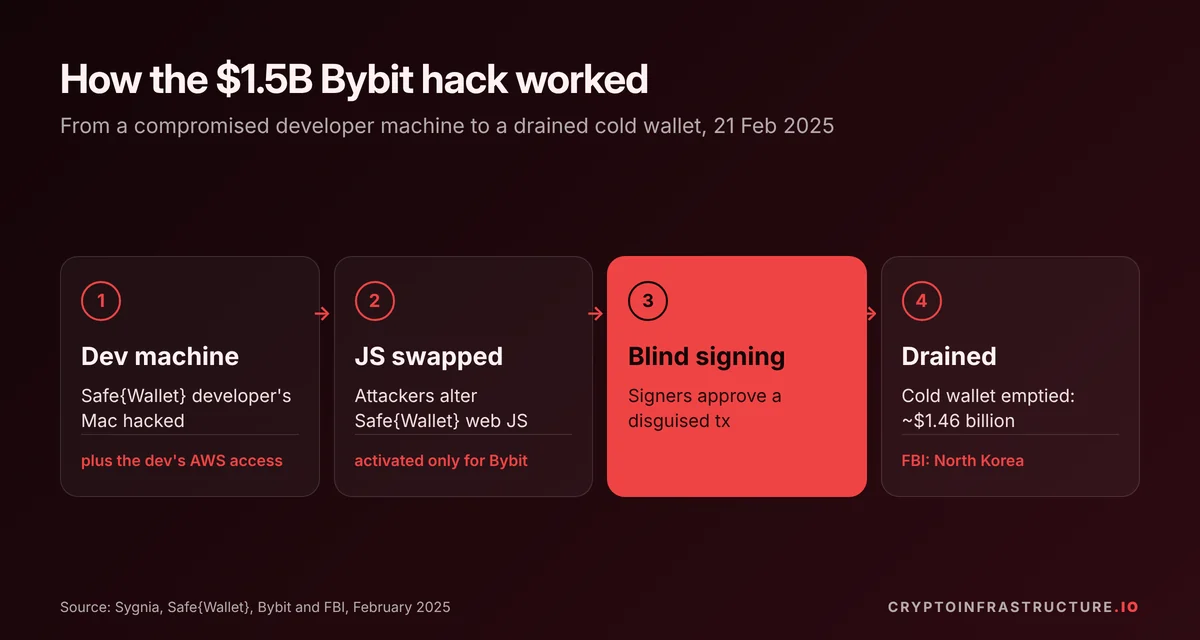
The FBI’s public service announcement of 26 February 2025 attributed the theft to North Korea, naming the activity “TraderTraitor”, also known as the Lazarus Group. Sygnia notes that Mandiant, working on Safe{Wallet}’s side, confirmed that attribution.
The lesson for you is about signing, not about Bybit alone. The signers saw a normal-looking transfer and approved something else. That is “blind signing” and it applies to any multisig or smart wallet that relies on a web interface. If you use one, the account abstraction and smart wallet guide explains how these wallets approve transactions.
Did Bybit users lose their money?
No report of customers losing balances has been published and Bybit says the loss was not passed on. All of what follows is Bybit’s own account, from its timeline:
- Within about two hours, chief executive Ben Zhou posted that “Bybit is Solvent even if this hack loss is not recovered” and that client assets were “1 to 1 backed”. Reuters reported the same statement on 21 February 2025.
- Withdrawals were not halted. Bybit says it processed 99.994% of more than 350,000 withdrawal requests within 10 hours and about $4 billion in withdrawals by 22 February.
- Only the one ETH cold wallet was affected, according to Bybit. Its other cold wallets, including its bitcoin reserves, were not.
How Bybit replenished its reserves
Bybit covered the hole with borrowed and bought ether, not with insurance. Its timeline says:
- 21 February 2025: Bitget deposited 40,000 ETH. Zhou said Bybit was using bridge loans from partners.
- 24 February 2025: Bybit said it had received $1.23 billion in ETH through “bridge loans, whale deposits and OTC purchases”, covering the ETH deficit. It named Galaxy Digital, FalconX and Wintermute as partners, with support from Bitget, MEXC and DWF Labs.
- 24 February 2025: Hacken published an updated proof of reserves that Bybit says showed the ETH gap closed within 72 hours, with BTC, ETH, SOL, USDT and USDC above 100%.
A replenished reserve is not a recovered one. Most of the stolen ether was never returned. By 23 February 2025, Bybit counted $42.89 million frozen with help from Tether, THORChain, Circle and others and said the mETH Protocol recovered the 15,000 cmETH (about $43 million). Bybit also launched a bounty paying 10% of any recovered funds. The cost of the hack sat with Bybit’s balance sheet and its lenders. That worked in 2025. It is not a promise for next time.
Is Bybit legal? Licences by region
Yes, in several places, but there is no single “Bybit licence”. Which protection you have depends on which Bybit company your account sits with.
| Region | Bybit entity | Regulator and permission | Source |
|---|---|---|---|
| Global platform (UAE, Abu Dhabi) | Bybit Virtual Asset Platform Operator L.L.C. S.P.C (“BVAPO”) | Its terms say it is regulated by “the Capital Markets Authority of the United Arab Emirates” to provide Virtual Asset Platform Operator services under licence number 20200000337. Bybit announced a UAE Virtual Asset Platform Operator licence on 9 October 2025, reported at the time as issued by the Securities and Commodities Authority (SCA). | Company terms; crypto.news, 9 October 2025 |
| EU and EEA | Bybit EU GmbH (Austria) | MiCA crypto-asset service provider, authorised by Austria’s Financial Market Authority (FMA) on 28 May 2025, for custody, exchange of crypto for funds and for other crypto, placing and transfer services. Passported to other EEA countries, including Germany, France, Italy, Spain and the Netherlands. | ESMA interim MiCA register of crypto-asset service providers |
| Dubai | Bybit Fintech FZE | In-principle approval only (IPA/24/08/001, issued 21 August 2024) for exchange services. VARA says IPA holders are “strictly prohibited from initiating operations”. The BVAPO terms list Dubai as an excluded jurisdiction. | VARA public register |
| India | Bybit Fintech Limited | Registered with FIU-IND as a reporting entity under the Prevention of Money Laundering Act, after a Rs 9.27 crore penalty on 31 January 2025 | PIB release, 31 January 2025; see the Bybit India guide |
| United Kingdom | No FCA-authorised Bybit entity | Spot service relaunched in December 2025, with financial promotions approved by FCA-authorised Archax | CoinDesk, 19 December 2025 |
What a licence does not mean
A licence lets a regulator supervise and fine one company. It does not guarantee your balance and it does not follow you if you sign up with a different Bybit company. Bybit’s EU site says so itself: “Certain offerings on bybit.eu fall outside the scope of MiCAR regulatory oversight.” India’s registration is an anti-money-laundering registration, not supervision of Bybit’s solvency. And Dubai’s in-principle approval is not a licence at all.
Where Bybit is legal and where it is not
Bybit publishes its restricted list in two places and they do not match. The BVAPO terms (section 3.4) exclude: the United States, mainland China, Hong Kong, Singapore, Canada, France, the United Kingdom, Dubai, North Korea, Cuba, Iran, Uzbekistan, Russian-controlled regions of Ukraine, Sudan and Syria. Bybit’s Service Restricted Countries page gives a similar list but leaves out France and the UK and says Dubai is restricted only for BVAPO. French users can be served by Bybit EU under its MiCA passport. Read the terms for the company you would actually sign up with.
Why is Bybit banned in the US?
Bybit is not licensed in the US and both of its restricted lists exclude US residents. No US company or US licence appears in Bybit’s terms and licence disclosures. No US enforcement action against Bybit has been reported. Using a VPN to get around the restriction breaks Bybit’s terms and puts your account at risk of closure with funds frozen while it is reviewed. For licensed choices, see the best crypto exchanges in the US.
Is Bybit legal in the UK?
Not through the global platform: the BVAPO terms list the United Kingdom as an excluded jurisdiction. Bybit left the UK in October 2023 when the FCA’s rules on crypto financial promotions took effect. It returned in December 2025 with spot trading on about 100 pairs. It operates and markets in the UK through Archax, a London firm with FCA permission to approve financial promotions. Bybit itself is not FCA-authorised (CoinDesk, 19 December 2025). That means the protections of a fully FCA-authorised firm do not apply.
Is Bybit legal in India?
Yes. Bybit Fintech Limited is registered with FIU-IND. It was fined Rs 9.27 crore on 31 January 2025 for serving Indian users without registering and FIU-IND had its websites blocked through the IT ministry (PIB release). It then registered and restored access in stages through September 2025. The full timeline and tax rules are in the Bybit India guide.
Is Bybit legal in Canada?
No. Canada is on both of Bybit’s restricted lists.
Is Bybit legal in Australia?
Australia is not on either of Bybit’s restricted lists, so Bybit does not exclude Australian users. Bybit’s terms do not name an Australian registration. If you are in Australia, look up the company you would contract with on AUSTRAC’s register of digital currency exchange providers before you deposit.
Which country owns Bybit?
No country owns it. Bybit is a privately held company founded in 2018 by Ben Zhou, who is still chief executive (Wikipedia). Its group is spread across several countries: the global platform is run from Abu Dhabi under the BVAPO terms, the EU business from Austria through Bybit EU GmbH and the Indian registration is held by Bybit Fintech Limited. Your contract is with whichever of these serves your country and that company decides which regulator, if any, can hear your complaint.
Does Bybit have proof of reserves?
Yes. Bybit publishes proof of reserves monthly, so check its page for the newest report. Report #40 showed:
| Item | What Bybit publishes |
|---|---|
| Method | Merkle tree for user balances, with open-source verification tools on GitHub. Wallet ownership is shown by “Send to Self” transfers from published addresses. |
| Report #40 | Snapshot 23 September 2026, 03:00 UTC: “Mainstream asset value reaches up to $19.6B” |
| Earlier reports | #39, 26 August 2026: $18.1B. #38, 22 July 2026: $16.2B. #37, 24 June 2026: $15.7B. |
| Reserve ratios (23 September 2026) | BTC 104%, ETH 103%, USDT 110%, USDC 223%, SOL 104%, XRP 115% |
| Who checked it | No auditor named on the reserve-ratio page. Bybit’s “Independent Audit Report” page lists “No Records”. Bybit’s timeline says Hacken produced the post-hack report of 24 February 2025. |
| Scope | Spot, futures, options and unified margin trading accounts, plus funding accounts. Only the listed coins are covered. |
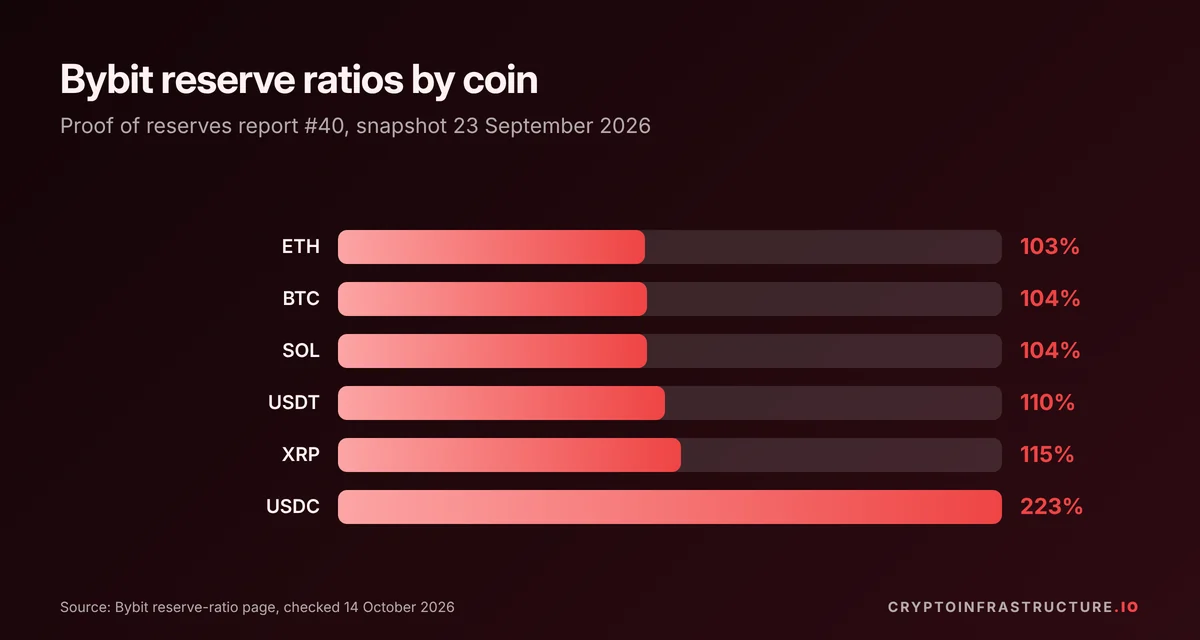
Source: Bybit proof-of-reserves and reserve-ratio pages.
Before and after the hack, the picture is consistent: Bybit kept publishing reports and report #40 shows every listed coin above 100%. The limits matter just as much. A proof of reserves is a snapshot of selected coins on one day. It does not show Bybit’s other debts, including any of the 2025 bridge loans still outstanding. With no auditor named, you are relying on the published data and your own check of your Merkle inclusion.
Custody: what Bybit’s terms say
Everything here comes from the BVAPO terms of 13 October 2026, not from an independent check.
- Segregation: clause 23.2 says assets held in custody for users “shall be segregated from Bybit’s own Virtual Assets and held and controlled by Bybit”, subject to applicable law.
- Keys: clause 23.3 says “you will not know or be given direct access to the private keys”. Bybit holds them.
- Losses you carry: clause 23.4 says Bybit is not responsible for losses from user error, incorrect instructions, compromised user credentials or blockchain protocol failures.
Segregation on paper is better than pooling with company assets, but you still do not hold the keys. If you want that, you need a self-custody wallet and a properly stored seed phrase.
Is Bybit insured?
No. Clause 41.1 of the BVAPO terms says: “Virtual Assets and Fiat are not protected by any form of deposit protection or deposit insurance scheme in the UAE or any other jurisdiction.” The 2025 hack shows what that means in practice: users were made whole because Bybit could borrow and buy enough ether, not because a policy paid out.
Bybit’s incident and enforcement history
| Date | What happened | Outcome for users | Source |
|---|---|---|---|
| October 2023 | Bybit left the UK when the FCA’s crypto financial promotion rules took effect | UK users had to leave the platform | CoinDesk, 19 December 2025 |
| October 2024 | Bybit settled the FTX bankruptcy estate’s lawsuit, filed in November 2023, by paying $228 million | No user impact reported | Wikipedia |
| 31 January 2025 | India’s FIU-IND fined Bybit Fintech Limited Rs 9.27 crore for operating without registration; its websites had been blocked | Indian users’ service suspended from January 2025, restored in stages after registration | PIB release, 31 January 2025 |
| 21 February 2025 | About $1.44 billion to $1.5 billion in ETH and ETH derivatives stolen from one cold wallet; FBI attributed it to North Korea | Bybit says client assets stayed backed 1:1 and withdrawals kept running | Bybit timeline; FBI PSA, 26 February 2025 |
| December 2025 | Bybit returned to the UK with spot trading, using Archax to approve its promotions | UK users can trade spot pairs; Bybit is not FCA-authorised | CoinDesk, 19 December 2025 |
Two ranking pages are out of date here. One beginner review updated in October 2025 still says Bybit “has never been hacked” while describing the 2025 hack further down the same page. Another still describes the UAE licence as an SCA licence, while Bybit’s current terms name the Capital Markets Authority.
Can a Bybit account be hacked?
Yes. The 2025 hack hit Bybit’s own wallet, but the more common risk for you is your own account: stolen passwords, SIM swaps, phishing pages that copy Bybit’s login and people posing as Bybit support. Bybit’s terms put losses from “compromised User Credentials” on you. To reduce that risk:
- Type the address yourself or use the official app. Don’t follow ads or links in messages.
- Use an authenticator app or passkey, not SMS. Set an anti-phishing code if offered.
- Turn on a withdrawal address whitelist, so funds can only go to addresses you approved earlier.
- Limit API keys to the permissions you need and never enable withdrawals on a key a bot or third party holds.
- Treat any “Bybit support” contact as suspect, especially one asking you to move funds or release P2P crypto.
- Keep only what you are actively trading on the exchange.
Is Bybit safer than other offshore exchanges?
A one-word ranking won’t tell you. Compare the same points for each platform: which company serves your country, the latest proof of reserves and who checked it, custody terms, insurance and incident history. The offshore exchange comparison sets Bybit beside OKX, KuCoin, MEXC and Binance on licences, reserves, hacks and fees and the Binance review covers the largest of them.
What this means for you
Bybit is a legitimate exchange group with a MiCA authorisation in Austria, a UAE licence claimed in its terms, an Indian FIU-IND registration and monthly proof of reserves. It is also the exchange that lost about $1.5 billion to North Korean hackers in February 2025 and it paid its way out with loans and purchases rather than insurance. Its reserves report has no named auditor, its terms offer no deposit protection and its global platform does not serve the US, UK, Canada, France and others. The risk that stays with you is counterparty risk: you are trusting Bybit’s solvency and security with whatever you leave on it. Hold an amount that matches that trust and check which Bybit company you are actually dealing with.
For the same evidence check on other platforms, see the Exchanges section.