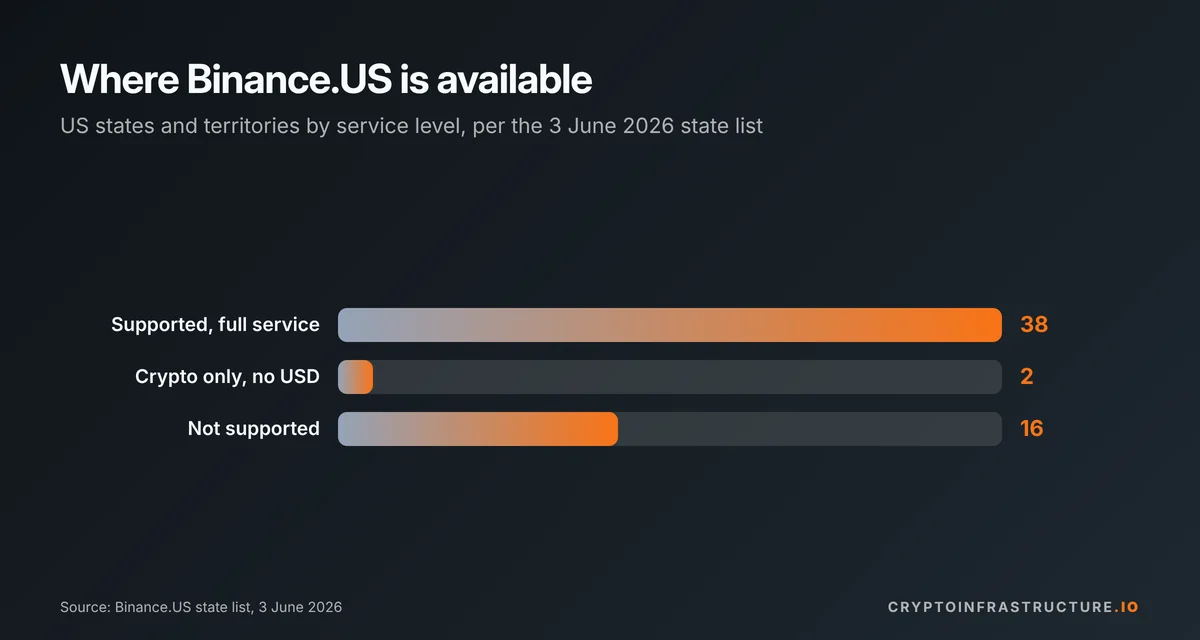
Is Binance legal in the US? It depends which Binance you mean. Binance.com, the global exchange, does not serve US residents: in 2023 its operator pleaded guilty to US charges that included running an unlicensed money transmitting business while serving Americans and in October 2026 the Justice Department confirmed it is reviewing whether Binance has kept that deal. Binance.US is a separate company, BAM Trading Services Inc. (NMLS ID 1906829). It is registered with FinCEN, lists money transmitter licences in 32 jurisdictions (30 states plus the District of Columbia and Puerto Rico) and its state list of 3 June 2026 shows it serving 40 jurisdictions (38 states plus DC and Puerto Rico). It does not serve 16 jurisdictions, including Texas, New York, North Carolina, Georgia, Ohio and Washington. In Kansas and Wisconsin it is crypto-only. The SEC’s lawsuit against both Binance entities was dismissed with prejudice on 29 May 2025.
If you live in the US and search “is Binance legal”, you get two answers that sound like they contradict each other: “Americans can’t use Binance” and “Binance.US is a regulated US exchange”. Both are true, because they describe two different companies. This guide separates them, shows what each one’s own pages and the regulators’ records say and answers the state questions people ask most, including Texas and New York.
Is Binance legal in the US? The short answer
Binance.com is not available to you if you live in the US. Binance.US is, in 38 states plus DC and Puerto Rico and nowhere else in the country. The two share a brand and, according to Binance.US, “common majority ownership”, but they are different companies with different licences, terms and legal records.
| Question | Binance.com (global) | Binance.US |
|---|---|---|
| Open to US residents? | No | Yes, in 38 states plus DC and Puerto Rico |
| Operating company | Binance Holdings Limited and affiliates outside the US | BAM Trading Services Inc., NMLS ID 1906829 |
| US registration and licences | None. Its 2023 plea included failing to register as a money transmitting business | FinCEN money services business since 11 June 2019; money transmitter licences in 30 states plus DC and Puerto Rico |
| Products for US users | None | Spot trading, staking, USD by ACH and wire (not in Kansas or Wisconsin) |
| Open US enforcement matter | DOJ review of compliance with the 2023 plea, confirmed 9 October 2026 | None reported. SEC case dismissed 29 May 2025 |
Based on Binance.US’s about, trust, licence and state pages, the DOJ release of 21 November 2023, SEC litigation release 26316 and Bloomberg Law (9 October 2026).
Why can’t Americans use Binance.com?
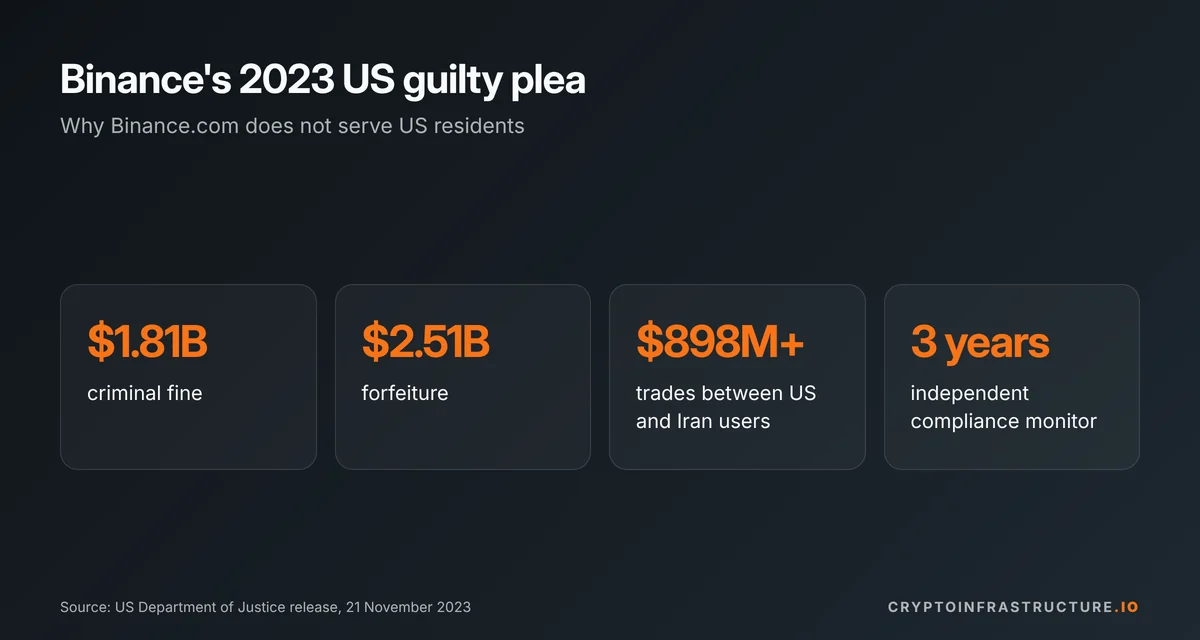
Because serving US customers requires registering with FinCEN as a money services business and holding state money transmission licences and the DOJ found Binance.com served Americans without registering. The Justice Department set out the record when Binance Holdings Limited pleaded guilty on 21 November 2023 (DOJ release):
- Binance pleaded guilty to Bank Secrecy Act violations, failing to register as a money transmitting business and violating the International Emergency Economic Powers Act (US sanctions law).
- The DOJ said the largest share of Binance’s customers had come from the US. In 2019 Binance announced it would block US users and launched Binance.US, but kept many US customers, especially “VIP” ones.
- From January 2018 to May 2022, Binance caused more than $898 million in trades between US users and users in Iran.
- The company agreed to pay $4,316,126,163 ($1.81 billion criminal fine plus $2.51 billion forfeiture) and to keep an independent compliance monitor for three years. The DOJ credited about $1.8 billion toward the separate FinCEN, OFAC and CFTC resolutions, so those figures overlap and should not be added together.
- Founder Changpeng Zhao pleaded guilty to failing to maintain an effective anti-money laundering programme and resigned as CEO.
The case was against the company, not its users. For you, the practical point is simpler: Binance.com does not offer itself to US residents and Binance.US’s own trust page says Binance.com “is not available” to them.
Is the 2023 case over?
Not fully. On 9 October 2026 Tysen Duva, head of the DOJ Criminal Division, told Bloomberg that officials are reviewing whether Binance has complied with the 2023 settlement, alongside an inquiry into possible Iran sanctions violations on the platform. He did not say Binance had breached the agreement and no new charges had been reported. Binance said it “continues to strengthen its compliance controls”. The reports do not mention Binance.US. The full enforcement record is in the Binance safety review.
Can you use Binance.com in the US with a VPN?
Not without misrepresenting where you live to a platform that does not serve the US. If that is discovered, through identity checks or withdrawal patterns, the account can be restricted and there is no US-licensed company on the other side and no US state regulator to complain to. This guide does not explain how to get around the block. Ignore anyone offering to “unlock” an offshore account for a fee: that is a common scam.
What is Binance.US and who owns it?
Binance.US is the trade name of BAM Trading Services Inc. It registered with FinCEN as a money services business on 11 June 2019 and opened to the public on 24 September 2019, according to its about page. On ownership, Binance.US says BAM Trading Services and Binance Holdings Limited “share common majority ownership” but keep separate corporate and management structures and that Binance.US licenses the Binance brand and technology from Binance Holdings. It does not publish ownership percentages on its public pages.
Binance.US lists more than 200 cryptocurrencies to trade and 25 or more staking assets. It does not offer futures, margin or the other derivatives available on Binance.com.
Which licences does Binance.US hold?
Its licence page (dated 4 June 2026) lists 32 money transmitter or equivalent licences: 30 states plus the District of Columbia and Puerto Rico.
| Status | States and territories |
|---|---|
| Licence listed (32: 30 states, DC and Puerto Rico) | Alabama, Arizona, Arkansas, Delaware, District of Columbia, Florida, Idaho, Illinois, Iowa, Kentucky, Louisiana, Maryland, Michigan, Minnesota, Mississippi, Missouri, Nebraska, Nevada, New Hampshire, New Jersey, New Mexico, Oklahoma, Pennsylvania, Puerto Rico, Rhode Island, South Carolina, South Dakota, Tennessee, Utah, Virginia, West Virginia, Wyoming |
| Served but no licence listed (8) | California, Colorado, Hawaii, Indiana, Kansas, Massachusetts, Montana, Wisconsin |
Source: Binance.US licence page (4 June 2026) and state list (3 June 2026). Binance.US’s trust page says some states it serves require no licence for its activity, but does not say which. Confirm any state on the NMLS Consumer Access register under ID 1906829.
A state licence means a regulator can examine and fine Binance.US. It does not insure your balance: Binance.US’s trust page says “FDIC and SIPC do not cover digital assets at any exchange”.
Which states allow Binance.US?
Binance.US’s state list, dated 3 June 2026, splits the US like this:
| Status | States and territories |
|---|---|
| Supported, full service (38: 36 states, DC and Puerto Rico) | Alabama, Arizona, Arkansas, California, Colorado, Delaware, District of Columbia, Florida, Hawaii, Idaho, Illinois, Indiana, Iowa, Kentucky, Louisiana, Maryland, Massachusetts, Michigan, Minnesota, Mississippi, Missouri, Montana, Nebraska, Nevada, New Hampshire, New Jersey, New Mexico, Oklahoma, Pennsylvania, Puerto Rico, Rhode Island, South Carolina, South Dakota, Tennessee, Utah, Virginia, West Virginia, Wyoming |
| Supported, crypto only, no USD (2) | Kansas, Wisconsin |
| Not supported (16: 12 states and 4 territories) | Alaska, American Samoa, Connecticut, Georgia, Guam, Maine, New York, North Carolina, North Dakota, Northern Mariana Islands, Ohio, Oregon, Texas, US Virgin Islands, Vermont, Washington |
If you live in an unsupported state, you cannot register or verify a Binance.US account. Binance.US says the gaps “may be due to pending regulatory approvals”. The page has an “Onboarding Paused States” section, which lists no states.
Many ranking pages are behind this list. Several still say Binance.US is unavailable in only four states (Hawaii, New York, Texas and Vermont). Hawaii is now on the supported list and the unsupported list is 16 jurisdictions long, including Georgia, Ohio, Washington and North Carolina. For the same check across other brands, see the exchange legality matrix.
Is Binance legal in Texas?
No for both. Binance.com does not serve any US state and Texas is on Binance.US’s unsupported list of 3 June 2026, so Texas residents cannot open or verify a Binance.US account. Binance.US’s licence page lists no Texas licence. It gives no Texas-specific reason beyond the general note about pending approvals.
Is Binance legal in New York?
No for both. New York is on Binance.US’s unsupported list and its licence page lists no New York licence. New York runs its own licensing regime for crypto businesses that deal with its residents, the BitLicense, explained in the BitLicense guide. Exchanges that do serve New York are compared in the best US crypto exchanges guide.
What happened between Binance.US and the SEC?
On 5 June 2023 the SEC sued Binance Holdings Limited, BAM Trading Services Inc., BAM Management US Holdings Inc. and Changpeng Zhao. On 29 May 2025 the SEC filed a joint stipulation with the defendants to dismiss the case with prejudice (SEC litigation release 26316). The SEC said it acted “in the exercise of its discretion and as a policy matter” and that the decision does not necessarily reflect its position on other cases. No court ruled on the merits. “With prejudice” means the SEC cannot bring the same claims again. The wider picture of who regulates what is in the US crypto regulation guide.
Why can’t I withdraw from Binance.US?
The answer has changed over time, which is why old forum threads are confusing.
| Date | What happened to USD on Binance.US |
|---|---|
| June to July 2023 | After the SEC filed suit in June 2023, Binance.US became “crypto-only” in July 2023: no USD deposits or withdrawals. It says finding a “secure and compliant payment and banking partner” took most of the time to fix. CoinDesk reported it cut 70% of its staff in this period. |
| 19 February 2025 | USD deposits and withdrawals by ACH bank transfer restored for eligible customers, with zero ACH fees, rolled out over the following days (Binance.US announcement) |
| Status | USD by ACH and wire available, except in Kansas and Wisconsin, which remain crypto-only |
So if you cannot withdraw dollars today, the usual reasons are: you live in Kansas or Wisconsin, where USD services are off; you have moved to an unsupported state; or your account has an open verification or compliance review, which only Binance.US support can explain. In a crypto-only state you can still withdraw crypto to a wallet you control.
What does Binance.US charge?
Binance.US’s fee page, which carries no effective date, lists:
- Spot trading: 0% maker fee at every volume level. Taker fee 0.019% on “Tier I” pairs and 0.0095% on “Tier 0” pairs (the top volume level pays 0.0095% on both).
- ACH: free for deposits and withdrawals.
- Wire: free to deposit; $25 per withdrawal, plus any bank fee.
- Debit or credit card: 3.99% deposit fee.
- Simple “buy” screen: no percentage listed; a spread is built into the price and shown on the Preview Purchase screen.
Worked example, trading fee only, as a taker on a Tier I pair: a $100 market order costs $0.019, $1,000 costs $0.19 and $10,000 costs $1.90. A resting limit order (maker) costs nothing in trading fees. Card deposits and the buy-screen spread can cost far more than the trading fee, so check the preview before you confirm. One widely shared guide still quotes 0.038% maker and 0.057% taker, which is not what the fee page shows today. For how this compares with Coinbase, see Coinbase vs Binance.
Is Binance safe for US citizens?
No exchange can be called safe and for US residents the question is about Binance.US, not Binance.com. What Binance.US publishes: state licences and FinCEN registration (above), a statement that “all balances are held 1:1 in full reserve” and that “the majority” of crypto is in US-based cold storage and SOC 2 Type II and ISO 27001 certifications. These are company statements. The trust page names no reserve auditor and shows no proof-of-reserves report. No US enforcement action against Binance.US has been reported as open, but it shares majority ownership with a company whose plea deal is under DOJ review and it went without USD banking for about 19 months after the 2023 lawsuit. Nothing insures your crypto if the exchange fails. The Binance safety review covers the global company’s record.
Does Binance report to the IRS?
Binance.US is a US platform and CoinLedger reports that it issues Form 1099-DA starting with the 2025 tax year, showing gross proceeds, with cost basis to follow for the 2026 tax year. Binance.com does not serve US residents, so you should not expect US tax forms from it. Either way, you owe tax on gains whether or not you receive a form. The US crypto regulation guide covers 1099-DA rules.
What this means for you
“Binance” in the US means Binance.US. If you live in one of its 40 supported jurisdictions (38 states plus DC and Puerto Rico), it is a FinCEN-registered company with 32 licences (30 states plus DC and Puerto Rico), published spot fees of 0% maker and 0.019% taker on Tier I pairs and a history that includes about 19 months without USD banking. If you live in Texas, New York, North Carolina, Georgia, Ohio, Washington or the other unsupported jurisdictions, it is not available to you and Binance.com is not an option anywhere in the country. Before you deposit, check your state on Binance.US’s state list on the day you sign up, read the fee preview before each buy and keep only what you are actively trading on any exchange.
For licensed alternatives in every state, see the best US crypto exchanges. For Binance’s status elsewhere, the UK, Canada, Australia and India guides use the same checks and the Exchanges section has the rest.