Coinbase vs Binance has no single winner, and the answer to all three questions in the title changes with your country. Cheaper: as of 14 October 2026, Binance.com charges 0.10% maker and taker at its entry tier, while Coinbase Advanced charges a new US customer 0.50% maker and 0.90% taker, so a $10,000 market order costs $10 on Binance and $90 on Coinbase in the US. Outside the US the gap narrows or flips: Coinbase’s entry tier is 0.25% and 0.50% in the EU and UK, and 0.09% and 0.10% in India, Brazil and other international markets.
Legal where: Binance.com does not serve the US (Binance.US is a separate company), stopped serving several EU countries from 1 July 2026 after withdrawing its MiCA application, and has not taken new UK users since October 2023; Coinbase is licensed in New York and holds permissions in Singapore, India and Australia. Safer: neither can be called safe. Binance pleaded guilty to US anti-money-laundering and sanctions offences in 2023 and the Justice Department confirmed on 9 October 2026 it is reviewing whether Binance has kept that deal; Coinbase disclosed a 2025 insider data theft it estimated would cost $180 million to $400 million. Neither exchange insures your crypto balance.
If you are comparing Coinbase and Binance, most pages give you the same one-line answer: Coinbase for regulated simplicity, Binance for low fees. Both halves need a date and a country. Coinbase changed its Advanced fees on 16 September 2026 and now charges US customers more than most comparisons quote, while charging customers in India less than Binance at the maker rate.
Binance lost access to much of the EU in July 2026 and is again under Justice Department scrutiny. This comparison sets out the evidence on the criteria in this site’s methodology: what each exchange publishes about safety, dated fees with worked examples by region, and a country-by-country legal table. It does not name a winner, because the right answer depends on where you live and what you are trying to protect.
Coinbase vs Binance: the short answer
Coinbase and Binance are two separate, competing companies. Binance is much cheaper to trade on in the US and the EU at entry level, but in the US you cannot use Binance.com at all, only the separately owned Binance.US.
Coinbase is licensed in more of the places most English-speaking readers live, publishes audited quarterly accounts as a listed company, and has no criminal plea on its record, but it has paid anti-money-laundering penalties in New York and Ireland and had customer data stolen through bribed support staff in 2025. As of 14 October 2026, which one fits you depends first on your country, then on how much you trade, then on how you weigh Binance’s 2023 plea and the review of it now under way.
Side-by-side: Coinbase vs Binance at a glance
Each row summarises evidence set out in the sections below. Read the section before relying on any one cell.
| Criterion | Coinbase | Binance (Binance.com) |
|---|---|---|
| Entry-tier spot fee, US | 0.50% maker, 0.90% taker (Coinbase Advanced) | Not available to US residents; Binance.US charges 0% maker, 0.019% taker on most pairs |
| Entry-tier spot fee, EU and UK | 0.25% maker, 0.50% taker | 0.10% maker and taker (0.075% paying in BNB), where Binance still serves you |
| Entry-tier spot fee, India and other international markets | 0.09% maker, 0.10% taker | 0.10% maker and taker (0.075% paying in BNB) |
| US status | Coinbase, Inc. (NMLS 1163082), New York BitLicense 122466 | Binance.com: no US entity. Binance.US: BAM Trading Services Inc. (NMLS 1906829), a separate company |
| EU status | Reported MiCA licence via Luxembourg (June 2025) | No MiCA licence; Greek application withdrawn 24 June 2026; services halted in several EU countries from 1 July 2026 |
| Proof of reserves | None published; states it holds assets 1:1 and is audited annually | Merkle tree plus zk-SNARK proofs; no auditor named |
| Largest penalty checked | $50 million to NYDFS (2023), plus $50 million compliance spend | $4.32 billion to the DOJ (2023 guilty plea) |
| Open matter in October 2026 | None found in the sources checked | DOJ review of compliance with the 2023 plea, confirmed 9 October 2026 |
All entries checked 14 October 2026 against each exchange’s fee, licence and legal pages, the VARA register, regulator and DOJ releases, and Coinbase’s SEC filings.
Are Coinbase and Binance the same company?
No. They are separate businesses with different owners, regulators and legal records. Coinbase’s US business is Coinbase, Inc., and its parent publishes financial statements every quarter and is audited each year, according to Coinbase’s security page. Binance.com is run by Binance companies abroad; the only entities on its licences page, checked 14 October 2026, are three Abu Dhabi Global Market companies (Nest Exchange, Nest Clearing and Custody, and Nest Trading). Binance.US adds a third name to the comparison: it is operated by BAM Trading Services Inc., which its own trust page describes as a separate company from Binance.com.
How this comparison works
The criteria come from the site’s methodology: track record, transparency, security practices, pricing clarity and jurisdiction coverage. For an exchange comparison they become six checks, applied to both exchanges in the same order:
- Safety evidence: proof of reserves or filings, custody statements, insurance
- Incident and enforcement history, dated and sourced
- Fees, from each exchange’s own fee page or announcement, with worked examples at $100, $1,000 and $10,000
- Where each one is legal, across the US, EU, UK, UAE, Singapore, India and Australia
- Which entity holds your account in each place
- The risk that remains whichever you choose
There was no hands-on testing, and neither exchange paid to be included. There are no affiliate links on this page. The same structure is used in the Coinbase vs Kraken and Kraken vs Binance comparisons.
Which is safer, Coinbase or Binance?
Neither can be called safe, and no single score settles it. What you can compare is what each one publishes and what has gone wrong. The table sets the evidence side by side; the risks that remain follow it.
| Safety criterion | Coinbase | Binance |
|---|---|---|
| Reserve evidence | No Merkle-tree proof of reserves. Security page: “We hold our customers’ assets 1:1”; quarterly financial statements and an annual independent audit | Merkle tree of user balances plus zk-SNARK proofs; the page claims 1:1 backing but showed no snapshot date, ratios or named auditor when checked |
| What you can verify yourself | Company-wide audited accounts, including debts; not your own balance | That your balance was included in a snapshot; not Binance’s other debts |
| Lending of your assets | “Doesn’t lend or take any action with your assets without your permission” (company statement) | Not checked for this article; see the Binance safety review |
| Ownership terms (US) | User agreement, updated 22 July 2026: “Title to Supported Digital Assets shall at all times remain with you” | Binance.US says balances are “held 1:1 in full reserve” (company claim, no attestation shown) |
| Deposit insurance on crypto | None: “Digital Assets are not subject to protections or insurance provided by the Federal Deposit Insurance Corporation” | None. Binance.US: “FDIC and SIPC do not cover digital assets at any exchange” |
| Exchange wallet theft | None found in the sources checked | 7,000 BTC from a hot wallet, 7 May 2019, covered from Binance’s SAFU fund |
| Criminal record | None found | 2023 guilty plea; compliance now under DOJ review |
From Coinbase’s security page and US User Agreement, Binance’s proof-of-reserves page, Binance.US’s trust page and Binance’s 7 May 2019 announcement, all checked 14 October 2026. Rows marked as statements are company claims, not independent findings.
The risks that remain are different for each. With Coinbase, the main recent harm came from leaked customer data that scammers can use to pose as support staff, and you cannot check your own balance against its reserves. With Binance, the main risk is regulatory: your access depends on its standing in your country, which has changed at short notice in the EU, the UK and India, and the 2023 plea could be reopened if the DOJ finds a breach. With both, nothing insures your crypto if the exchange fails. The Coinbase safety review and Binance safety review go through each point in full.
Can you trust Binance?
Trust here means trusting Binance’s controls and solvency with what you leave on it, and the record cuts both ways. In its favour: it covered its one exchange hack from its own fund in 2019, publishes a proof of reserves you can check your balance against, and holds an active Dubai VARA licence. Against: on 21 November 2023 Binance Holdings Limited pleaded guilty to Bank Secrecy Act violations, failing to register as a money transmitting business and violating US sanctions law, and agreed to pay about $4.32 billion with a three-year independent monitor (DOJ release). Google’s AI Overview calls Binance “legitimate” with “robust technical security”; that answer leaves out the plea and the current review.
Enforcement and incident history
Coinbase
| Date | What happened | Outcome |
|---|---|---|
| 4 January 2023 | NYDFS found an inadequate customer due diligence programme and more than 100,000 unreviewed transaction monitoring alerts by late 2021 | $50 million penalty plus $50 million in compliance spending over two years |
| 11 to 15 May 2025 | An attacker paid support contractors or employees outside the US to copy customer data (names, addresses, masked SSN and bank numbers, ID images, balances) and demanded payment. Coinbase says passwords and private keys were not involved and the staff could not access funds. | Demand not paid. Estimated $180 million to $400 million for remediation and voluntary reimbursement (Form 8-K) |
| 6 November 2025 | Central Bank of Ireland: Coinbase Europe did not properly monitor 30,442,437 transactions worth over €176 billion between April 2021 and March 2025 | €21,464,734 fine after a 30% settlement discount |
Checked 14 October 2026 against the NYDFS release of 4 January 2023, Coinbase’s 8-K dated 14 May 2025 and the Central Bank of Ireland release of 6 November 2025. Older and smaller actions are in the Coinbase safety review.
Koinly’s comparison, updated 28 July 2026, says Coinbase “has never been hacked”. No theft from Coinbase’s own wallets was found for this article, but the 2025 insider data theft is the kind of incident that leads to customer losses through impersonation scams, and Coinbase itself budgeted to reimburse some of them.
Binance
| Date | What happened | Outcome |
|---|---|---|
| 7 May 2019 | Hackers used user API keys, 2FA codes and other stolen data to withdraw 7,000 BTC from the bitcoin hot wallet, about 2% of Binance’s BTC | Covered from SAFU; “No user funds will be affected,” per Binance |
| 21 November 2023 | Guilty plea to Bank Secrecy Act, unlicensed money transmitting and sanctions offences | $4.32 billion to the DOJ ($2.51 billion forfeiture, $1.81 billion fine), three-year monitor, about $1.8 billion credited to CFTC, FinCEN and OFAC resolutions |
| 19 June 2024 | FIU-IND found Binance served Indian clients without meeting its obligations under the Prevention of Money Laundering Act | Rs 18.82 crore penalty (Order-in-Original 10/DIR/FIU-IND/2024) |
| 29 May 2025 | SEC lawsuit against Binance Holdings, BAM Trading Services, BAM Management US Holdings and Changpeng Zhao | Dismissed “in the exercise of its discretion and as a policy matter” (litigation release 26316) |
| 24 June to 1 July 2026 | Withdrew its Greek MiCA application; EU services halted in several countries | No EU licence reported as of 14 October 2026 |
| September 2026 | US forfeiture case over about $61 million allegedly laundered from Iranian oil sales by two Chinese firms using Binance accounts | No wrongdoing by Binance alleged in the complaint; Binance says it removed both firms |
| 9 October 2026 | Tysen Duva, head of the DOJ Criminal Division, confirmed to Bloomberg that officials are reviewing Binance’s compliance with the 2023 settlement | No new charges reported |
Checked 14 October 2026 against Binance’s announcement of 7 May 2019, the DOJ release of 21 November 2023, the FIU-IND order of 19 June 2024, SEC litigation release 26316, Yahoo Finance (25 June 2026) and OneBullEx (4 September 2026) on the EU exit, and BeInCrypto (10 October 2026) reporting Bloomberg’s interview. Binance’s March 2026 Australian court penalty is covered in the Binance safety review.
Which is cheaper, Coinbase or Binance? (checked 14 October 2026)
Binance.com is cheaper at entry level wherever it still serves you outside the international tier, and Binance.US is cheaper than Coinbase in the US, but the gap depends on your country, because Coinbase now sets different Advanced fees by region. Both exchanges also run simple buy screens that price your order with a spread built into the quote; the figures below are the order-book maker and taker rates. A maker order adds liquidity, usually a resting limit order; a taker order removes it, usually a market order.
| Fee | Coinbase Advanced | Binance.com | Binance.US (US only) |
|---|---|---|---|
| Entry-tier maker / taker | US 0.50% / 0.90%; EU and UK 0.25% / 0.50%; Brazil, India and other international markets 0.09% / 0.10% | 0.10% / 0.10% (Regular user) | 0% / 0.019% on most pairs; 0% / 0.0095% on BNB/USD |
| Exchange-token discount | None | 25% off with BNB: 0.075% / 0.075% | 5% off with BNB |
| Next tier | Starts at $10,000 qualifying volume (or by holding USDC); rates shown after sign-in | VIP 1 from $1 million 30-day volume and 5 BNB: 0.09% / 0.10% | Taker falls with volume |
| Simple buy screen | Fee and spread shown before you confirm | Not checked for this article | Spread built into the price, shown on Preview Purchase |
| Date on the source | Effective 16 September 2026 | None shown | None shown |
From Coinbase’s announcement “We’re lowering fees for many active traders on Coinbase Advanced” (16 September 2026), the Binance spot fee page and the Binance.US fee page, all checked 14 October 2026. Binance’s pages show no effective date, so their rates are those displayed that day.
Worked example: $100, $1,000 and $10,000
Assumptions: a new customer with no 30-day volume, buying bitcoin with cash or a dollar stablecoin already in the account, so no deposit fee applies. Trading fee only; on the order book there is no added spread, but the price you get depends on market depth, and withdrawal network fees are extra.
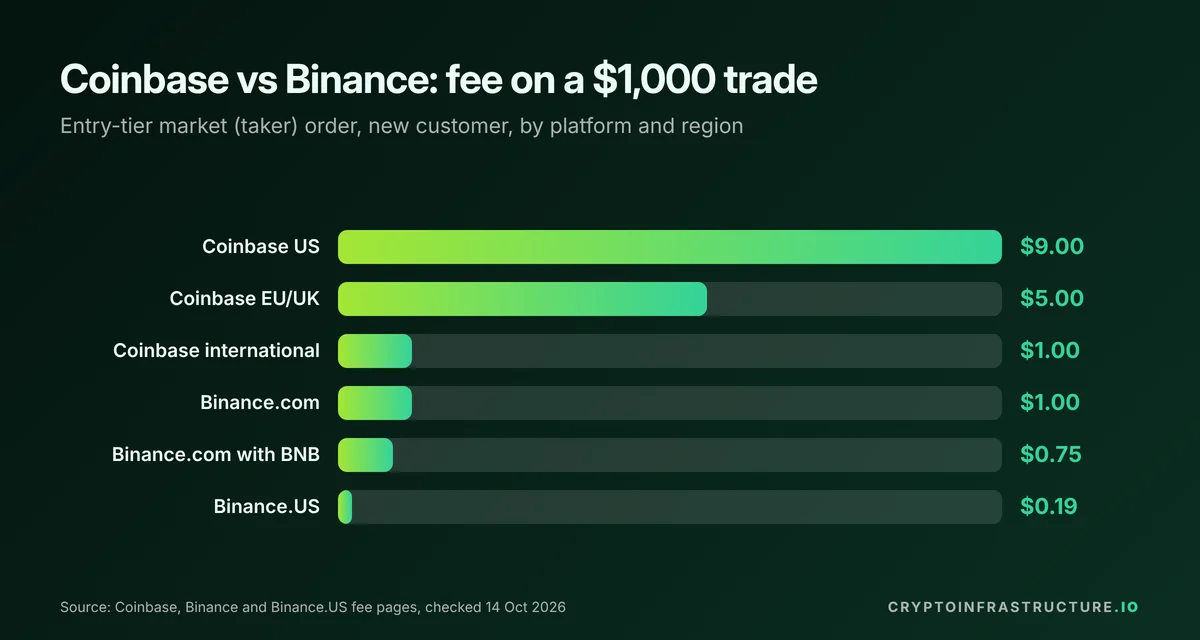
| Market order (taker) | Coinbase US | Coinbase EU/UK | Coinbase international | Binance.com | Binance.com with BNB | Binance.US |
|---|---|---|---|---|---|---|
| $100 | $0.90 | $0.50 | $0.10 | $0.10 | $0.075 | $0.019 |
| $1,000 | $9.00 | $5.00 | $1.00 | $1.00 | $0.75 | $0.19 |
| $10,000 | $90.00 | $50.00 | $10.00 | $10.00 | $7.50 | $1.90 |
| $10,000 resting limit order (maker) | $50.00 | $25.00 | $9.00 | $10.00 | $7.50 | $0.00 |
Two things stand out. In India, Brazil and Coinbase’s other international markets, Coinbase’s entry maker rate (0.09%) is below Binance’s standard 0.10%, and the taker rates match, so “Binance is cheaper” holds there only if you pay fees in BNB. In the US, the comparison is really Coinbase against Binance.US, where Binance.US’s published taker rate is a small fraction of Coinbase’s. Most ranking pages still quote Coinbase at up to 0.60%; for a new US account the taker rate is now 0.90%.
How much does Coinbase charge for $1,000?
On Coinbase Advanced, a $1,000 market order at the entry tier costs $9.00 in the US, $5.00 in the EU and UK, and $1.00 in India and other international markets, as of 14 October 2026. A resting limit order costs $5.00, $2.50 and $0.90. Through the simple buy button, Coinbase sets the fee and spread at order time and shows the total in the preview, so read it before you confirm.
How much does Binance cost?
Binance.com charges 0.10% per spot trade for makers and takers at the Regular tier, or 0.075% if you pay fees in BNB, per its fee page on 14 October 2026. That is $1 on a $1,000 trade, or $0.75 with BNB. Withdrawals carry a separate network fee that varies by coin. Neither fee page checked lists a single minimum deposit, so check the deposit screen for your payment method.
Which crypto platform has the lowest fees?
Of the options here, Binance.US has the lowest published entry rates for US residents (0% maker, 0.019% taker), and Binance.com is lowest for most users elsewhere once the BNB discount is applied. Low trading fees are only one cost: card deposits on Binance.US cost 3.99% and wire withdrawals $25, and simple buy screens on every platform add a spread. For a wider US ranking on the same criteria, see the best US crypto exchanges.
Where are Coinbase and Binance legal? (checked 14 October 2026)
For most readers this table decides more than fees do. “Legal” here means the exchange holds the licence or registration a regulator requires to serve you, or has said it does not serve your country. It shows the entity that serves each region and who supervises it.
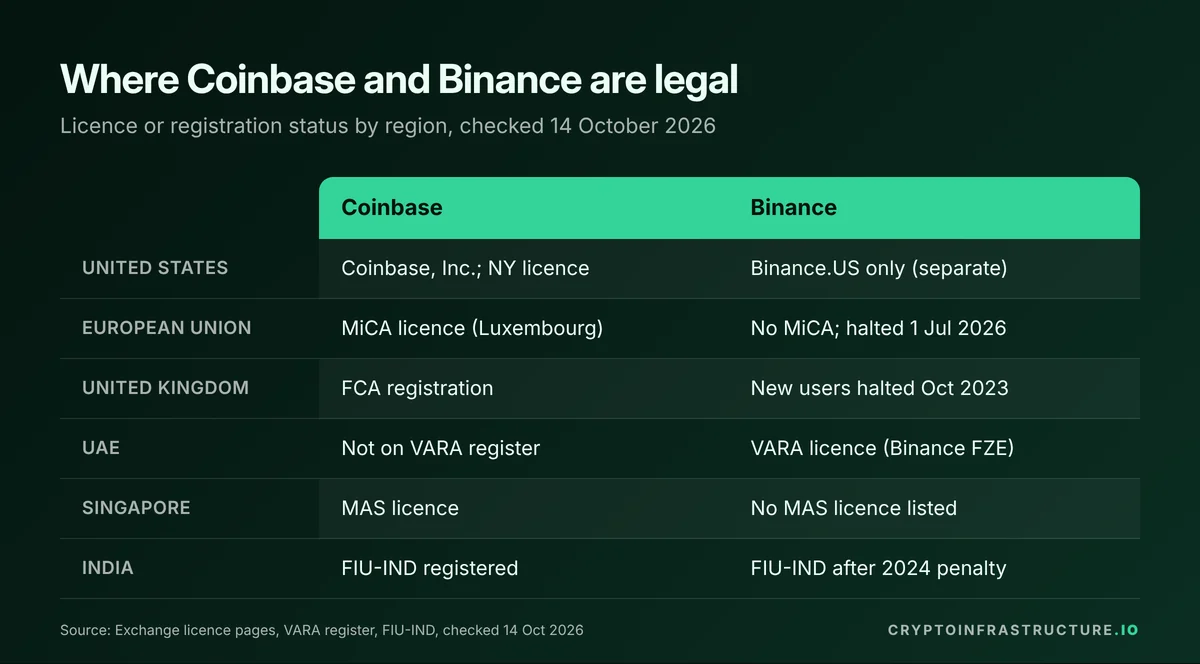
| Region | Coinbase | Binance |
|---|---|---|
| United States | Coinbase, Inc. (NMLS 1163082) lists money transmitter licences in 45 states plus DC and Puerto Rico; California, Hawaii, Massachusetts, Montana and Wyoming are not in its licence table. New York virtual currency licence 122466 and money transmitter licence MT 103755. Coinbase Derivatives, LLC is a CFTC designated contract market. | Binance.com lists no US entity and does not serve US residents. Binance.US is operated by BAM Trading Services Inc. (NMLS 1906829), registered with FinCEN, with 32 state money transmitter licences, serving 40 states and territories per its trust page. |
| European Union | MiCA crypto-asset service provider licence from Luxembourg’s CSSF, reported June 2025. Coinbase Financial Services Europe Ltd. holds CySEC licence 374/19 for derivatives on Coinbase Advanced. | No MiCA licence. Binance withdrew its Greek application on 24 June 2026 and stopped new services in several EU countries from 1 July 2026, when the MiCA transition ended; France is confirmed, and Binance notices named Italy, Poland and Spain among others. Binance says it will apply in another member state and that user assets remain accessible. |
| United Kingdom | FCA cryptoasset registration for its UK entity, reported February 2025. | Stopped accepting new UK users from 16 October 2023, after losing its FCA-authorised approver for financial promotions. No later change was found in the sources checked. |
| UAE | No Coinbase entity on the VARA public register. | Binance FZE holds VARA licence VL/24/04/001, active, issued 15 April 2024, including exchange services and virtual asset derivatives. Three Nest entities are regulated by the FSRA in Abu Dhabi Global Market. |
| Singapore | Coinbase Singapore Pte. Ltd. holds a Major Payment Institution licence from the Monetary Authority of Singapore for digital payment token services, per its user agreement. | No MAS licence on Binance’s licences page. |
| India | Coinbase India Private Limited is registered with FIU-IND as a reporting entity, No. VA00061119, per its user agreement. | Penalised Rs 18.82 crore by FIU-IND on 19 June 2024 for serving Indian clients without meeting its obligations; registered afterwards as a reporting entity. Details in the Binance in India guide. |
| Australia | Coinbase Australia Pty Ltd holds Australian Financial Services Licence 569752 from ASIC and is registered with AUSTRAC as a virtual asset service provider, per its user agreement updated 17 September 2026. | Binance Australia is registered with AUSTRAC as a virtual asset service provider, No. 100576141-001, per its terms. |
Sources: Coinbase’s US licences page and its Singapore, India and Australia user agreements; Binance’s licences page and Australian terms; Binance.US’s trust page; the VARA public register; the FIU-IND order of 19 June 2024; Yahoo Finance (25 June 2026) and OneBullEx (4 September 2026) on Binance’s EU exit; Business Times and Yahoo Finance (17 October 2023) on the UK. All checked 14 October 2026. Coinbase’s EU and UK entries are as reported on the dates shown; confirm them on the CSSF and FCA registers.
Can US citizens use Binance?
Not Binance.com. Its licences page lists no US entity, and the 2023 plea included operating as an unlicensed money transmitting business. US residents who want a Binance-branded exchange use Binance.US, which is a separate company with its own licences, fees and record, and is not available in every state. Coinbase, by contrast, holds a New York licence, which matters if you live there, but its licence table does not list five states, so check availability in the app before you sign up.
Is Binance still available in Europe?
Only partly, and not for new customers in the countries affected. As of 14 October 2026 Binance holds no MiCA licence, has not named the member state where it will reapply, and halted services in France and other EU markets from 1 July 2026. Existing users were told their assets remain accessible. Coinbase serves the EU under MiCA. If you are in the EU, check what Binance’s notice to your country allows before you send anything to it.
Can I cash out large amounts from Coinbase or Binance?
Neither exchange’s fee or licence pages checked for this article state a single maximum withdrawal. Limits depend on your country, verification level and payment method, and both show your own limits inside your account. Large cash-outs can trigger extra identity or source-of-funds checks under the anti-money-laundering rules both exchanges are supervised under. On Binance.US, wire withdrawals cost $25 per its fee page.
Which fits which reader
- You live in the US: the real choice is Coinbase or Binance.US. Binance.US publishes far lower order-book fees; Coinbase holds a New York licence and publishes audited accounts.
- You live in the EU: Coinbase serves you under MiCA; Binance has no MiCA licence and has halted services in several countries since 1 July 2026.
- You live in the UK: Binance has not taken new UK users since October 2023. Coinbase’s entry fees are 0.25% maker and 0.50% taker.
- You live in the UAE: Binance FZE holds a VARA licence; no Coinbase entity is on the VARA register.
- You live in Singapore: Coinbase holds a MAS licence; no MAS licence appears for Binance.
- You live in India: both have gone through FIU-IND, Binance after a 2024 penalty. Coinbase’s international entry fees match or undercut Binance’s standard rate.
- You live in Australia: both are registered with AUSTRAC; Coinbase also holds an ASIC licence.
- The 2023 plea weighs on you: Binance’s compliance with it is under DOJ review as of October 2026; no comparable open matter was found for Coinbase.
What this means for you
As of 14 October 2026, Coinbase vs Binance is not a contest with a winner. Binance is cheaper at entry level in most places it serves and is licensed in Dubai and Abu Dhabi and registered in Australia, but it does not serve US residents through Binance.com, has stopped new services in much of the EU and in the UK, and is under DOJ review over its 2023 plea. Coinbase is licensed or registered in more of the regions covered here and publishes audited accounts, but charges US customers 0.90% per market order at entry level and lost customer data to bribed insiders in 2025.
Neither insures your crypto. Before you deposit, check which entity will hold your account in your country, read the fee page on the day you trade, and keep only what you are actively trading on any exchange. If you move coins to your own wallet, learn how to store a seed phrase first. Exchange comparisons on this site are reviewed monthly, and sooner after a hack, delisting or enforcement action.
For the full evidence on each platform, see Is Coinbase Safe? and Is Binance Safe?, the Coinbase vs Kraken and Kraken vs Binance comparisons, or browse the Exchanges section.