As of 14 October 2026, crypto tax in the UK works like this: HMRC taxes crypto as property, not money. When you sell, swap, spend or give away crypto, any gain is subject to Capital Gains Tax (CGT) at 18% or 24% once your total gains for the year pass the £3,000 annual exempt amount. Crypto you receive from mining, staking, lending or employment is taxed as income when you receive it.
You report gains in the cryptoasset section of the Self Assessment capital gains pages (boxes 13.1 to 13.5), and from 1 January 2026 UK platforms collect your details under the OECD Cryptoasset Reporting Framework, so HMRC will start receiving that data in 2027. Draft legislation published on 13 July 2026 would change the rules for DeFi loans, liquidity pools and stablecoins from 6 April 2027, but it is not law yet.
If you live in the UK and buy, trade, stake or get paid in crypto, the tax rules are not new, but the stakes are higher than they were. HMRC now has a dedicated crypto section on the tax return, exchanges have been collecting your tax details since 1 January 2026, and HMRC published its first crypto gains statistics in August 2026. Several of the pages that rank for this topic still quote old CGT rates, old allowances or nothing at all about the 2026 reporting rules.
This guide sets out the HMRC rules as they stand on 14 October 2026: what is taxable, the CGT and income tax rates for 2025-26 and 2026-27, how share pooling and the same-day and 30-day rules work, worked examples with stated assumptions, exactly where crypto goes on your return, and what the draft DeFi and stablecoin changes would mean.
Crypto tax in the UK: how is crypto taxed?
HMRC does not treat cryptoassets as currency. It treats them as assets, so there are two taxes to think about:
- Capital Gains Tax when you dispose of crypto and make a gain.
- Income Tax (and sometimes National Insurance) when you receive crypto as income, for example from staking, mining, lending or your job.
The same token can be hit by both. If you receive staking rewards, you pay Income Tax on their value when they arrive. If you later sell them for more than that value, the increase is a capital gain.
What counts as a disposal
According to HMRC’s guidance on selling cryptoassets (last updated 5 October 2026), you dispose of crypto when you:
- sell it for pounds or another currency
- exchange it for a different cryptoasset (a crypto-to-crypto swap is taxable even though no pounds change hands)
- use it to pay for goods or services
- give it away, unless the gift is to your spouse, civil partner or a charity
Buying crypto with pounds and holding it is not a disposal. Neither is moving tokens between wallets you own, although you need records to prove that is all it was.
How much tax do you pay on crypto in the UK?
Capital Gains Tax rates and allowance
| Tax year | CGT rates for individuals | Annual exempt amount |
|---|---|---|
| 2024-25 (6 April 2024 to 29 October 2024) | 10% and 20% | £3,000 |
| 2024-25 (30 October 2024 to 5 April 2025) | 18% and 24% | £3,000 |
| 2025-26 (6 April 2025 to 5 April 2026) | 18% and 24% | £3,000 |
| 2026-27 (6 April 2026 to 5 April 2027) | 18% and 24% | £3,000 |
Source: GOV.UK, Capital Gains Tax rates and allowances (last updated 13 April 2026), checked 14 October 2026.
Which rate you pay depends on your income. GOV.UK’s method: work out your taxable income, take the £3,000 allowance off your gains, then add the remaining gains on top of your income. Gains that fit inside the basic rate band are taxed at 18%. Anything above it is taxed at 24%. Higher and additional rate taxpayers pay 24% on all taxable gains. For 2026-27 the basic rate band is £37,700 of taxable income.
Watch out for stale figures. One crypto tax software guide cited in Google’s AI Overview on 14 October 2026 still gave UK CGT rates of 0%, 10% or 20% for 2026, and an accountancy page in the results still quoted a £12,300 threshold, which was the allowance for 2022-23.
Income Tax rates on crypto income
Crypto income is added to your other income and taxed at your normal rates. For 2026-27 in England, Wales and Northern Ireland, GOV.UK lists:
| Band | Taxable income | Rate |
|---|---|---|
| Personal Allowance | Up to £12,570 | 0% |
| Basic rate | £12,571 to £50,270 | 20% |
| Higher rate | £50,271 to £125,140 | 40% |
| Additional rate | Over £125,140 | 45% |
The Personal Allowance shrinks by £1 for every £2 of income over £100,000. Scotland has its own income tax bands, so the income examples below assume you live in England.
How much crypto can you sell without paying tax?
There is no limit on how much crypto you can sell. The tax-free part is the gain: in 2025-26 and 2026-27 your first £3,000 of total capital gains (crypto, shares and other assets combined) is tax-free. If you sell £40,000 of Bitcoin that cost you £38,000, your £2,000 gain is inside the allowance and there is no CGT to pay.
That does not always mean you can stay silent. HMRC’s SA108 notes for 2025-26 say you should fill in the capital gains pages if any of these apply:
- your disposals of chargeable assets were worth more than £50,000, even if you made no gain
- your gains before losses were more than £3,000
- you want to claim a capital loss
So an active trader who turns over £60,000 of crypto in a year at a small gain still has a reporting job to do. For crypto income, HMRC’s separate guidance gives a £1,000 trading and miscellaneous income allowance. Between £1,000 and £2,500 of such income you contact HMRC, and above £2,500 you register for Self Assessment.
Share pooling: how HMRC works out your cost
You cannot pick which coins you sold, and you cannot use first in, first out. HMRC requires every fungible token type to be matched in a fixed order, set out in CRYPTO22200 of the HMRC Cryptoassets Manual (last updated 28 November 2025):
- Same-day rule. Tokens you buy on the same day you sell are matched first.
- 30-day rule (“bed and breakfast”). Tokens of the same type you buy in the 30 days after a sale are matched next. This stops you selling at a loss and buying straight back just to crystallise the loss.
- Section 104 pool. Everything else comes out of a single pool for that token at its average cost.
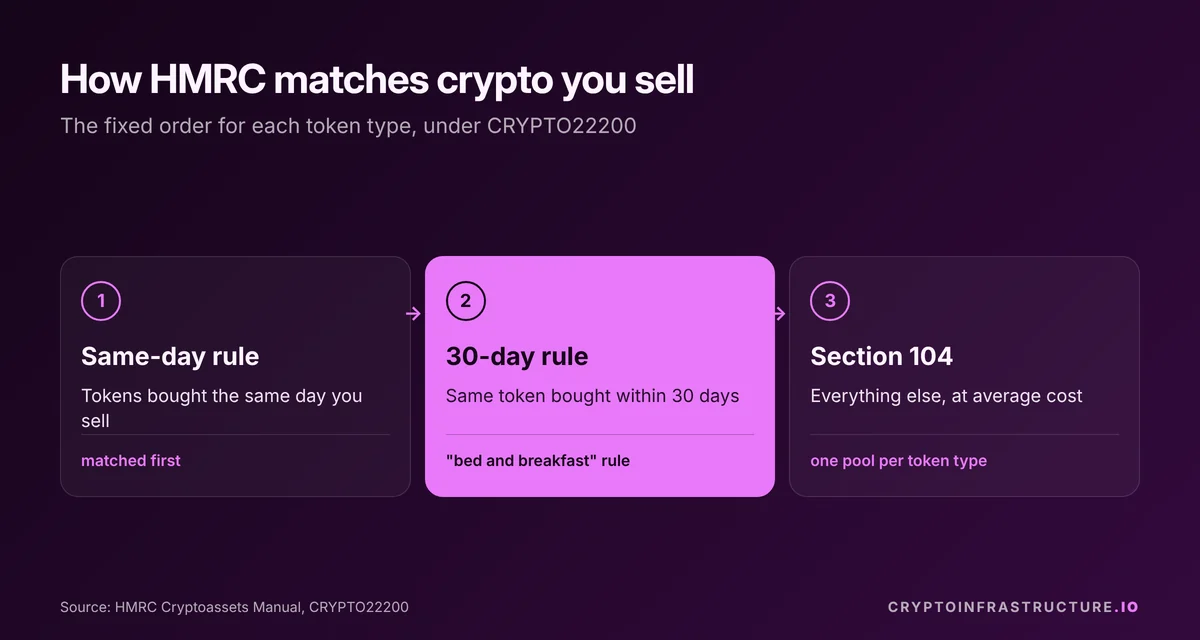
Each token type has its own pool, so your Ether pool and your Solana pool are separate. NFTs are separately identifiable, so they are not pooled and the matching rules do not apply. HMRC also warns that exchange statements are not tax calculations and do not track your pooled costs. You need your own records.
How to calculate crypto tax: worked examples
Assumptions for every example: you are a UK resident individual living in England, the year is 2026-27, you have no other capital gains or losses, no fees unless stated, and no reliefs. The figures are illustrations, not tax advice.
Example 1: a basic rate taxpayer sells at a gain
| Step | Amount |
|---|---|
| Salary | £40,000 |
| Taxable income after £12,570 Personal Allowance | £27,430 |
| Unused basic rate band (£37,700 minus £27,430) | £10,270 |
| Crypto gain for the year | £15,000 |
| Less annual exempt amount | £3,000 |
| Taxable gain | £12,000 |
| £10,270 at 18% | £1,848.60 |
| £1,730 at 24% | £415.20 |
| Total CGT | £2,263.80 |
If your taxable income were already above £50,270, the whole £12,000 would be taxed at 24%, which is £2,880.
Example 2: share pooling with the same-day and 30-day rules
This builds on HMRC’s own pooling example. You bought 100 of Token XY at £2 (£200) and later 300 at £1 (£300). Your Section 104 pool holds 400 tokens with a pooled cost of £500, which is £1.25 each.
Then, on 1 March 2027:
- you sell 200 tokens at £3 each, for £600
- on the same day you buy 50 tokens for £145
- on 15 March 2027, within 30 days, you buy another 50 tokens for £125
| Tokens sold | Matched with | Allowable cost |
|---|---|---|
| 50 | Same-day purchase | £145 |
| 50 | Purchase within 30 days | £125 |
| 100 | Section 104 pool at £1.25 | £125 |
| 200 | Total | £395 |
Your gain is £600 minus £395, which is £205. The pool now holds 300 tokens with a cost of £375. The 100 tokens bought in March were matched against the sale, so they never enter the pool. If you had used a simple average for everything, you would have reported a different gain, which is the kind of mismatch HMRC can now spot.
Example 3: staking rewards, then a sale
You stake tokens yourself (not as a trade) and receive rewards worth £800 in pounds at the time each reward arrives during 2026-27. You have no other trading or miscellaneous income.
- Income Tax: HMRC’s manual (CRYPTO21200) taxes the sterling value at the time of receipt as miscellaneous income. £800 is inside the £1,000 trading and miscellaneous income allowance, so on these assumptions there is no Income Tax to pay.
- Capital Gains Tax later: the £800 becomes your cost. If you later sell the reward tokens for £1,100, your gain is £300, which is inside the £3,000 annual exempt amount if you have no other gains.
Go over the £1,000 allowance, or add other side income, and the full value is taxed at your marginal rate. Keep a dated record of every reward and its sterling value at the time.
Staking, mining, airdrops and income in crypto
| How you get the crypto | Tax on receipt | Tax when you dispose of it |
|---|---|---|
| Salary or bonus paid in crypto | Income Tax and National Insurance. Bitcoin and similar exchange tokens are usually readily convertible assets, so the employer should run PAYE, but you are responsible for checking it was done | CGT on any rise in value after receipt |
| Mining (not a trade) | Miscellaneous income at the sterling value on receipt, less appropriate expenses (CRYPTO21150) | CGT on any rise in value |
| Staking (not a trade) | Miscellaneous income at the sterling value on receipt (CRYPTO21200) | CGT on any rise in value |
| Airdrop received in return for doing something | Income Tax, as miscellaneous income or trade receipts (CRYPTO21250) | CGT on disposal |
| Airdrop received without doing anything, outside a trade | Income Tax may not apply (CRYPTO21250) | A disposal can still create a chargeable gain |
| Mining or staking at a scale that amounts to a trade | Trading profits, taxed as self-employment income | Depends on how the tokens are held |
Whether mining or staking is a trade depends on factors HMRC lists such as degree of activity, organisation, risk and commerciality. Mining costs such as equipment and electricity cannot be deducted from a capital gain, according to HMRC’s selling guidance.
What are the new crypto tax rules in the UK for 2026?
No new crypto tax took effect in 2026. What changed is how much HMRC can see, plus a set of draft rules for 2027.
CARF: platforms report your data to HMRC
The UK began implementing the OECD Cryptoasset Reporting Framework (CARF) in January 2026, and it applies to UK users of UK platforms as well as cross-border data. HMRC’s guidance for users (last updated 1 January 2026) says every cryptoasset service provider you use, including non-UK ones, will ask for:
- your full name and date of birth
- your address and the country where you normally live
- your tax identification number, which for UK residents is your National Insurance number or Unique Taxpayer Reference (UTR)
If you give a UK provider inaccurate details or none, you could get a penalty of up to £300. Providers must register with HMRC by 31 January 2027 and send their first report, covering calendar year 2026, between 1 January and 31 May 2027, according to HMRC’s guidance for reporting providers. In its 27 August 2026 announcement, HMRC said providers that fail to comply face penalties of up to £300 per user.
Draft rules for DeFi loans, liquidity pools and stablecoins
This is the biggest gap in the pages ranking for this keyword. On 13 July 2026 the government published a policy paper and draft legislation on cryptoasset loans and liquidity pools:
- Loans and liquidity pools: for individuals and trustees, putting tokens into a crypto loan or an automated market maker pool would be treated as “no gain, no loss”, so CGT is deferred until you actually exit. The policy paper names three cases: lending a single cryptoasset, borrowing one, and automated market making. It does not mention staking.
- Stablecoins: separate draft legislation would make gains on “eligible stablecoins” (backed by reserves to hold a stable value against a currency, designed for payments and widely available) not chargeable for individuals. Holders on 5 April 2027 would be treated as selling and buying back at market value immediately before 6 April 2027. Companies are outside this exemption.
- Start date: both measures would apply from 6 April 2027.
Until then the current position applies. HMRC’s manual (CRYPTO61620) says that where a DeFi loan or staking arrangement transfers beneficial ownership of your tokens to the borrower or platform, that transfer is a disposal for CGT. Whether ownership passes depends on the protocol’s terms. If you use DeFi in 2025-26 or 2026-27, keep transaction-level records of every deposit and withdrawal. For how these protocols work, see the DeFi explainer, and for the regulatory side of stablecoins, the stablecoin regulation guide.
Can HMRC see your crypto?
Increasingly, yes. Three things are worth knowing as of 14 October 2026:
- Exchange data. Under CARF, UK platforms report your identity and transactions to HMRC, and platforms in other countries that follow the same rules report to their own tax authority, which shares the data with HMRC. So “does Kraken (or any exchange) inform HMRC?” now has a simple answer: if the platform is in a CARF country, expect your data to reach HMRC, with the first reports arriving in 2027.
- Letters. HMRC sends “nudge” letters to people it believes have unreported crypto gains. The Financial Times reported, from a Freedom of Information request covered by Cointelegraph on 18 October 2025, that HMRC sent nearly 65,000 such letters in 2024-25, up from 27,700 the year before.
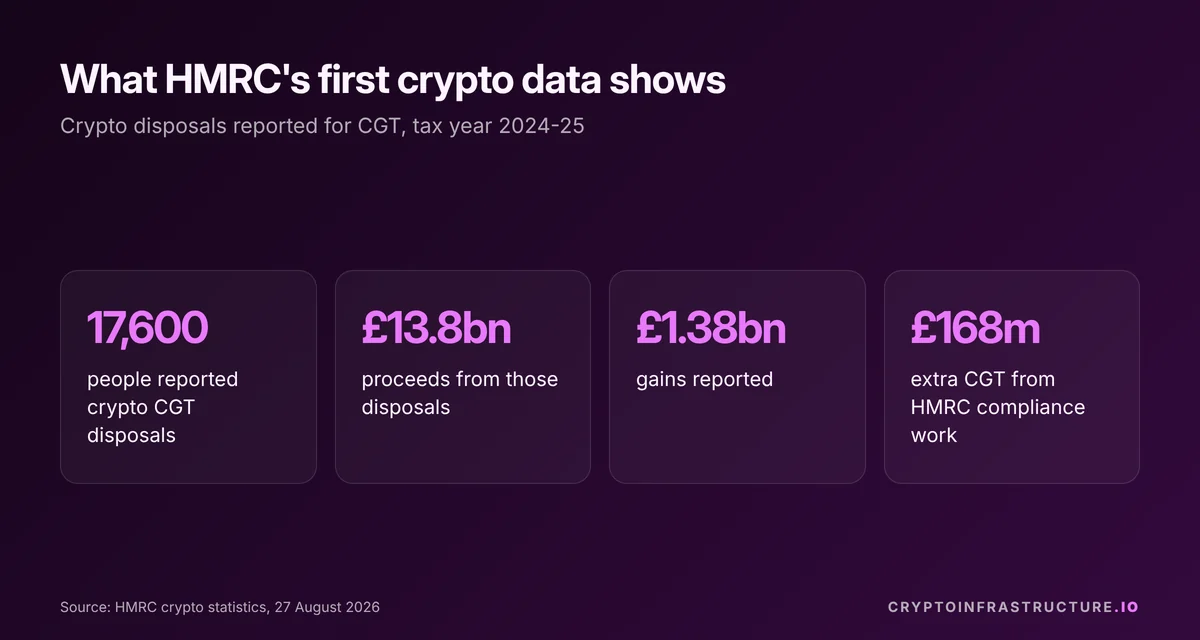
- Published results. HMRC’s first crypto statistics (27 August 2026) show 17,600 individuals reported CGT-liable crypto disposals for 2024-25, with £13.8 billion of proceeds and £1.38 billion of gains. HMRC estimates its compliance and education work brought in an extra £168 million of CGT.
If you have not paid tax you owed, HMRC’s guidance says you may face a penalty of up to 100% of the tax due plus interest, and more for offshore matters. HMRC’s Cryptoasset Disclosure Service lets you tell HMRC about unpaid tax from earlier years yourself, before it contacts you.
How to report crypto on your tax return
- Register if you need to. If you do not normally file a return, you must tell HMRC by 5 October after the end of the tax year. For 2025-26 that deadline was 5 October 2026, so if you missed it, register now and expect a possible penalty.
- Collect records from every platform and wallet. For each transaction: token type, date, number of tokens, sterling value, fees, and the pooled cost before and after each disposal.
- Apply the matching rules for each token type: same day, then 30 days, then the Section 104 pool.
- Fill in the cryptoasset section of SA108. HMRC added a dedicated crypto section to the capital gains pages from the 2024-25 return. For 2025-26 the boxes are:
- 13.1: number of cryptoasset disposals
- 13.2: total disposal proceeds
- 13.3: total allowable costs, including purchase price
- 13.4: total gains before losses
- 13.5: total losses
- 13.6 to 13.8: claim or election codes, and anything already reported through the Capital Gains Tax real time service
- Report crypto income separately. There is no separate crypto box for income. Staking, mining and similar income go under existing Income Tax sections, such as other income or self-employment.
- Claim losses. Capital losses must be reported to HMRC before they can reduce gains. Brought-forward losses only reduce your gains down to the £3,000 allowance, so the allowance is not wasted. Tax guides from TokenTax and Koinly put the time limit for claiming a loss at four years after the end of the tax year in which it arose.
- File and pay by 31 January. HMRC says anyone with crypto income or gains above the allowance for 2025-26 must declare them and pay by 31 January 2027.
You can also report gains during the year through HMRC’s Capital Gains Tax real time service instead of waiting for the return, which HMRC’s selling guidance lists as an option for crypto.
Common mistakes
- Treating crypto-to-crypto swaps as tax-free because no pounds were withdrawn.
- Using an exchange’s profit and loss figure as the taxable gain. It does not apply UK matching rules.
- Forgetting the £50,000 proceeds test, which can require a return even when there is no tax to pay.
- Not recording the sterling value of staking or airdrop rewards on the day they arrive, which leaves you without a cost for CGT later.
- Assuming the draft DeFi and stablecoin rules already apply. They start, if enacted, on 6 April 2027.
If you run a crypto business in the UK
This guide is about individuals. Companies pay Corporation Tax on crypto profits rather than CGT, and the draft stablecoin rules treat company holdings differently, through the loan relationship rules from accounting periods beginning on or after 1 April 2027. If your business lets users transact in cryptoassets, you are likely a reporting cryptoasset service provider under CARF: you must collect user tax details, register with HMRC by 31 January 2027 and file your first report by 31 May 2027. Tax reporting sits alongside FCA rules, not instead of them. The KYC/AML & Compliance section covers providers that handle customer due diligence and reporting.
What this means for you
As of 14 October 2026, the core UK rules are stable: 18% or 24% CGT above a £3,000 allowance, income tax on staking, mining and crypto pay, and pooled costs under the same-day, 30-day and Section 104 rules. What has changed is visibility. Platforms are collecting your tax ID, HMRC gets the first CARF data in 2027, and the 2025-26 return is due by 31 January 2027 with a dedicated crypto section.
If you use DeFi lending, liquidity pools or stablecoins, watch the Finance Bill: the draft rules would change your position from 6 April 2027. If your situation involves DeFi, large losses, trading-level activity or unpaid tax from earlier years, a crypto tax accountant can check your figures before you file.
For how other countries handle this, see Crypto Tax in India. To compare platforms on licensing and transparency, browse the Exchanges section, read Is Kraken Safe?, and see the site’s methodology for how providers are assessed.


