Binance operates in Australia through a local business, Binance Australia, which AUSTRAC (Australia’s anti-money laundering regulator) names as Investbybit Pty Ltd, a registered digital currency exchange provider. Binance says that registration is number 100576141-001 and that it has applied to ASIC for an Australian Financial Services Licence (AFSL), still pending. It does not hold an AFSL today. Its derivatives arm, Oztures Trading Pty Ltd (Binance Australia Derivatives), had its licence cancelled at its own request on 6 April 2023. On 27 March 2026 the Federal Court ordered that derivatives entity to pay a A$10 million penalty for misclassifying 524 retail clients. AUSTRAC ordered an external audit of Binance Australia’s AML controls in August 2025. Owning crypto is legal for you, and Binance Australia can legally serve you. Under the Corporations Amendment (Digital Assets Framework) Act 2026, platforms like it will need an AFSL once that law starts in April 2027 and a six-month transition ends.
If you live in Australia and are wondering whether Binance is allowed here, the search results give you mixed signals: a A$10 million court penalty, an AUSTRAC audit order, two years without bank transfers plus Binance’s own page saying it is regulated. All of these are true at once. This guide separates the two regulators that matter, AUSTRAC and ASIC. It sets out what each has done about Binance and explains what the new 2026 digital asset law changes, using the regulators’ own releases, the Federal Register of Legislation and Binance’s own statements.
Is Binance legal in Australia?
Yes, with conditions. “Legal” covers three separate questions, and the answers differ:
- Is Binance allowed to run an exchange for Australians? Yes. Australia requires crypto exchanges to register with AUSTRAC for anti-money laundering and counter-terrorism financing (AML/CTF) purposes. AUSTRAC’s own media release describes Investbybit Pty Ltd, “Binance Australia”, as registered with AUSTRAC as a digital currency exchange provider. Binance’s Australian support page says Binance Australia is an AUSTRAC reporting entity registered as a virtual asset service provider under registration number 100576141-001.
- Does Binance hold an Australian financial services licence? No. Its derivatives arm’s AFSL was cancelled on 6 April 2023. Binance says Binance Australia has lodged a new AFSL application with ASIC that “is currently pending determination” (Binance support page).
- Is it illegal for you to own or trade crypto? No. None of the regulator pages reviewed makes buying, holding or selling crypto an offence for an individual. The ATO treats crypto transactions as taxable events (see the tax section below).
So the accurate short answer is: Binance is legal to use in Australia through Binance Australia, which is AUSTRAC-registered. That registration is an AML registration, not a financial services licence. Binance Australia is not ASIC-licensed, its derivatives arm has been penalised following ASIC proceedings, it has been audited at AUSTRAC’s direction and the licensing rules it operates under are changing. When Binance’s pages say it is “regulated” in Australia, the AUSTRAC registration is what they refer to.
Binance’s global “supported regions” page lists Australia as “Available” (page updated 18 August 2026), but that page names no Australian legal entity. The registration that matters is Binance Australia’s, not the global app listing.
Who regulates Binance in Australia: AUSTRAC vs ASIC
Two federal regulators look at crypto exchanges, for different reasons.
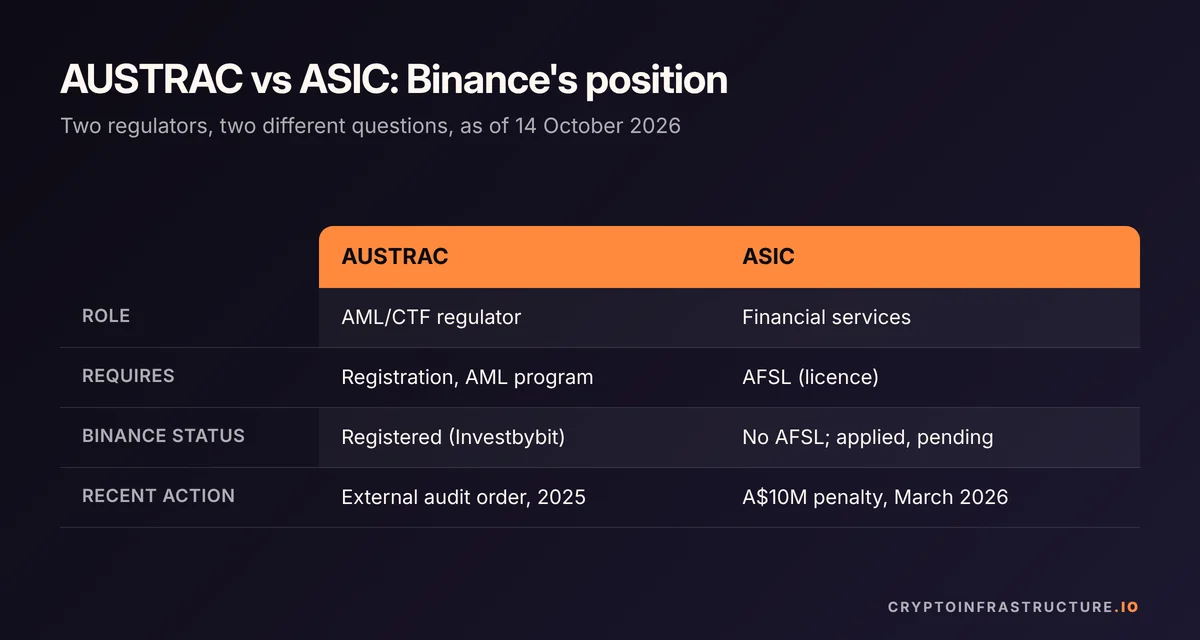
- AUSTRAC (Australian Transaction Reports and Analysis Centre) is the financial intelligence agency. Exchanges must register with it and run AML/CTF programs: identity checks, transaction monitoring plus reporting. Registration is not an endorsement and is not a financial services licence.
- ASIC (Australian Securities and Investments Commission) regulates financial products and services under the Corporations Act 2001. Crypto derivatives already counted as financial products, which is why Binance’s derivatives arm needed an AFSL. The 2026 Act extends ASIC licensing to digital asset platforms that hold crypto for clients.
| Binance entity in Australia | What it does | AUSTRAC | ASIC |
|---|---|---|---|
| Investbybit Pty Ltd (“Binance Australia”) | Spot crypto exchange for Australian users | Registered as a digital currency exchange provider (AUSTRAC release, August 2025); registration 100576141-001 per Binance | No AFSL; application pending per Binance |
| Oztures Trading Pty Ltd (“Binance Australia Derivatives”) | Crypto derivatives for Australian clients (2022 to 2023) | Not covered in the sources reviewed | AFSL cancelled at its own request on 6 April 2023; A$10 million penalty ordered 27 March 2026 |
Sources: AUSTRAC media release on the Binance Australia audit; ASIC media release 26-055MR (27 March 2026); Binance Australia support page. AUSTRAC’s online register blocks automated access, so search it yourself for “Investbybit” to confirm the current registration.
Timeline: Binance and Australian regulators
| Date | What happened | Source |
|---|---|---|
| July 2022 to April 2023 | Period in which Binance Australia Derivatives classed 524 retail clients as wholesale clients | ASIC 26-055MR |
| December 2022 | ASIC starts a targeted review of Binance’s Australian financial services business | ASIC 26-055MR |
| 6 April 2023 | ASIC cancels the Binance derivatives AFSL at the entity’s request, after issuing a notice of hearing on cancelling or suspending it | ASIC 26-055MR |
| Mid-May 2023 | Binance Australia stops PayID AUD deposits “with immediate effect”, blaming “a decision made by our third party payment service provider” | Binance Australia statement via FX News Group, 22 May 2023 |
| 1 June 2023 | Last day for AUD bank transfer withdrawals (17:00 AEST) under the payment partner’s cut-off | FX News Group, 22 May 2023 |
| 2023 | About A$13.1 million compensation paid to affected derivatives clients, overseen by ASIC | ASIC 26-055MR |
| December 2024 | ASIC starts civil proceedings against Oztures Trading Pty Ltd | ASIC 26-055MR |
| 22 August 2025 | AUSTRAC directs Binance Australia to appoint an external auditor over AML/CTF concerns | AUSTRAC media release; date per Finance Magnates, 22 August 2025 |
| 16 January 2026 | AUD deposits and withdrawals via PayID and bank transfer reinstated for all Binance Australia users | Cryptonews Australia, 20 January 2026 |
| 27 March 2026 | Federal Court orders Oztures to pay a A$10 million penalty | ASIC 26-055MR |
| 8 April 2026 | Corporations Amendment (Digital Assets Framework) Act 2026 receives Royal Assent | Federal Register of Legislation, Act No. 38, 2026 |
| 1 July 2026 | Binance Australia makes sender and beneficiary details mandatory for all crypto deposits and withdrawals | Binance Australia announcement, 8 May 2026 |
| 30 September 2026 | ASIC’s extended no-action position for digital asset firms seeking an AFSL ends; ASIC warned on 2 September 2026 that firms needing a licence that have not met its conditions risk breaching the law from 1 October | ASIC, 2 September 2026 |
| April 2027 | Digital Assets Framework Act commences (ASIC gives 9 April 2027), followed by a six-month transition period | ASIC, 2 September 2026; Act No. 38, 2026, section 2 and Part 8 |
The ASIC case: what Binance Australia Derivatives did wrong
The biggest Australian enforcement action involving Binance concerns its derivatives arm, not the spot exchange. According to ASIC media release 26-055MR (27 March 2026), Justice Moshinsky of the Federal Court ordered Oztures Trading Pty Ltd, trading as Binance Australia Derivatives, to pay a A$10 million penalty plus a contribution to ASIC’s costs. The penalty is on that derivatives entity, not on Investbybit Pty Ltd, which runs the spot exchange.
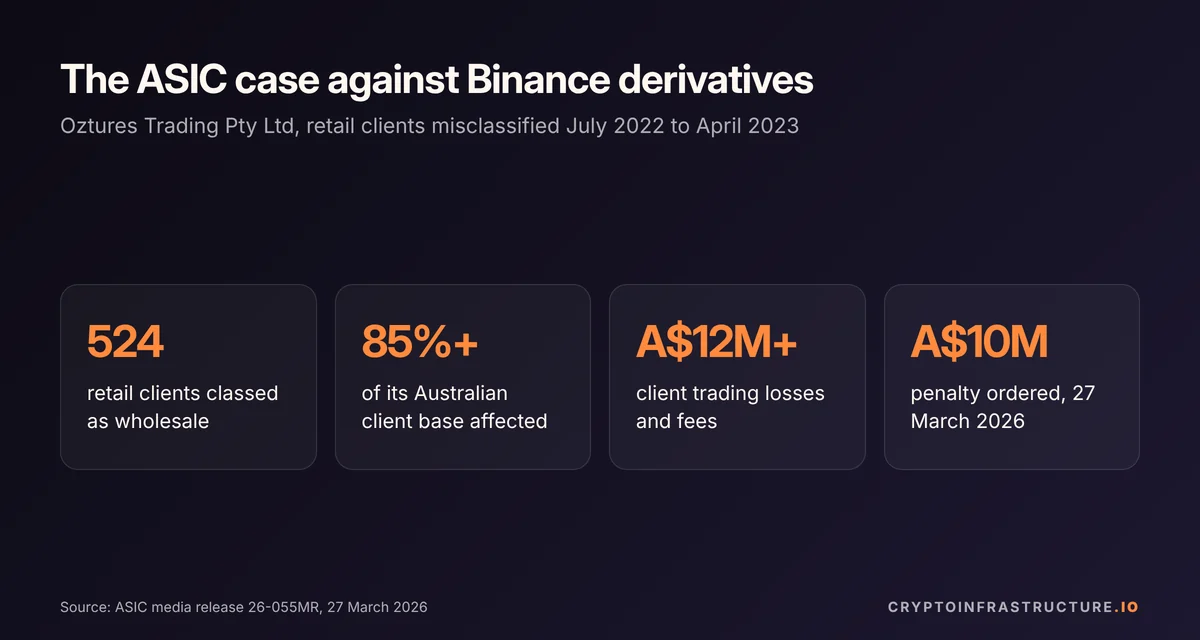
- What happened: between July 2022 and April 2023, Binance wrongly classed 524 retail investors as wholesale clients, which removed the consumer protections retail clients get for high-risk crypto derivatives. ASIC says more than 85% of Binance’s Australian client base for that business was affected.
- How: 460 of the 524 were approved under the sophisticated investor test, where applicants could retake a quiz without limit until they passed. One person was approved as a professional investor after certifying as an “exempt public authority” without adequate checks. ASIC’s release does not break down how the remaining 63 clients came to be classed as wholesale.
- The cost to clients: A$8.66 million in trading losses and A$3.89 million in fees, more than A$12 million combined. About A$13.1 million in compensation was paid in 2023.
- Admissions: Binance admitted all the contraventions ASIC alleged, including no Product Disclosure Statement, no Target Market Determination, a non-compliant internal dispute resolution system plus failing to act efficiently, honestly and fairly.
Some pages report this as a “$6.9 million” fine. That is the A$10 million penalty converted to US dollars; the court penalty is in Australian dollars.
The AUSTRAC external audit order
On the anti-money laundering side, AUSTRAC directed Binance Australia to appoint an external auditor after identifying “serious concerns” with its AML/CTF controls. The release was reported on 22 August 2025 (Finance Magnates). AUSTRAC said:
- Binance’s latest independent review was “limited in scope relative to its size, business offerings and risks”.
- There was “high staff turnover at Binance and a lack of local resourcing and senior management oversight”.
- Binance Australia had 28 days to nominate auditors for AUSTRAC’s consideration and selection.
An audit order is not a penalty or a cancellation of registration. No public AUSTRAC decision on the audit’s outcome has been found. Some summaries date this order to 2024; AUSTRAC’s release and the coverage of it are from August 2025.
Can you deposit and withdraw AUD on Binance Australia?
Yes, again. In May 2023 Binance Australia stopped PayID AUD deposits after its third-party payment provider pulled the service. Bank transfer withdrawals ended at 17:00 AEST on 1 June 2023, leaving card payments as the main fiat route. Cryptonews Australia reported on 20 January 2026 that AUD deposits and withdrawals via PayID and bank transfer were reinstated for all users from 16 January 2026, after a phased rollout. Binance has not named the new banking partner.
Crypto transfers changed too. From 1 July 2026, Binance Australia requires you to give the sender’s details for every crypto deposit and the beneficiary’s details for every withdrawal, at any amount, including transfers to and from self-hosted wallets (Binance Australia announcement, 8 May 2026). If the information is missing, transfers may be delayed, not processed or returned.
What the 2026 digital asset law changes
Australia has now legislated the licensing regime that sites still call “proposed”. The Corporations Amendment (Digital Assets Framework) Act 2026 (Act No. 38, 2026) received Royal Assent on 8 April 2026. The House of Representatives debated it as a Bill in February 2026.
- Who it covers: digital asset platforms, defined as facilities where an operator holds digital tokens for or on behalf of clients, plus tokenised custody platforms. A spot exchange that holds your crypto, such as Binance Australia, fits that description.
- When it starts: the day after the 12 months beginning on Royal Assent. ASIC gives the commencement date as 9 April 2027.
- Transition: a six-month transition period starts on commencement. During it, the new rules do not apply to a platform that has applied to ASIC for an AFSL (or a variation) covering the service. A platform that has not applied is caught as soon as the transition ends.
ASIC has also been licensing digital asset businesses under existing law while the Act waits to start. ASIC extended its no-action position for digital asset firms seeking an AFS licence from 30 June to 30 September 2026 (ASIC, June 2026). Its 2 September 2026 “final call” said firms that need a licence but have not met the no-action conditions risk breaching financial services law from 1 October 2026, with penalties up to 10% of annual turnover. It announced no further extension. ASIC’s notice does not say what happens to applications still pending after that date. Binance’s statement that its AFSL application is pending fits that process, but a pending application is not a licence. Until ASIC decides, look at Binance Australia’s own disclosure and ASIC’s professional register for any change.
Is crypto legal in Australia, and how is it taxed?
Crypto is legal to buy, hold and sell in Australia. None of the regulator sources reviewed makes it an offence for an individual. The rules sit on the businesses: AUSTRAC registration now, then ASIC licensing for platforms once the 2026 Act is in force.
Using Binance does not change your tax position. The ATO’s crypto asset investment pages explain how to work out and report capital gains tax on crypto transactions and when the personal use asset exemption can apply. Because Binance Australia is an AUSTRAC reporting entity that verifies your identity, assume your account activity is linked to you. Keep your own trade records, including from 2023 and earlier. The detail, and how Australia compares with other countries, is in How Is Crypto Taxed?.
What do you need to open a Binance Australia account?
You need to complete identity verification (KYC). Creating a login alone does not unlock deposits, withdrawals or trading. Binance’s guidance says you upload an identity document and complete a liveness check. This is part of Binance Australia’s AUSTRAC obligations. Since 1 July 2026 you also give counterparty details for crypto transfers.
What is Binance?
Binance is a centralised crypto exchange established in 2017. AUSTRAC describes it as the world’s largest centralised crypto exchange by transaction volume, holding regulatory approvals or permissions in about 20 jurisdictions. Binance Australia is its local arm.
Is Binance safe, and how does Australia compare?
Legal and safe are different questions. An AUSTRAC registration means Binance Australia must run AML/CTF controls; it does not insure your crypto or check the exchange’s solvency. Binance’s wider record, including its US settlement, licences elsewhere, proof of reserves and security history, is in Is Binance Safe?. The side-by-side with a US-listed exchange is in Coinbase vs Binance.
Australia sits in the middle of how regulators have handled Binance. In Canada, Binance left in 2023 and is not registered (see Is Binance Legal in Canada?). The UK position is covered in Is Binance Legal in the UK?. In Australia, Binance still operates through a registered local entity, but under active scrutiny from both regulators.
What this means for you
You can legally use Binance in Australia through Binance Australia (Investbybit Pty Ltd), which is registered with AUSTRAC. It is not ASIC-licensed. Its derivatives arm lost its AFSL in April 2023 and was ordered to pay a A$10 million penalty in March 2026. Binance says its new AFSL application is pending. AUSTRAC ordered an external audit of its AML controls in August 2025. AUD bank transfers and PayID returned on 16 January 2026. Crypto transfers now need sender or beneficiary details.
Before you use any Australian exchange, verify three things yourself: the legal entity name in its terms, that entity on AUSTRAC’s register and whether it holds or has applied for an AFSL on ASIC’s register. Watch for ASIC’s decision on Binance’s application and for the Digital Assets Framework Act’s start in April 2027. From then, a platform holding your crypto will need an AFSL once the transition ends.
For more on exchanges, browse the Exchanges section and read how this site assesses providers in its methodology.
This guide is general information, not legal or tax advice. Licensing rules change; take advice from a qualified Australian lawyer or tax adviser before acting. See the site’s disclaimer.