As of 14 October 2026, Binance is not registered with any Canadian securities regulator and is not on the Canadian Securities Administrators (CSA) list of crypto platforms authorized to do business with Canadians (last updated 18 September 2026). Binance announced on 12 May 2023 that it was withdrawing from Canada, citing new guidance on stablecoins and investor limits, and Canada’s anti-money laundering agency FINTRAC says it stopped operating in Canada on 25 September 2023.
FINTRAC fined Binance Holdings C$6,002,000 on 7 May 2024, a penalty Binance has appealed. Owning crypto is not illegal for you in Canada, but platforms that serve Canadians must register, and Binance has not. The 19 entities on the CSA list, including Coinbase Canada, Kraken’s Payward Canada, Crypto.com’s Canadian entity, Wealthsimple, Newton and Shakepay, are what Canadians use instead.
If you are in Canada and searching whether you can use Binance, you will find pages that say it is “illegal”, VPN sellers saying it works fine with their software, and Binance’s own app page listing Canada as “Available”. The confusion comes from mixing three questions: is crypto legal for you, is Binance allowed to serve you, and can you technically reach the app. This guide answers each with the CSA’s registration lists, FINTRAC’s penalty notice, the Ontario court rulings and Binance’s own statements, explains why Binance left in 2023, and sets out which platforms are authorized now, as of 14 October 2026.
Is Binance legal in Canada?
It depends which “legal” you mean. As of 14 October 2026:
- Is Binance authorized to serve Canadians? No. Binance does not appear on the CSA’s list of crypto platforms authorized to do business with Canadians (last updated 18 September 2026), and it is not on the CSA list of platforms operating under a pre-registration undertaking (last updated 17 July 2026). The CSA says platforms serving Canadians, including those based outside Canada, must register with provincial or territorial securities regulators.
- Is Binance banned in Canada? Not formally. The CSA’s banned crypto platforms list (last updated 23 October 2025) names KuCoin, Poloniex, CatalX, CoinEx, XT.COM and LATOKEN’s operator. Binance is not on it. Binance left on its own announcement rather than under a ban order.
- Is it illegal for you to own crypto? No source checked for this article makes owning crypto an offence for a Canadian. The Financial Consumer Agency of Canada says crypto assets “are not legal tender in Canada” and that tax rules apply to crypto transactions (page modified 27 November 2025). The registration duty sits on the platform, not on you.
The accurate short answer: crypto is legal to hold in Canada, but Binance is not registered to serve Canadians and has said it withdrew from the country in 2023.
Can you still use Binance in Canada?
Not as a supported customer. FINTRAC’s penalty notice records that Binance stopped operating in Canada on 25 September 2023. Binance has made no public announcement of a return that could be found when checked on 14 October 2026, and no Binance entity has been added to the CSA registration or undertaking lists.
One detail causes confusion. Binance’s “Countries/Regions where the Binance App is supported” page lists Canada as “Available” (page updated 18 August 2026). That page does not explain what “Available” means, and it sits next to Binance’s Abu Dhabi regulatory notices. It is not a Canadian registration, and nothing on it says Binance accepts Canadian residents. Treat it as a statement about the app, not about your right to an account.
VPN sellers often walk you through connecting via another country. A VPN does not change where you live. Opening an account that way means giving the platform a false location, which can leave your account restricted or closed later and leaves you outside the protections that come with a registered Canadian platform. This article does not recommend it.
Does Binance work in Ontario?
No, and Ontario went first. Binance stopped operating in Ontario at the end of 2021, according to the Nova Scotia Securities Commission, well before the national exit in 2023. Ontario is also where the main Canadian court case against Binance is running (see below).
Can I withdraw my funds from Binance in Canada?
No source checked for this article sets out Binance’s current withdrawal terms for former Canadian customers. FINTRAC records that Binance stopped operating in Canada on 25 September 2023, so if you still hold a balance from before then, read the notices inside your account, contact Binance through its official support channel only, and keep records of any withdrawal for your tax filings.
Why did Binance leave Canada?
Binance’s statement on 12 May 2023, quoted by Forbes and Reuters, said it would be “joining other prominent crypto businesses in proactively withdrawing from the Canadian marketplace” because “new guidance related to stablecoins and investor limits provided to crypto exchanges makes the Canada market no longer tenable for Binance at this time.” It said it hoped to return.
The guidance it meant was CSA Staff Notice 21-332, published on 22 February 2023 after the collapses of Voyager Digital, Celsius Network, the FTX group, BlockFi and Genesis Global. The Nova Scotia Securities Commission’s explainer (5 July 2023) sets out what it required of unregistered platforms that wanted to keep operating while their applications were reviewed:
- An enhanced pre-registration undertaking (PRU). A signed commitment to investor protection terms that mirror what registered platforms must meet.
- Stablecoin limits. No letting investors buy or deposit value-referenced crypto assets (VRCAs, the regulators’ term for stablecoins) without regulators’ consent.
- Investor limits. Caps on how much of certain crypto assets a retail investor can buy over 12 months, with bitcoin and ether excluded.
- No margin or leverage for Canadian clients, as Forbes summarised the notice in May 2023.
The NSSC says Binance did not sign the undertaking, while ten other unregistered platforms did, joining ten platforms that were already registered at the time. Binance was not alone in leaving: Forbes reported in May 2023 that OKX planned to withdraw and that Bittrex Global had left in late 2022.
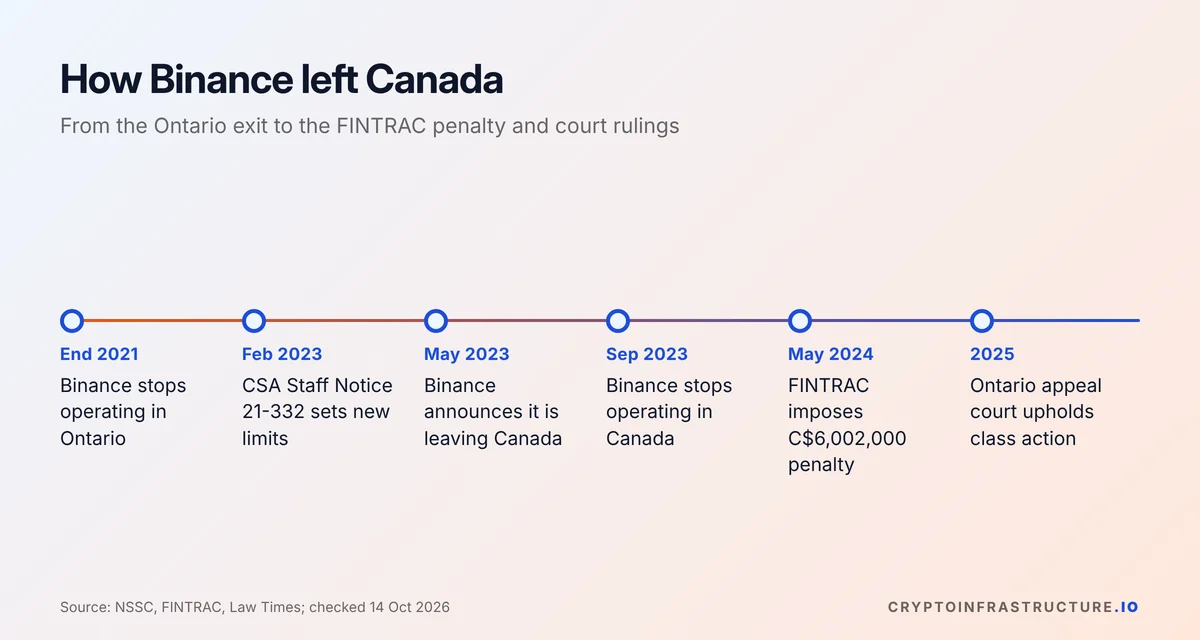
Timeline: Binance and Canadian regulators
| Date | What happened | Source |
|---|---|---|
| 13 September 2019 | Start of the class period in the Ontario class action over Binance crypto derivatives | Lochan v. Binance, Court of Appeal for Ontario (Law Times, 7 April 2025) |
| 29 March 2021 | CSA and IIROC publish a joint notice on how securities law applies to crypto trading platforms | CSA news release, 15 August 2022 |
| 1 June 2021 to 19 July 2023 | Period in which FINTRAC says Binance failed to report 5,902 large virtual currency transactions of C$10,000 or more | FINTRAC penalty notice, 9 May 2024 |
| End of 2021 | Binance stops operating in Ontario | Nova Scotia Securities Commission, 5 July 2023 |
| June 2022 | Proposed class action filed in Ontario under s. 133 of the Ontario Securities Act | Legal500 summary, 6 November 2024 |
| 15 August 2022 | CSA says operating platforms seeking registration must provide a pre-registration undertaking | CSA news release, 15 August 2022 |
| 22 February 2023 | CSA Staff Notice 21-332 sets enhanced undertaking terms, including stablecoin and investor limits | Nova Scotia Securities Commission, 5 July 2023 |
| 12 May 2023 | Binance announces it is withdrawing from Canada | Binance statement via Reuters and Forbes, May 2023 |
| 25 September 2023 | Binance stops operating in Canada, per FINTRAC | FINTRAC penalty notice, 9 May 2024 |
| April 2024 | Ontario Superior Court of Justice certifies the class action against Binance Holdings | Advisor.ca, 22 April 2024 |
| 7 May 2024 | FINTRAC imposes a C$6,002,000 penalty on Binance Holdings Limited. Binance appeals to the Federal Court | FINTRAC penalty notice, 9 May 2024 |
| 2024 (reported 6 November 2024) | Court of Appeal for Ontario upholds the refusal to send the claim to arbitration, finding Binance’s arbitration clause void as contrary to public policy and unconscionable | Legal500 summary, 6 November 2024 |
| 2025 (reported 7 April 2025) | Court of Appeal for Ontario dismisses Binance’s appeal and upholds certification (2025 ONCA 221) | Law Times, 7 April 2025 |
| May 2025 (reported 22 May 2025) | Supreme Court of Canada denies Binance leave to appeal the arbitration ruling | Supreme Court of Canada docket 41615; Investment Executive |
| 18 August 2026 | Binance’s app support page lists Canada as “Available”, with no Canadian registration named | Binance supported regions page |
| 18 September 2026 | Latest update of the CSA authorized platforms list. No Binance entity on it | CSA |
All entries checked 14 October 2026. No public decision on Binance’s Federal Court appeal of the FINTRAC penalty was found when checked.
The FINTRAC penalty: what Binance was fined for
FINTRAC (the Financial Transactions and Reports Analysis Centre of Canada) supervises anti-money laundering compliance, separately from the provincial securities regulators. Its penalty notice of 9 May 2024 sets out two violations by Binance Holdings Limited, which it describes as a foreign money services business:
| Violation | What FINTRAC found |
|---|---|
| Failure to register with FINTRAC (PCMLTFA s. 11.1) | Binance was required to be registered as a foreign money services business until 25 September 2023, when it stopped operating in Canada |
| Failure to report large virtual currency transactions (PCMLTF Regulations para. 30(1)(f)) | 5,902 transactions of C$10,000 or more not reported between 1 June 2021 and 19 July 2023, identified with blockchain analytics |
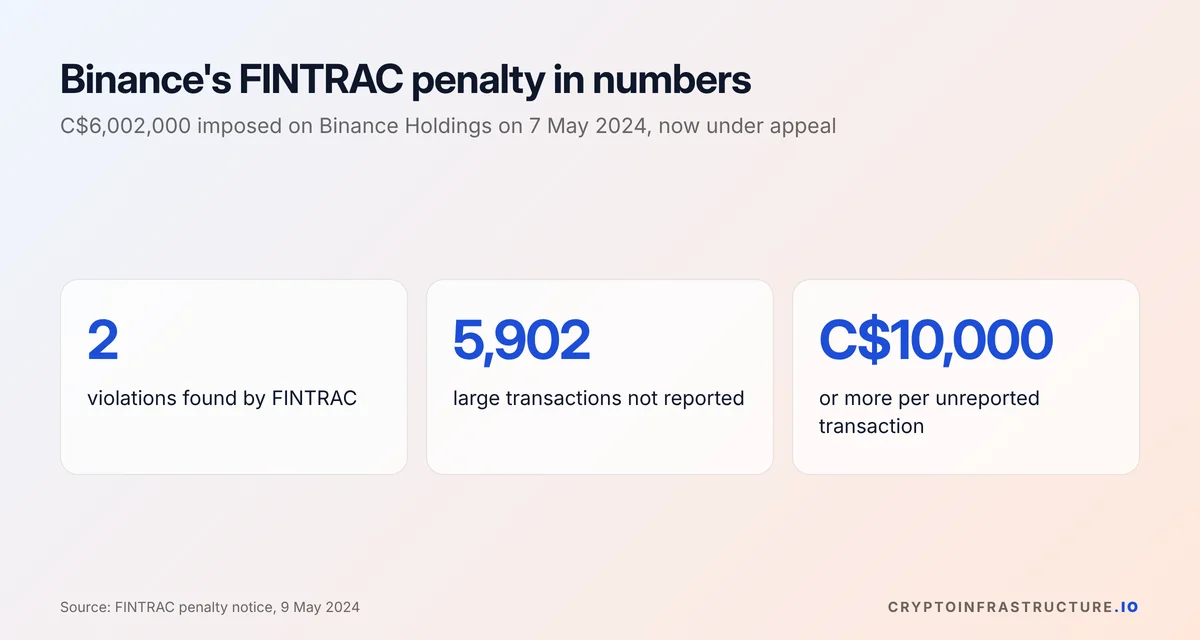
Total penalty: C$6,002,000, imposed on 7 May 2024. FINTRAC’s notice states that Binance has appealed the decision to the Federal Court. It is sometimes quoted as “US$4.4 million”, which is a conversion at the time; the penalty itself is in Canadian dollars.
The registration point matters for you. A platform registered as a money services business with FINTRAC is not the same as one registered with a securities regulator. The Financial Consumer Agency of Canada warns that some platforms claim to be “registered businesses” when that “isn’t the same as being registered with a securities regulator.” To serve Canadians, a crypto trading platform needs both.
The Ontario class action against Binance
If you traded Binance crypto derivatives from Canada, this is the case to know. In Lochan v. Binance Holdings Limited, investors allege Binance traded securities in Canada without registering and distributed them without a prospectus, contrary to sections 53(1) and 71(1) of Ontario’s Securities Act and equivalent laws elsewhere, and seek rescission or damages. The allegations have not been proven.
- Class: investors who bought Binance crypto derivative products from 13 September 2019 to the certification date (Law Times, 7 April 2025).
- Arbitration: Binance’s terms required arbitration in Hong Kong, where the minimum cost was almost C$37,000 before travel and legal fees. The Court of Appeal for Ontario agreed the clause was void as contrary to public policy and unconscionable (Legal500, 6 November 2024), and in May 2025 the Supreme Court of Canada denied Binance leave to appeal that ruling, closing the arbitration route.
- Certification: the Ontario Superior Court certified the class action (reported 22 April 2024) and the Court of Appeal upheld that in 2025 ONCA 221 (reported 7 April 2025).
No trial outcome or settlement was found when checked on 14 October 2026.
What replaced Binance: the CSA-authorized platforms
The platforms Canadians now use are those that completed registration. The CSA list “Crypto Platforms Authorized to Do Business with Canadians” named these 19 entities when checked on 14 October 2026 (list last updated 18 September 2026). This is a factual list from the regulator, not a recommendation, and inclusion is not an endorsement of any platform’s security or fees.
| Entity (brand) | Type listed by the CSA | Scope or condition noted by the CSA |
|---|---|---|
| APX Inc. | Crypto-backed lending platform | None noted |
| Coinbase Canada Inc. | Crypto asset trading platform | None noted |
| Coinsquare Capital Markets Limited | Crypto asset trading platform | None noted |
| Cybrid Canada Inc. | Crypto asset trading platform | Ontario only |
| Fidelity Clearing Canada ULC | Crypto asset trading platform | None noted |
| Fidelity Digital Assets Services | Exempt marketplace and clearing agency | None noted |
| Foris DAX CAN ULC (Crypto.com) | Crypto asset trading platform | None noted |
| Hibit Technology Ltd. | Crypto asset trading platform | Alberta, BC, Manitoba and Saskatchewan only |
| Payward Canada Inc. (Kraken) | Crypto asset trading platform | None noted |
| Ndax Canada Inc. | Crypto asset trading platform | None noted |
| Netcoins Inc. | Crypto asset trading platform | None noted |
| Newton Crypto Ltd. | Crypto asset trading platform | None noted |
| Satstreet Inc. | Crypto asset trading platform | Ontario, Alberta, BC, Manitoba, Québec and Saskatchewan only |
| Shakepay Inc. | Crypto asset trading platform | None noted |
| Shakepay Credit Inc. | Crypto-backed lending platform | None noted |
| VirgoCX | Crypto asset trading platform | Subject to terms requiring wind-down of registrable business |
| Wealthsimple Investments Inc. | Crypto asset trading platform | None noted |
| Webull Canada Crypto Limited | Crypto asset trading platform | None noted |
| zerohash llc | Immediate delivery VRCA (stablecoin) trading platform | None noted |
Source: CSA authorized platforms list, last updated 18 September 2026, checked 14 October 2026. Fifteen of the 19 are listed as crypto asset trading platforms.
Two other CSA lists complete the picture. Platforms still operating under a pre-registration undertaking, as of 17 July 2026: DigiFinex (undertaking dated 24 March 2023) and Uphold (undertaking dated 27 March 2023, with a notice of withdrawal delivered on 29 May 2025). Binance is on neither of these lists. Older alternatives lists still name platforms, such as Bitbuy or Coinberry, that do not appear under those names on the September 2026 CSA list. Check the current list rather than any article, this one included.
How to check a platform yourself
- Find the platform’s legal entity name (usually in its footer or terms), not just the brand.
- Look for that entity on the CSA authorized platforms list, or search it in the CSA National Registration Search, which the Financial Consumer Agency of Canada points to.
- Check the CSA banned platforms list for the brand.
- Read the platform’s own disclosure. Coinbase’s Canadian site, for example, states that Coinbase Canada, Inc. is a Restricted Dealer in all provinces and territories and is registered with FINTRAC as a money services business (checked 14 October 2026).
- Remember that registration does not bring deposit insurance. The Financial Consumer Agency of Canada says federal and provincial deposit insurance plans do not cover crypto assets.
Is Binance coming back to Canada?
There is no public sign of it as of 14 October 2026. Binance said in May 2023 that it hoped to return, but no Binance entity has filed a pre-registration undertaking or been added to the CSA’s authorized list, and its FINTRAC penalty appeal and the Ontario class action are both unresolved as far as public records checked show. Any return would mean registering with Canadian securities regulators under the same rules it declined in 2023. Until a CSA decision names a Binance entity, treat claims that Binance “is back in Canada” as unverified.
Is crypto legal and taxed in Canada?
Yes to both. None of the regulator pages checked for this article makes buying, holding or selling crypto an offence for an individual, and the Financial Consumer Agency of Canada notes that crypto is not legal tender (page modified 27 November 2025). The FCAC says tax rules apply to crypto transactions, and using an unregistered or offshore exchange does not change your obligations. If you used Binance before 2023, you still need records of those trades for your tax filings. The Canadian rules are covered in How Is Crypto Taxed?.
Is Binance safe?
For a Canadian these questions come after the legal one: Binance is not registered to serve you, so the comparison with a registered platform is uneven from the start. Binance’s wider record, including its settlements, licences elsewhere and security history, is in Is Binance Safe?, and the platform-by-platform comparison is in Coinbase vs Binance. Coverage of its Canadian exit described Binance as the world’s largest crypto exchange, but size is not a registration.
Canada is not the only country where the answer depends on the regulator. For how the same exchange stands elsewhere, see Is Binance Legal in the UK? and Is Binance Legal in India?.
What this means for you
As of 14 October 2026, owning crypto is legal in Canada, but Binance is not registered with any Canadian securities regulator, is not on the CSA’s authorized or pre-registration lists, and stopped operating in Canada on 25 September 2023 according to FINTRAC. Binance appealed its C$6,002,000 FINTRAC penalty to the Federal Court, with no decision found when checked, and the Ontario class action over its crypto derivatives has been certified. If you want a Canadian platform, start from the CSA list rather than from any article, check the legal entity name, and keep your own trade records for tax. Treat any headline about Binance returning as a plan until a CSA decision says otherwise.
For more on exchanges, browse the Exchanges section and read how this site assesses providers in its methodology.
This guide is general information, not legal advice. Licensing requirements change and depend on your structure; take advice from a regulated lawyer before acting. See the site’s disclaimer.