Whether Gemini is safe enough for you depends on what you need protected. As of 14 October 2026 the evidence is: a New York limited purpose trust charter for Gemini Trust Company, money transmitter licences across most US states, annual SOC 1 Type 2 and SOC 2 Type 2 exams by Deloitte, and quarterly SEC filings since its September 2025 Nasdaq listing. But most US customers now contract with Gemini Moonbase, LLC, a Florida-headquartered company, not the New York trust company.
Gemini’s Earn product froze about $900 million of customer crypto in 2022, it paid a $37 million NYDFS penalty in 2024, and it reported a $216.7 million net loss for the first half of 2026. Gemini says your digital assets “are not 100% insured”, and neither FDIC nor SIPC covers them. The “most regulated US exchange” label does not hold up against the regulator registers.
“Is Gemini safe?” is usually asked by someone choosing a US exchange, or by someone who remembers that Gemini customers once could not get their crypto back. Most answers lead with Gemini’s New York charter and a list of security certificates, and many still describe Gemini as “one of the most heavily regulated” exchanges. That is only part of the picture in 2026. This guide checks Gemini on the same six points this site uses for every exchange: licences, proof of reserves and audits, custody terms, insurance, incident and enforcement history, and the risk that stays with you. It also tests the claim in the title, that Gemini is the most regulated exchange in the US.
Is Gemini safe? The short answer
No exchange can be called safe outright, and Gemini is no exception. What you can check is the evidence. As of 14 October 2026, Gemini is a US-listed, state-regulated exchange that publishes more independent control reports than most of its peers, and no theft from its own wallets was found in the sources reviewed for this article. Against that sit the 2022 Earn freeze, a 2024 NYDFS finding that it failed to vet the lender holding Earn customers’ crypto, a shrinking business that is closing its UK, EU and Australian operations, and insurance that, by Gemini’s own terms, does not cover all digital assets or any loss from someone getting into your account.
Gemini is also not the Google AI model of the same name. This guide covers only the crypto exchange run by Gemini Space Station, Inc.
The six checks, the same ones used in the Kraken safety review:
- Licences by region, from regulator registers and Gemini’s own licence list
- Proof of reserves and audits, including what Gemini reports to the SEC
- Custody terms, labelled as company statements
- Insurance, and what it actually covers
- Incident and enforcement history, dated and sourced
- The risk that remains for you
These map onto the site’s methodology criteria of track record, transparency, security practices and jurisdiction coverage.
Is Gemini the most regulated US exchange?
Not on the evidence. Gemini is heavily regulated, but the registers do not support calling it the most regulated US exchange. Here is how its main US permissions compare with Coinbase’s, as listed on 14 October 2026:
| Permission | Gemini | Coinbase |
|---|---|---|
| New York limited purpose trust charter (NYDFS) | Yes: Gemini Trust Company, LLC | Yes: Coinbase Custody Trust Company, LLC |
| New York BitLicense (virtual currency licence) | Not listed on the NYDFS register (the trust charter is a different permission) | Yes: Coinbase, Inc., licence 122466, plus a New York money transmitter licence |
| State money transmitter licences | About 30 state licences listed for Gemini Trust Company, plus a Nevada trust company licence; Tennessee licence does not cover virtual currency | 45 states plus Washington, D.C. and Puerto Rico listed for Coinbase, Inc. |
| CFTC designated contract market | Yes: Gemini Titan, LLC (prediction markets, launched December 2025) | Yes: Coinbase Derivatives, LLC |
| SEC reporting company | Yes, Nasdaq: GEMI, since September 2025 | Yes |
Checked 14 October 2026 against the NYDFS list of regulated virtual currency entities, Gemini’s Trust Center licence list and Coinbase’s US licences page. The Gemini state count is the number of states with a licence number shown on its Trust Center.
The trust charter is the strongest single permission Gemini holds. NYDFS lists Gemini Trust Company as a limited purpose trust company, and Gemini’s Trust Center describes it as “a fiduciary and qualified custodian under the New York Banking Law”. But 13 companies hold that same charter on the NYDFS list, Coinbase among them. Coinbase also holds a BitLicense that Gemini does not appear to need, and a longer published list of state licences. Other exchanges hold different kinds of charter again, as the Kraken vs Gemini comparison shows. “One of the more heavily regulated US exchanges” is fair. “The most regulated” is a marketing line, not a finding.
Which Gemini company actually holds your account?
This matters more than the charter. Gemini’s user agreement page, dated 19 February 2026, splits US customers by the state in their account profile:
- Gemini Trust Company, LLC, the New York trust company: residents of Idaho, Louisiana, New York, Ohio and Texas.
- Gemini Moonbase, LLC: residents of the other states listed, from Alabama to Wyoming, plus Washington, D.C. and Puerto Rico.
The Moonbase agreement (dated 21 August 2026) describes it as “a Delaware limited liability company headquartered in Florida”, subject to FinCEN money services business rules and state money transmission and virtual currency laws. Gemini’s Trust Center lists Moonbase (NMLS 2403509) under its licences, but shows no individual licence numbers for it. So if you live outside those five states, Gemini’s famous New York trust charter is not the legal home of your account. Read the Moonbase agreement, not the trust company’s.
Outside the US
Gemini announced on 5 February 2026 a plan to wind down its operations in the UK, the EU, other European jurisdictions and Australia, with about 200 jobs cut, according to its 10-Q for the quarter to 30 June 2026. CryptoSlate’s review reports that UK, EEA and Australian customer accounts were closed effective 6 April 2026. If you live in those regions, Gemini is no longer an option, whatever older reviews say about its European licences.
Does Gemini have proof of reserves?
Not in the Merkle-tree form that lets you check your own balance is included. Gemini’s Trust Center (checked 14 October 2026) relies on audits and statements instead:
| Item | What Gemini publishes |
|---|---|
| Reserve statement | Gemini calls itself “a full-reserve exchange and custodian” and says “all customer funds held on Gemini are held 1:1 and available for withdrawal at any time” |
| Merkle-tree proof of reserves | None published |
| SOC 1 Type 2 | Six annual periods from 1 October 2019 to 30 September 2025, conducted by Deloitte |
| SOC 2 Type 2 | The same six periods, plus 1 January to 30 September 2019, conducted by Deloitte |
| Audited financial statements | December 2019 to December 2025 and June 2024 (auditor not named on the page) |
| Other certifications | ISO/IEC 27001:2022 (no date or certifying body given); PCI DSS attestation for card payments |
| Capital rules | NYDFS requires the trust company to hold capital above customer deposits and report material changes |
A SOC 2 Type 2 report tests whether a company’s controls, such as access and change management, worked over a period. It is a meaningful signal, and Gemini’s run of reports is longer than most exchanges publish. It does not prove that customer balances were fully backed on any given day. A Merkle-tree proof of reserves is narrower, but it does that one job, and Gemini does not offer one.
Is Gemini exchange losing money?
Yes, as a company. Gemini Space Station, Inc. reported a net loss of $107.7 million for the quarter to 30 June 2026 and $216.7 million for the six months, with an accumulated deficit of about $2.26 billion, according to its 10-Q. Customer custodial (fiat) funds fell to $454.7 million at 30 June 2026 from $527.4 million at 31 December 2025. The company also relies on loans from Winklevoss Capital Fund, LLC, a related party, and on secured funding from Galaxy Digital and Ripple, per the same filing.
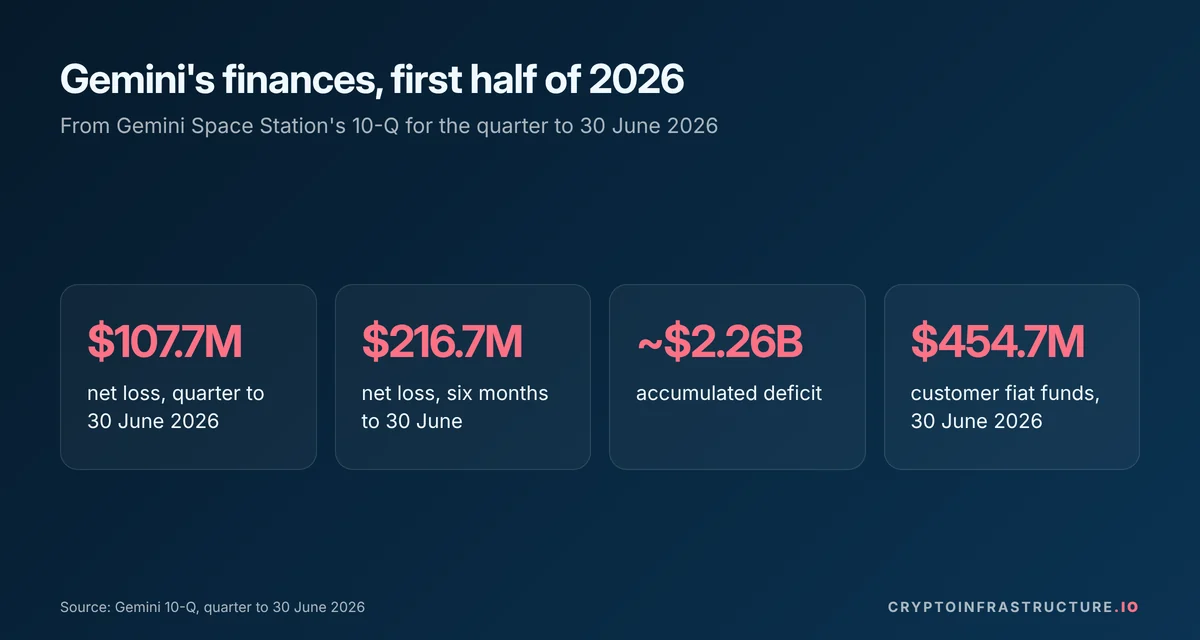
A company loss does not mean customer assets are missing; Gemini says customer funds are held 1:1 and separately from its own. It does tell you about the business you are trusting with your balance, and in 2026 that business is shrinking.
Custody: what Gemini says about your crypto
Everything in this section comes from Gemini’s own user agreements and Trust Center, not from an independent check.
- Ownership: both the Trust Company and Moonbase agreements say “You retain full title to your Digital Assets at all times”, and that assets held for you “are not treated as general assets of Gemini”.
- Pooled wallets: “Gemini holds your Digital Assets in an omnibus Digital Asset Account.” Only the optional Custody Account uses segregated wallets. In an omnibus account your coins sit alongside other customers’ and your share is tracked on Gemini’s ledger.
- Segregation from Gemini’s money: the Trust Center says customer fiat and digital assets are held in accounts segregated from Gemini’s own, and that Gemini does nothing with them unless you authorise it.
- Security interest: the Moonbase agreement gives Gemini “a first priority security interest and pledge over your Digital Assets” linked to open orders or pending transactions, and lets it liquidate other assets in your account after a default, fraud or regulatory action.
- Cash: for US dollar balances, the Moonbase agreement says the bank relationship “represents a banking relationship, not a custodial relationship, between each Bank and Gemini”.
None of the agreements reviewed sets out what would happen to customer assets if Gemini became insolvent. “Not general assets of Gemini” is a contractual statement; a bankruptcy court would decide how it applies.
Is Gemini FDIC insured? What its insurance covers
Your crypto is not FDIC insured, and the insurance Gemini does carry is limited. From the Trust Company and Moonbase user agreements, checked 14 October 2026:
- Crypto: “Digital Assets are not subject to or insured by the Federal Deposit Insurance Corporation”, and not covered by SIPC either.
- US dollar balances: may be eligible for FDIC “pass-through” insurance up to the standard maximum, “currently $250,000 per eligible Gemini Customer”, if a partner bank fails. Pass-through insurance protects against bank failure, not Gemini failure, and “does not cover any losses resulting from any unauthorized access to your User Account”.
- Crime and specie insurance: Gemini says it maintains commercial crime and specie insurance “for a specified amount of Digital Assets”. It covers theft from “a direct security breach or hack of Gemini’s systems”, fraudulent transfers by Gemini and theft by a Gemini employee. The amount is not stated, and the agreement says plainly that “Digital Assets are not 100% insured”.
- Your account: the policy “does not cover any losses resulting from any unauthorized access to your User Account”. If someone phishes your login and empties your account, Gemini’s insurance does not pay.
Some ranking pages quote a “$125 million hot wallet insurance” figure and a “95% cold storage” share. Neither number appears in Gemini’s user agreements or Trust Center as checked for this article, so they are left out here.
Has Gemini ever been hacked? Incident and enforcement history
No theft from Gemini’s own wallets was found in the sources reviewed. The record that matters is Gemini Earn, the lending product that froze in 2022, and the regulatory actions that followed.
What happened with Gemini Earn and Genesis
Gemini Earn let customers lend their crypto to Genesis Global Capital in return for interest. In November 2022 Genesis halted withdrawals. The SEC said Genesis then held about $900 million of assets from 340,000 Earn investors. NYDFS says Genesis defaulted on about $1 billion in loans from Earn customers and filed for bankruptcy two months later, leaving over 200,000 customers, almost 30,000 of them New Yorkers, unable to reach their crypto.
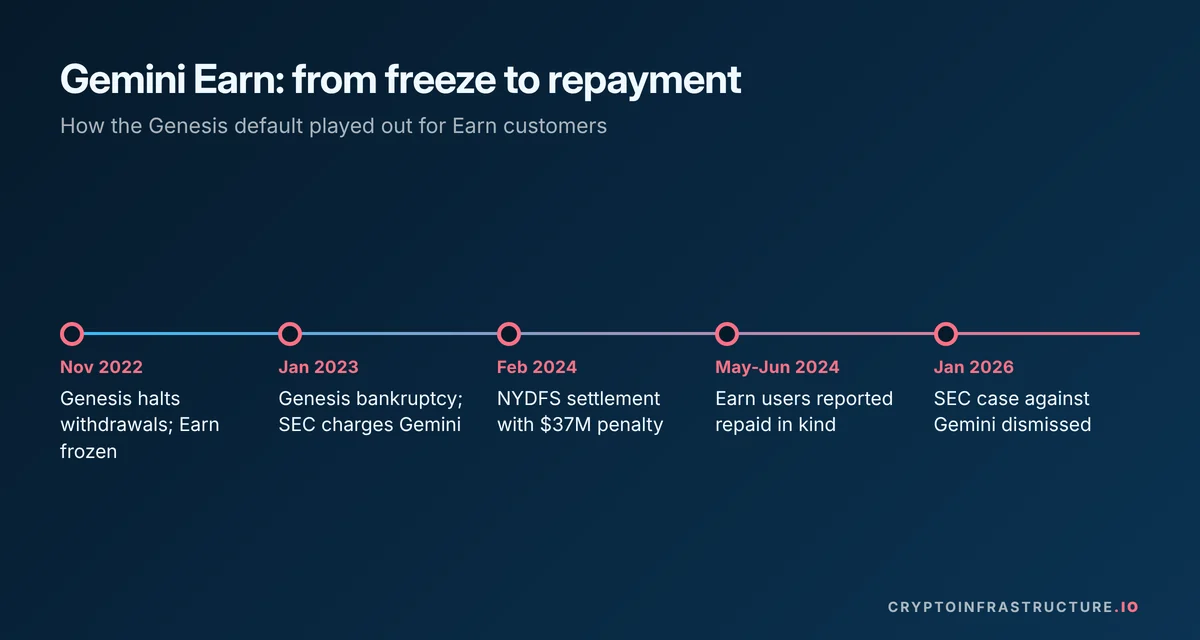
| Date | Regulator or event | What happened | Outcome |
|---|---|---|---|
| November 2022 | Genesis default | Genesis halted withdrawals and defaulted on about $1 billion of Earn loans; bankruptcy followed in January 2023 | Earn customers locked out |
| 12 January 2023 | SEC | Charged Genesis and Gemini Trust Company with the unregistered offer and sale of securities through Earn | Genesis agreed a $21 million penalty (reported 19 March 2024). The case against Gemini was dismissed in January 2026 after Earn users recovered their assets, as reported on 25 January 2026. |
| 28 February 2024 | NYDFS | Found Gemini “did not fully vet or sufficiently monitor” Genesis and failed “to maintain adequate reserves throughout the life of Earn” | Settlement: at least $1.1 billion to be returned to Earn customers through the Genesis bankruptcy, a $40 million contribution and a $37 million penalty |
| May to June 2024 | Return of assets | Earn users were reported to have been repaid in kind, in the crypto they had lent | Completed, per reports at the time of the SEC dismissal |
| 2 June 2022 to 6 January 2025 | CFTC | Lawsuit against Gemini Trust Company over statements to CFTC staff | $5.0 million penalty by consent order, without admitting or denying; joint motion to vacate the order filed 27 May 2026, pending |
| 18 March 2026 | Securities class action (SDNY) | Alleges misleading statements in Gemini’s IPO registration statement and later disclosures | Pending; two related shareholder derivative suits filed in Nevada |
| 21 April 2026 | New York Attorney General | Petition alleging Gemini Titan ran “an unlicensed gambling business” through Gemini Predictions | Pending; removed to federal court, remand motion filed 1 May 2026 |
Checked 14 October 2026 against the NYDFS and SEC releases and the commitments and contingencies note in Gemini’s 10-Q for the quarter to 30 June 2026. The SEC dismissal and the in-kind repayment are from press reports, not the court docket.
Earn is the clearest test Gemini has faced of what happens to customer assets under stress. Customers did eventually get their crypto back, but it took about 18 months, a bankruptcy and a regulator’s settlement. Gemini has since closed Earn; its current yield products are staking and “Asset Rewards”, which carry their own terms.
Why is it so hard to withdraw from Gemini?
Usually because of a hold, a verification step or a compliance review, and the user agreements give Gemini broad room to delay. The Trust Company agreement says Gemini may “freeze/lock the funds and assets” in an account when it suspects a violation, and that “Digital Asset withdrawals may be delayed”, including for “regulatory or administrative purposes”. The Moonbase agreement adds that Gemini “may implement temporary withdrawal queuing with prompt notice”, with queued withdrawals processed as liquidity becomes available. Withdrawal complaints are a common theme in the Reddit threads that rank for this search. Treat that as a signal, not evidence, but read the hold and freeze terms before you deposit money you may need quickly.
Who owns Gemini?
Gemini’s parent, Gemini Space Station, Inc., has traded on Nasdaq under the ticker GEMI since its IPO in September 2025. Its leadership page lists Tyler Winklevoss as chief executive officer and Cameron Winklevoss as president. Its 10-Q shows the company has borrowed from Winklevoss Capital Fund, LLC, a related party, and made a private placement with that fund on 14 May 2026. As a listed company, Gemini must file quarterly and annual reports with the SEC, which is why the figures in this guide can be checked.
Is Gemini legit?
Yes, in the sense that it is a real, licensed and publicly listed company, not a scam site. “Legit” is not the same as “safe”, though. Use the official domain only, since scam sites copy exchange branding. And note that Gemini’s business now goes beyond spot trading: its Gemini Predictions product, offered through Gemini Titan, is the subject of the New York Attorney General petition listed above.
Is Gemini better than Coinbase?
It depends on what you weigh most. On the registers, Coinbase has the broader US licence list, including a New York BitLicense. Gemini has the longer published run of SOC reports, and its user agreement page assigns customers in all 50 states to one of its two US companies. The full side-by-side, with fees at $100 and $10,000, is in the Coinbase vs Gemini comparison. For Kraken, see Kraken vs Gemini, and for a wider shortlist the best US crypto exchanges ranking.
Can you lose your crypto on Gemini?
Yes, in several ways that nothing above removes:
- Exchange failure: there is no FDIC or SIPC cover for crypto, insurance covers only a “specified amount”, and the agreements do not say how an insolvency would be handled.
- Third-party risk in yield products: Earn showed that crypto you lend through the platform is exposed to the borrower, not just to Gemini.
- Account takeover: Gemini’s insurance and FDIC pass-through both exclude losses from unauthorised access to your account.
- Delays and freezes: the agreements let Gemini lock accounts, delay withdrawals and queue them.
- Regional exit: if you live in a market Gemini leaves, as UK, EU and Australian customers did in 2026, you have to move your assets on its timetable.
How to reduce the risk you control
- Check which entity holds your account. If you live outside Idaho, Louisiana, New York, Ohio or Texas, read the Moonbase agreement.
- Use the strongest login protection offered, such as a hardware security key, since insurance does not cover account takeover.
- Whitelist withdrawal addresses where the setting is available, so a stolen session cannot send funds to a new address.
- Read the terms of any yield product before opting in, including who holds your assets and whether you can withdraw at any time.
- Keep only what you are actively trading on the exchange. Move long-term holdings to a wallet you control, and learn how to store your seed phrase first, since that responsibility then becomes yours.
What this means for you
As of 14 October 2026, Gemini publishes a lot of checkable evidence: a New York trust charter for part of its business, a long run of Deloitte SOC 1 and SOC 2 Type 2 exams, audited financials and quarterly SEC filings. It is not the most regulated US exchange on the registers, and for most US customers the account sits with Gemini Moonbase, not the trust company.
Its record includes the Earn freeze and a $37 million NYDFS penalty for failing to vet the lender behind it, a $5 million CFTC penalty now subject to a motion to vacate, and pending suits over its IPO disclosures and its prediction markets. It is losing money and closing markets outside the US. Your crypto has no FDIC cover and only partial insurance that excludes account takeover. The risk that remains is counterparty risk: you are trusting Gemini’s solvency, controls and judgement with whatever you leave on it, so size that balance to the trust the evidence supports.
For the same evidence check on other platforms, see Is Coinbase Safe?, Is Kraken Safe? or the Exchanges section.