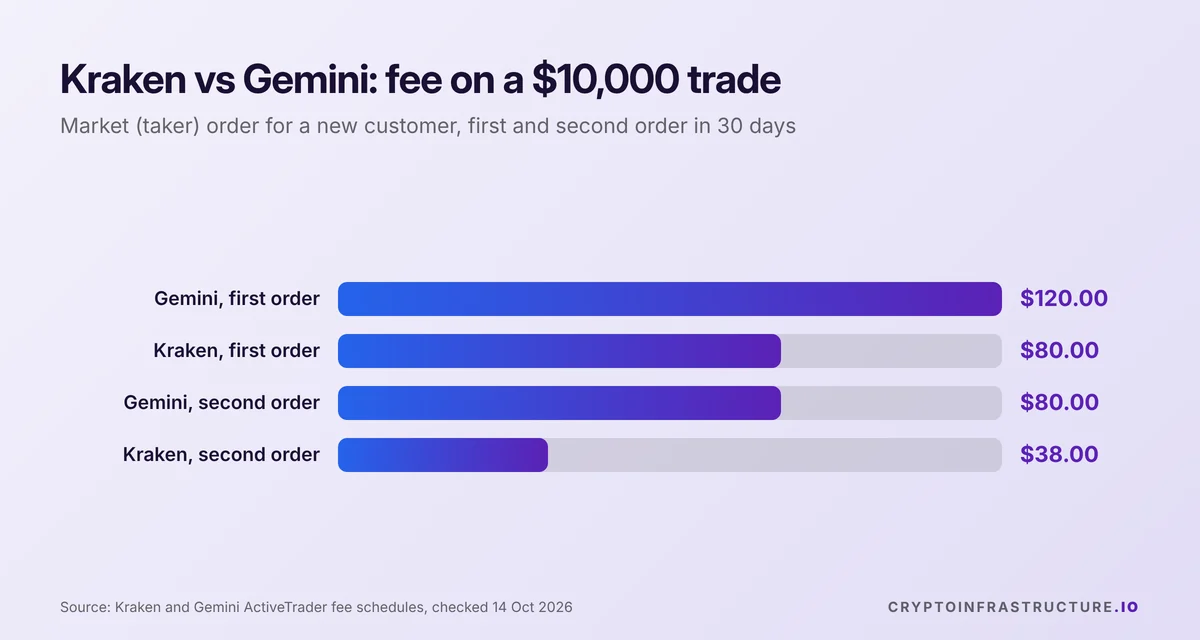
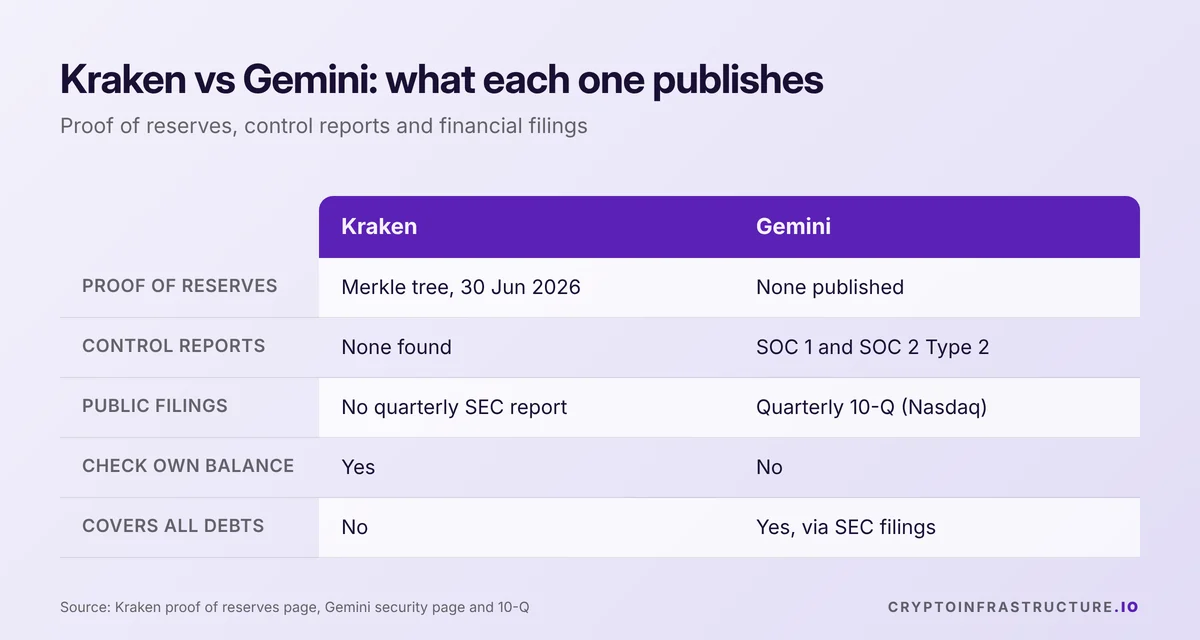
Kraken vs Gemini has no single winner. As of 14 October 2026, a new customer on Kraken Pro pays 0.40% maker and 0.80% taker, against 0.60% and 1.20% on Gemini ActiveTrader, so a $10,000 market order costs $80 on Kraken and $120 on Gemini at the entry tier. Kraken publishes a Merkle-tree proof of reserves (latest snapshot 30 June 2026); Gemini does not, and instead points to SOC 1 and SOC 2 Type 2 reports and its quarterly SEC filings as a Nasdaq-listed company.
Gemini serves all 50 states, but its New York trust company now holds accounts only for residents of Idaho, Louisiana, New York, Ohio and Texas; everyone else in the US is with Gemini Moonbase, LLC. Kraken does not serve New York or Maine. Gemini’s record is dominated by the 2022 Earn freeze and a 2024 NYDFS settlement; Kraken’s by a $30 million SEC staking settlement in 2023 and an April 2026 extortion attempt over leaked support data. Neither insures your exchange balance like a bank deposit.
If you are choosing between Kraken and Gemini, most pages you will read say Kraken is for active traders and Gemini for beginners who want a heavily regulated US exchange. That framing hides the details that decide your costs and protections. Gemini’s published trading fees are higher than many comparisons quote, most US Gemini accounts are no longer held by its New York trust company, and Gemini is closing accounts in the UK, EU and Australia.
This comparison puts the two exchanges side by side on the criteria in this site’s methodology: licences by region, proof of reserves and filings, dated fees with a worked example, where you can use each one, and every incident and enforcement action checked. It does not pick a winner. It shows which one fits which kind of user, and why.
Kraken vs Gemini: the short answer
Kraken and Gemini are both US-headquartered exchanges regulated as money transmitters in most US states. As of 14 October 2026, Kraken is cheaper at every published tier up to $10,000 in monthly volume, offers far more assets, and publishes a proof of reserves you can check your own balance against. Gemini serves every US state including New York, publishes independent control reports, and files quarterly accounts with the SEC, but its business is shrinking and it is leaving the UK, EU and Australia. Kraken does not serve New York or Maine. Which matters more depends on where you live, how you trade and what evidence you want before you trust an exchange with your balance.
Side-by-side: Kraken vs Gemini at a glance
Each row summarises evidence set out in the sections below. Read the section before relying on any one cell.
| Criterion | Kraken | Gemini |
|---|---|---|
| US operating entity | Payward Interactive, Inc. (NMLS 1843762) | Gemini Moonbase, LLC (NMLS 2403509) for most states; Gemini Trust Company, LLC (NMLS 1518126) for ID, LA, NY, OH and TX |
| New York | Not served (New York and Maine residents excluded) | Served by Gemini Trust Company, a New York trust company supervised by NYDFS |
| EU and UK | Crypto-asset service providers regulated by the Central Bank of Ireland; FCA cryptoasset registration since 22 November 2021 | Closing all UK and EEA customer accounts, effective 6 April 2026 |
| Entry-tier order-book fee | 0.40% maker, 0.80% taker (Kraken Pro) | 0.60% maker, 1.20% taker (ActiveTrader, schedule dated 1 September 2026) |
| App buy fee | 1% on instant and recurring buys, 1.5% on custom orders, plus spread | Variable, shown before you confirm, plus spread |
| Proof of reserves | Merkle tree; snapshot 30 June 2026, 100.3% to 102.9% on the main coins listed | None published; SOC 1 and SOC 2 Type 2 reports and quarterly SEC filings instead |
| Assets | “Hundreds of cryptocurrencies” (Kraken) | 79 on Gemini’s supported list, some for Moonbase customers only |
| Biggest incident | April 2026 extortion attempt after insider-linked access to support data on about 2,000 accounts | 2022 Earn freeze; NYDFS settlement in 2024 committed at least $1.1 billion back to Earn customers |
| Largest penalty checked | $30 million SEC staking settlement (2023) | $37 million NYDFS penalty plus $40 million contribution (2024) |
All entries checked 14 October 2026 against each exchange’s licence, fee, availability and reserve pages, Gemini’s user agreement and 10-Q, and regulator releases.
How this comparison works
The criteria come from the site’s methodology: track record, transparency, security practices, pricing clarity and jurisdiction coverage. For an exchange comparison they become six checks, applied to both exchanges in the same order:
- Fees, from each exchange’s own fee schedule, with a worked example at $100 and $10,000
- Licences and regulators by region, from each exchange’s legal pages and user agreement
- Proof of reserves and filings: what each one publishes and its limits
- Custody and insurance, labelled as company statements
- Where you can use each one and what you can trade
- Incident and enforcement history, dated and sourced
There was no hands-on testing, and neither exchange paid to be included. There are no affiliate links on this page. The same structure is used in the Coinbase vs Gemini and Coinbase vs Kraken comparisons.
Kraken vs Gemini fees (checked 14 October 2026)
Both exchanges run two pricing systems. The simple app screens (the Kraken app, Gemini’s standard app) price your order with a fee plus a spread built into the quote. The order-book platforms (Kraken Pro, Gemini ActiveTrader) charge published maker and taker rates. A maker order adds liquidity, usually a limit order that rests on the book; a taker order removes it, usually a market order.
| Fee | Kraken | Gemini |
|---|---|---|
| Entry tier, maker / taker | 0.40% / 0.80% ($0+ 30-day volume) | 0.60% / 1.20% ($0+) |
| Next tiers | $2,500+: 0.30% / 0.60%; $10,000+: 0.22% / 0.38%; $25,000+: 0.20% / 0.35% | $10,000+: 0.40% / 0.80%; $25,000+: 0.25% / 0.50% |
| How tiers qualify | 30-day spot volume or assets on platform, whichever gives the higher tier | 30-day volume or USD asset balance, whichever gives the lower fee |
| Stablecoin pairs | 0.20% / 0.20% at entry tier for stablecoin-base and FX pairs | 0% on RLUSD/USD, USDC/GUSD and GUSD/USD; 0% / 0.01% on other stablecoin pairs |
| App buy | 1% on instant and recurring trades, 1.5% on custom orders, plus payment fee and spread; Kraken+ waives the trading fee on up to $10,000 a month | Calculated when you place the order and shown on the review screen; depends on payment method, size, asset and jurisdiction; spread included |
| Deposits | Vary by method; shown before you confirm | ACH and wire free; debit card 3.49% |
| Date on the source | None shown | ActiveTrader 1 September 2026; app fees 15 February 2026; transfers 20 January 2026 |
From the Kraken fee schedule and the Gemini ActiveTrader fee schedule, plus Gemini’s app and transfer fee schedules, all checked 14 October 2026. Kraken’s page shows no effective date; confirm the rate in your own account before you trade.
Worked example: $100 and $10,000
Assumptions: a new customer with no 30-day trading volume, buying bitcoin with US dollars already in the account, so no deposit fee applies. The figures are the trading fee only. On the order book there is no added spread, but the price you get depends on market depth; withdrawal network fees are extra.
| Order | Kraken Pro | Gemini ActiveTrader |
|---|---|---|
| $100 market order (taker) | $0.80 (0.80%) | $1.20 (1.20%) |
| $100 resting limit order (maker) | $0.40 (0.40%) | $0.60 (0.60%) |
| $10,000 market order (taker) | $80.00 (0.80%) | $120.00 (1.20%) |
| $10,000 resting limit order (maker) | $40.00 (0.40%) | $60.00 (0.60%) |
| A second $10,000 market order in the same 30 days | $38.00 (0.38%, $10,000+ tier) | $80.00 (0.80%, $10,000+ tier) |
The gap widens after your first large trade, because Kraken’s $10,000 tier drops further than Gemini’s. Through the apps, a $100 instant buy on Kraken costs $1.00 plus spread and a $10,000 buy costs $100 plus spread, unless you pay for Kraken+. Gemini does not publish a fixed app fee, so the only way to compare is the total in each order preview. If you fund a Gemini purchase by debit card, add 3.49%.
What are the fees for using Gemini?
On ActiveTrader, 0.60% maker and 1.20% taker for a new account, falling to 0.40% and 0.80% from $10,000 of 30-day volume, per the schedule dated 1 September 2026. Several stablecoin pairs trade free. In the standard app, the fee is set at order time and shown before you confirm, with a spread in the quoted price. ACH deposits and withdrawals are free; debit card deposits cost 3.49%; crypto withdrawals carry a network fee that Gemini says it passes on.
Is Kraken cheaper than Gemini?
On the published order-book rates checked on 14 October 2026, yes, at every tier up to $25,000 of monthly volume. Many ranking pages quote Gemini ActiveTrader at 0% to 0.40%, or about 0.03% to 0.40%. Those are its high-volume rates; a new account starts at 0.60% and 1.20%. Gemini is cheaper only on its zero-fee stablecoin pairs, which matters if you mostly move between stablecoins and dollars.
Licences and regulators by region (checked 14 October 2026)
For many readers this table decides more than fees do. It shows the entity that serves each region and who supervises it.
| Region | Kraken | Gemini |
|---|---|---|
| United States | Payward Interactive, Inc. is a FinCEN-registered money services business with state money transmitter licences. Its California Digital Financial Assets Law licence is pending, and it says it may operate there during review. Payward Financial, Inc. holds a Wyoming special purpose depository institution charter. | Gemini Moonbase, LLC holds accounts for residents of 45 states plus DC and Puerto Rico. Gemini Trust Company, LLC holds accounts for residents of Idaho, Louisiana, New York, Ohio and Texas. |
| New York | Not served. Kraken’s restrictions article (updated 30 September 2026) excludes New York and Maine residents. | Served through Gemini Trust Company, LLC, a New York trust company supervised by NYDFS |
| European Union | Payward Europe Solutions Limited and Payward Global Solutions Limited are crypto-asset service providers regulated by the Central Bank of Ireland; derivatives through a CySEC-licensed entity (licence 342/17) | Closing all EEA customer accounts, effective 6 April 2026 |
| United Kingdom | Payward Limited registered with the FCA as a cryptoasset business from 22 November 2021; Payward Services Limited is an FCA e-money institution (FRN 1010381) | Closing all UK customer accounts, effective 6 April 2026 |
| Australia | Bit Trade Pty Ltd is registered with AUSTRAC and states it holds no Australian financial services licence for its exchange | Closing Australian accounts, per its availability page |
| Singapore | Kraken states it is not licensed or regulated in Singapore | Singapore is on Gemini’s availability list, and its transfer schedule includes SGD transfers |
Sources: Kraken legal disclosures (last updated 11 August 2026) and its geographic restrictions article (updated 30 September 2026); the Gemini user agreement page (last updated 19 February 2026) and Gemini’s areas-of-availability page. All checked 14 October 2026.
Which Gemini company holds your account?
Gemini’s reputation rests on its New York trust charter, and comparison pages still describe Gemini simply as a New York trust company. Gemini’s own user agreement page, last updated 19 February 2026, splits US customers by the state on their profile. Residents of Idaho, Louisiana, New York, Ohio and Texas are under the Gemini Trust Company user agreement. Residents of every other state, DC and Puerto Rico are under the Gemini Moonbase, LLC agreement. Some assets on Gemini’s list, such as BNB, HYPE, TRX and WLFI, are only offered to Moonbase customers. If you live outside those five states, read the Moonbase agreement rather than assuming trust company rules apply to you.
Is Kraken available in every US state?
No. As of 30 September 2026 Kraken does not serve residents of New York or Maine, and some features are narrower in a few other states: no crypto transfers in Indiana, and no fiat transfers in Indiana, Louisiana, Massachusetts and Utah, per its restrictions article. Some pages, including a source Google cites in its answer for this search, also list Washington as excluded; Kraken’s current article does not.
Proof of reserves, filings and custody
Neither exchange’s security can be tested from outside. What you can compare is what each one publishes, and the two take different approaches.
| Item | Kraken | Gemini |
|---|---|---|
| Proof of reserves | Merkle-tree proof by an unnamed independent third-party accountant | None published |
| Latest snapshot | 30 June 2026: BTC 102.9%, ETH 100.5%, SOL 100.6%, XRP 102.3%, ADA 100.3%; USDC, USDT and USDG 105%+ | Not applicable |
| Control reports | None found for this article | Says it is the first crypto exchange and custodian with SOC 1 Type 2 and SOC 2 Type 2 certification; lists ISO 27001 and annual penetration testing |
| Financial reporting | No quarterly SEC report from Kraken found for this article | Nasdaq-listed (GEMI); files quarterly 10-Q reports |
| Security claim | “Kraken-managed custodial wallets have never been breached” (Kraken’s own Gemini alternatives page) | Security page lists certifications; it does not mention cold storage percentages, insurance amounts or reserves |
From the Kraken proof of reserves page, Kraken’s “Gemini alternatives” page (dated 14 April 2026), Gemini’s security page and Gemini’s 10-Q for the quarter to 30 June 2026, checked 14 October 2026. All rows are company statements.
The two approaches cover different things. Kraken’s proof lets you confirm your own balance was counted and that Kraken controlled at least that much of the listed coins on 30 June 2026. Kraken itself says the check “cannot identify any hidden encumbrances” and cannot show that funds were not borrowed to pass it. Gemini’s control reports test its internal processes, and its SEC filings cover the whole company including its debts, but neither lets you check your own balance. Neither approach is a guarantee about today.
Is Gemini losing money?
Yes, as a company. Gemini Space Station, Inc. reported a net loss of $107.7 million for the quarter to 30 June 2026 and $216.7 million for the first half of 2026, per its 10-Q. The Block reported (13 August 2026) that its quarterly trading volume fell to $3.8 billion from $11.3 billion a year earlier, and assets on the platform fell to $8.4 billion from $18.2 billion. A company loss does not mean customer assets are missing. It does tell you about the business you are trusting with your balance. Kraken’s finances could not be compared on the same basis, because no quarterly filing from Kraken was found for this article.
Is Gemini safe for crypto?
Google’s AI Overview for this question calls Gemini one of the safest exchanges, and leaves out its Earn failure. No exchange can be called safe outright. The evidence as of 14 October 2026: Gemini is supervised in New York through its trust company and licensed as a money transmitter elsewhere, publishes SOC 1 and SOC 2 Type 2 reports, and no theft from its own wallets was found in the sources checked. Against that sit the 2022 Earn freeze and the 2024 NYDFS findings that it failed to vet the borrower, a company losing money and leaving markets, and no proof of reserves. The Coinbase vs Gemini comparison covers Gemini’s filings in more detail.
Is Kraken good for crypto?
It depends on what you need. On the evidence checked: Kraken has the lower published entry fees of the two, a dated proof of reserves, licences in the EU and UK, and a Wyoming bank charter for one of its US entities. It does not serve New York or Maine, paid a $30 million SEC settlement over staking in 2023, and disclosed an extortion attempt over leaked support data in April 2026. The Kraken safety review sets out its full licence list, terms and record.
Can you lose your crypto on either exchange?
Yes. Crypto held on an exchange is not a bank deposit, and none of the pages checked for this article shows insurance covering your individual exchange balance against theft or the exchange failing. Kraken’s own disclosures note that most cryptoassets are not covered by the UK’s Financial Ombudsman Service or the FSCS. You can also lose funds to account takeover, to scammers using leaked personal data, or by sending to the wrong address or network.
What you can trade
- Gemini: 79 assets on its supported list, checked 14 October 2026, including 7 stablecoins. Ten are for Moonbase customers only, and USDT and four other tokens are not available in New York.
- Kraken: Kraken describes access to “hundreds of cryptocurrencies”; an exact count was not verified for this article. Ranking pages quote anything from 500 to 600 or more. Kraken also offers margin, futures and, in some regions, US-listed stocks.
- Stablecoins: Gemini’s zero-fee pairs on RLUSD, USDC and GUSD are the one fee area where it undercuts Kraken.
Count matters less than whether the specific asset you want is listed in your state.
Incident and enforcement history
Kraken
| Date | What happened | Outcome |
|---|---|---|
| 28 September 2021 | CFTC: Payward Ventures, Inc. offered margined retail commodity transactions in digital assets to US customers who were not eligible, from about June 2020 to July 2021, and operated as an unregistered futures commission merchant | $1.25 million civil penalty |
| 9 February 2023 | SEC: Payward Ventures, Inc. and Payward Trading Ltd. sold an unregistered staking-as-a-service programme advertising returns of up to 21% | $30 million paid, without admitting or denying; agreed to stop offering the programme (SEC release 2023-25) |
| November 2023 to March 2025 | SEC lawsuit alleging Kraken operated as an unregistered securities exchange | Dismissed with prejudice, with no penalty or admission, announced 3 March 2025 (Crypto Briefing) |
| 13 April 2026 | Kraken said criminals were trying to extort it after two insider-related instances of access to client support data, the first found in February 2025. About 2,000 accounts may have been viewed, roughly 0.02% of clients. | Kraken refused to pay. Its security chief said systems were never breached and funds were never at risk (CoinDesk, 13 April 2026) |
Gemini
| Date | What happened | Outcome |
|---|---|---|
| November 2022 to 2024 | Genesis Global Capital, which borrowed Gemini Earn customers’ crypto, defaulted on about $1 billion in loans in November 2022 and filed for bankruptcy two months later. Over 200,000 Earn customers could not access their crypto. | NYDFS settlement on 28 February 2024: at least $1.1 billion to be returned to Earn customers, a $40 million contribution and a $37 million penalty. NYDFS found Gemini failed to vet Genesis and did not keep adequate reserves. |
| 12 January 2023 | SEC charged Genesis and Gemini Trust Company over the unregistered offer of securities through Gemini Earn; the SEC said Genesis held about $900 million from roughly 340,000 Earn investors when withdrawals stopped | Later status not re-verified for this article; see the Coinbase vs Gemini comparison |
| June 2022 to January 2025 | CFTC lawsuit over statements Gemini made to CFTC staff during a registration process | $5 million penalty by consent order in January 2025. On 27 May 2026 the CFTC joined Gemini in asking the court to vacate the order’s forward-looking terms, saying the case relied on a whistleblower “known to be lacking in credibility”; the penalty stays paid (CFTC release 9236-26). |
| 5 February 2026 | Wind-down of UK, EU, other European and Australian operations, with about 200 jobs cut | UK and EEA accounts closing effective 6 April 2026 |
Checked 14 October 2026 against CFTC releases of 28 September 2021 and 27 May 2026, SEC releases 2023-7 and 2023-25, the NYDFS release of 28 February 2024, Gemini’s 10-Q for the quarter to 30 June 2026, CoinDesk and Crypto Briefing. Older and smaller actions are listed in the Kraken safety review.
The two records point to different risks. Kraken’s are about product registration and, in 2026, insiders selling access to customer data. Gemini’s biggest failure involved customer assets directly: Earn users lent their crypto to a third party Gemini had not properly vetted and waited well over a year to get it back. Leaked account data does not move your coins, but it makes you an easier target for scammers posing as support staff, so treat any unexpected call or email from either exchange as suspect.
Which fits which user
- You live in New York or Maine: Kraken does not serve you. Gemini does, through its trust company in New York and Moonbase in Maine.
- You trade on the order book and fees come first: Kraken Pro is cheaper at every published tier up to $25,000 of monthly volume, as of 14 October 2026.
- You mostly convert between stablecoins and dollars: Gemini charges 0% on several stablecoin pairs.
- You want to check your own balance was counted: Kraken publishes a Merkle-tree proof of reserves; Gemini does not.
- You want audited public accounts and control reports: Gemini files quarterly with the SEC and publishes SOC 1 and SOC 2 Type 2 reports.
- You want a broad asset list, margin or futures: Kraken lists far more assets and offers derivatives where it is licensed to.
- You live in the UK, EU or Australia: Gemini is closing accounts there; Kraken is regulated in Ireland and registered with the FCA and AUSTRAC.
If neither fits, the best US crypto exchanges ranking applies the same criteria to six exchanges, which also answers which are the major US exchanges today. For other match-ups, see Kraken vs Binance.
What this means for you
As of 14 October 2026, Kraken vs Gemini is not a contest with a winner. Kraken is cheaper on its published order-book fees, lists far more assets, and gives you a dated proof of reserves, but does not serve New York or Maine and disclosed an insider-linked data exposure in April 2026. Gemini serves every US state, publishes control reports and SEC filings, and charges nothing on several stablecoin pairs, but most US accounts now sit with Gemini Moonbase rather than its New York trust company, the company is losing money and leaving markets, and its Earn failure is the most direct customer-asset loss in either record.
Neither exchange insures your crypto balance. Before you deposit, check which entity will hold your account, read the fee page on the day you trade, and keep only what you are actively trading on any exchange. If you move coins to your own wallet, learn how to store a seed phrase first. Exchange comparisons on this site are reviewed monthly, and sooner after a hack, delisting or enforcement action.
For the full evidence on each platform, see Is Kraken Safe?, the Coinbase vs Gemini and Coinbase vs Kraken comparisons, or browse the Exchanges section.