MoonPay is a real, registered company, not a scam. Whether it is safe enough for you depends on what you need protected. As of 14 October 2026 the evidence is: a FinCEN money services business registration and state money transmitter licences in the US, including a New York BitLicense since June 2025; a MiCA authorisation from the Dutch AFM for the EU; an FCA anti-money-laundering registration in the UK.
Card purchases cost up to 4.5% with a minimum fee of up to $3.99, plus a network fee and a spread built into the price. The record also includes a C$536,853.35 FINTRAC penalty on a Canadian subsidiary (November 2025, under appeal), a refused licence in Malta in 2021, and a 2020 attack that used MoonPay’s integration to steal from IOTA Trinity wallets. Most complaints are about declined payments, verification holds and closed accounts, not about stolen balances.
You usually meet MoonPay inside something else. You tap “Buy” in a wallet app such as Trust Wallet or MetaMask, a MoonPay window opens and asks for your card and a photo of your ID. It is fair to wonder who you are handing that to. Most answers say “yes, it is safe” and point to its encryption. This guide checks the things that matter more: which licences MoonPay holds and where, what it really charges, what its complaint record shows, and what has gone wrong before. It then sets out the risk that is still yours.
Is MoonPay safe and legit? The short answer
MoonPay is legit: it is a licensed payments company, not a scam site. No payment provider can be called safe outright, though. What you can check is the evidence. As of 14 October 2026, MoonPay lists registrations or licences in the US, Canada, the UK, the EU, Australia and Jersey. In the US it lists 47 state and territory licences, and New York’s BitLicense. It does not hold your crypto in a custodial exchange account. That removes one big risk, an exchange collapsing with your coins, but leaves others: high fees on small card orders, payments that get declined or held, and accounts that can be restricted at MoonPay’s discretion.
This review checks MoonPay on the same points this site uses for every “Is X safe?” review, adapted for a payment provider:
- Licences by region, from MoonPay’s licence list and regulator registers where they could be checked
- Custody: what MoonPay holds and what it does not
- Fees, from MoonPay’s own pricing disclosures, with a worked example
- Complaints: Trustpilot and BBB data, dated, and the recurring issues
- Incidents and enforcement, dated and sourced
- The risk that remains for you
These follow the site’s methodology criteria of track record, transparency, security practices, pricing clarity and jurisdiction coverage.
Who owns MoonPay? Is it a crypto company?
MoonPay is a privately held crypto payments company. It was founded in 2019 by Ivan Soto-Wright, Victor Faramond and Maximilian Crown. Soto-Wright is its founder and CEO; a 13 October 2026 MoonPay press release calls him that and names Anne Giviskos as its new chief financial officer. The same release says MoonPay serves “more than 35 million customers in 180 countries” and more than 1,500 enterprise clients. Those are company figures, not audited ones.
Outside investors include Tiger Global and Coatue, which led a $555 million round at a $3.4 billion valuation in November 2021. In the same month, executives sold $150 million of shares in a secondary sale. Since 2025 the company has bought Helio and the stablecoin platform Iron (now MoonPay Enterprise), and announced a deal to acquire North Capital. MoonPay is not listed on any stock exchange, so it does not publish audited accounts the way a public company must.
Is MoonPay regulated? Licences by region
Yes, but through different MoonPay companies in each region, and several of these permissions are anti-money-laundering registrations rather than full consumer-protection licences.
| Region | MoonPay entity | Regulator and permission | Checked against |
|---|---|---|---|
| United States (federal) | MoonPay USA LLC | FinCEN money services business (MSB) registration 31000301673327; NMLS ID 2071245 | MoonPay licence page |
| United States (states) | MoonPay USA LLC | 47 money transmitter or equivalent licences, Alabama to Wyoming, including DC, Guam and Puerto Rico | MoonPay licence page |
| New York | MoonPay USA LLC | NYDFS virtual currency business licence (BitLicense) and money transmitter licence, licence 0000045; announced 4 June 2025 | MoonPay licence page; MoonPay newsroom, 4 June 2025 |
| European Union | MoonPay Europe B.V. | MiCA crypto-asset service provider, authorised by the Dutch AFM (licence received 30 December 2024; register number 41000002 as MoonPay lists it). Passported to France from 15 January 2025 for crypto-for-funds exchange, crypto-for-crypto exchange and transfer services | AMF France MiCA passport list; Finextra |
| Netherlands / EEA | MoonPay Europe B.V. | Electronic money institution licence from De Nederlandsche Bank, reported 8 September 2026 | MoonPay newsroom; Stablecoin Insider |
| United Kingdom | MoonPay (UK) Limited | FCA cryptoasset business registration under the Money Laundering Regulations, announced 20 December 2022 | MoonPay licence page; MoonPay newsroom |
| Canada | MoonPay USA LLC | FINTRAC money services business registration M24701825 | MoonPay licence page |
| Australia | MoonPay AUS Pty Ltd | AUSTRAC digital currency exchange registration DCE100858195-001 | MoonPay licence page |
| Jersey | MoonPay Jersey Ltd. | Jersey Financial Services Commission registration SCH-14176 | MoonPay licence page |
All entries checked 14 October 2026 against MoonPay’s licences and registrations page and, for the EU, the AMF’s MiCA passport list. The FCA, FinCEN, AUSTRAC and NMLS registers could not be loaded for this check; confirm the numbers there before relying on them.
What these licences do not cover
Read the small print on MoonPay’s own licence page. Its consumer notices say the Louisiana money transmission licence “does not cover the exchange or transmission of virtual currency”, the Tennessee licence and surety bond “do not cover the transmission of virtual currency”, and the Virginia licence “does not cover the transmission of virtual currency (Bitcoin)”.
In the UK, an FCA cryptoasset registration is an anti-money-laundering registration: it lets the FCA supervise MoonPay’s money-laundering controls, but it is not a promise to compensate you if something goes wrong. One ranking page reviewed for this article even contradicts itself on this, saying MoonPay “isn’t directly FCA-regulated” in its text and “FCA oversight” in its description. The accurate version is: FCA-registered for anti-money-laundering purposes, as of 14 October 2026.
Does MoonPay hold your crypto?
For a normal purchase, no. MoonPay’s US terms (effective 6 August 2026) say “MoonPay does not provide any custodial wallet services”. You give it a wallet address and it sends the crypto there. Its security page says “MoonPay never holds your crypto”. That is the main difference from an exchange like Coinbase: there is no exchange balance of coins waiting to be lost in a hack or a bankruptcy.
Two parts of the service do involve MoonPay holding something:
- MoonPay Balance is a fiat (cash) balance. MoonPay’s US terms say the money sits at FDIC-insured banks but is “not eligible for FDIC pass-through insurance”. So it is not FDIC-insured for you.
- Selling means sending your crypto to a MoonPay address first and waiting for the payout. Between those two steps you are trusting MoonPay to pay.
MoonPay’s own security claims, which come from the company and were not independently checked here: SOC 2 Type 2 certification (its newsroom reports the 2026 report added privacy to the criteria), ISO/IEC 27001:2022, 27701:2019 and 27018:2019 certificates, PCI DSS compliance, TLS 1.2 or higher in transit and AES-256 encryption at rest, and a public bug bounty on HackerOne. The security page mentions no insurance. These certificates show MoonPay passed audits of its controls; they say nothing about whether a payment will go through.
MoonPay fees: what you really pay
MoonPay’s fee is a percentage with a minimum, and it is only one of three costs. From MoonPay’s pricing disclosures, checked 14 October 2026:
| Cost | US (direct on MoonPay) | EU and UK (MoonPay Europe) |
|---|---|---|
| MoonPay fee, cards and similar methods | Up to 4.5%, minimum up to $3.99 below a threshold | Up to 4.5% buy and sell; minimum €3.99 below a threshold |
| Bank transfer | Not broken out in the US disclosure | Up to 1% buy and sell |
| PayPal | Not broken out in the US disclosure | Up to 4.5% buy, up to 3.4% sell |
| Via a partner wallet or app | Up to 4.5%, minimum up to $4.50 | Up to 4.5%, minimum never more than €/£/$4.50 |
| Ecosystem fee (set by the partner app) | Shown as a separate line when it applies | Usually 0% to 2%, capped at 10% |
| Network fee | Separate line item; varies with blockchain congestion | |
| Spread | Built into the price shown at checkout, not shown as a line item | |
| MoonPay Balance | Zero MoonPay fee to buy or sell from your balance (top-up and withdrawal fees are set in the terms) | |
Source: MoonPay US pricing disclosure and MoonPay’s Europe pricing disclosure, both checked 14 October 2026. Neither page shows a last-updated date.
Several review pages give other numbers: “around 3.5–4%” for cards, or a base fee of $3.99 “plus” 4.5%. MoonPay’s current disclosures describe a percentage of up to 4.5% with a minimum fee that applies to small orders, not both stacked together.
Worked example: two card purchases
Assumptions: a US customer buying directly on MoonPay with a debit card, charged the maximum disclosed rate. Network fee and spread are left out because MoonPay does not publish fixed figures for them.
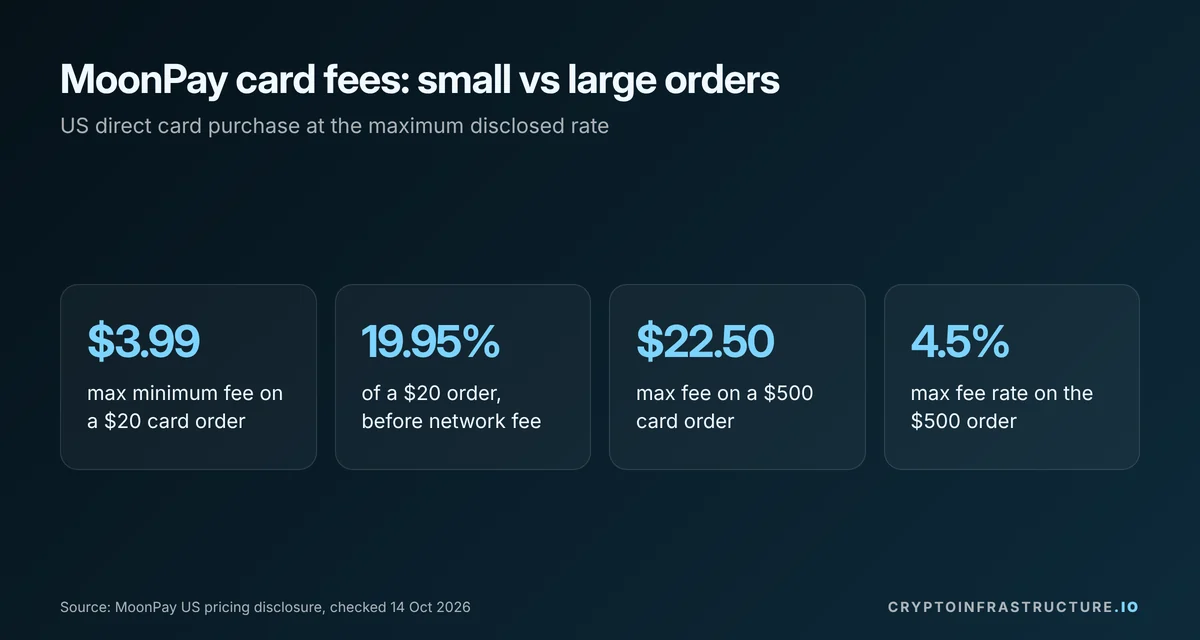
- $20 order (MoonPay’s stated minimum purchase): 4.5% would be $0.90, so the minimum fee of up to $3.99 applies. That is up to 19.95% of your order before the network fee and spread.
- $500 order: 4.5% is $22.50, which is above the minimum, so the fee is up to $22.50, or 4.5%.
The lesson: MoonPay is expensive for small card orders. Compare the final “you receive” amount on the checkout screen, not the headline fee, because the spread is already in the price you see.
What are MoonPay’s limits, and how long do transfers take?
MoonPay’s help centre (article dated 28 July 2026) gives a minimum purchase of $20 or the equivalent in other currencies. It does not publish fixed daily or monthly maximums; limits depend on your verification level, country and payment method, and you see yours in the app. Settlement times from the same article:
- Buying: cards, Apple Pay, Google Pay, PayPal and Venmo (US) are instant; Interac in Canada up to 30 minutes; UK Faster Payments and Brazil’s PIX one business day; SEPA one to three business days.
- Selling: PayPal and Venmo (US, not New York) instant; Visa and Mastercard payouts and UK Faster Payments one to two business days; SEPA two to four; ACH three to five.
“Instant” refers to the payment side. Blockchain confirmation time to your wallet comes on top.
Can you withdraw money from MoonPay?
Yes. You sell crypto through MoonPay and receive the proceeds by bank transfer, card, PayPal or Venmo where available, using the payout times above. MoonPay’s terms also let it “suspend, delay, redirect, or cancel any transaction” at its sole discretion, and limit or close stored-value accounts. Crypto transactions are generally irreversible, and US disputes go to individual arbitration rather than court. If a sale stalls, you are dealing with MoonPay support, not a regulator’s compensation scheme.
MoonPay complaints: what users report
MoonPay’s public complaint record, checked 14 October 2026:
| Source | What it shows |
|---|---|
| Trustpilot | TrustScore 4.1 out of 5 from 115,439 reviews: 72% five-star, 13% one-star. MoonPay invites customers to review and says it replied to 99% of negative reviews, typically within 24 hours. |
| Better Business Bureau (MoonPay USA LLC, Miami) | Not BBB accredited. 159 complaints in the last three years, 41 in the last 12 months; 140 marked answered and 19 resolved. Largest categories: product issues (52), service issues (48), billing (32). |
A high Trustpilot score and a steady stream of formal complaints are not a contradiction. Most purchases go through without fuss and get rated, while the problems that do happen are serious for the person involved. The recurring themes in recent BBB complaints and one-star reviews:
- Accounts disabled or restricted without explanation (BBB complaints from May to August 2026, one saying the decision “can not be appealed”).
- Charges the customer says they did not authorise, where MoonPay replies that crypto transactions cannot be reversed.
- Card charged, crypto not received, or refunds slow, including one BBB complaint of a refund delayed about a month.
- Verification holds: repeated requests for ID or more documents, and purchases held for more than 24 hours.
- Scam victims: people pushed by a scammer to buy crypto through MoonPay and send it on. In one BBB reply, MoonPay says it has “no involvement or relationship” with the scam. It is right that it did not run the scam, and the money is still gone. If anyone tells you to buy crypto through MoonPay and send it to an address they give you, stop.
Why is MoonPay declining my payment?
Most declines come from your bank, not MoonPay. MoonPay’s help article (19 February 2026) lists three common causes: your bank’s own risk rules on crypto purchases, an incomplete 3D Secure check, and orders above your card’s daily or monthly limit. Its advice is to confirm with your bank that it allows crypto purchases, complete the 3D Secure prompt quickly, or try a bank transfer. It warns that repeated retries can trigger fraud controls and a temporary block. Declines can also come from MoonPay’s side when your verification is incomplete or your account is restricted.
Has MoonPay been hacked? Incidents and enforcement
No breach of MoonPay customer funds was found in the sources reviewed for this article. These are the events on record, checked 14 October 2026:
| Date | What happened | Outcome | Source |
|---|---|---|---|
| 25 January to 12 February 2020 | An attacker intercepted MoonPay’s DNS and served malicious code through the MoonPay integration in IOTA’s Trinity wallet, capturing seeds and passwords | About 8.55 Ti of IOTA stolen from 50 seeds; MoonPay revoked the attacker’s API key around 10 February; IOTA removed the integration | IOTA Foundation post-mortem |
| 26 May to 28 July 2021 | Malta’s MFSA refused MoonPay Limited a Virtual Financial Assets licence because it “failed to meet the pre-licencing conditions” | Directed to cease operations from and within Malta from 9 July 2021; no fine | MFSA notice, 28 July 2021 |
| July 2025 | A US Justice Department filing described two victims named “Ivan” and “Mouna” sending $250,300 in USDT to a scammer posing as a Trump inaugural committee co-chair. The Block reported the victims may be MoonPay’s CEO and its CFO at the time; this was not confirmed | No customer funds reported involved | The Block, 12 July 2025 |
| 20 November 2025 | Canada’s FINTRAC penalised MP Technology Services Ltd., a MoonPay subsidiary, for four anti-money-laundering violations, including a “very serious” failure to report four declined transactions with suspicious indicators | C$536,853.35 penalty; the company has appealed to the Federal Court | FINTRAC public notice |

None of the top-ranking “is MoonPay safe” pages reviewed for this article mention the FINTRAC penalty or the Malta refusal. Neither involved lost customer money. Both are about compliance controls, which is exactly what you rely on when you hand a payments company your ID and card.
The Trinity attack is the one to understand if you buy inside other apps. MoonPay often runs as a widget inside a wallet. The 2020 attack showed that a compromise of that integration can reach the wallet itself. Wallet and on-ramp security are linked; see the Trust Wallet and MetaMask reviews for the wallet side.
MoonPay or Coinbase: which is better?
They solve different problems. MoonPay is an on-ramp: it converts your money into crypto and sends it to your wallet, so you hold the keys afterwards. Coinbase is an exchange that holds your crypto for you unless you withdraw it. MoonPay removes exchange custody risk but tends to cost more per small card purchase; an exchange can be cheaper for repeat buying but leaves a balance exposed to the exchange. Compare the same points for both: licence in your country, all-in cost on the size of order you make, and who holds the coins afterwards. The guide to choosing a crypto payment gateway or on-ramp covers the criteria in more depth.
Can you lose money using MoonPay?
Yes, in several ways that the licences above do not prevent:
- Wrong address or network: crypto sent to a wrong address cannot be pulled back.
- Scams: MoonPay processes the purchase; if a scammer told you where to send it, the money is gone.
- Fees on small orders: up to 19.95% on a $20 card buy before network fee and spread.
- Frozen balances and stalled sales: MoonPay can delay or cancel transactions and restrict accounts, and US disputes go to arbitration.
- No deposit insurance: MoonPay Balance is not covered by FDIC pass-through insurance.
How to reduce the risk you control
- Check you are on moonpay.com or inside a wallet you installed yourself, never a link from a message or ad.
- Use the checkout’s “you receive” figure to compare the full cost, and avoid many small card orders.
- Send a test amount first when you sell or use a new wallet address.
- Do not let anyone guide you through a purchase on a call or chat. That is a common pattern in scam complaints.
- Back up your wallet properly, because after the purchase the coins are your responsibility. Start with how a seed phrase works.
What this means for you
As of 14 October 2026, MoonPay is a licensed and registered payments company with a broad, checkable licence list, a MiCA authorisation in the EU and a New York BitLicense. It does not keep your crypto in an exchange account. On the other side are high minimum fees on small card orders, a complaint pattern of declined payments, verification holds and closed accounts, a 2025 Canadian anti-money-laundering penalty under appeal, and a 2020 integration attack that cost IOTA wallet users. The risk that remains is mostly yours to manage: the cost of each purchase, where you send the coins and who is telling you to send them.
For more reviews of on-ramps and payment providers, see the Payment Gateways & On-Ramps section. For the exchange side of the same question, read Is Coinbase safe? and Is Kraken safe?.


