What is a KOL? KOL stands for key opinion leader: a crypto creator on X, YouTube, Telegram or Discord whose posts move what an audience buys, trades or uses. A KOL gets paid in one of two ways. A paid deal is a fee for posts. A KOL round sells the KOL tokens at a discount, usually with a short unlock, and asks for promotion in return. That second model means the person telling you about a token may be able to sell it to you on launch day.
The legal rules, checked on 14 October 2026: in the US, the FTC requires clear disclosure of paid endorsements, and the SEC’s anti-touting rule has led to settled cases against Kim Kardashian (2022) and eight celebrities promoting Justin Sun’s tokens (2023). In the UK, crypto promotions have needed a lawful route since 8 October 2023, and the FCA has convicted seven finfluencers (2024 to 2026, over a forex scheme). In the EU, MiCA requires marketing to be identifiable and treats undisclosed “talk your book” posts as market manipulation. If you read KOLs, check for disclosure and unlock timing. If you hire them, put disclosure in the contract.
If you have spent any time on crypto X, you have seen “KOL” used for everyone from respected researchers to anonymous accounts posting the same token at the same hour. Most pages ranking for this term stop at the definition, and most are written by agencies or exchanges that sell KOL campaigns. This guide does two jobs.
For readers, it explains how KOLs actually get paid, including the “KOL round” model that gives creators discounted tokens, and the warning signs that a post is paid. For project teams, it sets out the dated legal rules in the US, UK and EU and what to require in a KOL contract. There are no affiliate links on this page and nothing here is investment advice.
What does KOL mean in crypto?
KOL means key opinion leader. In crypto, a KOL is a creator or public figure whose analysis, calls or endorsements change what their audience buys, trades or uses. In practice the term covers researchers, traders who post “calls”, YouTube explainers, Telegram channel owners and founders with large followings.
Google’s AI Overview for this search (checked 14 October 2026, US) gives only the expansion of the acronym and points to an exchange’s wiki and a crypto swap site. Both are vendors, and neither explains how KOLs are paid or which laws apply. That is the gap this page fills.
KOL vs influencer: is there a difference?
Marketers often say a KOL is valued for expertise and an influencer for reach. In daily use the terms overlap almost completely, and agencies sell both under the same price list. The distinction that matters to you is not the label. It is whether the person was paid, in cash or in tokens, to say what they said, and whether they told you.
What is a KOL in crypto trading?
In trading communities, a KOL is usually a “caller”: someone whose posts about a token, often a new or low-liquidity one, can move its price on their own. That price impact is exactly why projects want them, and why the timing of a caller’s own buying and selling matters so much (see the red flags below).
How KOLs get paid: paid deals vs KOL rounds
There are two main models, and many campaigns mix them.
| Paid deal (sponsored post) | KOL round (token allocation) | |
|---|---|---|
| What the KOL gets | A fee per post, video, thread or campaign, in cash or stablecoins | The right to buy tokens before launch, usually at a lower price than later buyers |
| What the project gets | Agreed posts on agreed dates | Posts over months, plus creators whose own profit depends on the token’s price |
| Contract | Influencer agreement or agency insertion order | Usually a SAFT (simple agreement for future tokens) plus promotion obligations |
| Cost to the project | Cash out of the marketing budget | Little or no cash; the cost is dilution and sell pressure at unlock |
| Main risk for readers | Undisclosed paid posts | Undisclosed holdings and selling into the hype the KOL created |
What a paid KOL deal costs
There is no public rate card. As one reference point, ICODA, a crypto marketing agency, published market ranges on 6 October 2026 of $500 to $3,000 for one X post from a 10,000 to 100,000-follower account and $20,000 to $100,000 or more for accounts above one million followers. These are one vendor’s estimates, not audited prices. Agencies also quote CPM (cost per thousand impressions), which lets you compare a fee against the views a post actually got.
How a KOL round works
A KOL round is a small allocation in a token’s private sale reserved for creators. CoinDesk’s investigation, updated 9 May 2024 and based on more than two dozen interviews, described the model this way:
- Discounted entry and faster exit: KOLs get discounted valuations and the option to sell sooner than other early investors, sometimes at token launch. Participants often get a large share of tokens unlocked on launch day.
- Promotion is the price: Humanity Protocol’s KOL form, seen by CoinDesk, asked for six months of activity: three posts a week, three threads and monthly X Spaces. It said it could void the SAFT and refund KOLs who were not supportive. Humanity raised $1.5 million from angels and KOLs in early March 2024, per an investor presentation.
- Short vesting: one KOL-round organiser told CoinDesk that “nobody accepts more vesting than 12 months”. Creator.Bid’s terms let KOLs access up to 23% of their allocation on the day of its public airdrop. Citizend said it gave KOLs a less favourable unlock than retail buyers, which shows terms vary.
- Scale: influencer Stacy Muur, who says she does not join these deals, estimated that 75% of better-known token launches that year had KOL rounds. One investor said he received KOL round offers “10x a day”, almost none of which required disclosure.
Researcher Ignas, writing in July 2024, put typical tickets at $1,000 to $20,000 per KOL, with valuations and vesting often better than most VCs get, in return for “a few tweets per month”. He added that rounds once seen as nearly risk-free had become riskier as low-float, high-FDV tokens faced constant selling.
A worked example: why unlock timing matters
The figures below are hypothetical, chosen only to show the mechanics.
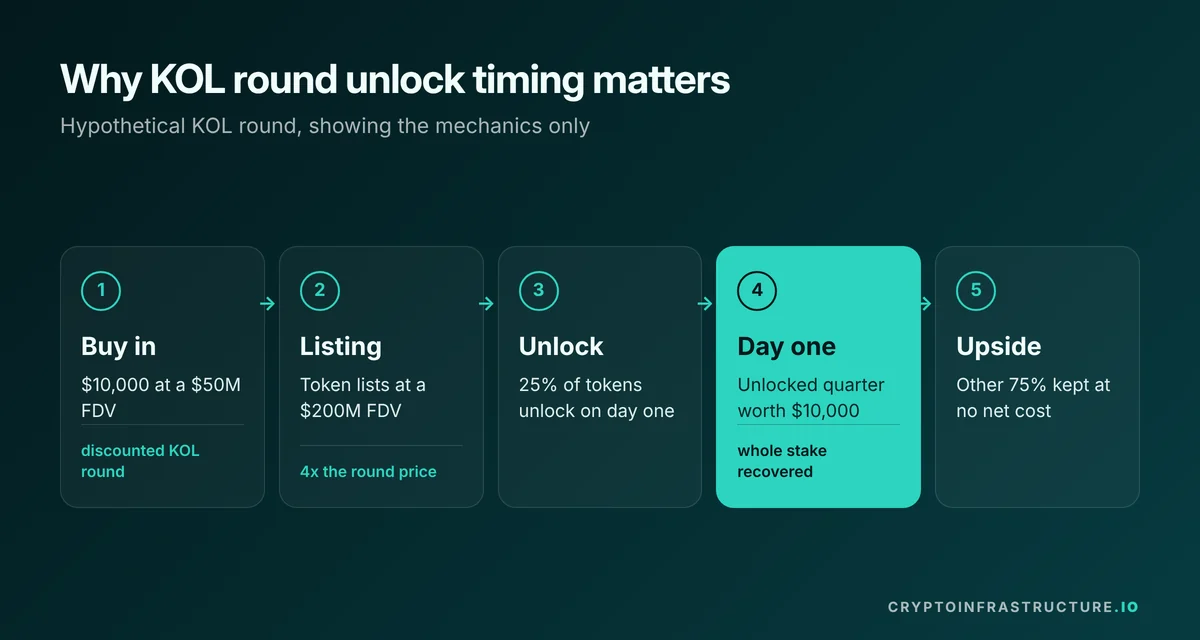
- A KOL puts $10,000 into a KOL round at a $50 million fully diluted valuation (FDV).
- The token lists at a $200 million FDV, four times the round price.
- 25% of the KOL’s tokens unlock on listing day.
The unlocked quarter is worth $10,000 × 4 × 25% = $10,000 at the listing price. The KOL can recover their entire stake on day one and keep the other 75% as free upside, while the price only has to hold for a few hours. A reader buying at listing has no such cushion. This is why a short unlock plus heavy promotion around launch is a structural conflict, not just a matter of one person’s honesty. For how FDV and circulating supply interact, see the guide on market cap vs FDV.
What is a KOL strategy?
For a project team, a KOL strategy is the plan for which creators to work with, in which regions, at what stage and on what terms. A sound one decides four things in writing before any outreach: the goal (awareness, testnet users, liquidity, developer sign-ups), the creator list and how it was vetted for bots, the payment model (fee, allocation or both), and the disclosure and compliance rules for each market. The legal part is where most strategies fall short, so it gets its own section.
The legal frame for paid crypto promotion
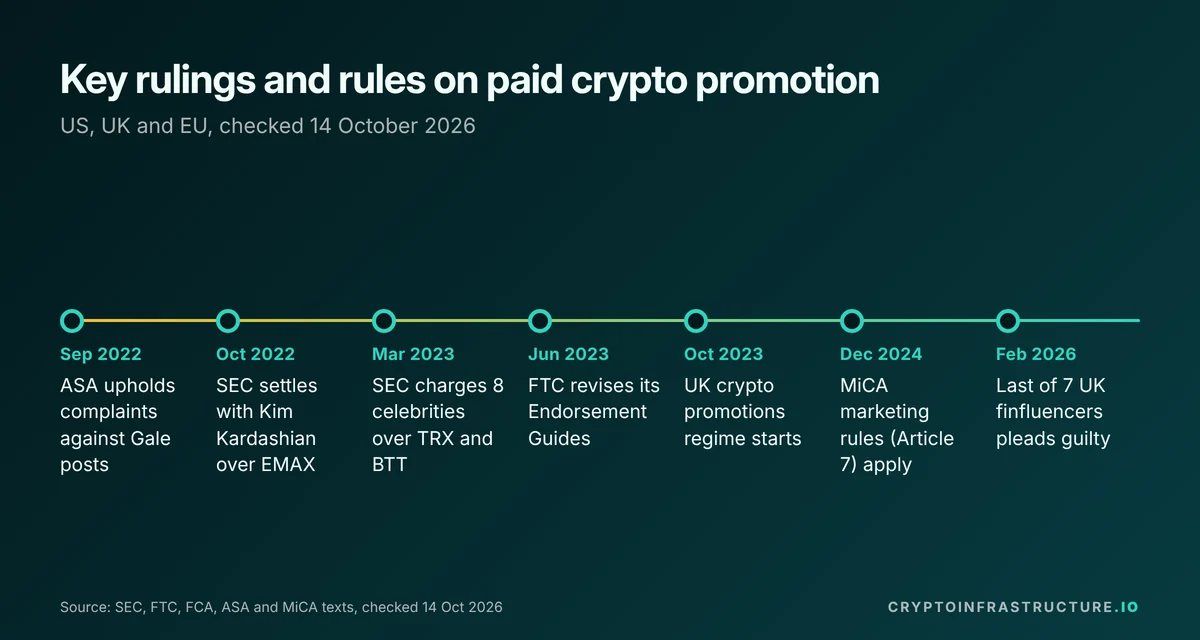
The rules below were checked on 14 October 2026. They apply whether you pay in cash or in tokens: a token allocation is a payment.
| Jurisdiction and rule | What it requires | Enforcement on record |
|---|---|---|
| US: FTC Endorsement Guides (16 CFR Part 255), revised 29 June 2023 | Material connections, including payment and free or discounted tokens, must be disclosed clearly and conspicuously. The FTC says a platform’s built-in disclosure tool might not be enough. Advertisers, endorsers and intermediaries such as agencies can all be liable. | Applies whether or not the token is a security. |
| US: Securities Act Section 17(b), the SEC’s anti-touting rule | Anyone paid, directly or indirectly, by an issuer, underwriter or dealer to publicise a security must disclose the payment and its amount. | Kim Kardashian, 3 October 2022: paid $250,000 for an EthereumMax (EMAX) post; settled for about $1.26 million and a three-year promotion ban. Eight celebrities including Lindsay Lohan, Jake Paul, Soulja Boy and Akon, 22 March 2023: charged over undisclosed paid promotion of Justin Sun’s TRX and BTT; six settled for more than $400,000 combined. |
| UK: cryptoasset financial promotions regime, from 8 October 2023 | A promotion to UK consumers must be made or approved through a lawful route (an FCA-authorised firm, an FCA-registered cryptoasset firm, approval by an authorised firm, or an exemption). It needs risk warnings, may not offer incentives to invest, and first-time buyers get a 24-hour cooling-off period. Overseas firms are covered. | The FCA’s finalised guidance FG24/1 (26 March 2024) says influencers who promote without approval may commit a criminal offence, and that memes can be promotions. |
| UK: FCA finfluencer prosecutions, 2024 to 2026 | Communicating an unauthorised financial promotion is an offence under the Financial Services and Markets Act 2000, punishable by up to two years in prison and a fine. | Nine people were charged in 2024 over an unauthorised forex trading scheme promoted on Instagram. Seven pleaded guilty at Southwark Crown Court, the last on 20 February 2026, receiving fines of £600 to £3,750 or discharges, plus costs. The case was about forex, not crypto, but the same offence covers crypto promotions. |
| UK: Advertising Standards Authority (CAP Code) | Ads must be socially responsible, not misleading, and make investment risk clear. | 7 September 2022: the ASA upheld complaints against Instagram stories by influencers Eve and Jessica Gale promoting a crypto trading service, even though the posts were labelled “AD”. 28 January 2026: it upheld complaints against a Coinbase campaign for trivialising crypto risk. |
| EU: MiCA Article 7, applying from 30 December 2024 | Marketing for a crypto-asset offer or admission to trading must be clearly identifiable as marketing, fair, clear and not misleading, consistent with the white paper, and carry a set statement that no authority has approved it. Where a white paper is required, no marketing may go out before it is published. | Enforced by national regulators in each member state. |
| EU: MiCA Article 91, market manipulation | Voicing an opinion about a crypto-asset in the media after taking a position in it, then profiting from the price impact, without disclosing that conflict properly, counts as market manipulation. | This is the provision that fits a KOL round most directly: the creator holds the token they promote. |
Sources: FTC press release, 29 June 2023; 15 U.S.C. 77q(b); SEC release 2022-183; SEC release 2023-59; FCA policy statement PS23/6 and finalised guidance FG24/1; reporting of the Southwark Crown Court sentences (February 2026); ASA ruling on Elizabeth O’Donell, 7 September 2022; ASA ruling on CB Payments Ltd t/a Coinbase, 28 January 2026; Regulation (EU) 2023/1114 (MiCA), Articles 7, 91 and 149. All checked 14 October 2026.
Two points that most KOL guides get wrong. First, US securities rules are not the only US rule: whether a token is a security is often disputed, and industry insiders told CoinDesk that many projects assume promoter rules do not apply to them. The FTC’s disclosure rules apply either way. Second, an “#ad” label is necessary but not sufficient. The ASA’s Gale ruling shows a labelled post can still breach the rules if it makes crypto investing sound simple or risk-free, and in the UK the promotion also needs a lawful route under the FCA regime.
Red flags for readers
- No disclosure on a post that reads like an ad. Identical wording or timing across several accounts, launch-day countdowns and referral links with no “ad”, “sponsored” or “I hold this” label. CoinDesk’s sources said almost no KOL round offers required disclosure, and at least one project left disclosure entirely to its KOLs.
- The creator joined a KOL round. If a token’s docs, investor list or the creator’s own posts mention a KOL, “community” or “strategic” round, assume promoters may hold discounted tokens. Ask, or skip the post.
- Promotion that peaks right before an unlock or listing. Heavy posting around the token generation event (TGE) is when early buyers with short unlocks can sell. Check the token’s unlock schedule against the posting dates.
- Deleted posts after a crash. In July 2025, on-chain investigator ZachXBT alleged that wallets linked to the influencer Crypto Beast sold more than $11 million of the ALT meme token on 14 July 2025 after he promoted it, and that promotional posts were deleted afterwards (Benzinga, 22 July 2025). These are allegations; the influencer blamed “whale snipers” for the crash.
- Return claims. “100x”, guaranteed listings or risk-free language. In the UK that alone can breach the CAP Code, as the ASA found in 2022.
A useful habit: treat any undisclosed token call from a large account as an advertisement until shown otherwise.
What project teams should require in a KOL contract
If you run a KOL campaign, the legal exposure is yours as well as the creator’s. The FTC names advertisers and intermediaries as potentially liable, and the FCA’s guidance expects firms to vet and monitor influencers. Put these in writing before any payment or allocation:
- Disclosure wording and placement. Exact words (“Paid partnership with X”, “I received discounted tokens from X”) at the start of every post, video and Space, not only in a bio or a platform toggle.
- Disclosure of holdings. For any allocation, the KOL must disclose that they hold the token whenever they discuss it, to meet the FTC’s material-connection rule and MiCA Article 91 where EU audiences are reached.
- Lock-up aligned with the promotion period. No sales during the promotion window and for a set period after it. If promotion runs six months, a 25% day-one unlock defeats the purpose.
- Geographic restrictions. No targeting of UK consumers unless the promotion goes through a lawful FCA route with the required risk warnings; no EU marketing before a required MiCA white paper is published, and the Article 7 statement included.
- Content rules. No price predictions, return figures or “risk-free” language; the project approves scripts and keeps copies.
- Audience checks and reporting. Audience analytics you can verify, raw post links and the right to claw back fees or void the allocation for bot audiences or non-disclosure.
- Record-keeping. Keep every brief, post and payment record yourself rather than relying on platforms, as FG24/1 expects of firms.
If an agency runs the campaign, ask for its written disclosure policy before signing. The site’s guide to choosing a web3 marketing agency lists KOL disclosure as a first-call question and flags agencies whose own sites show risky practices.
How do I become a KOL?
The audience part is ordinary creator work: consistent, verifiable analysis on one niche for long enough that people come back. The crypto-specific part is compliance. Once projects pay you, in cash or tokens, you are an endorser under the FTC’s rules, you may be a promoter under the UK’s financial promotions regime, and in the EU your undisclosed positions can fall under MiCA’s market manipulation rules. Disclosing every deal and holding is the simplest way to keep both your audience and your legal position.
What this means for you
As of 14 October 2026, a KOL is best understood as a channel with a built-in conflict of interest, not just a popular account. If you read KOLs, look for disclosure, look for KOL rounds in a token’s investor list, and compare posting dates with unlock dates. If you hire KOLs, assume the posts are your advertising in law: write disclosure, lock-ups and regional limits into the contract, and keep the records. Rules here move fast, so check the regulator sources above before each campaign.
For agency write-ups and vetting criteria, see the KOL & Influencer Agencies section and Marketing & Growth Agencies. For wider regulatory context, read the October 2026 regulation roundup.


