Leverage in crypto means opening a position bigger than the money you put up, using your deposit (margin) as collateral. At 10x, $1,000 of margin controls a $10,000 position, so a 1% price move changes your margin by about 10%. Most crypto leverage today runs through perpetual futures (“perps”): contracts with no expiry that use a funding rate, paid between longs and shorts, to stay close to the spot price.
If losses eat your margin down to the maintenance level, the exchange liquidates you, usually before the move a simple “1 divided by leverage” sum would suggest. Retail access is restricted in some places: the UK has banned crypto derivatives for retail customers since 6 January 2021, and the EU limits retail crypto CFDs to 2:1.
Most explanations of crypto leverage stop at “$1,000 controls $10,000” and a warning that it is risky. That skips the parts that actually decide what happens to your money: how the exchange calculates your liquidation price, why it uses a “mark price” rather than the last trade, what the funding rate costs you while you hold, and what happens when a liquidated position cannot be closed in time. This guide explains each of those using the exchanges’ own published formulas, with worked examples using clearly hypothetical numbers, then shows what the 10 October 2025 liquidation cascade looked like and where regulators restrict retail leverage. It explains mechanics. It does not tell you whether or how to trade.
What is leverage in crypto?
Leverage in crypto is a way to hold a position worth more than the capital you deposit. You post collateral, called margin, and the exchange or protocol lets you control a larger position against it. The leverage ratio is the position size divided by your margin.
- Margin: the collateral you lock up to open and keep a position, often a stablecoin such as USDT or USDC, sometimes BTC or another coin. (For how stablecoins work, see what a stablecoin is.)
- Leverage ratio: position size ÷ margin. $10,000 position ÷ $1,000 margin = 10x.
- Notional value: the full size of the position at the current price. Gains, losses and funding are all calculated on notional, not on your margin.
Leverage does not change how far the price moves. It changes how much that move matters relative to your own money. A 2% move on a $10,000 position is $200 either way. On $1,000 of margin, that is 20% of your stake.
What does 5x, 20x or 100x leverage mean?
The number tells you how many times your margin the position is worth, and roughly how small a move against you would wipe out the margin:
| Leverage | Margin for a $10,000 position | Rough move that would erase the margin |
|---|---|---|
| 2x | $5,000 | about 50% |
| 5x | $2,000 | about 20% |
| 10x | $1,000 | about 10% |
| 20x | $500 | about 5% |
| 100x | $100 | about 1% |
So 20x leverage on $10 of margin is a $200 position, and a move of about 5% against it would use up the $10. The “rough move” column is the simple 1 ÷ leverage figure. In practice liquidation comes earlier, because exchanges require you to keep a maintenance margin and charge fees and funding along the way. The worked examples below show by how much.
Margin trading, futures and perps: where leverage comes from
You will meet leverage in three main forms:
- Margin trading on spot: you borrow funds or coins from the platform to buy or sell more of the actual asset, and pay interest on the loan.
- Dated futures: contracts to buy or sell at a set date. Their price converges with spot at expiry.
- Perpetual futures (perps): futures with no expiry date. You can hold the position as long as your margin covers it. Because there is no expiry to pull the contract price back to spot, perps use a funding rate instead.
CFDs (contracts for difference) are a fourth route, sold by brokers rather than crypto exchanges. They are the product most European rules on retail leverage were written for.
What is a perp in crypto?
A perp is a derivative contract that tracks the price of a crypto asset without you owning the asset and without an expiry date. You go long if you gain when the price rises, short if you gain when it falls. The exchange settles profit and loss in the margin currency. Since there is no settlement date, how long you can hold a perp depends only on your margin staying above the maintenance level, plus the funding you pay or receive along the way.
In the US, the Commodity Futures Trading Commission (CFTC) published a 29 May 2026 article on its website describing a perpetual contract as “a type of derivative contract that has no fixed expiration date”.
Isolated vs cross margin
When you open a leveraged position you usually choose how your collateral is shared. Hyperliquid’s documentation (checked 14 October 2026) describes the two modes clearly:
| Isolated margin | Cross margin | |
|---|---|---|
| Collateral | Confined to one position | Shared across all cross positions in the account |
| Liquidation price | Depends on the leverage you set, because that decides how much margin is allocated | Does not depend on the leverage setting; it depends on the account’s total equity |
| Worst case on liquidation | That position and its margin are lost; other positions are unaffected | On a backstop liquidation, all cross positions and cross margin are transferred to the liquidator; with no isolated positions, account equity ends at zero |
Cross margin can keep a position open longer because the whole balance supports it, but that means the whole balance is at risk. Isolated margin caps the loss at what you put into that position.
Mark price vs last price
Exchanges do not liquidate you on the last traded price on their own order book. They use a mark price, built to be harder to spike or manipulate.
- Binance’s FAQ (updated 25 September 2026) sets its perpetual mark price as the median of three values: the price index adjusted by the last funding rate, the price index plus a 30-second moving average of the order-book midpoint minus the index, and the contract price. The price index is a weighted average of the asset’s price across several major spot exchanges. Binance says it uses the mark price “to prevent unnecessary liquidations”.
- Hyperliquid says its mark price combines external centralised-exchange prices with its own order book state, and warns that it can differ significantly from the book price during high volatility.
The practical effect: a brief wick on one exchange’s chart may not liquidate you if the mark price did not follow it, and you can be liquidated while the last price on your screen is still above your liquidation level, if the mark price moved first.
How liquidation works, with worked examples
Liquidation happens when your account equity (margin plus unrealised profit or loss) falls below the maintenance margin. On Hyperliquid, maintenance margin is set at half the initial margin at an asset’s maximum leverage, which ranges from 1.25% of position value for assets with 40x maximum leverage to 16.7% for assets capped at 3x (Hyperliquid liquidation docs, checked 14 October 2026). Centralised exchanges publish their own tiered maintenance rates that rise with position size.
Hyperliquid publishes the formula:
liq_price = price − side × margin_available ÷ position_size ÷ (1 − l × side)
where side is 1 for a long and −1 for a short, l is the maintenance margin rate (1 ÷ maintenance leverage), and margin_available for an isolated position is the isolated margin minus the required maintenance margin.
Example 1: a 10x long
All numbers are hypothetical, chosen to make the maths easy. They are not a price view and ignore fees and funding.
| Input | Value |
|---|---|
| Entry price | $100,000 |
| Position | 0.1 units long (notional $10,000) |
| Isolated margin | $1,000 (10x) |
| Maintenance margin rate (l) | 1.25% (an asset with 40x maximum leverage) |
- Required maintenance margin at entry: 1.25% × $10,000 = $125
- margin_available: $1,000 − $125 = $875
- liq_price = $100,000 − 1 × $875 ÷ 0.1 ÷ (1 − 0.0125) = $100,000 − $8,860.76 = $91,139.24
That is a drop of about 8.86%, not the 10% that “1 ÷ leverage” suggests. Check: at $91,139.24 the position is worth $9,113.92, the loss is $886.08, equity is $113.92, and 1.25% of $9,113.92 is also $113.92. Equity has reached maintenance, so the position is liquidated.
Example 2: the same trade at other leverage levels
| Leverage | Margin | Liquidation price (long) | Move against you |
|---|---|---|---|
| 5x | $2,000 | $81,012.66 | about 18.99% |
| 10x | $1,000 | $91,139.24 | about 8.86% |
| 20x | $500 | $96,202.53 | about 3.80% |
| 40x | $250 | $98,734.18 | about 1.27% |
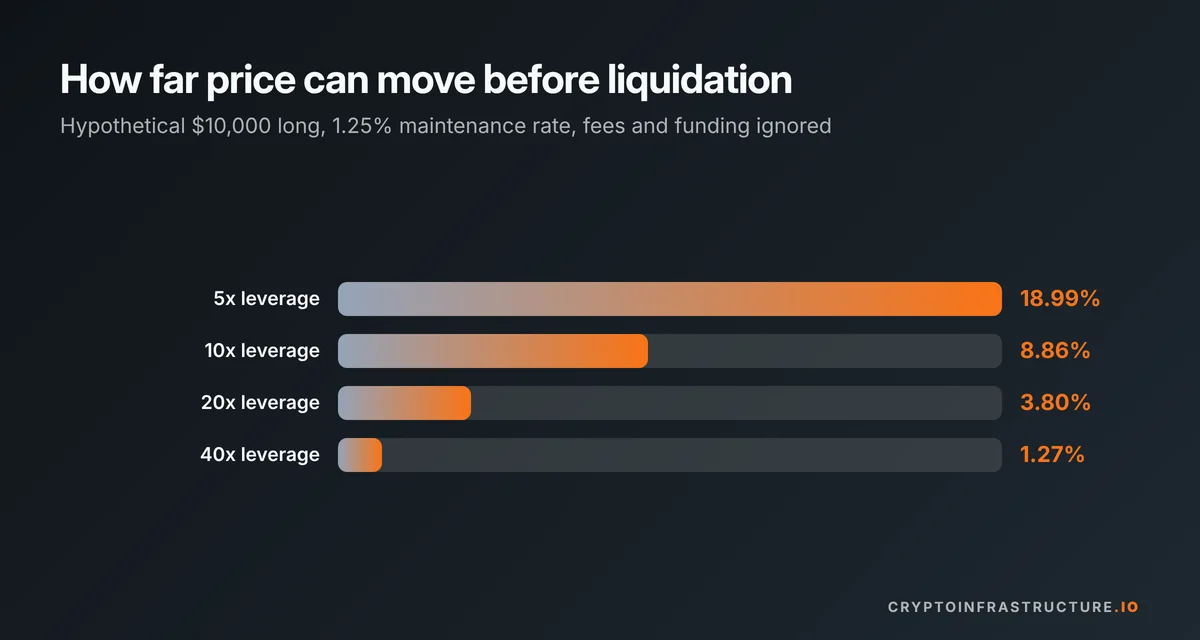
Same hypothetical inputs as Example 1, isolated margin, 1.25% maintenance rate, fees and funding ignored. Fees and negative funding would move each liquidation price closer still.
Example 3: a 10x short
For a short, side = −1, so the liquidation price sits above entry: $100,000 + $875 ÷ 0.1 ÷ (1 + 0.0125) = $108,641.98, a rise of about 8.64%. A short has no natural ceiling on how far the price can rise, so the loss on a short is not capped by the price falling to zero the way a long’s is.
What happens during liquidation
Hyperliquid’s docs describe the order of events, and centralised exchanges follow a similar pattern:
- Market orders to the book. The exchange first tries to close the position on the order book. On Hyperliquid, positions over 100,000 USDC are closed in parts (20% first, then a 30-second cooldown).
- Backstop. If equity falls below two-thirds of maintenance margin without a successful book liquidation, Hyperliquid’s liquidator vault takes the position over and the maintenance margin is not returned to you.
- Insurance fund or ADL. If a position goes bankrupt (losses larger than its margin), something has to cover the gap. That is the job of the insurance fund and, as a last resort, auto-deleveraging.
Whether you can lose more than your margin depends on the venue. On a crypto perp exchange, losses beyond your margin are normally absorbed by the insurance fund or ADL rather than billed to you, but check the venue’s terms. Spot margin loans and some broker products work differently.
Insurance funds and auto-deleveraging (ADL)
An insurance fund is a pool an exchange holds to absorb bankrupt positions, so the winning side still gets paid. Binance describes auto-deleveraging as “the final step in the liquidation process”, which happens only if its futures insurance funds cannot accept a bankrupt position (Binance FAQ, updated 13 January 2026). Binance also notes that coin-margined contracts using the same collateral asset share one insurance fund.
Auto-deleveraging means the exchange closes part of a profitable trader’s position on the other side, against the insolvent account, without that trader choosing to close. On Hyperliquid (docs checked 14 October 2026):
- ADL starts when an account or isolated position value goes negative.
- Traders on the opposite side are ranked by unrealised profit and leverage, using the index (mark price ÷ entry price) × (notional position ÷ account value).
- Selected positions are closed at the previous mark price.
- An account with no open positions never absorbs platform losses.
The point many explainers miss: leverage risk is not only yours. In a fast crash, a profitable, highly leveraged position can be closed by ADL because other traders were liquidated too late. The higher your profit and leverage, the higher you sit in the queue.
What is the funding rate in crypto?
The funding rate is a periodic payment between long and short holders of a perp that keeps the perp price close to the spot index. When the rate is positive, longs pay shorts. When it is negative, shorts pay longs. Binance states that it does not take a fee from funding payments; they pass directly between traders.
The funding rate formula
Binance publishes its formula (Binance funding rate FAQ, updated 6 March 2026):
Funding Rate (F) = [Average Premium Index (P) + clamp(interest rate − P, 0.05%, −0.05%)] ÷ (8 ÷ N)
- Interest rate: fixed at 0.03% a day by default, which is 0.01% per 8-hour interval (some contracts use 0%).
- Premium index: how far the perp’s impact bid and ask prices sit from the price index. It is positive when the perp trades above spot.
- clamp: limits the interest-minus-premium adjustment to ±0.05%.
- N: the funding interval in hours. The default is every 8 hours, at 00:00, 08:00 and 16:00 UTC, though Binance can change the interval for a contract, for example during extreme volatility.
- Funding amount = nominal value of the position × funding rate, where nominal value is mark price × contract size.
Hyperliquid uses the same structure with a different rhythm: the premium is sampled every 5 seconds, funding is paid every hour at one-eighth of the computed 8-hour rate, the interest component is 0.01% per 8 hours, funding is capped at 4% an hour, and the payment uses the oracle price rather than the mark price (Hyperliquid funding docs, checked 14 October 2026).
Worked funding example
Hypothetical inputs, using Binance’s formula with an 8-hour interval:
- If the average premium index is 0.02%: interest − P = −0.01%, which is inside the ±0.05% clamp, so F = 0.02% − 0.01% = 0.01%. While the premium stays within 0.05% of the interest rate, funding settles at the interest rate.
- If the average premium index is 0.10%: interest − P = −0.09%, clamped to −0.05%, so F = 0.10% − 0.05% = 0.05%.
At 0.05% on the $10,000 position from Example 1, a long pays $5 per interval, or $15 a day over three intervals. Against $1,000 of margin, that is 1.5% of the margin each day, before any price move. Funding is calculated on notional, so the higher your leverage, the bigger a share of your margin it takes.
Is a negative funding rate bullish?
A negative rate means shorts are paying longs, which tells you the perp has been trading below the spot index: more demand to be short than long on that venue at that time. It describes positioning, not where the price goes next. Funding can stay negative or positive for long periods, and it differs between exchanges for the same asset.
A dated example: the 10 October 2025 liquidation cascade
On Friday 10 October 2025, crypto prices fell sharply after US President Donald Trump threatened new “massive” tariffs on China. Decrypt reported, citing a CoinGlass post on X, that 1,618,240 traders were liquidated in 24 hours, for a total of $19.13 billion, which CoinGlass called “the largest liquidation event in crypto history”. Long positions made up close to $17 billion of that. Bitcoin fell from above $121,000 that morning to below $106,000 in the afternoon, then recovered to just above $112,000, still down nearly 8% on the day. CoinGlass added that the actual total was likely much higher.
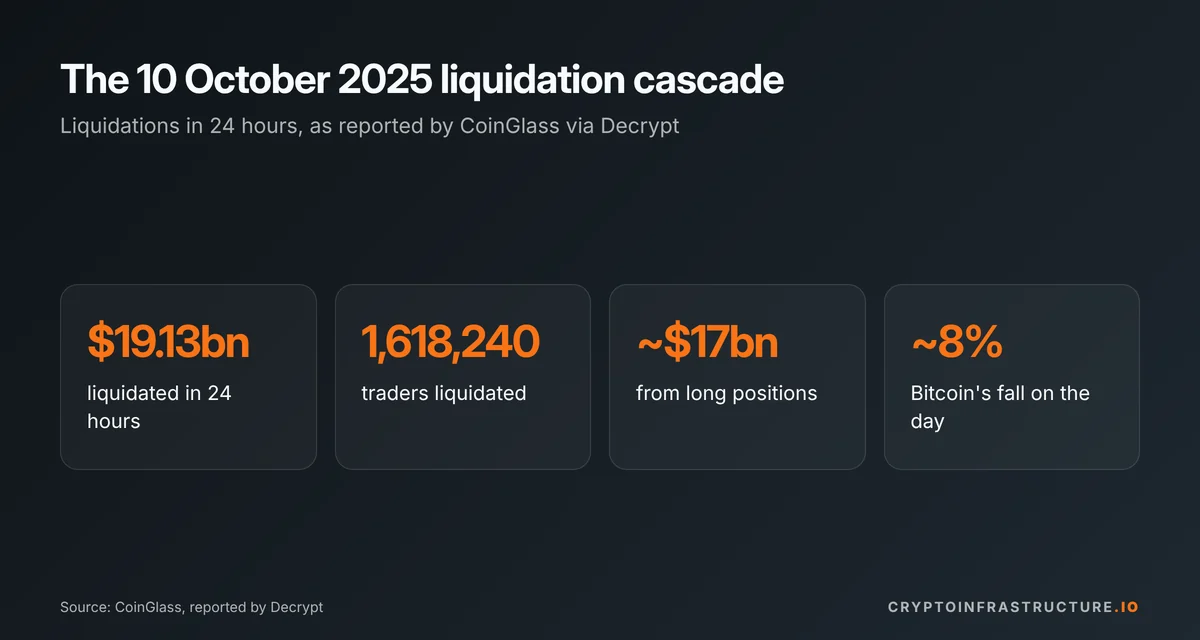
How the mechanics above fit together in an event like this: forced market sells from liquidations push the mark price lower, which pushes more positions below maintenance margin, which triggers more forced sells. When order books thin out, liquidations fill at worse prices, insurance funds take the shortfall, and where they cannot, ADL closes profitable positions on the other side. Leverage that looked moderate in calm markets can be liquidated in minutes.
Where retail crypto leverage is restricted
Rules differ by country and by product. Status as checked on 14 October 2026:
| Jurisdiction | Rule | What it means for retail |
|---|---|---|
| United Kingdom | FCA ban on the sale, marketing and distribution of derivatives (CFDs, options, futures) referencing unregulated transferable cryptoassets to retail consumers, in force since 6 January 2021 | UK-authorised firms cannot sell crypto derivatives, including perps, to retail customers. The original ban also covered crypto ETNs; the FCA later lifted the ETN part (reported as effective 8 October 2025) while keeping the derivatives ban. |
| European Union | ESMA product intervention measures announced 27 March 2018: retail CFD leverage capped at 2:1 for cryptocurrencies, a 50% margin close-out rule per account, and negative balance protection | Retail crypto CFDs in the EU are limited to 2x, positions must be closed when margin falls to half the minimum, and you cannot lose more than your deposit. Crypto derivatives are generally financial instruments under MiFID II rather than covered by MiCA. |
| United States | Perps on CFTC-regulated venues: Coinbase launched perpetual-style futures for US traders on 21 July 2025 (reported with up to 10x intraday leverage); the CFTC issued a policy statement and an order permitting a bitcoin perpetual on 29 May 2026; on 12 June 2026 its Division of Market Oversight let exchanges remove expiry dates from existing perpetual-style digital commodity futures | US retail traders can access perps through CFTC-regulated exchanges and brokers. Perps on other assets go through case-by-case CFTC review. |
Sources: FCA press release, 6 October 2020; ESMA press release, 27 March 2018; CFTC press release 9242-26, 29 May 2026; CFTC press release 9252-26 (12 June 2026); Crypto Briefing (21 July 2025). All checked 14 October 2026.
If you use a venue that is not authorised in your country, local complaint and compensation routes may not apply. For one exchange’s regional status, see the evidence on Binance’s licences and settlements, and for this month’s rule changes, the October 2026 regulation roundup.
Common mistakes with leverage
- Using 1 ÷ leverage as your liquidation point. Maintenance margin, fees and funding put liquidation closer, as the examples show.
- Watching last price, not mark price. Liquidation follows the mark price.
- Ignoring funding on long holds. Funding is charged on the full notional at every interval, so it adds up on a leveraged position held for days or weeks.
- Running everything on cross margin without meaning to. Cross is the default on some venues and puts the whole balance behind every position.
- Assuming a profitable position cannot be force-closed. ADL can close it in a crash.
- Assuming a stop-loss always fills at its price. In fast markets, orders fill at whatever price the book offers.
What this means for you
Leverage multiplies exposure, not skill. Before you read any leverage figure on an exchange, you need four numbers from that venue’s own documentation: the maintenance margin rate for your position size, how it calculates the mark price, the funding interval and formula, and what happens after liquidation (insurance fund, ADL, or a claim on your other balances). Then check whether the venue is authorised to offer derivatives where you live. The 10 October 2025 cascade showed that these mechanics act on everyone at once in a crash, whatever leverage each trader thought was moderate.
Nothing here is a recommendation to trade with leverage. For how this site sources and dates figures, read the methodology, and find more plain-English explainers in Guides, including what DeFi is and where the risks are.


