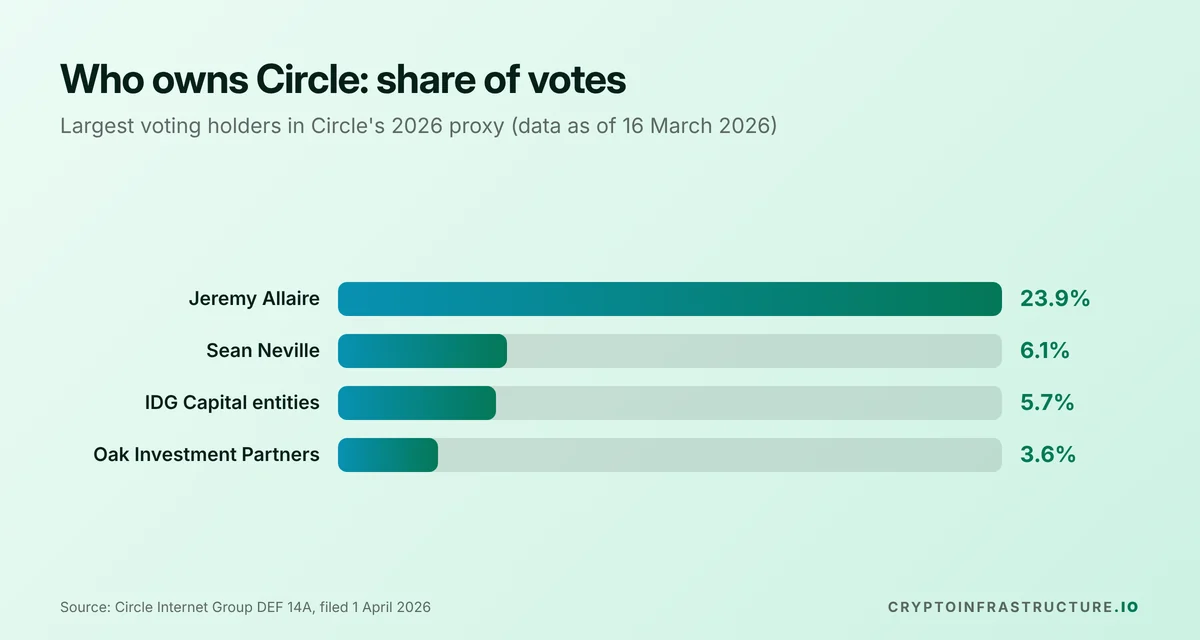
Circle is owned by its public shareholders and co-founder and CEO Jeremy Allaire holds the single largest block of votes. Circle Internet Group, Inc. listed on the New York Stock Exchange as CRCL in June 2025, selling 34 million shares at $31. Its 2026 proxy (data as of the 16 March 2026 record date) shows Allaire with 79.8% of the five-vote Class B shares and 23.9% of all votes and co-founder Sean Neville with the rest of Class B and 6.1% of votes. Class B voting is capped at 30% in total. IDG Capital entities (7.4% of Class A on 30 June 2026) and Oak Investment Partners (5.2%) are the only other holders above 5%. In Q2 2026 Circle made about 95% of its revenue from interest on the reserves behind USDC and it paid $324.6 million of that to Coinbase.
If you hold USDC, “who owns Circle?” is a practical question. Circle issues the token, holds the reserves behind it and decides how it is run, so its owners, its board and its business model shape the coin in your wallet. Most answers stop at “it’s a public company”, repeat IPO coverage from 2025, or credit stakes to investors that do not appear in Circle’s own filings. This guide goes back to Circle’s SEC filings: who holds the shares and the votes, what the June 2025 IPO actually sold, how Circle earns money and what it pays Coinbase and its new national trust bank charter, with dates.
Ownership figures are dated to the filing they come from. This is not investment advice and says nothing about whether CRCL shares are worth buying. The ownership table will next change materially with Circle’s 2027 proxy statement, expected around April 2027.
Who owns Circle? The short answer
Circle Internet Group, Inc. is a publicly traded Delaware company owned by its shareholders and its co-founder, Chairman and CEO Jeremy Allaire controls the largest voting block. It is the parent of Circle Internet Financial, LLC, the company that issues USDC. Circle has three share classes, according to its 2026 proxy statement (DEF 14A, filed 1 April 2026):
- Class A shares trade on the NYSE as CRCL and carry one vote each.
- Class B shares carry five votes each, subject to a cap of 30% of total voting power. Allaire and Neville and their related entities hold all of them.
- Class C shares carry no vote. None were outstanding.
On 16 March 2026, the proxy’s record date, Circle had 228,495,769 Class A and 18,714,651 Class B shares outstanding. By 30 July 2026 the counts were 234,685,190 Class A and 19,190,691 Class B, per the cover of Circle’s 10-Q for the quarter to 30 June 2026, filed 5 August 2026.
So no single person or fund owns Circle outright. Economic ownership is spread across institutions, insiders and individual investors and the two founders hold 30% of the vote between them.
Several unrelated businesses also use the name Circle. This article covers only Circle Internet Group, the USDC issuer.
Circle ownership table (2026 proxy)
The table lists the holders named in the proxy’s beneficial ownership table above 1% of a class, plus the latest IDG filing. “% of votes” is the proxy’s own figure. Beneficial ownership under SEC rules includes options and restricted stock units that vest within 60 days.
| Holder | Class A shares | Class B shares | % of votes | Data date |
|---|---|---|---|---|
| Jeremy Allaire, co-founder, Chairman and CEO | 56,408 | 17,708,642 (79.8% of Class B) | 23.9% | 16 March 2026 |
| P. Sean Neville, co-founder (left the board 25 September 2026) | None | 4,488,271 (20.2% of Class B) | 6.1% | Proxy table, 16 March 2026 |
| All 14 directors and executive officers as a group | 4,618,561 (2.0%) | 22,196,913 (100%) | 31.4% | 16 March 2026 |
| IDG Capital entities (Chuang Xi Capital and Wide Palace) | 18,581,540 (8.1%) | None | 5.7% | 4 February 2026, per the proxy |
| IDG Capital entities, updated | 17,355,322 (7.4%) | None | Not stated | 30 June 2026, per Schedule 13G/A filed 11 August 2026 |
| Oak Investment Partners XIII | 11,880,678 (5.2%) | None | 3.6% | 30 June 2025, per its Schedule 13G |
Source: Circle Internet Group DEF 14A filed 1 April 2026, “Security Ownership of Certain Beneficial Owners, Directors, and Management”; IDG update from the Schedule 13G/A filed with the SEC on 11 August 2026. The 100% Class B figure for the group counts Neville’s shares and the shares behind exercisable options.
How much of Circle does Jeremy Allaire own?
About 7% of the shares and 23.9% of the votes, on 16 March 2026. His 17.76 million beneficially owned shares include 1.48 million Class B shares from options and 335,684 Class B shares in the Allaire 2025 Qualified Annuity Trust. Against all shares outstanding, that works out to roughly 7.1% of the company (calculated here from the proxy’s share counts). Insiders report later trades on Form 4; this figure has not been adjusted for any Form 4 filings after 16 March 2026, so check EDGAR for anything since.
Who are the other big shareholders?
Only two outside groups crossed the 5% line in the proxy: IDG Capital, an early venture investor and Oak Investment Partners. Names often listed in news coverage do not appear in the 5% table:
- BlackRock manages the Circle Reserve Fund that holds most of USDC’s reserves, according to Circle’s USDC page. Forbes reported on 5 June 2025 that BlackRock, an existing investor, was a buyer in the IPO. It is not shown as a 5% holder in the 2026 proxy.
- ARK Investment Management indicated interest in buying up to $150 million of IPO shares, according to the prospectus. That was an indication, not a commitment.
- Binance is a paid distribution partner in Circle’s filings, not a listed shareholder. Some online sources claim Binance invested $100 million in Circle; that figure does not appear in Circle’s filings.
- Coinbase took an equity stake in Circle in 2023 when the two companies wound down the Centre consortium that governed USDC, according to public reporting. It is not listed as a 5% holder.
How the founders keep control: five-vote shares with a 30% cap
Circle’s structure gives the founders a large say without a majority. Each Class B share carries five votes, but the charter caps all Class B voting at 30% of the total, so Allaire and Neville together could not outvote the other 70%. The proxy says the founders can still “significantly influence” any action that needs stockholder approval.
The Class B shares also have an expiry date. Per the 2026 proxy, all Class B converts to one-vote Class A on the earliest of:
- Allaire and his affiliates holding less than 50% of the Class B shares he held when the IPO closed;
- the first day Allaire is neither CEO nor Chairman;
- 5 June 2030.
Class B shares also convert when sold or transferred outside a list of permitted transfers. Compare this with Robinhood, where the founders hold about 58% of votes with no cap: see Who owns Robinhood?
Who runs Circle?
Who is the CEO of Circle? Jeremy Allaire, who is also Chairman. Heath Tarbert is President. Circle was founded in 2013 by Allaire and Sean Neville, who were initially co-CEOs; Neville stepped down as co-CEO in late 2019 and stayed on the board (The Block).
Two leadership changes came in a single 8-K on 25 September 2026:
- Sean Neville resigned from the board “for personal reasons”, effective immediately. The board shrank from eight to seven directors. Circle said the move was part of board refreshment and not due to any disagreement.
- CFO Jeremy Fox-Geen said he will step down. He stays as CFO until the end of December 2026 or until a successor is appointed and Circle has started a search.
Neville’s departure from the board does not, by itself, appear among the Class B conversion triggers in the proxy, which are tied to Allaire and to transfers.
Is Jeremy Allaire a billionaire? Forbes estimated his net worth at at least $1.7 billion on IPO day, 5 June 2025, based on the share price that afternoon. That number moves with the stock, so treat it as a snapshot from that date.
Is Circle publicly traded? The June 2025 IPO
Yes. Circle’s Class A shares trade on the NYSE under the ticker CRCL. According to the final IPO prospectus (424B4, dated 4 June 2025 and filed 5 June 2025):
| IPO detail | Figure |
|---|---|
| IPO price | $31.00 per Class A share |
| Shares sold | 34,000,000: 14,800,000 new shares from Circle and 19,200,000 from selling stockholders |
| Gross value at the IPO price | About $1.05 billion (calculated); Circle received proceeds only on its 14.8 million shares, about $459 million before fees |
| Underwriters’ option | Up to 5,100,000 additional shares from Circle, within 30 days |
| Registration effective | 4 June 2025 (per the Q2 2026 10-Q) |
| First trading day | 5 June 2025 (Forbes, 5 June 2025) |
| Lead underwriters | J.P. Morgan, Citigroup and Goldman Sachs |
More than half the shares sold came from existing holders, Allaire among them, per Forbes. Forbes reported that the stock opened at $69 on its first day.
If you want to own CRCL, you buy Class A shares through a brokerage account like any NYSE stock. Whether that makes sense is a personal decision this article does not cover.
Who owns USDC?
Circle does. USDC is issued by Circle’s regulated subsidiaries and Circle holds the reserves that back it. From 2018 to August 2023, USDC was governed through the Centre consortium, of which Coinbase was a member. After Centre was dissolved, Circle became USDC’s sole issuer and governor and Circle and Coinbase signed the Collaboration Agreement dated 18 August 2023 (listed as Exhibit 10.1 to Circle’s 2025 annual report).
Holding USDC does not give you a share of Circle. You have a claim to redemption and even that has limits: Circle’s 10-Q says it must redeem USDC one-for-one for dollars when presented by Circle Mint customers and generally does not redeem directly for other holders, except where EU rules require it. For how USDC compares with Tether, see USDT vs USDC and for the basics, What is a stablecoin?
Is Circle USDC safe?
No stablecoin is risk-free, so the useful question is what backs it. Circle’s USDC page says reserves are held in cash at regulated banks and, mostly, in the Circle Reserve Fund (USDXX), an SEC-registered government money market fund managed by BlackRock and custodied at BNY Mellon. Circle publishes monthly attestations from a Big Four accounting firm. Circle’s 10-Q states that, on 30 June 2026, its liquid assets exceeded the funds owed to stablecoin holders. Risks that remain include the failure of a bank holding reserve cash, problems on the blockchains USDC runs on and changes in regulation. The stablecoin regulation guide covers what the GENIUS Act requires of issuers.
What blockchain does Circle use?
Many. USDC is natively issued on 38 blockchains, according to Circle, including Ethereum, Solana, Base, Arbitrum, Avalanche, Polygon PoS, Stellar and Circle’s own Arc network. Circle’s 10-Q also shows it sold ARC tokens to institutional investors in a presale in Q2 2026, recorded as deferred revenue.
How does Circle make money?
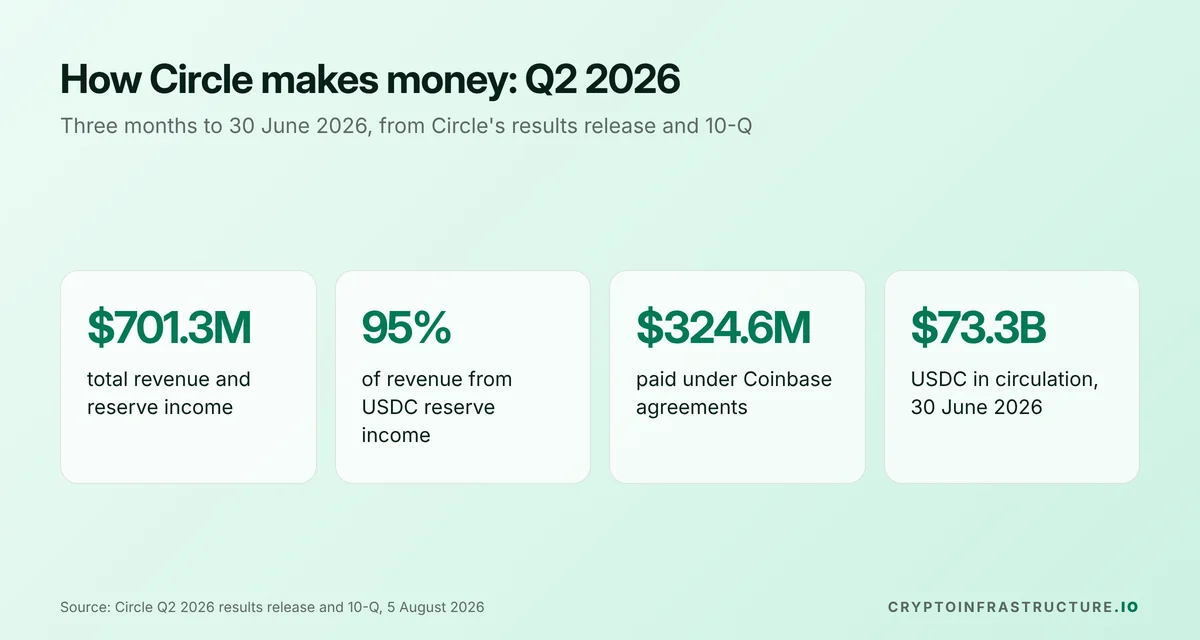
Almost entirely from interest on USDC’s reserves. When you hold USDC, the dollars behind it earn interest in Treasury-backed funds and bank deposits and Circle keeps that income. In Q2 2026, according to Circle’s results release of 5 August 2026 and the 10-Q:
| Q2 2026 (three months to 30 June 2026) | Figure |
|---|---|
| Total revenue and reserve income | $701.3 million (up 7% year on year) |
| Reserve income | $667.7 million, about 95% of the total |
| Other revenue (services, subscriptions and other products) | $33.6 million |
| Reserve return rate | 3.5%, down 66 basis points year on year |
| USDC in circulation, 30 June 2026 | $73.3 billion, up 19% year on year |
| Distribution and transaction costs | $410.4 million |
| Of which, paid under Coinbase agreements | $324.6 million |
| Revenue less distribution costs | $289 million (41% margin) as Circle reports it. Subtracting the two lines above gives $290.9 million; the small gap comes from other items Circle includes in its own measure |
| Net income from continuing operations | $48.2 million |
Sources: Circle Q2 2026 results release (Exhibit 99.1 to the 8-K filed 5 August 2026) and 10-Q filed 5 August 2026. Reserve income share calculated here.
That model makes Circle sensitive to interest rates. Its revenue depends on two things: how much USDC is in circulation and the rate earned on reserves. In Q2 2026 a 25.2% rise in average USDC in circulation more than offset the lower rate, per the 10-Q. The wider question of how issuers profit across the market is covered in the section on how stablecoin issuers make money in the stablecoin explainer.
Why Circle pays Coinbase so much
Coinbase is Circle’s largest distribution cost. The 10-Q describes the Collaboration Agreement this way: Coinbase receives allocations based on the amount of USDC held on its platform after Circle’s issuer retention and it also receives half of the remaining amount tied to broader ecosystem growth, after payments to approved third parties under the Stablecoin Ecosystem Agreement (dated 14 November 2024).
In Q2 2026 Circle’s Coinbase-related distribution costs were $324.6 million, about 79% of all distribution and transaction costs and about 46% of total revenue (both calculated here). For the first half of 2026 the figure was $655.3 million. Circle says it expects distribution expense to rise as it adds distributors and as reserve income grows.
Coinbase is not the only partner Circle pays. On 17 September 2026 Circle agreed a five-year arrangement with Binance, replacing deals from November 2024 and August 2025, under which Circle pays Binance a monthly incentive fee based on the USDC held through Circle’s wallet infrastructure service. For how Coinbase itself is regulated, see Is Coinbase Safe?
Circle’s bank charter and recent deals
Circle now owns a federally supervised national trust bank alongside its licensed money transmitter business. The key dates, from its Q2 2026 10-Q and 8-K filings:
| Date | Event |
|---|---|
| 9 July 2026 | Final approval from the Office of the Comptroller of the Currency (OCC) to establish First National Digital Currency Bank, N.A., a national trust bank operating as Circle National Trust |
| 24 July 2026 | Circle National Trust opened under direct OCC supervision, offering fiduciary digital asset custody to Circle and its affiliates at launch |
| 31 July 2026 | New York Department of Financial Services granted a limited purpose trust charter for Circle Internet Trust Company LLC |
| 4 September 2026 | Agreement to buy Singapore payments firm Tazapay for Circle Class A shares worth $400 million (subject to adjustments), announced 8 September and subject to closing conditions |
| 17 September 2026 | Expanded five-year USDC promotion arrangement with Binance |
| 25 September 2026 | Sean Neville leaves the board; CFO Jeremy Fox-Geen to step down by the end of 2026 |
The Tazapay deal is paid in new Class A shares, so if it closes, the sellers become Circle shareholders and existing holders are slightly diluted. The OCC approval covers the trust bank entity, not every Circle subsidiary.
What this means for you
Circle is a public company whose founders hold 30% of the vote through capped five-vote shares, with Jeremy Allaire alone at 23.9%. IDG Capital and Oak Investment Partners are the only other holders above 5% and the BlackRock, Binance and Coinbase links that often appear in “who owns Circle” answers are business relationships, not large listed shareholdings. For USDC holders, the entity that matters most is the Circle subsidiary that issues and redeems your coins and the reserves it reports each month. Circle earns about 95% of its revenue from reserve interest and passes a large part to Coinbase, so interest rates and distribution deals drive its results. Check the filing dates above when the next proxy or 10-Q updates these numbers.
For the rules that now govern issuers like Circle, read the stablecoin regulation guide.