
Yes, Coinbase reports to the IRS. As of 14 October 2026, Coinbase says it issues Form 1099-DA to US customers with gross proceeds from crypto sales or exchanges, Form 1099-MISC for rewards and staking income, plus Form 1099-B and 1099-DIV where they apply. For 2025 transactions the 1099-DA shows gross proceeds only. From 1 January 2026 it also shows cost basis, but only for “covered” crypto bought in your Coinbase account after 2025. Coinbase Wallet (now the Base app) activity, DEX trades and crypto transferred in from elsewhere are where your own records matter most. You report sales on Form 8949 and Schedule D and reward income on Schedule 1, whether or not a form arrives.
Coinbase taxes used to feel simple: a gain/loss report you could download, maybe a 1099-MISC if you earned rewards, and nothing the IRS could match line by line. That changed with the 2025 tax year. Coinbase is now a broker under the IRS digital asset reporting rules, which means a copy of your sales goes to the IRS on Form 1099-DA, and from 2026 trades some of them carry a cost basis figure the IRS can compare with your return.
Several pages ranking for this topic still quote a $600 threshold that no longer applies to 2026 income, describe forms Coinbase no longer lists, or skip the gap between what Coinbase reports and what you actually owe. This guide covers what Coinbase sends you and the IRS as of 14 October 2026, what the 1099-DA does and does not show, three worked examples, and how to file.
Does Coinbase report to the IRS?
Yes. Coinbase’s help page for tax professionals states that “Coinbase must report gross proceeds from the sale or exchange of digital assets directly to the IRS using Form 1099-DA”, starting with the 2025 tax year, and that the form will also include cost basis for sales of covered digital assets. That makes Coinbase a 1099-DA broker in its own words, alongside the IRS rule that brokers report gross proceeds on transactions from 1 January 2025 and basis on certain transactions from 1 January 2026 (IRS Digital assets page, last updated 2 September 2026).
Because the 1099-DA goes directly to the IRS, the IRS sees the same proceeds figures you see and can compare them with your return. Simply holding crypto on Coinbase is not a taxable event, according to Coinbase’s tax glossary. Selling, swapping and earning crypto are.
What tax forms does Coinbase send?
| Form | Who gets it (Coinbase’s wording) | What it means for you |
|---|---|---|
| 1099-DA | US customers with gross proceeds from sales or exchanges of crypto assets | Your sales and crypto-to-crypto swaps. Goes on Form 8949 and Schedule D |
| 1099-MISC | US customers who earned at least $2,000 in crypto and miscellaneous income, including staking rewards and incentives | Reward and staking income. Goes on Schedule 1. The threshold was $600 for 2025 income |
| 1099-B | US customers who sold futures, securities or other financial instruments | Futures and similar products, not spot crypto |
| 1099-DIV | US customers who earned more than $10 in dividends or capital gain distributions from investments | Dividends from investment products held through Coinbase |
Source: Coinbase Help, Taxes for US customers, checked 14 October 2026.
The 1099-MISC threshold changed: $600 for 2025, $2,000 from 2026
Coinbase’s glossary and download pages still describe the $600 threshold for 2025 rewards, and most ranking pages repeat it. For later years the number is different. The IRS instructions for Form 1099-MISC (IRS 1099-MISC instructions, checked 14 October 2026) say that for tax years beginning after 2025 the minimum reporting threshold for other income increased to $2,000, and may be adjusted for inflation from calendar year 2027. Coinbase’s current form list already uses $2,000.
The threshold only decides whether Coinbase sends a form. It does not decide whether the income is taxable. Coinbase’s own tax glossary says crypto income must be reported regardless of amount, even $1.
Forms Coinbase no longer provides or never issued
- Form 8949: Coinbase says that from tax year 2025 onward, Form 8949 is no longer available through the Coinbase Retail Tax Center. You build it yourself, or with tax software or a preparer.
- Form 1099-K: it does not appear on Coinbase’s current list of US tax forms (checked 14 October 2026). If a guide tells you to expect one from Coinbase for spot crypto sales, check the date it was written.
- Non-US customers: Coinbase’s download page says non-US customers receive no 1099 forms.
What Form 1099-DA shows for 2025 and 2026
The 1099-DA is the form that matters most, and the difference between the 2025 and 2026 versions is the main reason Coinbase tax questions spike.
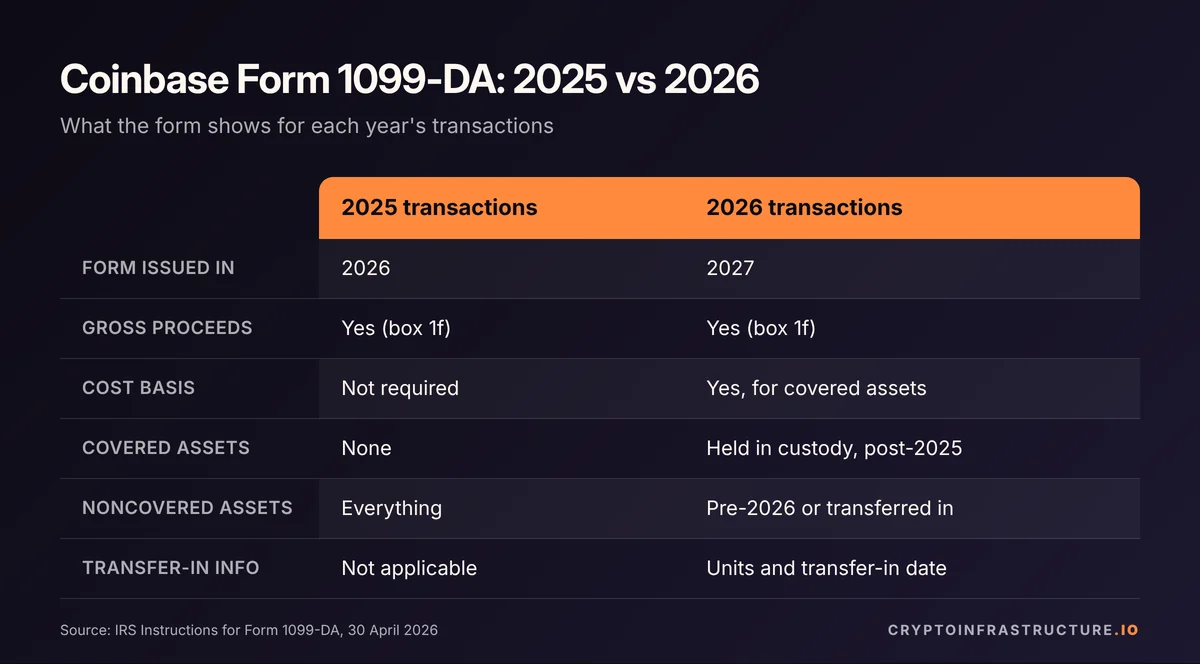
| 2025 transactions (forms issued in 2026) | 2026 transactions (forms issued in 2027) | |
|---|---|---|
| Gross proceeds (box 1f) | Yes | Yes |
| Cost basis (box 1g) | Not required | Yes for covered assets; optional for noncovered |
| Covered asset | None | Crypto acquired after 2025 in an account where the broker provided custody |
| Noncovered asset (box 9 checked) | Everything | Crypto acquired before 2026, or transferred into your account from elsewhere |
| Transfer-in details | Not applicable | Units and transfer-in date (boxes 12a and 12b) |
Source: IRS Instructions for Form 1099-DA (last updated 30 April 2026), checked 14 October 2026.
Three details in the IRS instructions explain most surprises:
- Transfers in start a new clock. Without acquisition information from you, a broker treats crypto transferred into your account as acquired at the date and time of the transfer. Coinbase repeats this and warns it “may result in differences between the cost basis reported by Coinbase and a client’s actual acquisition cost.”
- Stablecoins and NFTs have de minimis rules. Under an optional method, brokers need not report sales of qualifying stablecoins if your aggregate gross proceeds do not exceed $10,000 for the year, or sales of specified NFTs under $600. Not getting a form for these does not make the sale tax-free.
- Box 2 tells you what the IRS has. Box 2 is checked when the basis was reported to the IRS. That decides which Form 8949 box you use (see below).
When does Coinbase send the 1099-DA?
For the first 1099-DA, covering 2025, Coinbase’s blog post of 10 February 2026 told customers the form would be available by 19 March 2026, inside Coinbase Taxes. Some tax software pages say forms are “typically due by January 31”; for the 2025 forms Coinbase’s own date was later. Expect the 2026 forms in early 2027, and check Coinbase’s announcement for the exact date.
What Coinbase does not report
- Coinbase Wallet (Base app). Coinbase’s tax page says its tax documents do not include Coinbase Wallet or Coinbase Pro activity. Coinbase Wallet is self-custody, so swaps, DeFi and NFT trades there are yours to track. Coinbase’s wallet help page suggests exporting your public addresses (Base app, Assets, Settings, “Export public addresses”) into a crypto tax tool, and says you are still required to report crypto sales, conversions, payments and income to the IRS.
- DEX trades and Token Sales. Coinbase says DEX trades are not reported on its IRS forms, and Token Sales purchases are not reported on a Form 1099-DA.
- Coinbase Pro. Discontinued in December 2023. Coinbase says past activity stays viewable through account statements until 2027.
- Your real cost for transferred-in crypto. When cost basis is unknown, Coinbase’s wallet page says it defaults to $0 with the acquisition date set to the receipt date. Coinbase’s February 2026 blog post shows these as “Unknown” or “missing”. Filing with a $0 basis overstates your gain.
Which Coinbase activity is taxable?
| Activity on Coinbase | Taxable? | Where it goes |
|---|---|---|
| Buying crypto with dollars and holding | No | Nothing to report on the sale side; keep the purchase record |
| Selling crypto for dollars | Yes, capital gain or loss | Form 8949 and Schedule D |
| Converting one crypto to another | Yes, it is an exchange | Form 8949 and Schedule D |
| Spending crypto | Yes, a disposal | Form 8949 and Schedule D |
| Staking rewards and incentives | Yes, ordinary income when received | Schedule 1, then a new cost basis for later sales |
| Moving crypto between your own accounts or wallets | No, but keep records | Nothing, unless a later sale shows the wrong basis |
The IRS describes digital assets as property, reports sales on Form 8949, and directs income from staking, mining and forks to Schedule 1 (IRS Digital assets page, checked 14 October 2026). Every Form 1040 also asks whether you received digital assets as a reward or payment, or sold, exchanged or otherwise disposed of them. Converting BTC to ETH on Coinbase is a “yes” to that question even if you never withdrew dollars.
Will you be taxed on $1,000 of crypto profit?
Generally yes, and it does not matter whether Coinbase sent a form. How much depends on how long you held the crypto. Under IRS Topic 409 (last updated 24 September 2026), crypto held one year or less produces a short-term gain taxed as ordinary income at your graduated rates. Held more than a year, it is long-term: 0% at lower incomes, 15% for most people, and 20% above the 15% band thresholds. Net capital losses offset gains, and up to $3,000 a year ($1,500 married filing separately) of excess loss can offset other income, with the rest carried forward.
Do you need to report crypto income under $600?
Yes. The $600 (2025) and $2,000 (2026 onward) figures only decide whether Coinbase files a 1099-MISC. Reward income below them is still income, and Coinbase’s glossary says so directly.
What about cashing out $100,000?
A large withdrawal is not itself taxed. The sale that turned crypto into dollars is. A $100,000 sale appears on your 1099-DA as $100,000 of gross proceeds, and your tax depends on your gain, which could be close to zero or close to the full amount depending on your cost basis.
Worked examples
Assumptions for all three: you are a US individual, a calendar-year filer, no wash sale or business activity, figures are net of fees (Coinbase says US trading fees are included in cost basis and subtracted from proceeds), and the numbers are illustrations, not tax advice.
Example 1: 2025 sale of crypto you transferred in
You bought 1 ETH on another exchange on 10 January 2024 for $1,500, moved it to Coinbase, and sold it on Coinbase on 20 March 2025 for $3,000.
| Item | What Coinbase’s 1099-DA shows | What you report |
|---|---|---|
| Gross proceeds | $3,000 | $3,000 |
| Cost basis | Not reported (2025, noncovered) | $1,500, from the other exchange’s records |
| Holding period | Not shown | More than one year: long-term |
| Form 8949 box | Box K (long-term digital asset, basis not reported) | |
| Gain | $1,500 long-term |
If you filed the 1099-DA figure alone as profit, you would report $3,000 instead of $1,500. If you used Coinbase’s transfer-date logic, you would also wrongly treat it as short-term.
Example 2: 2026 sale of crypto bought on Coinbase
You buy BTC on Coinbase on 3 February 2026 for $2,000 and sell it on Coinbase on 10 August 2026 for $2,600. This is a covered asset, so the 2026 form (issued in 2027) should show $2,600 proceeds, $2,000 basis and box 2 checked.
- Short-term, basis reported to the IRS: Form 8949 box G, gain $600.
- If the form shows basis reported and no adjustments in boxes 1h or 1i, the Form 8949 instructions let you skip the 8949 line and report the totals directly on Schedule D line 1a (short-term) or 8a (long-term).
- If the reported basis is wrong, you still enter the reported figure in column (e) and correct it in column (g) with code B.
Example 3: rewards below the new threshold
During 2026 you receive staking rewards worth $700 at the time each one arrives. That is under the $2,000 1099-MISC threshold, so on Coinbase’s stated rules you get no 1099-MISC for 2026. You still report $700 of ordinary income on Schedule 1, and $700 becomes the cost basis of those reward tokens. The same rewards in 2025 would have crossed the old $600 line and produced a form.
How to file your Coinbase taxes
- Download your documents. Coinbase’s steps: go to Coinbase Taxes (accounts.coinbase.com/taxes), select Documents, and download the 1099 forms, gain/loss summaries and transaction history.
- Collect everything else. Records from other exchanges, Coinbase Wallet addresses, DeFi activity and the purchase records for anything you transferred in. The 1099-DA cannot see these.
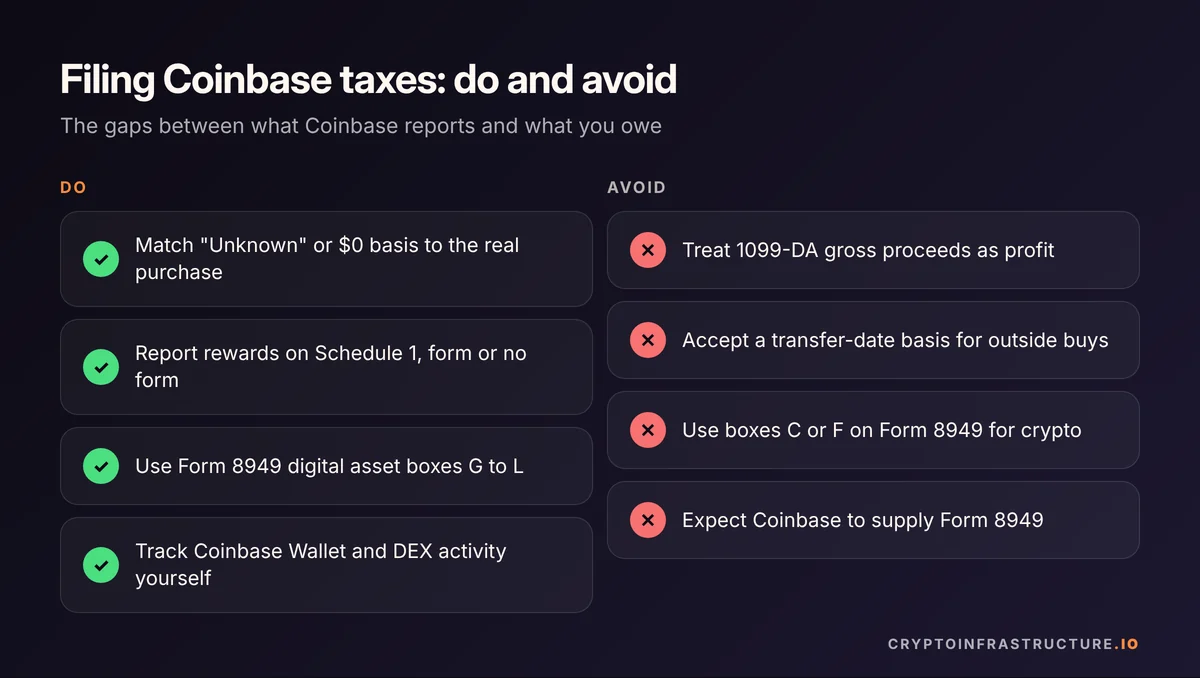
- Fix missing and $0 basis. Match every sale showing “Unknown” or $0 basis to the original purchase. This is where most overstated gains come from.
- Build Form 8949. Use the digital asset boxes from the 2025 Form 8949 instructions: G, H or I for short-term and J, K or L for long-term, not boxes C or F. Use G or J when basis was reported to the IRS, H or K when it was not.
- Carry totals to Schedule D. Combine with any stock sales and apply the $3,000 loss limit.
- Report income on Schedule 1. Staking, rewards and incentives, at their dollar value when received, whether or not you got a 1099-MISC.
- Answer the digital asset question on Form 1040 “Yes” if you sold, swapped, spent or received crypto during the year.
- Check 2025 lot identification. IRS Notice 2025-7 let you identify which units you sold from broker custody during 2025 using your own books and records, including a standing order recorded before the sale. If you relied on it, keep that record with your return.
Coinbase points users to a CoinTracker plan as a replacement for its Form 8949. Its February 2026 announcement lists 20% off for new CoinTracker users and up to $199 off for Coinbase One members, with fees applying and the offer expiring 31 December 2026. That is a company offer, not a recommendation here, and any tax tool works if your records are complete. This page carries no affiliate links.
Common mistakes with Coinbase taxes
- Treating 1099-DA gross proceeds as profit.
- Accepting a $0 or transfer-date basis on crypto you bought elsewhere.
- Assuming no 1099-MISC means no reward income to report.
- Forgetting Coinbase Wallet, DEX and other-exchange activity because it is not on Coinbase’s forms.
- Using boxes C or F on Form 8949 for crypto instead of the new digital asset boxes.
- Expecting Coinbase to supply Form 8949 for 2025 or later.
If you are outside the US
Everything above is US federal tax. Coinbase says non-US customers receive no 1099 forms, so a UK, Australian or other customer reports under local rules using Coinbase’s transaction history. Whether your Coinbase data reaches your own tax authority depends on that country’s reporting rules, not on the 1099 system. For the UK, where platforms began collecting tax details under the OECD Cryptoasset Reporting Framework in January 2026, see Crypto Tax in the UK. For Australia, Canada and India alongside the US, see How Is Crypto Taxed? The 2026 Guide.
What this means for you
As of 14 October 2026, Coinbase files Form 1099-DA with the IRS for your sales and swaps, 1099-MISC for rewards of $2,000 or more (from 2026 income), and 1099-B or 1099-DIV where they apply. The 2025 form shows proceeds only, so your cost basis is your job. The 2026 form shows basis only for crypto bought on Coinbase after 2025, so anything you moved in still needs your records. Coinbase Wallet, DEX trades and other platforms sit outside all of it. If your gains are large, your basis records are incomplete, or you used DeFi, a crypto-aware tax preparer can check your Form 8949 before you file.
To compare Coinbase with other platforms on licensing and transparency, read Is Coinbase Safe?, Coinbase vs Gemini and Best Crypto Exchanges in the USA, or browse the Exchanges section. The site’s methodology explains how sources are checked.


