In Dubai, VARA is the crypto regulator, not DMCC or IFZA. DMCC and IFZA are free zones: they issue the company’s trade licence, but any regulated virtual asset activity (exchange, broker-dealer, custody, lending, management, transfer, advisory) also needs a VARA licence, applied for through that free zone. The one exception is the DIFC, where the DFSA regulates crypto instead. VARA charges an application fee of AED 40,000 or AED 100,000 per activity and an annual supervision fee of AED 80,000 or AED 200,000. It requires paid-up capital from AED 100,000 (advisory) to AED 1,500,000 (exchange). DMCC quotes about AED 31,000 for a crypto trade licence; IFZA publishes no crypto fee on its own site.
If you are setting up a crypto business in Dubai, most of the pages you will find are written by company formation agents. Many of them describe a “DMCC crypto licence” or an “IFZA crypto licence” as if it were a regulatory licence. It usually is not. This guide separates the two layers every Dubai crypto company deals with: the trade licence from a free zone or the mainland, and the virtual asset licence from VARA. It then sets out official VARA fees and capital, what DMCC and IFZA actually provide, a year-one cost example and when the DIFC or Abu Dhabi’s ADGM is the better fit. Official figures come from the regulators’ own pages. Consultant figures are labelled as such.
Who licenses crypto businesses in Dubai?
The Virtual Assets Regulatory Authority (VARA) licenses virtual asset activities everywhere in Dubai, on the mainland and in the free zones, except the Dubai International Financial Centre (DIFC). VARA was set up in March 2022 under Dubai Law No. 4 of 2022 and describes itself as “the sole authority regulating virtual assets across Dubai’s free zones and mainland”, covering “Special Development Zones and Free Zones but excluding the Dubai International Financial Centre” (VARA).
So a Dubai crypto company needs two things:
- A commercial or trade licence from Dubai Economy and Tourism (DET) for the mainland, or from a free zone such as DMCC or IFZA. This creates the company.
- A VARA licence for each regulated virtual asset activity it carries out. VARA’s own process starts with an Initial Disclosure Questionnaire filed through DET or the free zone that will issue your commercial licence.
A free zone licence on its own lets you run activities that VARA does not regulate, such as blockchain software development or consulting. It does not let you exchange, hold or manage crypto for customers.
VARA vs DMCC vs IFZA at a glance
| VARA | DMCC | IFZA | |
|---|---|---|---|
| What it is | Dubai’s virtual asset regulator | Free zone authority with a dedicated Crypto Centre | Free zone authority (International Free Zone Authority, Dubai) |
| What it issues | VASP licence, one per regulated virtual asset activity | Company and trade licence | Company and trade licence |
| Covers regulated crypto activity on its own? | Yes, for the activities on the licence | No. DMCC says an “additional VARA licence will be required through DMCC” for regulated activities | No. VARA regulates virtual asset activity in all Dubai free zones except the DIFC |
| Official cost | AED 40,000 or 100,000 application fee per activity; AED 80,000 or 200,000 annual supervision fee per activity | About AED 31,000 for a crypto licence (DMCC’s own estimate, undated) | No crypto fee published on ifza.com |
| Capital | AED 100,000 to AED 1,500,000 per activity, or a share of fixed overheads if higher | No regulatory capital for the trade licence; VARA capital applies to regulated activities | Same as DMCC |
| Good fit for | Exchanges, brokers, custodians, lenders, asset managers, advisers serving clients from Dubai | Crypto companies that want a large crypto cluster (650+ crypto firms, per DMCC) and a free zone address for their VARA licence | Unregulated crypto activities (software, consulting) at a lower set-up cost, per consultant quotes |
Sources: VARA rulebook Schedule 2 and Company Rulebook Part VI.B, VARA “About” and licence application pages, DMCC crypto page, ifza.com.
Is crypto legal in the UAE?
Yes. Crypto is legal and regulated in the UAE, but who regulates it depends on where your company sits:
- Dubai mainland and Dubai free zones (DMCC, IFZA, DWTC and others): VARA.
- DIFC: the Dubai Financial Services Authority (DFSA), under its crypto token regime introduced in 2022. Since 12 January 2026 the DFSA no longer keeps a list of recognised crypto tokens; each firm must assess and document whether a token is suitable for its activity.
- Abu Dhabi Global Market (ADGM): the Financial Services Regulatory Authority (FSRA) authorises virtual asset activities inside ADGM.
- Federal level: the federal securities regulator, whose old sca.gov.ae pages now redirect to the Capital Market Authority (CMA) at uaecma.gov.ae, announced a Virtual Assets Framework on 13 April 2026 with “five core modules and eight regulated activities”. VARA’s public register now shows a CMA registration number column for its licensees. The Central Bank of the UAE separately covers payment tokens such as dirham stablecoins.
“Legal” does not mean “unlicensed is fine”. Carrying on a regulated virtual asset activity in Dubai without a VARA licence breaches VARA’s regime. VARA says plainly that a firm holding only its Approval to Incorporate “is not permitted to carry on Virtual Asset activities”.
How the VARA licence works
VARA licenses activities, not companies. The activities in its fee schedule and register are advisory, broker-dealer, custody, exchange (including exchange-traded derivatives for some licensees), lending and borrowing, VA management and investment, VA transfer and settlement plus Category 1 VA issuance. You pay and hold capital for each one you add.
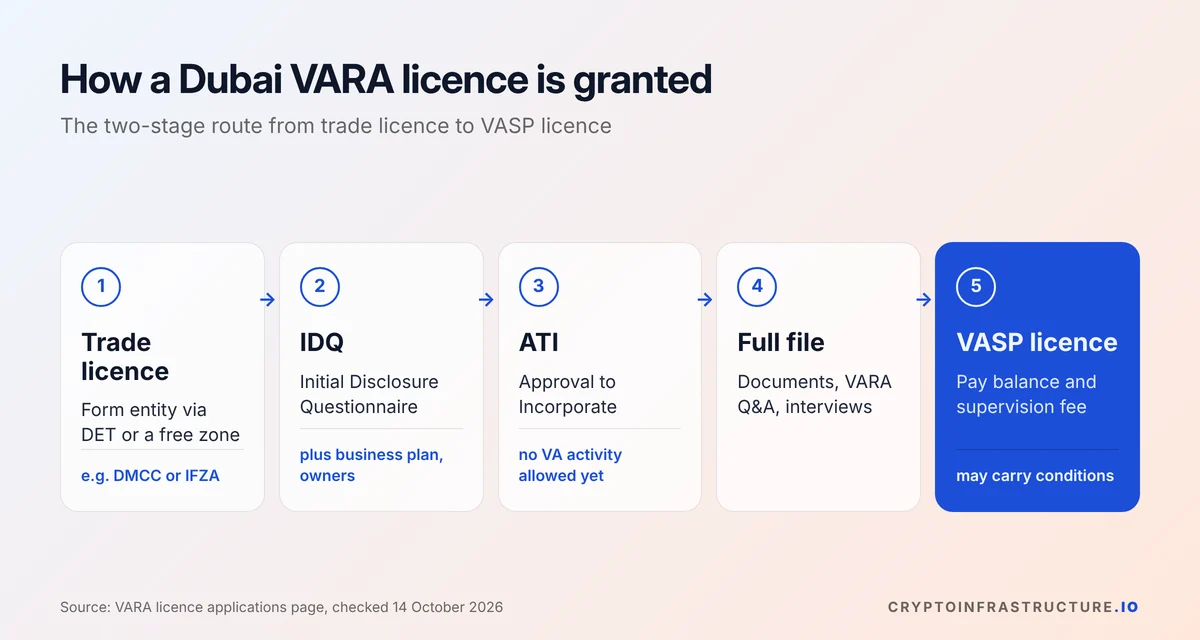
The process has two stages (VARA licence applications):
- Approval to Incorporate (ATI). You file an Initial Disclosure Questionnaire with DET or your free zone, add a business plan and details of owners and senior management and pay initial fees, typically about 50% of the licence application fee. The ATI lets you finish incorporating and setting up operations. You cannot carry on virtual asset activity yet.
- VASP licence. You file the full documentation, answer VARA’s questions (meetings and interviews are common), pay the rest of the licence fee and the first year’s supervision fee, then receive the licence, which may carry operating conditions.
VARA can refuse at either stage. It publishes no statutory decision deadline. Ranking consultant pages quote anything from “3 to 5 weeks” to about 16 to 25 weeks for VARA; treat both as sales estimates, not commitments.
How much does a VARA licence cost?
These are VARA’s own figures. Fees come from Schedule 2 of its regulations (VARA fee schedule) and capital from the Company Rulebook (VARA paid-up capital rules).
| VA activity | Application fee | Annual supervision fee | Paid-up capital (higher of) |
|---|---|---|---|
| Advisory services | AED 40,000 | AED 80,000 | AED 100,000 flat |
| VA transfer and settlement | AED 40,000 | AED 80,000 | AED 500,000 or 25% of fixed annual overheads |
| Broker-dealer | AED 100,000 | AED 200,000 | AED 600,000 or 25%; AED 400,000 or 15% using a VARA-licensed custodian |
| Custody | AED 100,000 | AED 200,000 | AED 600,000 or 25% |
| Exchange | AED 100,000 | AED 200,000 | AED 1,500,000 or 25%; AED 800,000 or 15% using a VARA-licensed custodian |
| Lending and borrowing | AED 100,000 | AED 200,000 | AED 500,000 or 25% |
| VA management and investment | AED 100,000 | AED 200,000 | AED 500,000 or 25%; AED 280,000 or 15% using a VARA-licensed custodian |
| Category 1 VA issuance | AED 100,000 | AED 200,000 | Set by the VA Issuance Rulebook |
The rulebook web page does not label every fee column; the reading above matches the advisory row, which is labelled, and the VASP licence comparison. Schedule 2 states an extension fee of 50% of the lower application fee in the advisory row; confirm with VARA how it applies when you add other activities. VARA may add or change supervision fees based on a firm’s risk, and may charge for VA issuance and whitepaper approvals.
Three rules matter for budgeting:
- Capital is per activity. A firm licensed for exchange and custody holds both amounts, each calculated on that activity’s own overheads.
- Capital is locked. It must sit in a trust account at a UAE-licensed bank or a surety bond from a UAE-authorised surety company, with VARA as beneficiary. It is reconciled monthly.
- Supervision fees are paid in advance of carrying on the activity, every year.
DMCC crypto licence: what it covers and what it costs
DMCC runs a Crypto Centre and says it hosts more than 650 crypto firms. Its standard crypto licence covers non-regulated activities such as software development, consultancy and trading. For regulated virtual asset activities, DMCC states that an “additional VARA licence will be required through DMCC”. It has a formal partnership with VARA for that process (DMCC crypto page).
DMCC’s own cost figure is “approximately AED 31,000”, covering company formation and licence application, with a trade licence taking about 4 weeks. Its Crypto Centre package advertises 70% off first-year licence fees and 50% off the second-year renewal. DMCC does not date these figures, so get a written quote before you budget.
Consultant figures (not official): one ranking setup agent puts DMCC year one at AED 55,000 to 75,000 including office, one visa and its fees; it puts renewal at AED 40,000 to 55,000.
IFZA crypto licence: what it covers and what it costs
IFZA is a Dubai free zone, so the same rule applies: it issues the company’s trade licence and VARA licenses any regulated virtual asset activity. IFZA’s own website does not publish licence package prices and does not mention crypto, virtual assets or VARA on its public pages; it directs enquiries to its sales team.
Consultant figures (not official): one setup agent quotes IFZA “from AED 15,000” in one section and a licence fee “from 9,000” in another, with year one at AED 25,000 to 30,000. Another agent’s IFZA guide lists a “VASP license” with AED 2,000,000 capital and an “annual license fee” of AED 150,000 to 300,000. Those capital and licence categories do not match VARA’s rulebook, which sets the requirements for any regulated activity an IFZA company carries out. If an agent sells you an “IFZA VASP licence”, ask which VARA activity it covers and when VARA will issue it.
IFZA can make sense for crypto businesses that stay outside VARA’s perimeter, such as blockchain development studios or analytics firms. If you will hold, exchange or manage customer assets, the VARA costs above apply in IFZA exactly as in DMCC.
Worked example: a broker-dealer in DMCC, year one
Assumptions: one VARA activity (broker-dealer), customer assets held with a VARA-licensed custodian, DMCC as the free zone, official figures only.
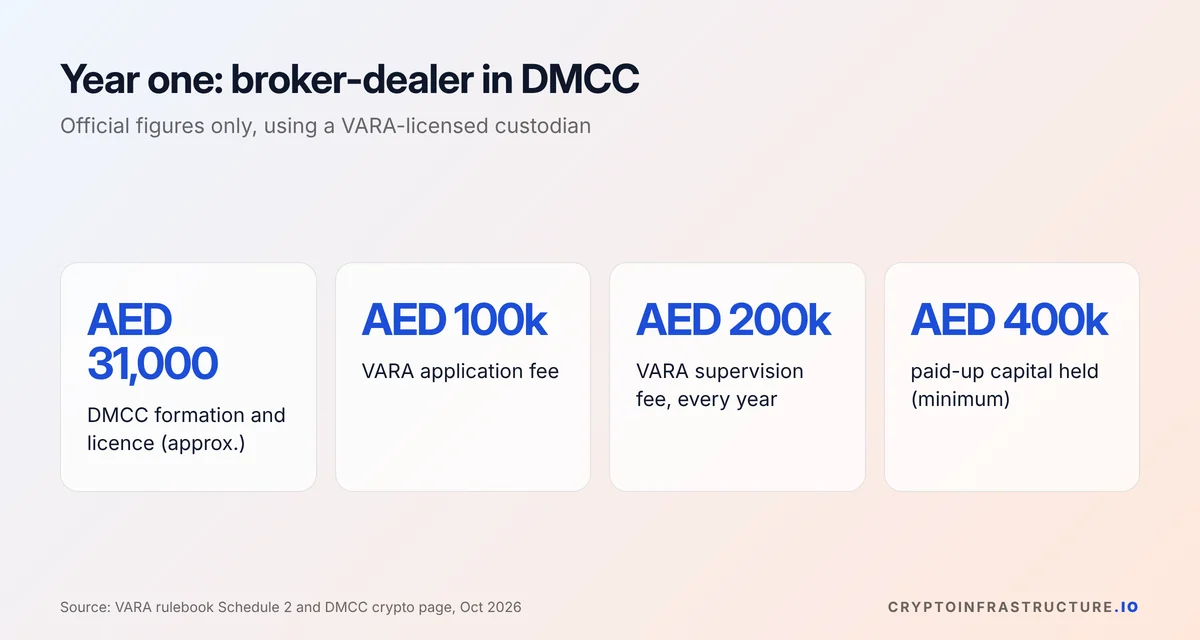
| Item | Amount | Type |
|---|---|---|
| DMCC company formation and crypto licence | About AED 31,000 | Spent (DMCC estimate) |
| VARA application fee | AED 100,000 | Spent (about half at the ATI stage) |
| VARA annual supervision fee | AED 200,000 | Spent, every year |
| Paid-up capital | AED 400,000, or 15% of fixed annual overheads if higher | Held in trust or surety bond |
| Total | About AED 331,000 spent, AED 400,000+ held |
Adding your own custody instead of using a licensed custodian would add an extension fee (AED 50,000 if the 50% rule applies; confirm with VARA), another AED 200,000 a year in supervision fees and AED 600,000 more capital for custody. It would also lift the broker-dealer capital from AED 400,000 to AED 600,000. Office, staff, audit, legal advisers and compliance tooling come on top and usually exceed the regulator’s fees.
Which exchanges already hold a VARA licence?
The VARA public register listed 59 active VASP licences in October 2026, with a separate tab for in-principle approvals. Examples, with the licensed entity and issue date:
- Binance FZE: licence issued 15 April 2024 (broker-dealer, management and investment, lending and borrowing, exchange including VA derivatives).
- Foris DAX Middle East FZE (Crypto.com): issued 3 April 2024.
- OKX Middle East Fintech FZE: issued 17 September 2024.
- Payward FZCO: issued 6 October 2026 for management and investment and broker-dealer services. Payward is Kraken’s parent company; see the Kraken review.
Bybit does not appear on the licensed tab; its Dubai status is covered in the offshore exchange comparison. If you are asking which exchange is “best” in Dubai, this site does not rank them for investing. The useful check is whether the entity you deal with is on the licensed tab, which activities it holds and whether it is an in-principle approval rather than a full licence.
DIFC and ADGM: when the alternative fits
- DIFC (DFSA): worth considering if you already run, or want, a DFSA-regulated financial services firm and crypto is one product among many. Crypto tokens fit into ordinary DFSA permissions and new firms start with an enquiry through DFSA Connect. Since 12 January 2026 you carry the token suitability assessment yourself. VARA has no jurisdiction there.
- ADGM (FSRA): Abu Dhabi’s financial free zone, with its own virtual asset authorisation. It is a separate emirate and a separate regulator, so an ADGM authorisation does not let you operate from a Dubai free zone. A VARA licence does not cover ADGM either. ADGM fees are not covered here; check the FSRA’s current fee rules.
The decision rule: if your team, office and customers are in Dubai outside the DIFC, VARA is the route and the free zone choice is mostly about cost, cluster and visas. If you need a common-law financial centre and a broader financial services licence, compare DIFC and ADGM directly.
Requirements checklist for a VARA licence
- A Dubai legal entity, formed through DET (mainland) or a Dubai free zone other than the DIFC.
- A business plan and details of beneficial owners, directors and senior management for the Initial Disclosure Questionnaire.
- Fit and proper senior management and a compliance function, under VARA’s Company Rulebook.
- Paid-up capital per activity, in a UAE trust account or surety bond naming VARA.
- AML/CFT, custody and technology controls; see the crypto compliance guide for the tooling.
- Fees paid in advance: about half the application fee at ATI, the balance and the first supervision fee before the licence.
Red flags in Dubai licence quotes
- “DMCC crypto licence” or “IFZA crypto licence” sold as permission to run an exchange. Regulated activity needs VARA; DMCC itself says so.
- Capital figures that don’t match VARA’s rulebook. Pages ranking for this keyword quote “Full Market AED 10M” or “IFZA VASP AED 2M”; VARA’s exchange figure is AED 800,000 or AED 1,500,000 (or a share of overheads).
- Weeks-long VARA timelines. VARA sets no deadline; a trade licence in weeks is not a VARA licence.
- Undated fee tables that mix trade licence, visa, consultant and VARA fees into one number.
- An ATI or in-principle approval presented as a licence. At ATI stage you may not carry on virtual asset activity.
What this means for you
“VARA vs DMCC vs IFZA” is not really a choice between three licences. VARA is the regulator for crypto activity in Dubai outside the DIFC. DMCC or IFZA is where your company lives. Pick your VARA activities first, because they drive most of the cost (AED 300,000 in year-one VARA fees for one higher-tier activity, AED 200,000 a year after that, plus locked capital), then choose the free zone on price, cluster and office needs. Confirm every figure with VARA and the free zone in writing before you sign a consultant’s package.
For how Dubai compares with the EU, UK, Singapore and Hong Kong, read the VASP licence guide. Providers that help with applications and ongoing compliance are covered in KYC/AML & Compliance. Month-to-month rule changes are tracked in the regulation roundup.
This guide is general information, not legal advice. Licensing requirements change and depend on your structure; take advice from a regulated lawyer before acting. See the site’s disclaimer.