Labuan does not issue a standalone “crypto exchange licence”. A crypto exchange in Labuan IBFC is licensed by the Labuan Financial Services Authority (Labuan FSA) as a money-broking business with digital asset activities, under the Guidelines on the Establishment of Money Broking Business dated 9 September 2024. The official numbers: RM1,500,000 minimum paid-up capital, a USD500 processing fee and a USD10,000 annual licence fee for new digital asset brokers (Labuan FSA lists the revised fee schedule as effective 1 January 2026; the regulations were gazetted on 30 June 2026 and came into operation on 1 July 2026). Existing licensees get a transitional phase-in to USD10,000 by 2028. You need a real office in Labuan, at least two board members plus a client base aimed at institutional investors and high-net-worth individuals. The licence gives no right to serve Malaysian onshore investors, where the Securities Commission (SC) runs its own exchange regime, and no passport to the EU or anywhere else.
If you are weighing Labuan as a base for a crypto exchange, the hard part is not finding a provider who will file the paperwork. It is working out which licence you actually need, what Labuan FSA’s own documents require and which of the figures on consultant pages are still current. Several ranking pages quote capital and fee numbers that predate the 2024 guidelines or the 2026 fee regulations. This guide works from Labuan FSA’s guidelines, the gazetted fee rules and the SC’s enforcement record. It labels every consultant figure as one.
Is Labuan right for you, in one line? Yes if you will serve mainly institutional and high-net-worth clients outside Malaysia and can hold RM1.5 million in capital with a real Labuan office; no if you want Malaysian retail users or access to the EU.
Labuan crypto licence at a glance
| Item | What applies | Source |
|---|---|---|
| Regulator | Labuan Financial Services Authority (Labuan FSA) | Labuan FSA |
| Licence used by crypto exchanges | Money-broking licence (Part VI, Labuan Financial Services and Securities Act 2010) covering “trading and exchanging of Digital Assets” | Money Broking Guidelines, 9 Sep 2024, para 6.2 |
| Minimum paid-up capital | RM1,500,000 with digital assets (RM1,000,000 without) | Money Broking Guidelines, para 7.1 |
| Processing fee | USD500 (USD1,500 extra for approval faster than the client charter period) | P.U.(A) 247/2026, gazetted 30 Jun 2026, in operation 1 Jul 2026 |
| Annual licence fee | USD10,000 with digital asset facilitation (USD5,000 conventional only); existing licensees phase in to these amounts by 2028 | P.U.(A) 246/2026; Labuan FSA fee schedule |
| Substance | Operational office in Labuan, at least two board members, fit and proper persons, dedicated IT staff for electronic models | Money Broking Guidelines, paras 7.2, 7.3, 7.12 |
| Target clients | Institutional investors and high-net-worth individuals; retail under half the client portfolio | Guidelines para 7.6; Labuan FSA FAQ Q6 |
| Tokens you may list | Only those that pass a board-approved admission process; privacy coins and algorithmic stablecoins banned | Admissibility Framework for Digital Currencies, 30 Dec 2024 |
| Malaysian onshore clients | Not covered; onshore exchanges need SC registration as a recognized market operator | SC, Labuan FSA FAQ Q7 |
This is a summary, not legal advice.
Is there a Labuan crypto exchange licence?
Not under that name. Labuan FSA says Labuan entities must get its “prior approval before undertaking proposed DFS-related activities”, where DFS (digital financial services) includes digital asset exchanges and crypto trading platforms. The approval route for an exchange is the money-broking licence. The Guidelines on the Establishment of Money Broking Business in Labuan IBFC (9 September 2024, replacing the 24 November 2017 version) define a digital asset as a “digital representation of value that can be digitally traded or transferred”. Paragraph 6.2 lets a licensed money broker bring together counterparties for trading and exchanging digital assets and run a system that matches those orders. That is an exchange in everything but name.
Three boundaries matter:
- Security tokens are out. A tradable digital asset under these guidelines “shall not have the features of securities” (footnote 1). Tokenised securities fall under Labuan’s securities rules, including the Guidelines on Labuan Securities Token Offering (9 October 2023). A securities exchange is approved separately under section 134 of the Act.
- Principal trading is out. Money broking means arranging deals as an intermediary for a fee. Buying and selling currencies as principal, market making and liquidity provision are excluded (para 1.1). If your model depends on an in-house market maker, raise it with Labuan FSA before you file.
- Other DFS activities need their own approvals. Labuan FSA lists separate guidelines for credit token business (7 February 2025) and, in a March 2026 exposure draft, payment system operators that provide digital asset services. Map every product line before choosing the licence.
Is Labuan considered Malaysia?
Yes. Labuan is part of Malaysia. Its fee regulations refer to offices “within Malaysia apart from Labuan”. It runs a separate regime for international business, Labuan IBFC, regulated by Labuan FSA rather than by the onshore regulators. That separation is exactly why a Labuan licence does not cover Malaysian onshore clients (see below).
Labuan crypto licence requirements
Capital
Paragraph 7.1 of the 2024 guidelines sets minimum paid-up capital of RM1,000,000 for conventional money broking and RM1,500,000 if you also carry on digital asset activities, “or its equivalent in any foreign currency”. The capital must be deposited with a regulated bank in Labuan or Malaysia, with certified evidence. Labuan FSA may ask for more based on your risk profile. Labuan FSA’s FAQ (dated 24 March 2025) adds that applicants should show funds to inject at least RM1.0 million and that shareholders are expected to keep a further 20% in reserve to cover any shortfall. Brokers licensed before September 2024 got two years to comply with the revised guidelines.
Several pages still quote RM500,000. That figure appears in a 2020 Labuan IBFC webinar and in COREDO’s November 2025 article; it is not the minimum in the current guidelines. Hans Worldwide lists a “Digital Asset Exchange” at RM10,000,000 paid-up with “no license fee”. No Labuan FSA document cited here supports either figure for a money-broking exchange.
Office, people and governance
- Operational office in Labuan, used for business purposes only and properly furnished, handling finance and accounting, regulatory and audited submissions, record keeping plus a contact person such as the principal officer (para 7.2).
- At least two board members; controllers, directors and the principal officer must pass fit and proper checks (paras 7.3, 8.1).
- Dedicated IT staff where the business runs on an electronic platform (para 7.12), which every exchange does.
- Home regulator consent if the applicant is already a regulated broker elsewhere (para 5.1).
- Marketing offices outside Labuan are allowed under separate guidelines (FAQ Q8).
The guidelines do not set a staff headcount. QX Trust, a Labuan trust company, says Labuan FSA expects at least two full-time staff and minimum annual operating expenditure of RM100,000; treat that as a consultant reading, not a rule from the guidelines.
Who you can serve
The licence is “intended to serve institutional investors and high-net worth individuals” (para 7.6). Appendix II defines high-net-worth individuals as having net assets above USD1 million or gross annual income above USD150,000. It defines institutional investors as including regulated firms, VASPs, governments and companies with net assets above USD3 million. The FAQ says retail clients should be less than half the client portfolio. Leverage on digital assets is capped at 1:1, against 100:1 for general money broking.
Which tokens you can list
Since 1 January 2025, Labuan money brokers and banks have had to follow the Admissibility Framework for Digital Currencies (30 December 2024), with existing firms given until 1 January 2026. In short:
- A Digital Currency Oversight Committee decides admissions under board-approved policies, after due diligence on each token.
- “Privacy coins and algorithmic stablecoins are not admissible” (para 8.2(iii)).
- Fiat-backed stablecoins need reserves at least equal to coins in circulation, held in segregated accounts with regulated banks or custodians, with quarterly public disclosures and annual independent verification.
- Delisting needs at least 30 calendar days’ client notice where practicable. Labuan FSA can order a token removed.
- You must publish admission and removal criteria plus a Key Features document for every token.
Platform rules from 2027
The Guidelines on the Management of Digital Money Broking Platform (issued 16 December 2025) take effect on 1 January 2027 for money brokers running platforms that trade digital currencies. They require prior Labuan FSA approval to outsource platform functions, and only to providers regulated by a financial regulator; two-factor login and intrusion detection; order controls and pre- and post-trade monitoring; a tested business continuity plan with notice to Labuan FSA within 48 hours of activating it; records kept for at least six years; internal audit of the platform at least every three years. You may not lend to clients to buy assets on the platform. If you plan to run a white-label exchange engine from an unregulated vendor, this is the rule that will stop you. See the white-label exchange guide for how those deals are structured.
AML and the Travel Rule
The admissibility framework lists Labuan FSA’s AML/CFT/CPF guidelines for reporting institutions and its Guidelines on Travel Rule for Labuan Digital Financial Services among the documents a licensee must also follow. Expect customer due diligence, transaction monitoring, suspicious transaction reporting and Travel Rule messaging from day one. The crypto compliance guide covers the tooling.
Labuan crypto licence cost: official vs consultant figures
| Cost item | Figure | Source type |
|---|---|---|
| Processing fee, licence application | USD500 | Official: P.U.(A) 247/2026, item 8(a) |
| Faster approval than the client charter period | USD1,500 | Official: P.U.(A) 247/2026, item 9 |
| Annual licence fee, money broking with digital asset facilitation (new applicant) | USD10,000 | Official: P.U.(A) 246/2026, Third Schedule item 5(i)(vi)(B) |
| Annual licence fee, digital asset money broker already licensed (transitional) | USD1,500 (2026), USD5,750 (2027), USD10,000 (from 2028) | Official: Labuan FSA fee schedule, transitional arrangement for existing licensees |
| Annual licence fee, conventional money broking | USD5,000 (existing licensees: USD1,500 in 2026, USD3,250 in 2027, USD5,000 from 2028) | Official: P.U.(A) 246/2026, item 5(i)(vi)(A); Labuan FSA fee schedule |
| Annual fee per marketing office in Malaysia outside Labuan, where applicable | USD3,500 | Official: P.U.(A) 246/2026, item 5(p) |
| Annual fee, exchange approved under section 134 (securities) | USD13,000 | Official: P.U.(A) 246/2026, item 5(q) |
| Minimum paid-up capital (held, not spent) | RM1,500,000 | Official: Money Broking Guidelines para 7.1 |
| Processing fee / fast track | USD350 / USD1,550 | Consultant (Global Law Experts, July 2026); USD350 also in the 2024 guidelines, superseded by the 2026 order |
| One-off set-up (incorporation, legal, tech audit, AML tools) | USD25,000 to USD100,000+ | Consultant (Global Law Experts) |
| First-year government and initial operating cost | About USD42,000 to USD83,000, excluding staff and platform | Consultant (Global Law Experts) |
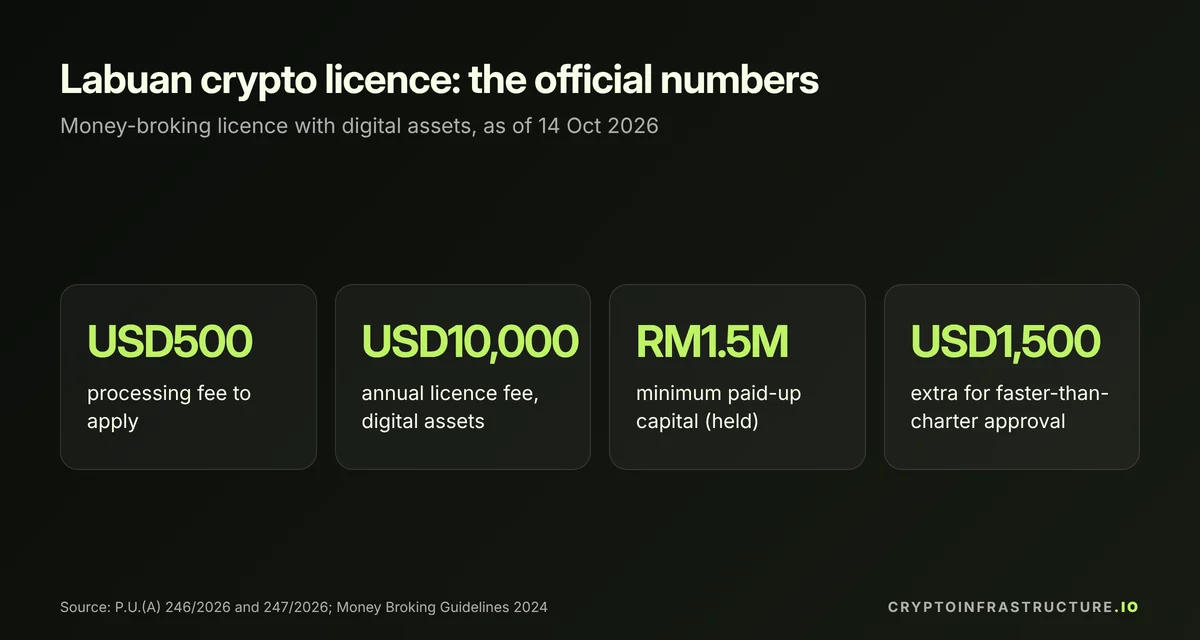
Labuan FSA’s fee schedule page lists the revised structure as effective 1 January 2026. The fee regulations themselves (P.U.(A) 246/2026 and P.U.(A) 247/2026) were gazetted on 30 June 2026 and came into operation on 1 July 2026. Labuan FSA’s circular of 15 July 2026 says it is reconciling fees paid in the first half of 2026. Consultant figures are their own estimates. This is a summary, not legal advice.
Two things stand out. First, pages written before July 2026 can carry the wrong processing fee: the 2024 guidelines say USD350, the gazetted order says USD500. Second, the annual fee for a digital asset broker is now double the conventional fee. A new applicant pays the full USD10,000 from the start; brokers that were already licensed get Labuan FSA’s own transitional phase-in (USD1,500 in 2026, USD5,750 in 2027, USD10,000 from 2028). Ask any provider which category you fall into and which gazette item or Labuan FSA schedule their number comes from.
Worked example: the official floor
Assume one new Labuan company applying for a money-broking licence with digital asset activities, using only the official figures:
- Processing fee: USD500
- First annual licence fee: USD10,000
- Paid-up capital deposited with a bank in Labuan or Malaysia: RM1,500,000, plus the 20% shareholder reserve Labuan FSA’s FAQ expects (RM300,000)
That is USD10,500 paid to the regulator and RM1.8 million tied up before you pay for the Labuan office, staff, the platform, an approved auditor, AML tooling or advisers. On tax, Hans Worldwide states a 3% rate on audited net profit for Labuan entities that meet substance requirements; this guide cites no Labuan FSA or tax authority document for that rate, so confirm it with a tax adviser.
How long does it take?
The guidelines and fee orders set no statutory decision deadline for a money-broking application. Global Law Experts says Labuan FSA’s client charter gives 30 working days for normal processing and 15 for fast track. It estimates 45 to 120 days from incorporation to licence. COREDO says 2 to 3 months; QX Trust says “several months” plus around 90 days after a conditional approval to meet operating conditions. All three are consultant estimates. The USD1,500 fee for approval earlier than the client charter period confirms a charter clock exists, but its length is not stated in the fee order.
How to get a crypto exchange licence in Labuan: the steps
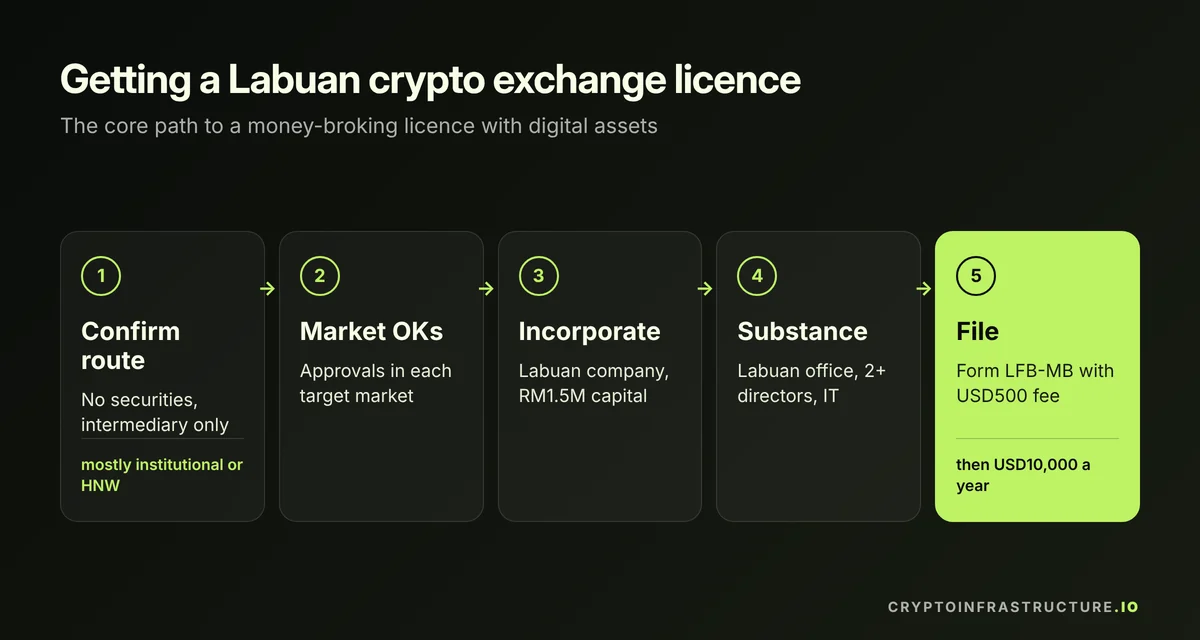
- Confirm the route. Make sure your tokens are not securities, that you act as intermediary rather than principal and that your clients will be mostly institutional or high-net-worth.
- Get approvals for target markets. Paragraph 7.15 requires approvals from the authorities in each market you intend to operate in before you start there, with copies to Labuan FSA. Where a market has no licensing regime, Labuan FSA may accept a legal opinion from a local law firm (FAQ Q10).
- Incorporate a Labuan company and deposit at least RM1,500,000 paid-up capital with a regulated bank in Labuan or Malaysia.
- Set up substance: the Labuan office, two or more fit and proper directors, a principal officer and IT staff.
- Write the token admission policy and set up the oversight committee required by the admissibility framework, plus AML, Travel Rule and technology risk policies.
- File Form LFB-MB with Labuan FSA’s Authorisation and Licensing Unit, paying the USD500 processing fee.
- Answer Labuan FSA’s questions, meet any conditions, then pay the USD10,000 annual fee by 15 January each year.
- Prepare for 1 January 2027, when the digital money broking platform guidelines take effect.
Serving Malaysian residents: the SC regime
A Labuan licence does not let you run an exchange for Malaysian onshore investors. Labuan FSA’s FAQ (Q7) says brokers must follow Malaysia’s Foreign Exchange Administration rules and get approval from the domestic authorities before doing business in Malaysia. Onshore, digital asset exchanges are registered by the Securities Commission Malaysia as recognized market operators (RMOs). The SC’s list of registered digital asset exchanges (updated 20 July 2026) names five: HATA Digital, Luno Malaysia, MX Global, SINEGY DAX and Kinetic DAX.
The SC enforces this against large offshore platforms. On 27 December 2024 it announced that it had reprimanded Bybit Technology Limited and its CEO Ben Zhou for operating a digital asset exchange in Malaysia without registration, an offence under section 7(1) of the Capital Markets and Services Act 2007. Bybit was directed to disable its website and apps in Malaysia within 14 business days from 11 December 2024, stop advertising to Malaysian investors and close its Malaysian Telegram support group. The SC said Bybit complied. It noted that Bybit and Ben Zhou had been on its Investor Alert List since July 2021. A Labuan entity that markets to Malaysians without SC registration runs the same risk.
Is Luno certified in Malaysia?
Luno Malaysia Sdn. Bhd. is on the SC’s list of registered digital asset exchanges updated 20 July 2026. That is an onshore SC registration, not a Labuan licence.
Does a Labuan licence work in the EU or other markets?
No. There is no passport. A Labuan money-broking licence authorises business from Labuan IBFC. The guidelines themselves require you to get approval in each market you intend to operate in (para 7.15). If you want EU clients, you need a separate authorisation under the EU’s Markets in Crypto-Assets Regulation (MiCA); the Lithuania licence guide shows what that involves. The same applies to Hong Kong, where an exchange needs its own SFC licence (see the Hong Kong VATP guide). For a side-by-side of eleven jurisdictions, use the VASP licence guide.
How to tell if a Labuan crypto exchange is legit
- Ask for the Labuan FSA licence and verify it. Labuan FSA publishes a financial institutions directory. Its “List of Labuan Digital Financial Service Providers” link pointed to a contact page in October 2026, so no public list of approved crypto operators was available; ask Labuan FSA directly.
- Look at the licence type. A Labuan company registration or a trust company relationship is not a money-broking licence.
- See where it markets. A Labuan exchange marketing to Malaysians without SC registration, or to EU residents without MiCA authorisation, is outside its licence.
- Compare its token list with the admissibility framework. Privacy coins or algorithmic stablecoins on a Labuan-licensed platform are a warning sign.
Red flags when buying a Labuan licence package
- RM500,000 quoted as the capital for a crypto exchange. The 2024 guidelines say RM1,500,000 for digital asset activities.
- USD350 processing fee or “no licence fee”. The 2026 rules set USD500 to apply and USD10,000 a year for new digital asset brokers.
- “Licence covers Malaysia” or “passport to Europe”. It covers neither.
- A virtual office only. Paragraph 7.2 requires an operational office in Labuan.
- Retail-first marketing plans. The licence is aimed at institutional and high-net-worth clients, with digital asset leverage capped at 1:1.
- An unregulated white-label engine. From 1 January 2027, outsourced platform functions need Labuan FSA approval and a regulated provider.
What this means for you
Labuan can work for a regional exchange serving professional and high-net-worth clients outside Malaysia. The official costs are clear: USD500 to apply, USD10,000 a year for a new digital asset broker and RM1.5 million in capital. It does not work as a way into Malaysian retail, which the SC has shown it will police, or as a shortcut to other markets, each of which needs its own approval. Build your plan from the 2024 guidelines, the admissibility framework and the 2026 fee rules. Prepare now for the platform rules that start on 1 January 2027. Compliance providers for KYC, monitoring and Travel Rule are covered in the KYC/AML & Compliance section. Rule changes are tracked in the regulation roundup.
This guide is general information, not legal advice. Licensing requirements change and depend on your structure; take advice from a regulated lawyer before acting. See the site’s disclaimer.