OKX vs Binance, with KuCoin, Bybit and MEXC alongside them, has no single winner, because each one is licensed for different things in different places. OKX holds an EU MiCA licence through Malta, a Dubai VARA licence and US state licences through a separate company. Binance holds a Dubai VARA licence and three Abu Dhabi licences but no EU licence. It stopped EU services from 1 July 2026. KuCoin’s Austrian company has a MiCA authorisation it is still not allowed to start using. Bybit’s global terms name an Abu Dhabi company that says it is licensed by “the CMA”. Its EU arm says it holds a MiCA licence. In Dubai it has only an in-principle approval. MEXC’s terms name a company in the Comoros and no licence. None of the five global platforms serves US residents. Three of them (Binance, OKX, KuCoin) have pleaded guilty in US criminal cases. Bybit lost about $1.5 billion to a North Korean hack in February 2025. Entry spot fees run from 0.05% taker (MEXC) to 0.10% (the other four).
If you are comparing OKX and Binance, you are probably also looking at KuCoin, Bybit and MEXC, because these five are the large offshore exchanges that keep coming up when one of them is not available where you live. Most comparison pages rank them on fees and coin counts and declare a winner. That leaves out the question that decides whether a platform is even an option for you: which company would hold your account, which regulator supervises it and what has gone wrong before. This comparison puts all five side by side on licences by region, US access and enforcement, proof of reserves, incidents, fees from each exchange’s own fee page plus India’s FIU-IND status. It does not pick a winner. It shows what each one is and isn’t licensed for, with dates.
OKX vs Binance (and KuCoin, Bybit, MEXC): the short answer
On fees, the five are close: four charge 0.10% for a spot market order at the entry tier, and MEXC charges 0.05%. On regulation, they are far apart. OKX has the broadest set of verifiable licences of the five (EU, Dubai and most US states through OKX US). Binance is licensed in Dubai and Abu Dhabi but has no EU licence. KuCoin and MEXC operate their global platforms without a licence named in their terms. Bybit sits in between, with a UAE licence claim for its global platform and a MiCA licence claim for its EU arm. On track record, Binance, OKX and KuCoin have US guilty pleas behind them. Bybit suffered the largest exchange hack on record in February 2025. Where you live narrows the choice before any of this: US residents can use none of the five global platforms, and Indian users should check FIU-IND registration first.
Side-by-side: the five exchanges at a glance
Each cell summarises evidence set out in the sections below. Read the section before relying on any one cell.
| Criterion | OKX | KuCoin | Bybit | MEXC | Binance |
|---|---|---|---|---|---|
| Global platform operator named in terms or filings | Aux Cayes FinTech Co. Ltd. (DOJ case, 2025) | No entity named in terms; governed by Turks and Caicos law | Bybit Virtual Asset Platform Operator L.L.C. S.P.C, Abu Dhabi | MEXC (Comoros) Ltd, Union of Comoros | Binance Holdings Limited (DOJ case, 2023) |
| EU | MiCA licence, OKX Europe Limited (Malta) | MiCA authorisation (Austria), but operations still prohibited by the FMA | Bybit EU (Austria) says it holds a MiCA licence | No licence named | No MiCA licence; EU services stopped from 1 July 2026 |
| Dubai (VARA) | Licensed since 17 September 2024 | Not on register | In-principle approval only (21 August 2024) | Not on register | Licensed since 15 April 2024 |
| US residents | Only via OKX US (OKX INC.); not New York | No; US accounts closed 23 January 2025 | No; US excluded in terms | No; US prohibited in terms | No; Binance.US is a separate company |
| US criminal case | Guilty plea, February 2025 | Guilty plea, January 2025 | None found | None found | Guilty plea, 21 November 2023 |
| Latest proof of reserves seen | 48th report, 3 October 2026 (zk-STARK) | 30 September 2026 (Merkle tree) | 23 September 2026 (Merkle tree) | 8 October 2026 (wallet vs user assets) | No snapshot date shown on page |
| Largest incident | No exchange-wide theft found | $281m hack, September 2020 | About $1.5bn hack, February 2025 | None found | 7,000 BTC hack, May 2019 |
| Entry spot maker / taker | 0.08% / 0.10% | 0.10% / 0.10% | 0.10% / 0.10% | 0.00% / 0.05% | 0.10% / 0.10% |
| Entry futures maker / taker | 0.02% / 0.05% | 0.02% / 0.06% | 0.02% / 0.055% | 0.01% / 0.04% (0.00% / 0.02% on BTC and ETH perps) | 0.02% / 0.05% |
| India FIU-IND | India on OKX’s restricted list | FIU-IND order 2024; registration not confirmed | Penalty January 2025, then registered | No order or registration found | Penalty June 2024, then registered |
Based on each exchange’s terms, fee and proof-of-reserves pages, the VARA public register, the FMA, FIU-IND and DOJ plus the sources named in each section. Proof-of-reserves snapshots are updated regularly, so the dates above may since have moved on.
How this comparison works
The criteria come from the site’s methodology: track record, transparency, security practices, pricing clarity and jurisdiction coverage. For five exchanges they become six checks, applied in the same order:
- Who runs the platform and which company your terms name
- Licences by region, from regulator registers where available
- US access and enforcement history, dated
- Proof of reserves: method, latest snapshot date and who checked it
- Incidents: hacks and how users were treated
- Fees, from each exchange’s own fee page, with a worked example
There was no hands-on testing. No exchange paid to be included. There are no sign-up or affiliate links on this page. The single-exchange evidence reviews for Binance, OKX and KuCoin go deeper on each. Bybit and MEXC are covered here at table depth.
The five exchanges, one by one
OKX
OKX runs as a group of regional companies. Its global platform operator, Aux Cayes FinTech Co. Ltd., is the company that settled with the US Justice Department in February 2025. EU users are served by OKX Europe Limited, which the OKX EU site says is “licensed by the Malta Financial Services Authority” as a crypto-asset service provider under MiCA. In Dubai, OKX Middle East Fintech FZE holds VARA licence VL/23/12/003, active since 17 September 2024, including exchange services with derivatives. In the US, OKX INC. (NMLS ID 1767779) serves customers in most states but not New York or four US territories, per its licence page updated 15 September 2026. OKX’s own risk disclosure (updated 8 July 2026) lists Canada, Hong Kong, India, Japan and Malaysia among fully restricted locations.
KuCoin
KuCoin’s terms of use name no operating company, describe KuCoin as an “information intermediary service Platform” and are governed by Turks and Caicos law. Its Austrian company, KuCoin EU Exchange GmbH, was granted MiCA authorisation on 27 November 2025. The Austrian regulator, the FMA, then banned new business on 19 February 2026 and lifted that ban on 18 May 2026. It says starting business operations “remains inadmissible” until governance conditions are met (FMA release, 18 May 2026). KuCoin’s restricted list includes the US, Singapore, mainland China, Hong Kong, Malaysia, Ontario, British Columbia, France and the Netherlands. In October 2026 South Korea’s Financial Intelligence Unit was reported to have ordered KuCoin’s website blocked as an unregistered foreign exchange (CryptoTicker). On 29 October 2026 KuCoin was reported to be ending services in Russia and Belarus (CoinSpectator).
Bybit
Bybit was founded in 2018 by Ben Zhou, who remains chief executive (Wikipedia). Its global terms name Bybit Virtual Asset Platform Operator L.L.C. S.P.C, incorporated in Abu Dhabi and described as “regulated by the CMA” under licence number 20200000337. The terms do not spell out the regulator’s full name and this review did not search that regulator’s register, so treat this as a company statement. In Dubai, the picture is different: the VARA register lists Bybit Fintech FZE with an in-principle approval (IPA/24/08/001, issued 21 August 2024) for exchange services, not a full licence. VARA says IPA holders may not start operations. Bybit’s own terms list Dubai as an excluded jurisdiction. Bybit EU, operating from Austria, says it holds a MiCAR licence “for designated services”. Wikipedia records the FMA authorisation as May 2025. In India, the registered entity is Bybit Fintech Limited, shown as incorporated in Seychelles (see the Bybit India guide).
MEXC
MEXC’s user agreement names MEXC (Comoros) Ltd, registered in Anjouan, Union of Comoros, with English law governing and disputes sent to arbitration in Hong Kong. The agreement names no licence. MEXC does not appear on the VARA register. No MEXC registration was found in the other sources reviewed. Its prohibited list includes the US, the UK, Canada, Singapore, Hong Kong, mainland China, Malaysia and Kazakhstan. South Korea’s Financial Intelligence Unit was reported to have included MEXC in the unregistered foreign exchanges it ordered blocked in October 2026 (CryptoTicker). The agreement also says “MEXC maintains full custody of the assets”, with no statement on segregation or insurance. Is MEXC a KYC exchange? MEXC’s own guide says yes: verification is required to use its products, and unverified accounts face limits. One competitor page describes it as lighter-KYC; the operator’s own guide is the source to rely on.
Binance
Binance’s licences page lists only three Abu Dhabi entities regulated by the FSRA: Nest Exchange Limited, Nest Clearing and Custody Limited and Nest Trading Limited. In Dubai, Binance FZE holds VARA licence VL/24/04/001, active since 15 April 2024, including exchange and derivatives services. In the EU, Binance withdrew its MiCA application in Greece and told French clients it would end crypto services in France from 1 July 2026, with similar notices to users in other EU markets (Euronews, 25 June 2026). Binance said user assets would stay accessible. Is Binance US the same as Binance.com? No. Binance.com does not serve US residents. Binance.US is a separate company with its own licences, as the Binance review sets out.
What each exchange is and isn’t licensed for
This is the table most comparisons skip. A licence covers one company in one place, so “licensed” means nothing until you know which company holds your account.
| Region | OKX | KuCoin | Bybit | MEXC | Binance |
|---|---|---|---|---|---|
| EU (MiCA) | Licensed: OKX Europe Limited, MFSA | Authorised 27 November 2025 (KuCoin EU Exchange GmbH, FMA); operations still prohibited under the FMA’s 18 May 2026 release | Bybit EU says it holds a MiCAR licence; FMA authorisation reported May 2025 | No licence named | None; Greek application withdrawn, services ended from 1 July 2026 |
| UAE | VARA licence VL/23/12/003 (Dubai) | Not on VARA register | “CMA” licence 20200000337 claimed in terms (Abu Dhabi); VARA in-principle approval only, Dubai excluded | Not on VARA register | VARA licence VL/24/04/001; three ADGM FSRA entities |
| United States | OKX INC., state money transmitter licences; not New York | Restricted | Excluded | Prohibited | Binance.com not available; Binance.US separate |
| United Kingdom | Derivatives, CeFi and P2P services restricted | Not on restricted list | Excluded | Prohibited | See the Binance UK guide |
| India | Fully restricted by OKX | FIU-IND order against Peken Global (KuCoin) listed; India not on KuCoin’s restricted list | FIU-IND registered after Rs 9.27 crore penalty | India not on MEXC’s prohibited list; no FIU-IND registration found | FIU-IND order 19 June 2024; registered afterwards |
Sources: the VARA public register (licensed and in-principle lists); each exchange’s terms and licence pages; the FMA; Euronews (25 June 2026); FIU-IND compliance orders page. The CMA, MFSA and FMA registers were not searched directly; entries marked as company statements are as each exchange describes them.
What a licence does not mean
A licence lets a regulator supervise and fine one company. It does not guarantee your balance. It does not cover you if you are signed up with a different company in the same group. Bybit’s EU site says this directly: “Certain offerings on bybit.eu fall outside the scope of MiCAR regulatory oversight.” An in-principle approval, like Bybit’s in Dubai, is not a licence at all.
Can US residents use any of them? US access and enforcement
Not the global platforms. KuCoin, Bybit and MEXC exclude US residents in their terms. Binance.com does not serve them. OKX serves them only through OKX US, a separate licensed company. The history behind those restrictions is what matters for everyone else, because it shows how each company operated before.
| Date | Exchange | Authority | What happened |
|---|---|---|---|
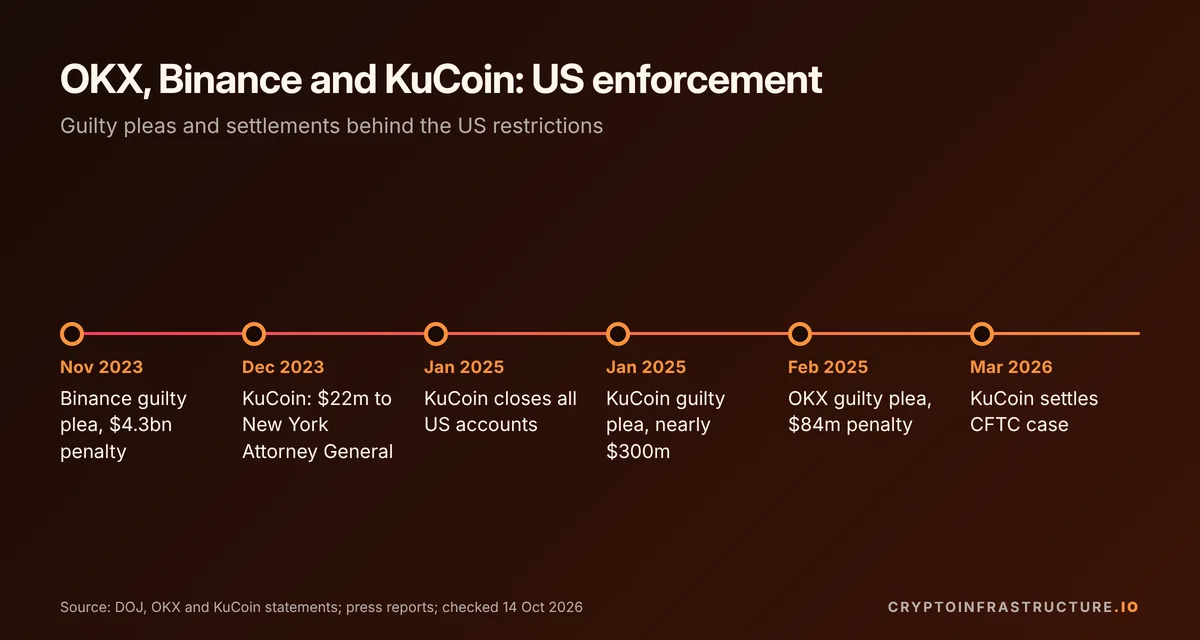
| 21 November 2023 | Binance | US Department of Justice | Binance Holdings Limited pleaded guilty to Bank Secrecy Act, unlicensed money transmitting and sanctions (IEEPA) violations. Total penalty $4,316,126,163, with an independent compliance monitor for three years (DOJ release). |
| December 2023 | KuCoin | New York Attorney General | $22 million in fines and refunds; New York trading discontinued (Bloomberg, via Wikipedia) |
| 23 January 2025 | KuCoin | KuCoin (self-imposed) | All US user accounts closed at 9:00 PM EST; later withdrawals need customer service and a one-time 30 USDT fee (KuCoin announcement, 16 January 2025) |
| January 2025 | KuCoin | US Department of Justice | Guilty plea on 27 January 2025 to operating an unlicensed money transmitting business; nearly $300 million in fines and forfeitures (DOJ release) |
| 24 February 2025 | OKX | US Department of Justice | Aux Cayes FinTech acknowledged it had not obtained a money transmitter licence; $84 million penalty and about $421 million forfeited fees from US customers. OKX said there were “no allegations of customer harm” (OKX statement). |
| March 2026 | KuCoin | CFTC | Consent order with a $500,000 penalty and a permanent bar on serving US customers unless KuCoin registers (CoinDesk, 31 March 2026). More in the KuCoin review. |
| No US action found | Bybit, MEXC | None | No US enforcement action against either was found in the sources reviewed. Both exclude US users in their terms. |
The Binance and OKX entries come from the DOJ and OKX directly. KuCoin’s DOJ entry links the Justice Department release, its CFTC entry CoinDesk’s report and its New York entry press reports summarised on Wikipedia.
Two other records belong here. Bybit paid Rs 9.27 crore to India’s FIU-IND on 31 January 2025 for serving Indian users without registering. FIU-IND had its websites blocked (PIB release, 31 January 2025). Bybit also settled a lawsuit from the FTX bankruptcy estate for $228 million in October 2024 (Wikipedia). For Binance, this site’s Binance review covers 2026 developments, including a reported Justice Department review of its compliance with the 2023 plea.
Proof of reserves compared
All five publish a proof of reserves (PoR): a snapshot showing the exchange’s wallets hold at least as much of certain coins as its records say users are owed. None of the five pages names an independent auditor.
| Exchange | Method | Snapshot date shown (autumn 2026) | Ratios shown in that snapshot | Auditor named |
|---|---|---|---|---|
| OKX | zk-STARK proofs; users can verify inclusion | 48th report, 3 October 2026; “$29.4B in primary assets” | BTC 110%, ETH 100%, USDT 105%, USDC 101% | No |
| KuCoin | Merkle tree | 30 September 2026 | BTC 109%, ETH 117%, USDT 110%, USDC 127% | No (“independent third party”, unnamed) |
| Bybit | Merkle tree; wallet ownership shown by “send to self” transfers | 23 September 2026, 03:00 UTC | Per-asset wallet balances listed; ratios not shown in the page text | No |
| MEXC | Wallet assets divided by user assets, with published wallet addresses | 8 October 2026, 22:00 UTC+8 | USDT 122%, USDC 115%, BTC 294%, ETH 111% | No |
| Binance | Merkle tree plus zk-SNARK proofs | No date shown | None shown | No |
From each exchange’s proof-of-reserves page, including OKX’s proof-of-reserves page. Exchanges publish new snapshots regularly, so ratios and dates change; open each page for the current figures before relying on them.
Read the limits before the ratios. A PoR covers a few coins on one day. It does not show the exchange’s other debts or whether assets were pledged elsewhere. It says nothing about the days after the snapshot. MEXC’s page goes further than any PoR can, claiming “Risk of bankruptcy eliminated”. A snapshot of four coins cannot support that. Treat it as marketing.
Hacks and incidents
| Date | Exchange | What happened | What users got |
|---|---|---|---|
| 7 May 2019 | Binance | 7,000 BTC withdrawn from the BTC hot wallet in one transaction, after hackers obtained user API keys and 2FA codes | Covered in full from Binance’s SAFU fund; “No user funds will be affected” (Binance announcement) |
| September 2020 | KuCoin | $281 million taken after hot wallet private keys were exposed; Lazarus Group blamed | KuCoin reported 78% recovered with partners, 6% with law enforcement plus 16% covered by its insurance fund |
| About 21 February 2025 | Bybit | About $1.5 billion in virtual assets stolen. The FBI attributed it to North Korea (“TraderTraitor”). Wikipedia reports the attacker exploited Bybit’s multisignature wallet setup through compromised Safe{Wallet} infrastructure. | Bybit said it replenished reserves within 72 hours with emergency funding of 447,000 ETH (Wikipedia) |
| None found | OKX, MEXC | No exchange-wide theft of client funds found in the sources reviewed. OKX’s account-level incidents are covered in the OKX review. | Not applicable |
Based on the FBI public service announcement of 26 February 2025, Binance’s announcement of 7 May 2019 and KuCoin’s February 2021 recovery figures as quoted on Wikipedia.
The Bybit hack is the clearest lesson of the five. It was the largest exchange theft on record. Bybit said it replenished its reserves within 72 hours through emergency funding. That depended on Bybit’s balance sheet and its partners, not on any protection you had as a customer. India’s FIU-IND registration, a MiCA licence or a proof of reserves would not have changed it.
Fees compared
All five use maker and taker pricing. A maker order adds liquidity, usually a limit order that rests on the book; a taker order fills immediately, usually a market order. These are entry-tier rates from each exchange’s own fee page.
| Exchange | Spot maker / taker | Token discount | Futures maker / taker | Date on fee page |
|---|---|---|---|---|
| OKX | 0.08% / 0.10% | None listed | 0.02% / 0.05% | None |
| KuCoin | 0.10% / 0.10% (Class A coins, including BTC) | 20% off with KCS | 0.02% / 0.06% | None |
| Bybit | 0.10% / 0.10% | None listed | 0.02% / 0.055% | None |
| MEXC | 0.00% / 0.05% on BTC/USDT | 20% off taker with MX (0.04%) | 0.01% / 0.04% standard; 0.00% / 0.02% on BTC and ETH perpetuals (“Special Rate”) | None |
| Binance | 0.10% / 0.10% | 25% off with BNB (0.075%) | 0.02% / 0.05% (USDⓈ-M); 0.018% / 0.045% with BNB | None |
From the OKX, KuCoin, Bybit, MEXC and Binance fee pages. OKX, Bybit and MEXC say rates can vary by region. MEXC’s rates are pair-specific and were read from its fee table as shown to a logged-out visitor. Fees change; check each fee page on the day you trade.
Worked example: $100 and $10,000
Assumptions: a new account with no trading volume, buying BTC with USDT already on the exchange, so no deposit fee. The figures are the trading fee only; network withdrawal fees and price slippage are extra.
| Order | OKX | KuCoin | Bybit | MEXC | Binance |
|---|---|---|---|---|---|
| $100 spot market order (taker) | $0.10 | $0.10 | $0.10 | $0.05 | $0.10 |
| $10,000 spot market order (taker) | $10.00 | $10.00 ($8.00 with KCS) | $10.00 | $5.00 ($4.00 with MX) | $10.00 ($7.50 with BNB) |
| $10,000 spot limit order (maker) | $8.00 | $10.00 | $10.00 | $0.00 | $10.00 |
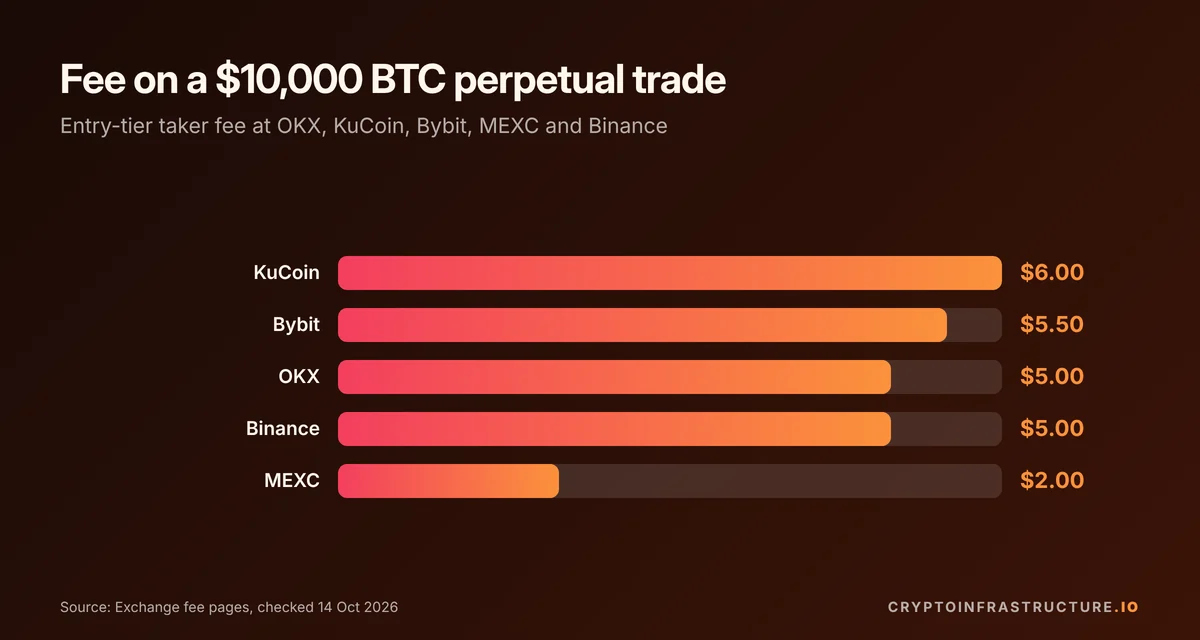
| $10,000 BTC perpetual, taker | $5.00 | $6.00 | $5.50 | $2.00 | $5.00 |
Fee differences between these five are small next to the regulatory differences. On a $10,000 market order the gap between the cheapest and the most expensive is $5 to $6. Paying fees in an exchange token cuts the cost but adds exposure to that token’s price.
Several ranking pages have these numbers wrong. One three-way comparison lists Bybit spot at 0.075% and Binance spot taker at 0.2%; the fee pages show 0.10% for both. A MEXC comparison gives MEXC futures taker as 0.06%; MEXC’s fee page and homepage show 0.04% at the standard rate.
Is Binance still trustworthy?
That depends on what you are trusting it with. On the evidence: Binance covered its one exchange hack in full in 2019, holds VARA and ADGM licences and publishes a proof of reserves. It also pleaded guilty to US anti-money-laundering and sanctions offences in 2023. It has no EU licence. Its PoR page showed no snapshot date. Calling Binance legitimate is fair as far as it goes, but legitimacy is not protection: no insurance or compensation scheme stands behind a Binance.com balance. The full evidence is in Is Binance Safe?
Is OKX a crypto wallet?
Not in the sense that matters for custody. OKX’s main product is a custodial exchange: OKX holds the coins in your account. OKX also offers a separate self-custody Web3 wallet, which CryptoNinjas notes launched for US users in April 2025 alongside the exchange. If you want to hold your own keys, that is a different product with different risks. The seed phrase then becomes your responsibility.
Which country owns Bybit?
No country owns it. Bybit is a privately held company founded in 2018 by Ben Zhou. Which company you deal with depends on where you live: its global terms name an Abu Dhabi company, Bybit EU operates from Austria and its Indian registration is held by Bybit Fintech Limited, shown as incorporated in Seychelles. Is Bybit a safe exchange? No exchange can be called safe outright. Bybit’s record includes the largest exchange hack to date and an Indian penalty, alongside a UAE licence claim, an EU MiCA arm and a recent proof of reserves.
Which fits which reader
- You live in the US: none of the five global platforms is an option. OKX US is the only one of these brands licensed to serve you, and not in New York. For other licensed choices, see the best US exchanges.
- You live in the EU: OKX holds a MiCA licence through Malta. Bybit EU says it holds one through Austria. Binance has stopped EU services, KuCoin’s EU company is not yet allowed to operate and MEXC names no EU licence.
- You live in the UAE: OKX and Binance hold full VARA licences in Dubai. Bybit excludes Dubai and holds only an in-principle approval there. KuCoin and MEXC are not on the VARA register.
- You live in the UK: Bybit and MEXC exclude the UK; OKX restricts derivatives, CeFi and P2P services for UK users.
- You live in India: Binance and Bybit are FIU-IND registered after penalties. OKX restricts India. For KuCoin and MEXC, no registration was confirmed in the sources reviewed. FIU-IND has kept issuing takedown notices to unregistered platforms, most recently on 9 September 2026 (PIB). Check before you deposit; the Bybit India guide shows how.
- You trade large volumes: MEXC’s published rates are the lowest, but cost is the smallest difference between these five. Its lack of a named licence is the largest.
Red flags to weigh
- Unlicensed global platforms: KuCoin’s and MEXC’s global terms name no licence. If something goes wrong, there may be no regulator to complain to.
- US criminal pleas: Binance (2023), KuCoin (January 2025) and OKX (February 2025) all admitted operating without required US licences.
- A licence that can’t be used: KuCoin’s MiCA authorisation has not been cleared for operations by the FMA.
- Approval, not licence: Bybit’s Dubai status is an in-principle approval, under which VARA says operations are prohibited.
- The largest hack on record: Bybit, about $1.5 billion, February 2025, attributed by the FBI to North Korea.
- Proof of reserves with no named auditor at all five, plus marketing claims on MEXC’s PoR page that no snapshot can support.
- No insurance: none of the terms or pages reviewed offers deposit insurance on your balance.
If you are looking at these exchanges because you want to avoid verification, read the guide to no-KYC exchanges first. MEXC’s own guide says it requires verification. The US cases above show what happened to exchanges that skipped it.
What this means for you
OKX vs Binance, KuCoin, Bybit and MEXC is not a fee decision. Their entry spot rates differ by a few dollars on a $10,000 order. What separates them is what each is licensed for and where: OKX has verifiable licences in the EU, Dubai and most of the US; Binance in Dubai and Abu Dhabi but not the EU; Bybit a UAE licence claim, an EU MiCA arm and only an approval in Dubai; KuCoin a MiCA authorisation it cannot yet use; MEXC none named. Three have US guilty pleas. One suffered a $1.5 billion hack. None insures your balance. Before you deposit, find the company your terms name, check it on your regulator’s register and keep only what you are actively trading on any exchange.
For the full evidence on each, see Is Binance Safe?, Is OKX Safe and Legit?, Is KuCoin Safe and Legit? and Is Bybit Legal in India?, or browse the Exchanges section.
This review is general information, not financial advice. Cryptoassets are volatile and uninsured; nothing here is a recommendation to use any platform or hold any asset. See the site’s disclaimer.