A crypto license is the authorisation or registration a regulator requires before a business can exchange, transfer or hold crypto for customers and there is no global one: you need one in each market whose customers you serve. Official application fees across the 18 jurisdictions below run from $0 (FinCEN in the US, FINTRAC in Canada) to AED 100,000 per activity in Dubai, with Malta’s EUR 25,000 for a trading platform and New York’s $5,000 in between. Fees are the small line. Capital runs from nothing in several registration regimes to RM1.5 million in Labuan, HK$5 million in Hong Kong and AED 1.5 million for a Dubai exchange. Only an EU MiCA licence passports to other countries. The cheapest licence on paper is usually the one that banks, payment partners and customers in big markets accept least.
If you are pricing a crypto license for an exchange, broker, wallet or on-ramp, you will find two kinds of numbers online: undated package prices from firms selling the work and regulator fee schedules that are hard to compare because they use different currencies, licence names and fee structures. This page puts 18 jurisdictions in one table: the regulator, the licence name, the official application fee, the annual fee, minimum capital, the regulator’s own timeline next to the timelines consultants report, whether the licence passports, the main catch and where each figure comes from. Every official figure comes from a regulator, statute or gazette. Consultant figures are labelled as consultant figures and where no official figure could be confirmed, the table says so instead of guessing.
How to read the table
- Official application fee is what the regulator or state charges to process or grant the licence. It is not what a licensing firm charges you.
- Annual fee is the recurring regulator charge. Many regimes set it each year or by income and the table says when no figure was published.
- Minimum capital is money you must hold, not spend. In most regimes it is the biggest cash commitment.
- Timeline shows the regulator’s statutory clock where one exists, then what licensing firms report. The statutory clock usually starts only once your file is complete.
- “Not confirmed” means no official figure has been published or confirmed, not that none exists.
Crypto licence costs in 18 jurisdictions
| # | Jurisdiction | Regulator | Licence | Official application fee | Annual fee | Minimum capital | Timeline (official vs reported) | Passporting | Key catch | Source |
|---|---|---|---|---|---|---|---|---|---|---|
| 1 | Lithuania (EU) | Bank of Lithuania | MiCA CASP licence | EUR 2,425 state fee (EUR 272 to amend) | Supervisory contribution set yearly by the Bank (amount not confirmed) | EUR 50,000 / 125,000 / 150,000 by class, or a quarter of fixed overheads if higher | Official: 25 working days completeness + 40 to decide (one pause up to 20). Reported: 5 to 12 months (Prifinance, Inteliumlaw) | Yes, EU and EEA by notification | 4 CASP licences granted; the Bank said nearly 50 firms applied in 2025. Old VASP registrations lapsed 31 Dec 2025 | Government Resolution No 1458; MiCA Art. 63, 67 |
| 2 | Malta (EU) | MFSA | MiCA CASP authorisation | EUR 10,000 (class 1), EUR 20,000 (class 2), EUR 25,000 (class 3) | Base EUR 10,000 / 25,000 / 50,000 by class, plus EUR 2,000 per service, plus 0.05% of transaction volume capped at EUR 250,000 | MiCA classes as above | Official: MiCA clock. Reported: not published | Yes, EU and EEA | Volume-based annual fee: a large exchange pays far more than the base | MiCA Act (Fees) Regulations, S.L. 647.1 |
| 3 | Netherlands (EU) | AFM | MiCA CASP licence | EUR 200 per hour, capped at EUR 100,000; plus EUR 700 (propriety) and EUR 2,900 (suitability) per person | Not confirmed | MiCA classes as above | Official: MiCA clock; AFM says at least 5 months even in a best case | Yes, EU and EEA | Hourly billing makes the fee hard to budget up front | AFM cost of licensing page |
| 4 | United Kingdom | FCA | Cryptoasset registration (MLRs 2017) now; FSMA authorisation from 25 Oct 2027 | Registration: FCA fee pages give Category 6 (£11,260) and an income-based scale (confirm in FCA Connect). New regime: not published | Not confirmed | None stated for registration | Official: 3 months once the FCA has all it needs. New-regime window 30 Sep 2026 to 28 Feb 2027 | No (UK only) | Registration does not convert; every firm must apply again for authorisation | FCA new regime page (updated 30 Sep 2026) |
| 5 | Switzerland | FINMA, plus an AML self-regulatory organisation (SRO) | SRO membership (AML); FinTech licence for deposits up to CHF 100m or collective crypto custody; banking licence above that | Fees set by FINMA’s Fees and Levies Ordinance (amount not confirmed); SRO fees vary by SRO | Not confirmed | Not confirmed | Official: FINMA sets no fixed period; it depends on complexity and completeness | No | SRO membership is AML supervision, not a FINMA licence | FINMA fintech and FinTech licence pages |
| 6 | Gibraltar | GFSC | DLT provider licence | Set by the Financial Services (Fees) Regulations 2020 (amount not confirmed) | Base fee by fee block plus an income and activity element (amount not confirmed) | No fixed amount: enough for an orderly wind-down (Principle 3) | Official: staged process (3 stages plus presentation), no clock on the page | No | Principles-based: the capital number is negotiated, not published | GFSC DLT providers and fees pages |
| 7 | Dubai (outside DIFC) | VARA | VASP licence, one per activity | AED 40,000 (advisory, transfer) or AED 100,000 (exchange, custody, broker-dealer and others) per activity | AED 80,000 or AED 200,000 per activity | AED 100,000 (advisory) to AED 1,500,000 (exchange), or 15 to 25% of fixed overheads | Official: no statutory deadline. Reported: 3 to 5 weeks up to 16 to 25 weeks (consultants) | No (Dubai only; not DIFC or ADGM) | Fees and capital stack per activity; a DMCC or IFZA trade licence is not a VARA licence | VARA Schedule 2 and Company Rulebook |
| 8 | Hong Kong | SFC | VATP licence: SFO Types 1 and 7 plus AMLO VA service licence | HK$4,740 per licence or activity; HK$2,950 per responsible officer; HK$1,790 per representative | Not confirmed | HK$5m paid-up, liquid capital at least HK$3m, plus 12 months of operating costs in Hong Kong liquid assets | Official: no deadline. SFC list shows approvals 7 to 27 months after the Feb 2024 filing deadline | No | 13 platforms licensed; “deemed licensed” is not licensed | SFC VATP pages and guidelines |
| 9 | Singapore | MAS | Payment Services Act licence for DPT services (standard or major payment institution) | S$1,000 (SPI) or S$1,500 (MPI) | Not confirmed | S$100,000 (SPI) or S$250,000 (MPI); MPIs also post S$100,000 or S$200,000 security | Official: no clock in the regulations. Reported: 6 to 12 months or more | No | Firms serving only overseas customers need a separate licence MAS says it will generally not issue | Payment Services Regulations (as reported in the VASP guide) |
| 10 | Labuan (Malaysia) | Labuan FSA | Money-broking licence with digital asset activities | USD500 processing fee (USD1,500 extra for faster approval) | USD10,000 | RM1,500,000 paid-up, plus a 20% shareholder reserve per the FAQ | Official: client charter (length not in the fee order). Reported: 45 to 120 days | No | No Malaysian onshore clients; aimed at institutional and high-net-worth clients | P.U.(A) 246/2026 and 247/2026; 2024 guidelines |
| 11 | Cayman Islands | CIMA | VASP registration; licence for custody and trading platforms since 1 Apr 2025 | CI$1,000 (US$1,219.50) for registration, plus an assessment fee on approval; licence fees in Schedule 2 of the 2025 regulations | Annual renewal fee due 15 January (amount not on CIMA’s FAQ), with monthly late surcharges | None stated on CIMA’s FAQ | Not stated | No | Exchanges and custodians now need the full licence, not the cheap registration | CIMA VASP FAQ |
| 12 | British Virgin Islands | Financial Services Commission | VASP registration (VASP Act 2022) | Not confirmed | Not confirmed | Not confirmed | Not confirmed | No | 22 entities on the FSC’s VASP list; fees not published on the FSC’s public pages | BVI FSC VASP list |
| 13 | Bahamas | Securities Commission of The Bahamas | Digital asset business registration (DARE Act) | B$6,250 application + B$18,750 registration (exchange); B$3,750 + B$12,500 (other digital asset businesses) | B$18,750 (exchange) or B$12,500 (other); B$800 per key individual | Not stated on the fee page | Not stated | No | Extra activities and each CEO, compliance officer and MLRO carry their own fees | SCB DARE fees page (Fees Rules 2024) |
| 14 | El Salvador | CNAD (National Commission of Digital Assets) | Digital asset service provider (DASP) registration | Not confirmed. Consultant: low four figures (Coincub) | Not confirmed | Not confirmed | Reported: weeks to a few months (Coincub) | No | CNAD says operating without its approval is illegal; Bitcoin-only services sit under a separate register (Coincub) | CNAD site; Coincub (consultant) |
| 15 | United States (federal and states) | FinCEN, plus each state | FinCEN MSB registration (Form 107), plus state money transmitter licences | FinCEN $0. States, e.g. Florida $375; California DFAL $7,500 plus review costs (reported) | FinCEN $0, re-register every 2 calendar years. Florida renewal $750 | Per state, e.g. Florida $100,000 net worth and $50,000 to $2m bond; Texas $100,000 net worth and $100,000 to $500,000 bond | Official: file Form 107 within 180 days. Reported: state licences 3 to 9 months each | No federal passport; 31 states have adopted the MTMA in full or part | FinCEN registration is not permission to operate; the states are the licence | 31 CFR 1022.380; Florida and Texas statutes; CSBS |
| 16 | New York | NYDFS | BitLicense (23 NYCRR Part 200) or limited purpose trust charter | $5,000 (BitLicense) | Supervisory assessments set by NYDFS (no fixed amount published) | Case by case; bond or trust account generally at least $500,000 | Official: 90 days after the file is deemed complete. Reported: 12 to 24 months | No (New York only) | Moving fiat also needs a NY money transmitter licence; 39 authorised entities | 23 NYCRR 200.5, 200.6; NYDFS licensing page |
| 17 | Canada | FINTRAC | MSB registration (dealing in virtual currencies) | $0 (FINTRAC charges no registration fee) | $0; renew every two years | None | Reported: 1 to 3 months (Coincub) | No | Registration is AML only; Quebec runs its own MSB licence and FINTRAC has been cancelling registrations (Coincub) | FINTRAC MSB page |
| 18 | Australia | AUSTRAC now; ASIC from 2027 | AUSTRAC digital currency exchange registration; AFSL for digital asset platforms under the Digital Assets Framework Act 2026 | Not confirmed. Consultant: no AUSTRAC application fee but an industry levy (Coincub) | Not confirmed | Not confirmed | Official: Act commences 8 Apr 2027, then a 6-month transition. Reported: 3 to 6+ months for AUSTRAC | No | Platforms holding client crypto will need an AFSL; AUSTRAC registration alone will not be enough | Act No. 38, 2026; ASIC and AUSTRAC releases |
Official sources include the VARA fee schedule, Malta’s MiCA Act (Fees) Regulations, the Securities Commission of The Bahamas DARE page and the SFC list of licensed platforms, plus the regulators named in each row. Bahamian dollar fees are shown as B$. Consultant figures are those firms’ own estimates and are named as such. This is a summary, not legal advice.
What does a crypto license cost?
The official fee is rarely the number that decides your budget. Split it into four layers before you compare jurisdictions:
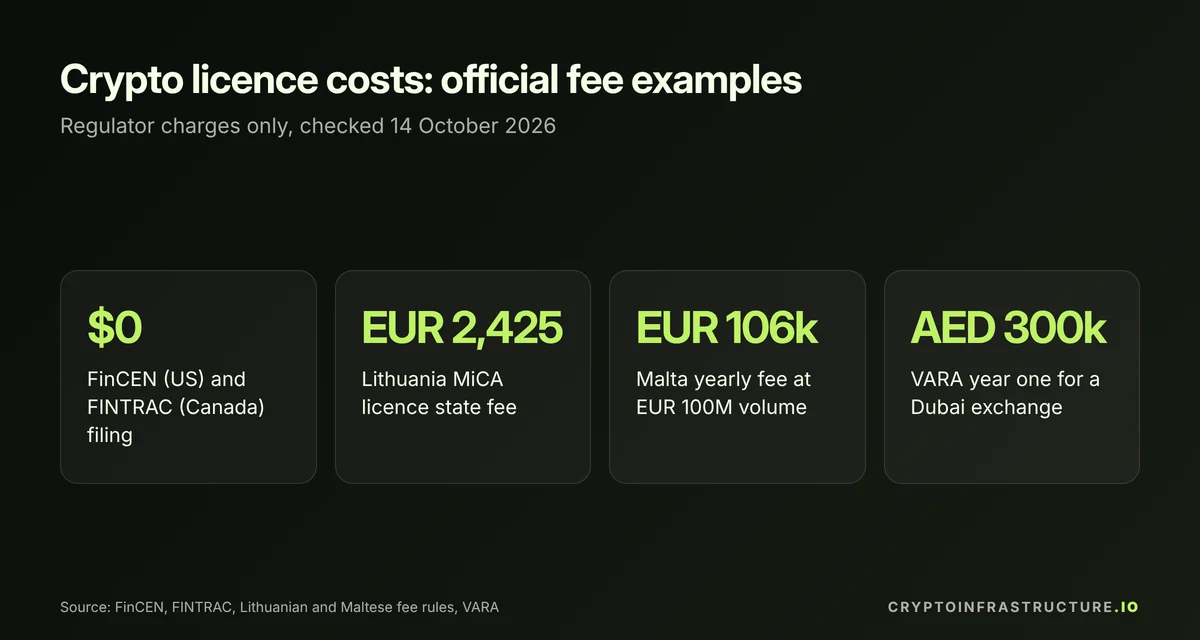
- Official fees: application plus the first annual fee. From the table, a Dubai exchange pays VARA AED 300,000 in year one (AED 100,000 to apply plus AED 200,000 supervision), while a Lithuanian CASP pays a EUR 2,425 state fee.
- Capital: held, not spent, for as long as you are licensed. It ranges from nothing in Canada, the US federal filing and Cayman registration to HK$5 million plus a year of operating costs in Hong Kong.
- Substance and people: local directors, a compliance officer and MLRO, office, audit and compliance tooling. The crypto compliance guide covers that stack.
- Advisers: legal and application work, which is where most quoted “licence prices” come from.
Two examples using only official figures:
- Malta, trading platform (class 3) authorised for three services: EUR 25,000 to apply, then an annual fee of EUR 50,000 base plus 3 x EUR 2,000, plus 0.05% of transaction volume (capped at EUR 250,000). At EUR 100 million of annual volume the volume element is EUR 50,000, so the annual fee is EUR 106,000, with at least EUR 150,000 held as own funds.
- Bahamas, digital asset exchange: B$6,250 to apply and B$18,750 to register, then B$18,750 a year, plus B$575 to apply and B$800 a year for each of the CEO, compliance officer and MLRO. Year one to the regulator: B$25,000 plus B$4,125 for the three individuals if the registration fee covers the first year. If the first annual fee is charged on top of the registration fee, year one rises to B$43,750 plus B$4,125. Confirm which applies with the Securities Commission before you budget.
Consultant figures (not official): ranking pages quote everything from a EUR 3,650 service package (COREDO, Panama) to EUR 85,000 and above (COREDO, Thailand) and Coincub puts year-one totals at $3,000 to $10,000+ for Costa Rica and $35,000 to $70,000+ for the AUSTRAC side in Australia. None of these is a regulator fee. Ask any adviser to split a quote into official fees, capital, staff and their own fee.
How much is a crypto exchange license?
Exchanges and custodians sit at the top of every fee and capital schedule: class 3 under MiCA (EUR 150,000 capital; Malta charges EUR 25,000 to apply), VARA’s exchange activity (AED 100,000 to apply, AED 200,000 a year, AED 800,000 to AED 1.5 million capital), Hong Kong’s VATP licence (HK$5 million paid-up) and the Bahamas’ exchange tier (B$18,750 a year against B$12,500 for other businesses). Cayman moved custody and trading platforms from registration to a full licence on 1 April 2025. If you are still choosing a model, the guide to starting a crypto exchange covers licence, stack and liquidity together.
What is the cheapest crypto license?
By official fee alone, the cheapest entries in the table are the registrations that charge nothing or close to it: FinCEN MSB registration in the US ($0), FINTRAC MSB registration in Canada ($0), Labuan’s USD500 processing fee and Cayman’s CI$1,000 registration. Lithuania’s EUR 2,425 is the cheapest official fee for a licence that passports across the EU.
Cheap is not the same as usable. Check each low-cost option against three questions:
- Does it let you serve the customers you want? A FinCEN registration gives no permission to operate in any US state. A FINTRAC registration does not cover US customers. A Labuan licence excludes Malaysian onshore clients and gives no EU access. Offshore registrations do not cover the EU, UK, Singapore or Hong Kong, where the licence follows the customer.
- Will a bank or payment partner accept it? Coincub’s own “cheapest countries” list says banking in Costa Rica means no big bank on day one and that Canadian banking depends on your Travel Rule and monitoring evidence, not the certificate. Ask your banking and payment partners which licences they accept before you file.
- Is it still the same regime? Lithuania’s cheap VASP registrations ended on 31 December 2025, Cayman’s registration no longer covers exchanges and Australia’s AUSTRAC registration will not be enough for platforms holding client crypto once the 2026 Act starts on 8 April 2027.
The honest answer: the cheapest licence that works is the cheapest one in the market your customers are in. For EU customers that is a MiCA licence and the official fees there range from EUR 2,425 (Lithuania) to up to EUR 100,000 in hourly charges (Netherlands).
Licence vs registration: what you are actually buying
Several rows above are registrations for anti-money-laundering supervision, not licences with capital, conduct and custody rules: FinCEN, FINTRAC, Swiss SRO membership, the UK’s current FCA registration and the BVI and El Salvador registrations. Registrations are cheaper and faster, but they give fewer rights and the trend is clearly toward full authorisation. The EU has replaced national VASP registrations with MiCA, the UK opens FSMA authorisation for crypto on 25 October 2027, Cayman requires a licence for custody and trading platforms and Australia legislated licensing for digital asset platforms in April 2026. The VASP licence guide explains the FATF definition behind all of these.
Which licences passport to other countries?
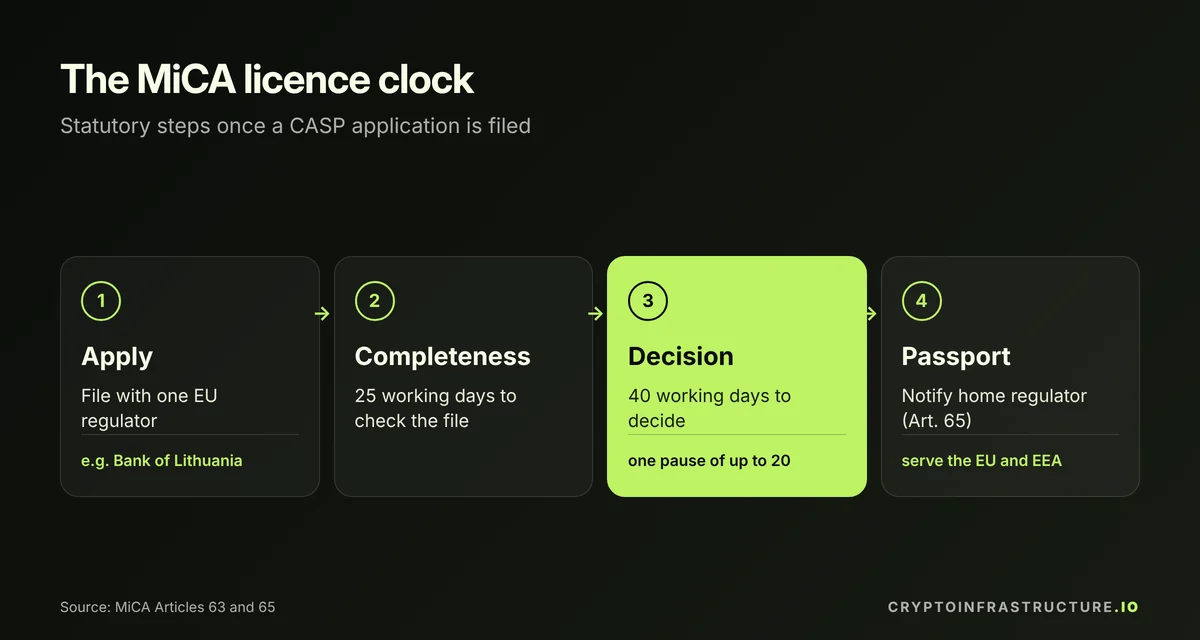
Only MiCA. A CASP authorisation from one EU regulator can be used across the EU and EEA by notifying your home regulator under Article 65 of MiCA, as the ESMA MiCA page and register reflect. Every other licence in the table covers its own jurisdiction only. In the US even that is split by state, although 31 states have adopted the Money Transmission Modernization Act in full or in part (CSBS, 23 April 2026) and New York and Wyoming signed a memorandum on 1 October 2026 to share licensing and examination work. The MiCA guide covers passporting and which exchanges hold MiCA licences.
Where each licence is covered in detail
- EU (MiCA): MiCA explained, with the Article 63 clock, capital classes and ESMA’s register and the Lithuania crypto licence guide with the four licences granted so far.
- Dubai: VARA vs DMCC vs IFZA, with a year-one cost example. Abu Dhabi’s ADGM authorises virtual asset firms separately (custody capital: the higher of USD 250,000 or six months’ audited expenditure, per FSRA guidance of 10 June 2025, as set out in the VASP guide).
- Hong Kong: Hong Kong VATP licence, with the 13 licensed platforms and an official-fee worked example.
- United States: the MSB licence guide for FinCEN and state licences and the BitLicense guide for New York.
- Labuan: Labuan crypto exchange licence, including the 2026 fee rules.
- Australia: the Binance Australia guide explains AUSTRAC registration and the Digital Assets Framework Act 2026.
- Singapore, UK, Cayman, BVI, El Salvador: the VASP licence comparison.
How long does a crypto licence take?
Only some regulators commit to a clock and it starts once your file is complete. MiCA allows 25 working days to check completeness and 40 to decide, with one pause of up to 20; New York’s Part 200 gives NYDFS 90 days after it deems a file complete; the UK FCA has 3 months for a registration once it has everything. VARA, the SFC, MAS, FINMA, the GFSC and Labuan FSA publish no statutory decision deadline on their public pages. In practice, the SFC’s own list shows Hong Kong approvals arriving 7 to 27 months after the February 2024 filing deadline and licensing firms report 12 to 24 months for a BitLicense. Treat any promise measured in weeks for a full licence as a sales line.
Red flags in licence quotes
- Undated fee tables. None of the top five ranking pages for this topic gave a dated regulator fee. Ask for the regulator’s schedule and its date.
- Adviser fees presented as regulator fees. Hong Kong’s SFC charges HK$4,740 per licence or activity to apply; six-figure “SFC application fees” are adviser fees.
- “Ready-made” licensed companies. Lithuanian and Czech VASP shells give no EU access and buying a company does not transfer a clean licence: FinCEN requires re-registration after a transfer of more than 10% of equity or voting power and MiCA assesses the shareholders of each applicant.
- Trade licences sold as crypto licences. In Dubai, a DMCC or IFZA licence does not cover regulated virtual asset activity; VARA does.
- Offshore registration sold as global. It covers the registering jurisdiction only.
What this means for you
Start from where your customers are, not from the cheapest row in the table. Price capital and local staff before fees, check whether the licence is a registration or a full authorisation and ask your bank and payment partners which licences they accept. Use this table to shortlist, then confirm every figure on the regulator’s own page before you commit, because fee rules changed in Labuan and Malta within the last two years and more regimes are moving from registration to licensing. Compliance providers that help with applications and ongoing obligations are reviewed in the KYC/AML & Compliance section under the site’s methodology and rule changes are tracked month to month in the regulation roundup.