A “no-KYC crypto exchange” is a platform that lets you trade without uploading ID. In practice that means one of three things: a decentralised exchange (DEX) you use from your own wallet, a peer-to-peer or swap service, or an offshore custodial exchange that skips or delays checks. The first is software with no account. The last is the risky one: offshore platforms that served US users without proper AML controls have been prosecuted (BitMEX fined $100 million, January 2025; KuCoin over $297 million, 27 January 2025; OKX about $505 million, February 2025). Garantex, sanctioned by the US since April 2022, had its domain seized in March 2025 and was sanctioned again with its successor Grinex in August 2025. “No KYC” also does not mean untraceable or untaxed. US taxpayers must report crypto transactions whatever platform they used. The EU applies the Travel Rule to every transfer between crypto firms. UK users must give their details to UK platforms for HMRC reporting, with penalties of up to £300 for not doing so.
If you searched for a crypto exchange without KYC, you probably want one of two things: privacy, or a way around an identity check you find intrusive. Most pages ranking for this search answer with a list of platforms, often with referral links, and a line saying legality is a “grey area”. This guide does not list platforms to sign up to, and it does not explain how to get around identity checks. It explains why KYC exists, what “no KYC” really means in each type of service, what has happened to offshore no-KYC platforms and their users (dated and sourced), where the legal exposure sits for you in the US, EU and UK plus which privacy options are lawful. Platforms are named only where a regulator or court has acted against them.
What is KYC in crypto, and why do exchanges require it?
KYC stands for Know Your Customer: a platform verifies who you are (name, date of birth, address, government ID, usually a selfie) before you can trade or withdraw. It is not a choice each exchange makes. It comes from anti-money-laundering law that treats crypto exchanges like other financial firms.
- Global standard (FATF). The Financial Action Task Force’s Recommendation 15, updated in 2019, requires virtual asset service providers (VASPs) to apply the same preventive measures as financial institutions: customer due diligence, record keeping and suspicious transaction reporting. The Travel Rule adds a duty to collect and send sender and recipient information with transfers (FATF, virtual assets). FATF’s latest targeted update on how countries apply this is dated 16 July 2026.
- United States (Bank Secrecy Act). FinCEN’s guidance FIN-2019-G001 of 9 May 2019 says “Persons accepting and transmitting CVC are required (like any money transmitter) to register with FinCEN as an MSB” (FinCEN guidance). A registered money services business must run an AML programme, which is where KYC comes from.
- European Union (AMLD and the Transfer of Funds Regulation). Regulation (EU) 2023/1113 has applied to crypto transfers since 30 December 2024 (Article 40), with no minimum amount for transfers between crypto-asset service providers (EUR-Lex, Regulation 2023/1113). The EU AML Regulation (EU) 2024/1624 follows from 10 July 2027, according to its EUR-Lex record.
The full rule set by jurisdiction, including the UK, Dubai, Singapore and India, is in the crypto compliance guide.
What “no KYC” usually means in practice
The phrase covers very different services. The legal and practical risk depends on which one you mean.
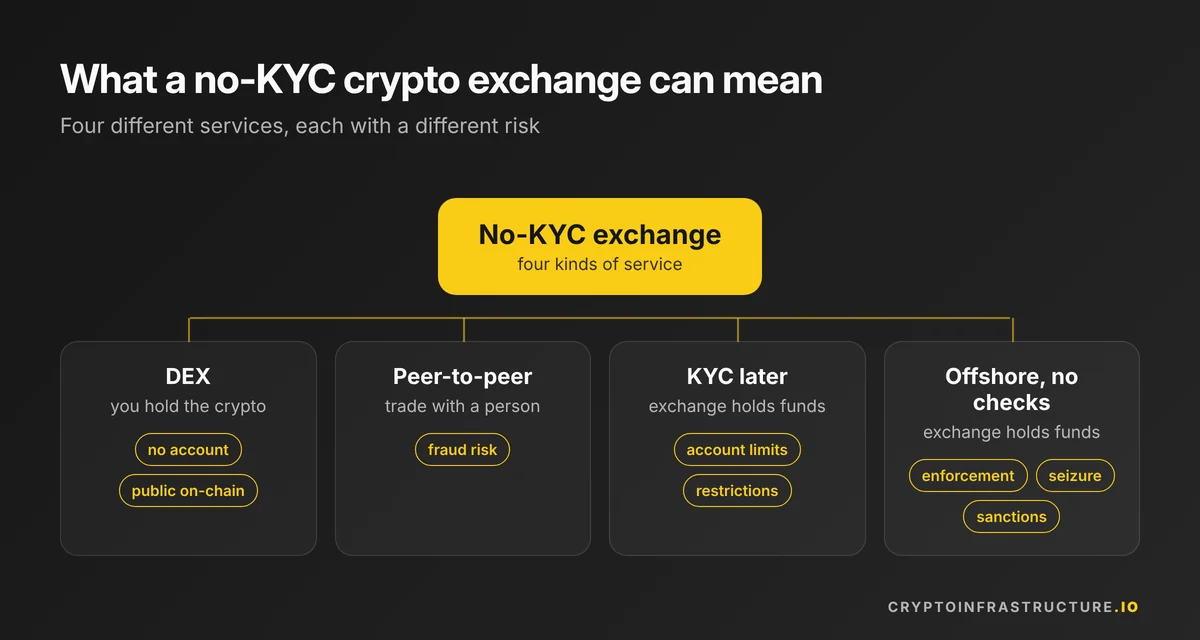
| Type | Who holds your crypto | Why there is no ID check | Main risk |
|---|---|---|---|
| Decentralised exchange (DEX) used from your own wallet | You, until the swap settles on-chain | No account or company holding funds; you interact with smart contracts | Smart contract bugs, scam tokens, wallet drainers; the trail is public on-chain |
| Peer-to-peer marketplace | You or an escrow, depending on design | You trade with another person rather than a firm | Counterparty fraud; the other side may be a business that should be registered |
| Tiered or “KYC later” custodial exchange | The exchange | Limits for unverified accounts; checks triggered by withdrawals, volume or a policy change | Restricted accounts when the platform tightens rules; no recourse if it is shut down |
| Offshore custodial exchange with no checks | The exchange | It does not run an AML programme, or ignores where users are | Enforcement, seizure, sanctions; your funds are inside the case |
Two points that ranking pages tend to blur. First, a centralised exchange that “does not require KYC” usually means it does not require it yet, or below a limit. The ranking pages reviewed cite withdrawal limits for unverified accounts that change often and are rarely dated. Second, buying with a bank card or bank transfer almost always involves a regulated payment firm, so true no-ID routes are mostly crypto-to-crypto.
Do self-custody wallets require KYC?
A self-custody (non-custodial) wallet is software that stores your keys on your device. There is no account to open, so the wallet itself usually asks for no ID. FinCEN’s 2019 guidance says a person using an unhosted wallet “to purchase goods or services on the user’s own behalf” is “not a money transmitter”. Buy, sell or swap features inside a wallet app are often run by third-party providers. Those providers can ask for ID. If you use a self-custody wallet, the seed phrase guide covers the part that matters most: protecting the keys.
Which brokers don’t require verification?
None that is registered to serve you in the US, EU or UK. A firm that exchanges crypto for customers as a business is a money services business in the US and a crypto-asset service provider in the EU. Both regimes require customer due diligence. FinCEN’s guidance applies this even to individuals: a natural person operating as a peer-to-peer exchanger as a business “must comply with BSA regulations as a money transmitter”, with an exemption only for occasional activity not done for profit. A platform that promises no checks while serving your country is telling you it is not following the rules that apply to it. The MSB licence guide explains the US registration and state licences such a business needs.
What has happened to offshore no-KYC platforms
These are the documented outcomes, from regulators, courts and official statements. They show what the risk looks like in practice, for the platform and for its users.
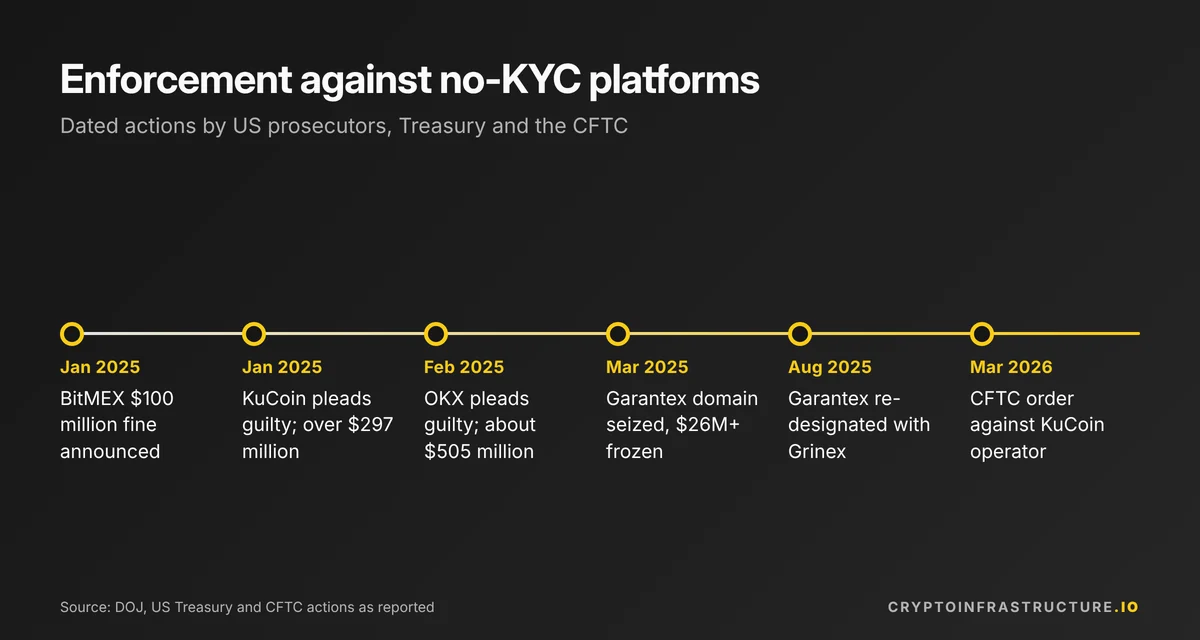
| Date | Platform and action | KYC or AML failure described | What it meant for users |
|---|---|---|---|
| July 2024 plea; $100 million fine announced 15 January 2025 | BitMEX (HDR Global Trading Limited): guilty plea to a Bank Secrecy Act violation, $100 million fine, US District Court for the Southern District of New York | Failure to implement an effective AML programme and KYC procedures while serving US customers (US Attorney’s Office, SDNY, 15 January 2025) | A long-running platform’s US exposure ended in a criminal case years after the conduct |
| 27 January 2025 | KuCoin (Peken Global Limited): guilty plea to operating an unlicensed money transmitting business; penalties over $297 million ($184.5 million forfeiture, about $112.9 million fine); exit from the US market for at least two years | The DOJ says that “until at least July 2023, KuCoin did not require customers to provide any identifying information”. It never registered with FinCEN and never filed suspicious activity reports (US Attorney’s Office, SDNY) | About 1.5 million registered US users between September 2017 and March 2024. From August 2023, unverified customers had to complete KYC to keep trading; those who did not could only withdraw or close positions |
| 24 February 2025 | OKX (Aux Cayes FinTech Co.): guilty plea to operating an unlicensed money transmitting business; about $505 million ($84 million fine, $421 million forfeiture) | Prosecutors said employees guided users to enter false nationality details to get around KYC; over $1 trillion of US customer transactions from 2018 to early 2024 (US Attorney’s Office, SDNY) | US users had been told the platform was not for them while being served anyway |
| March and 14 August 2025 | Garantex: sanctioned by OFAC since April 2022; web domain seized and over $26 million in crypto frozen on 6 March 2025; re-designated with its successor Grinex on 14 August 2025 | Treasury says Garantex processed over $100 million tied to illicit activity, including ransomware proceeds. It lost its Estonian licence in 2022 over AML deficiencies (Treasury release sb0225) | Funds on the platform were frozen at the seizure. Treasury says users who lost funds were later given value in the ruble-backed A7A5 token, which OFAC also sanctioned |
| 30 March 2026 | KuCoin operator (Peken Global): CFTC consent order in the Southern District of New York, permanent injunction and $500,000 civil penalty | Letting US participants trade without registering as a foreign board of trade (CoinDesk, 31 March 2026) | The platform is barred from US derivatives customers unless registered |
Based on the US Attorney’s Office (SDNY) releases for BitMEX, KuCoin and OKX, Treasury release sb0225 and CoinDesk’s report of the CFTC order.
The pattern for users is consistent. When a no-KYC platform is forced to comply, unverified accounts get restricted (KuCoin, August 2023). When it is shut down or seized, funds held there are frozen inside a legal process you have no part in (Garantex, March 2025). The platform’s history also follows it: these cases were brought years after the conduct.
What about Tornado Cash?
Tornado Cash is a mixing protocol, not an exchange, but it comes up in the same searches. The US Treasury removed sanctions against Tornado Cash on 21 March 2025, after a review of the novel legal and policy issues raised by applying financial sanctions to activity in evolving technology (Treasury release sb0057). The same release says Treasury remains concerned about North Korean hacking and money laundering. It advises US persons to be careful with transactions that carry that risk. The delisting removed one sanctions designation; it did not make mixing a safe or neutral choice. Anti-money-laundering and criminal laws still apply to how funds are used. Regulated exchanges can and do ask about, delay or refuse deposits traced to mixers. Tax reporting duties are unchanged.
Is using a no-KYC exchange illegal for you?
The rules reviewed for this guide put the KYC duty on platforms, not on you. None of the sources reviewed makes it a crime for an individual simply to trade on a DEX. That does not mean there is no legal exposure. Your obligations come from other rules that apply regardless of the platform:
| Region | What applies to you | Source |
|---|---|---|
| United States | You must report digital asset transactions “whether or not they result in a taxable gain or loss” and answer the digital asset question on Form 1040. Brokers report gross proceeds on Form 1099-DA for transactions from 1 January 2025. US persons generally cannot deal with OFAC-blocked persons, which includes sanctioned exchanges such as Garantex and Grinex; dealing with a sanctioned platform can expose you personally to civil or criminal penalties. KuCoin agreed in January 2025 to exit the US market for at least two years. | IRS, digital assets; Treasury sb0225; DOJ KuCoin plea |
| European Union | Since 30 December 2024 every transfer between crypto-asset service providers carries Travel Rule data. If you move more than EUR 1,000 from a self-hosted wallet to an EU exchange, the exchange must assess whether you own or control that address (Articles 14(5) and 16(2)). The AML Regulation applies from 10 July 2027. | Regulation (EU) 2023/1113; EUR-Lex record for 2024/1624 |
| United Kingdom | UK crypto platforms collect user details for HMRC under the Cryptoasset Reporting Framework. HMRC’s guidance says: “If you give inaccurate details or do not give details to a UK service provider, you could get a penalty of up to £300.” It adds that the penalty could be higher for non-UK service providers. | GOV.UK, information you need to give to UK cryptoasset service providers (penalty wording added 1 January 2026) |
Tax rules by country are summarised in how crypto is taxed. If you use a platform that serves your country without a licence, you are not the defendant in the cases above, but you carry the practical risk: frozen funds, sudden account restrictions and no regulator to complain to.
Can HMRC see my crypto wallet?
Not directly from the wallet. HMRC sees what platforms report under the Cryptoasset Reporting Framework. A public blockchain also shows every transaction from an address once that address is linked to you, for example through a deposit to or withdrawal from a reporting platform.
Can the FBI track crypto?
Often, yes. Bitcoin, Ethereum and most other public blockchains record every transfer permanently. Analytics tools link addresses to services, and a single deposit to a KYC’d exchange can connect an “anonymous” wallet to a name. The Garantex case shows the other route: in March 2025 the US Secret Service, working with German and Finnish police, seized the platform’s domain and froze over $26 million in crypto (Treasury, 14 August 2025). Records held by a platform become evidence when it is seized.
Lawful ways to keep more privacy
Privacy is a legitimate reason to limit how much data you hand out. These options do that without breaking the rules above:
- Self-custody. Hold your crypto in a wallet where you control the keys. A regulated exchange then sees only what you deposit and withdraw, not your whole portfolio.
- DEXs within the law. FinCEN’s guidance cited above treats people transacting from their own unhosted wallets on their own behalf as users, not money transmitters. A swap on a decentralised exchange is still a taxable disposal in many countries and fully visible on-chain. The DeFi explainer covers smart contract and exploit risk.
- Fewer, better-chosen KYC providers. You will usually need one regulated on-ramp. Choose a registered one and limit the number of platforms holding your ID.
- Keep records. Privacy from platforms is not privacy from the tax authority. Your own transaction records are what protect you if questions come later.
What does not count as lawful privacy: giving false identity or nationality details to a platform, splitting transfers to stay under reporting thresholds or using a sanctioned service. The OKX case shows prosecutors treat coached false details as evidence of a deliberate scheme.
What this means for you
“No KYC” is a feature of software you run yourself, not a protection an exchange can offer you. A DEX used from your own wallet has no ID check because there is no account. An offshore custodial exchange with no ID check is a platform type that US regulators have already prosecuted several times. Your funds sit inside that risk. Whatever route you use, your tax reporting duties stay the same, the blockchain stays public and the EU and UK are adding more reporting, not less.
If you run a crypto business and want the other side of this, the VASP licence guide covers who needs a licence and where. The KYC/AML & Compliance section lists the rules and tools exchanges use to meet them.
This guide is general information, not legal or tax advice. Sanctions, anti-money-laundering and tax rules depend on where you live and change often; take advice from a qualified professional before acting. See the site’s disclaimer.