Polymarket makes money mainly from taker fees on trades. It does not bet against its users: trades are matched peer to peer on an order book, and Polymarket takes a fee from the side that removes liquidity. Fees only arrived in 2026. They started on 15-minute crypto markets on 5 January 2026 and spread to most categories on 30 March 2026, and geopolitics markets are still fee-free. Part of every fee goes back out as maker rebates, taker rebates and liquidity rewards.
DefiLlama’s count for the 30 days to 14 October 2026 shows about $111 million in fees across Polymarket, and about $14.4 million kept as revenue by the on-chain business after those payouts. The rest of the business model is a CFTC-regulated US exchange (QCX LLC, trading as Polymarket US), a perpetual futures product in beta, builder fees for third-party apps, and data deals such as the one with NYSE owner ICE.
Polymarket processes billions of dollars of event trades, yet for most of its life it charged nothing to trade. That is why many explainers still say it has “no trading fee (yet)”. That stopped being true in January 2026.
This guide covers how Polymarket makes money in October 2026, using Polymarket’s own fee documentation and changelog: the fee formula and category rates, how much of each fee is paid back to market makers and traders, what the on-chain data says the platform keeps, the separate US exchange, and who owns and funds the company. It covers Polymarket as a business and a piece of crypto infrastructure. It is not a guide to trading on it.
How does Polymarket make money? The short answer
Polymarket earns most of its revenue from a taker fee, charged on trades that take an existing order off its order book. It does not act as a bookmaker. Its own documentation says you “trade directly with other users, not against the house”, so Polymarket’s income does not depend on who wins a market.
As of 14 October 2026, the revenue lines you can verify are:
- Taker fees on prediction markets, set per category, on the international platform that runs on Polygon.
- Fees on Polymarket US, the CFTC-regulated exchange run by QCX LLC.
- Perpetual futures (“Perps”) fees, a newer product Polymarket’s docs describe as in beta.
- Strategic and data deals, most visibly Intercontinental Exchange’s agreement to distribute Polymarket’s event data.
Against that income, Polymarket pays out a share of fees as maker rebates and taker rebates, and funds liquidity rewards from its own budget. The difference between fees collected and fees kept matters as much as the headline rate.
How Polymarket works, in brief
Every market is a Yes/No question. Each share is priced between $0.00 and $1.00, and the price reads as the market’s implied probability. According to Polymarket’s “Polymarket 101” documentation, each Yes/No pair is fully backed by $1 of collateral, winning shares redeem for $1.00 and losing shares for $0.00, and settlement happens automatically when the market resolves.
Many markets resolve through the UMA Optimistic Oracle: a proposer posts the outcome with a bond, there is a challenge window, and disputes go to UMA token holders. Shares are ERC-1155 tokens on Polygon. Because every winning dollar is paid by a losing dollar, trading between users is zero-sum before fees. The platform’s cut comes from the fee, not from the outcome.
USDC, pUSD and Polygon
Older pages say Polymarket settles in USDC on Polygon. That was true until 28 April 2026. The docs changelog records that the CLOB V2 upgrade went live that day, with “pUSD replacing USDC.e as collateral”. pUSD (Polymarket USD) is an ERC-20 token on Polygon with 6 decimals, which the docs say is backed by USDC and enforced by the smart contract, with “no algorithmic peg, no fractional reserve.” You wrap USDC.e into pUSD through a CollateralOnramp contract and unwrap it through a CollateralOfframp contract, and an admin can pause wrapping.
The pUSD page does not say whether any interest is earned on the USDC behind pUSD, or who would keep it, so any claim that Polymarket earns “float” income is unverified. For background on how dollar stablecoins are backed, see What Is a Stablecoin?
Does Polymarket charge fees?
Yes, on most markets since 2026. The fee is charged only to takers, in pUSD, at the moment a trade matches. Polymarket’s fee documentation states: “Makers are never charged fees.” The formula is:
fee = C × feeRate × p × (1 − p), where C is the number of shares and p is the share price.
The fee is highest at 50¢ and falls toward zero as the price nears $0 or $1. The docs give the minimum fee as 0.00001 USDC, so tiny trades near the extremes can pay nothing. There is no Polymarket fee to deposit or withdraw, though intermediaries such as an exchange or card on-ramp may charge their own.
Fee rates by category (checked 14 October 2026)
| Category | Taker fee rate | Maker fee | Share of fees rebated to makers | Fee on 100 shares at 50¢ |
|---|---|---|---|---|
| Crypto | 0.07 | 0 | 20% | $1.75 |
| Sports | 0.05 | 0 | 15% | $1.25 |
| Economics, Culture, Weather, Other/General | 0.05 | 0 | 25% | $1.25 |
| Finance, Politics, Mentions, Tech | 0.04 | 0 | 25% | $1.00 |
| Geopolitics | 0 (fee-free) | 0 | None | $0 |
Source: Polymarket documentation, “Trading fees” and “Maker Rebates” pages, and the Polymarket Help Center trading fees article (dated 10 July 2026), all checked 14 October 2026. Polymarket says it may change rates and rebate percentages at its discretion.
On geopolitical and world events markets, the docs say Polymarket charges no fee and doesn’t profit from the trading.
What the fee is as a share of the money you spend
The per-100-shares figures make the fees look small, but the cost of 100 shares changes with the price. Divide the fee by the cost of the shares (C × p) and the formula simplifies to feeRate × (1 − p). The worked figures below come from that formula:
| Example | Cost of shares | Fee | Fee as % of cost |
|---|---|---|---|
| 100 Crypto shares at 50¢ | $50.00 | $1.75 | 3.5% |
| 100 Sports shares at 50¢ | $50.00 | $1.25 | 2.5% |
| 100 Politics shares at 50¢ | $50.00 | $1.00 | 2.0% |
| 100 Politics shares at 30¢ | $30.00 | $0.84 | 2.8% |
| 100 Politics shares at 90¢ | $90.00 | $0.36 | 0.4% |
The pattern matters for the business model. Cheap, low-probability shares carry the highest fee relative to their cost. Short-dated crypto markets, the highest-rate category, are where the fee model began.
When did Polymarket start charging fees?
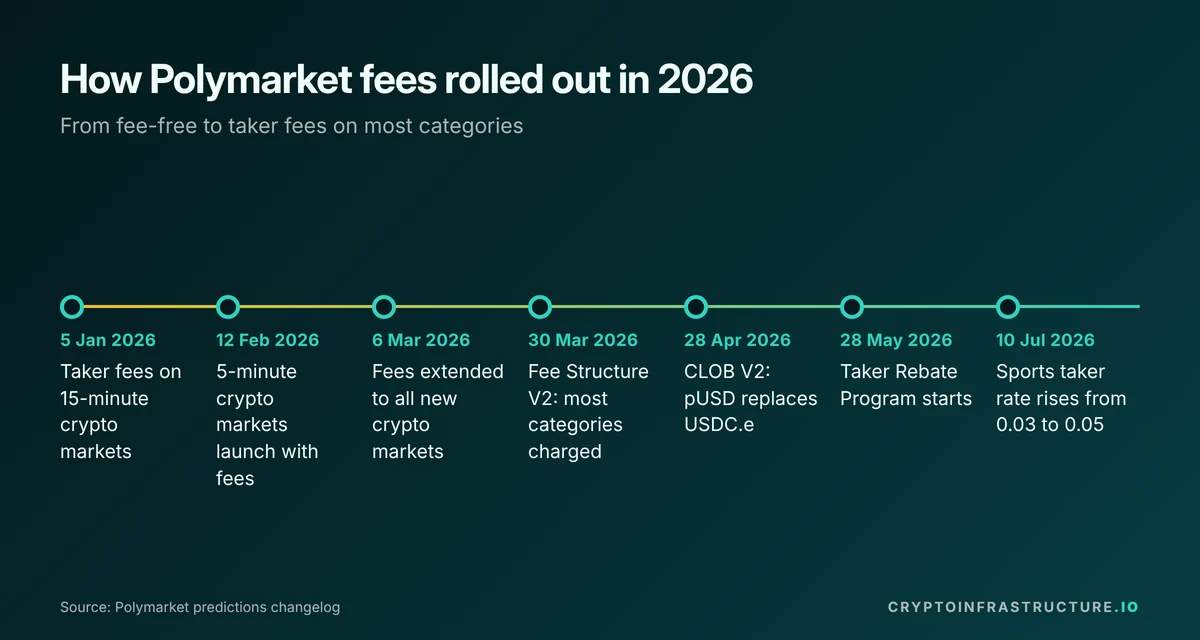
Polymarket’s predictions changelog gives the sequence:
| Date | Change |
|---|---|
| 5 January 2026 | Taker fees switched on for 15-minute crypto markets, peaking at 1.56% at 50% probability under the curve used then. Maker rebates funded by those fees start. |
| 12 February 2026 | 5-minute crypto markets launch, with the same fees and rebates. |
| 18 February 2026 | Taker fees extended to NCAAB and Serie A markets. |
| 6 March 2026 | Fees and rebates extended to all new crypto markets (1-hour, 4-hour, daily, weekly). |
| 30 March 2026 | “Fee Structure V2”: fees on Crypto, Sports, Finance, Politics, Economics, Culture, Weather, Tech, Mentions and Other. Geopolitics stays fee-free. |
| 28 April 2026 | CLOB V2 goes live. pUSD replaces USDC.e as collateral, and fees are set at match time by the protocol. |
| 28 May 2026 | Taker Rebate Program starts. |
| 10 July 2026 | Sports taker rate rises from 0.03 to 0.05, and the sports maker rebate drops from 25% to 15%. |
So yes, Polymarket has 15-minute (and 5-minute) crypto markets, and they were the first markets it charged fees on.
Where the fees go: maker rebates, taker rebates and liquidity rewards
A fee collected is not a fee kept. Polymarket returns part of it to the traders who supply and use liquidity.
Maker rebates
Taker fees in each eligible market fund a daily rebate pool for makers, the traders whose resting limit orders get filled. The share is set by category (15% to 25%, see the table above). Each maker’s cut is weighted by the same fee curve applied to their filled orders, and is calculated per market, so makers only compete with others quoting the same market. Rebates are paid daily in pUSD once they reach $1.
Taker rebates
Since 28 May 2026, high-volume takers can earn back part of the fees they pay. Tiers are based on 30-day “weighted volume”, which counts taker trades only and weights them by category (crypto weighted highest, geopolitics at zero). The tiers run from 3% (Bronze, $2,000 of weighted volume) to 50% (Obsidian, $10 million and up), plus one-off level-up bonuses of $10 to $25,000. Polymarket says it can remove rebates for activity such as wash trading.
Liquidity rewards
Separately, Polymarket pays makers for keeping tight, two-sided quotes on the order book. Its docs describe a scoring formula that favours orders close to the midpoint, samples the book once a minute, and pays daily at midnight UTC (minimum $1). Polymarket funds these pools itself: the docs cite $1 million of rewards for August 2025 crypto markets, and the changelog lists $2 million or more for March Madness 2026 markets. This is a marketing and liquidity cost, not income.
A worked example: what Polymarket keeps from one fee
Take one taker buying 100 Crypto shares at 50¢, using the published rates. The taker rebate is applied to the fee paid, which is how Polymarket describes it (“earn back a portion of fees”). Liquidity rewards and builder fees are left out.
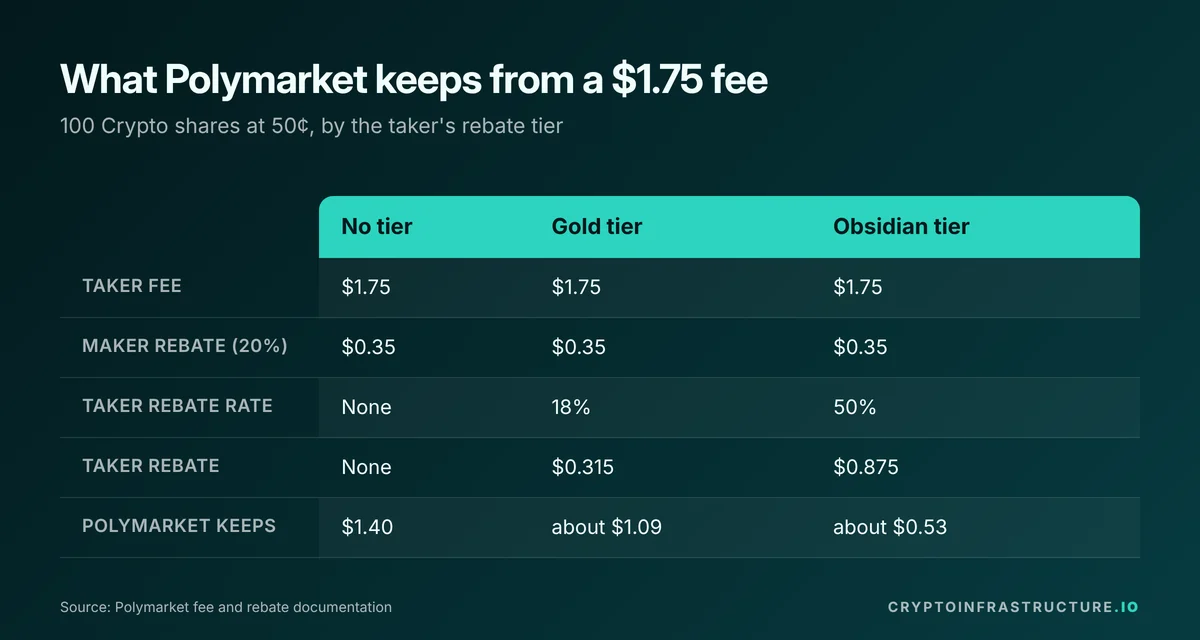
- Taker fee: 100 × 0.07 × 0.5 × 0.5 = $1.75.
- Maker rebate pool (20% for Crypto): $0.35. Left: $1.40.
- If the taker is in the Gold tier (18% rebate): $0.315. Left: about $1.09.
- If the taker is in the top Obsidian tier (50% rebate): $0.875. Left: about $0.53.
- If the taker has no tier: Polymarket keeps $1.40.
Depending on who trades, Polymarket keeps between about 30% and 80% of the headline fee on this trade, and less once liquidity rewards are counted.
How much does Polymarket earn?
Polymarket is private and does not publish accounts. The closest public measure is on-chain fee data. DefiLlama’s Polymarket page (checked 14 October 2026) shows:
| Metric (DefiLlama, checked 14 October 2026) | Last 30 days | Cumulative |
|---|---|---|
| Fees, all Polymarket | $111.01M | $477.9M |
| of which on Polygon (international platform) | $29.99M | $246.55M |
| of which labelled off-chain | $81.02M | $231.35M |
| Revenue kept after rebates and rewards (Polygon) | $14.37M | $129.04M |
| Value locked in Polymarket contracts (TVL) | $346.55M | |
Two points stand out. First, on the international platform, DefiLlama counts revenue at about 48% of fees over the last 30 days ($14.37M of $29.99M). That fits the worked example above: about half of what traders pay goes back to market makers and active takers. Second, most fees are now labelled off-chain, and DefiLlama shows no revenue figure for them. Its methodology says it can’t break out Polymarket US revenue because it lacks per-trader volume data. DefiLlama’s revenue figure is therefore a floor for the whole company, not the total.
Press figures are higher and measure different things. CNBC reported on 26 June 2026 that Polymarket’s annualised revenue had passed $1 billion, six weeks after its US exchange launched. On-chain trackers and press annualisations differ in scope (which entity, gross or net, which period), so compare them with care. Watch the definitions too: DefiLlama’s “fees” are what traders paid, and its “revenue” is what reached Polymarket after rebates.
Polymarket US: the regulated business
Polymarket runs two venues, and much of the business model now sits in the second one.
- The 2022 settlement. On 3 January 2022 the CFTC fined Blockratize, Inc. (d/b/a Polymarket) $1.4 million for offering event-based binary options without registering as a designated contract market (DCM) or swap execution facility, and ordered it to wind down non-compliant markets. US users were then restricted.
- Buying a licence. In July 2025 Polymarket acquired QCEX. The CFTC’s DCM register lists “QCX LLC d/b/a Polymarket US” as designated on 9 July 2025, with the note that QCX “is now operating under the assumed name of Polymarket US.” Clearing runs through QC Clearing LLC (d/b/a Polymarket Clearing), which Polymarket’s exchange site describes as a CFTC-registered derivatives clearing organization.
- Intermediated access. On 25 November 2025 Polymarket said the CFTC had approved an Amended Order of Designation letting it onboard brokerages and let customers trade through futures commission merchants (FCMs), using traditional market infrastructure.
The US exchange earns taker fees too. DefiLlama’s methodology describes the US fee as a price-dependent formula with a rate that has changed several times, most recently to 0.0695 from 16 September 2026. Polymarket US’s own fee page and market notices could not be loaded for this article, so treat that figure as DefiLlama’s reading until you confirm it on the exchange’s notices page.
Is Polymarket legal in the US?
It depends on the venue and the state. Polymarket US operates as a CFTC-designated exchange through QCX LLC, but New York’s attorney general sued Polymarket in September 2026 as an unlicensed gambling operation, and that case is still pending (see below).
Is Polymarket still operating, and what are the legal risks?
Yes. Both venues were still operating in October 2026, going by Polymarket’s docs changelog (updates through September 2026) and October 2026 news coverage, but the regulatory picture is contested and differs by country and US state:
- New York, United States: on 24 September 2026, Attorney General Letitia James sued Polymarket as an unlicensed gambling operation. Polymarket countersued in federal court in Manhattan the same day, arguing that the CFTC has exclusive authority over prediction markets. The case is pending. The same office sued Coinbase and Gemini over their prediction markets in April 2026.
- France: internet providers were told to block Polymarket’s website in July 2026 (see the gambling regulator’s ANJ notice), as Reuters reported on 17 and 22 July 2026. Polymarket said it would challenge the decision.
The site’s October 2026 regulation roundup covers the CFTC’s wider rulemaking on event contracts, and the guide to the CLARITY Act covers the stalled US market structure bill.
Other revenue lines
Perpetual futures
Polymarket’s docs now include a Perps product (perpetual futures, a leveraged derivative), described as being in beta, with its own volume tiers. Taker fees start at 0.0400% and makers pay 0.0125% at the lowest tier. At the $1 billion tier, makers get a 0.0050% rebate. The changelog shows fee-tier changes through September 2026. The docs don’t say which entity offers Perps or in which countries.
Builder fees
Third-party apps that route orders to Polymarket’s order book can add their own fee, up to 1% for takers and 0.5% for makers. Builder fees are paid to the builder’s wallet, and the docs say they “never replace platform fees”, so Polymarket still collects its taker fee on every order a builder routes.
Data and strategic deals
On 7 October 2025, Intercontinental Exchange announced an investment of up to $2 billion in cash at about an $8 billion pre-money valuation. ICE would become a global distributor of Polymarket’s event-driven data and partner on tokenisation. The release gives no revenue figure for the data deal.
Who owns Polymarket, and who funds it?
Polymarket was founded in 2020 by Shayne Coplan, who is still CEO. The CFTC’s 2022 order names the operating company as Blockratize, Inc., a Delaware company based in New York City. Funding milestones from sources checked for this article:
| Date | Event | Source |
|---|---|---|
| 2024 | About $70 million raised across two rounds. Backers include Founders Fund, Vitalik Buterin and General Catalyst. | Britannica (updated 24 September 2026) |
| 7 October 2025 | ICE commits up to $2 billion at about an $8 billion pre-money valuation. | ICE press release |
| 27 March 2026 | ICE completes a $600 million cash investment, part of the $2 billion commitment. | DefiLlama, CoinMarketCap Academy |
| 31 August 2026 | The New York Times reports a round of about $1 billion at a $21 billion valuation, led by 1789 Capital (linked to Donald Trump Jr.) with about $300 million. The prior valuation was reported at about $15 billion. | NYT report via Benzinga/AOL |
No public source checked for this article gives a full cap table. Coplan, ICE, 1789 Capital and earlier venture backers are the named holders.
Risks in the model that the fee table doesn’t show
- Security incidents. On 22 May 2026, a private key for a wallet used to top up accounts was leaked. ForkLog cites PeckShield and Bubblemaps estimates of $520,000 to $700,000 drained, and Polymarket said user funds and resolution were not affected. In late June 2026, a compromised third-party vendor let attackers inject a malicious script into Polymarket’s frontend, and about $2.94 million was drained from at least 11 users, according to on-chain analyst Specter. Polymarket said affected users would be fully refunded. DefiLlama lists the June incident at $3 million.
- Market integrity. Insider trading cases and fraud reports have drawn heavy press coverage in 2026, including US charges filed in May 2026 against a Google engineer accused of using internal data to bet on Polymarket (Axios). Enforcement and surveillance costs rise as volume grows.
- Oracle dependence. Many markets settle through UMA’s token-holder vote when disputed, which has produced contested resolutions before, such as the June 2023 Titan submarine market described by Britannica. The site’s DeFi explainer covers oracle and governance risk in general.
- Rebate economics. Polymarket can change fees, rebate shares and tiers at its discretion. The 10 July 2026 sports change, which raised the fee and cut the rebate, shows that the split between platform and traders can move quickly.
- Regulatory exposure. Revenue from sports markets in particular depends on the outcome of state-versus-CFTC litigation in the US and on access decisions abroad.
What this means for you
If you are studying Polymarket as a business, the core facts as of 14 October 2026 are these. It is an exchange, not a bookmaker. It started charging taker fees in 2026, and they now cover every category except geopolitics. It returns roughly half of on-chain fees to market makers and active traders.
It also runs a CFTC-designated US exchange, and most of its fees are now booked off-chain, where public trackers cannot show what it keeps. When a page tells you Polymarket is fee-free, settles only in USDC, or earns mainly from “float”, check the date: those claims describe the platform before 2026. Fee rates and rebate shares are set by Polymarket and can change without notice, so recheck the docs before relying on any number here.
For how this site sources and dates its claims, read the methodology, and find more explainers in Guides.
This guide is general information, not financial advice. Cryptoassets are volatile and uninsured; nothing here is a recommendation to use any platform or hold any asset. See the site’s disclaimer.